In the Footsteps of Athenodorus: Sir Richard Owen’s Probably Not True Ghost Story
Sir Richard Owen (1804-1892) was an anatomist and paleontologist whose work shaped how we talk about dinosaurs. Despite his interest, Owen opposed Darwin’s ideas on evolution, though this might have been kindled by professional jealousy. Still, he was part of a long tradition of important scientists — Johannes Kepler and Isaac Newton among them — who studied the natural world in order to illuminate God’s handiwork.
It’s interesting, then, that a ghost story told about Owen, one which would confirm the existence of the human soul beyond death, is probably not true. You see, though there’s a clever spin, the story is suspiciously close to the ancient legend of Athenodorus found in the letters of Pliny the Younger. (There’s a nice 1879 translation here.) Briefly, that very old tale goes like this:
Athenodorus came upon a house reputed to be haunted. Intrigued, he arranged to stay there. He spent his first night awake, focusing on his writing to ensure he wouldn't be misled by expectations of ghostly activity. Just the same, a creepy ghost appeared, bidding Athenodorus to follow him. After a short stroll to the back, the ghost sunk into the ground. At this very spot, the next day, Athenodorus unearthed shackled human bones! When the skeleton was reinterred with proper ceremony, the ghost never again appeared.Augustus Jessop, who offers his own translation of Pliny’s Athenodorus legend, mentions that the tale “is a specimen of the kind of ghost story which is very commonly repeated when such stories are going the round.” Indeed, I’ve found a few variations of it in Victorian ghostlore among reports that employ skeletal remains to support the reality of a haunting.
The Owen RevisionAt least in terms of the Owen story being told in newspapers, things seem to start with the June 18, 1893, issue of The San Francisco Chronicle. This article is attributed to Alan Owen, whose surname suggests some sort of relation to the scientist. However, my cursory search has provided no proof of such a connection. From San Francisco, the newspaper piece traveled east to places including Utah, Minnesota (shown below), and even Newcastle, England.

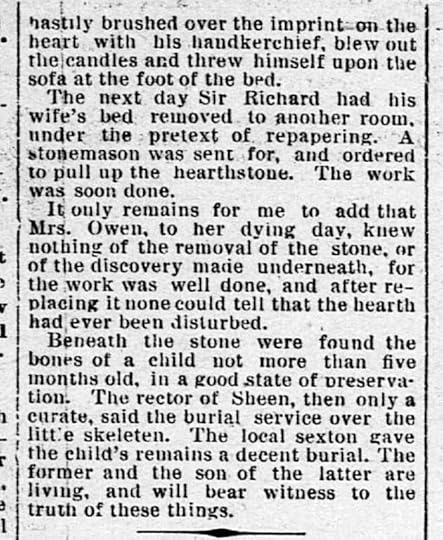
There are some nice details added, but the parallels between this and the Anthenodorus legend are striking: reports of a ghost, an investigator whiling his time by writing, the ghost leading that investigator to its hidden skeletal remains, and those remains receiving a long-overdue hallowed burial.
A Lack of Hard BonesI’ve found little to suggest this report is anything more than a tall tale concocted by “Alan Owen.” Granted, Richard Owen did live at Sheen Lodge. According to one bibliography, he “told excellent ghost stories” — though this is prefaced by saying he himself was without “the least superstition.” I have yet to find any evidence that the scientist ever told this particular story. And I fear my chances of contacting that unnamed rector or the unnamed son of the unnamed sexton are very, very slim.
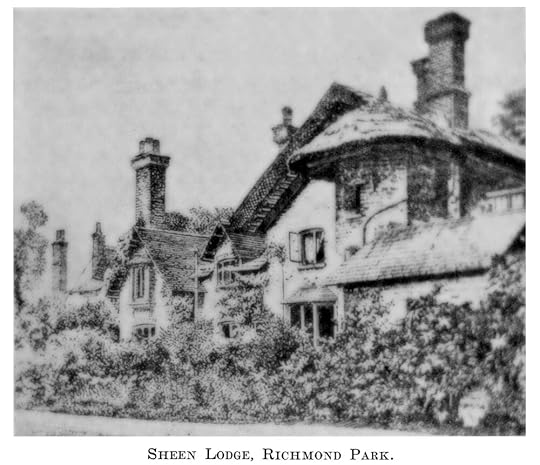 From a 1911 issue of the John Hopkins Hospital Bulletin.
All I’m left with, then, is another Athenodorusesque story to add to my collection of old ghost reports that use skeletal remains to substantiate a haunting, a topic I discuss here. I also discuss Athenodorus, the earliest inductee into The Ghost Hunter Hall of Fame, here.
— Tim