WILL THE REAL BABALON PLEASE STAND UP?
She rides astride a seven-headed Beast, brandishing a golden cup filled with the blood of saints.
She is called the Scarlet Woman, the Great Mother, the Mother of Abominations, and her name is BABALON.
In Aleister Crowley’s occult scripture, she is a sacred harlot and a vector of transcendence; a voluptuous embodiment of liberated sexuality and the ultimate mystery. Yet to some modern occultists, “Babalon” has become a trendy emblem – a Red Goddess of sex-positive empowerment – often reduced to a pin-up queen in scarlet robes, far gentler than the terrifying muse Crowley envisioned.
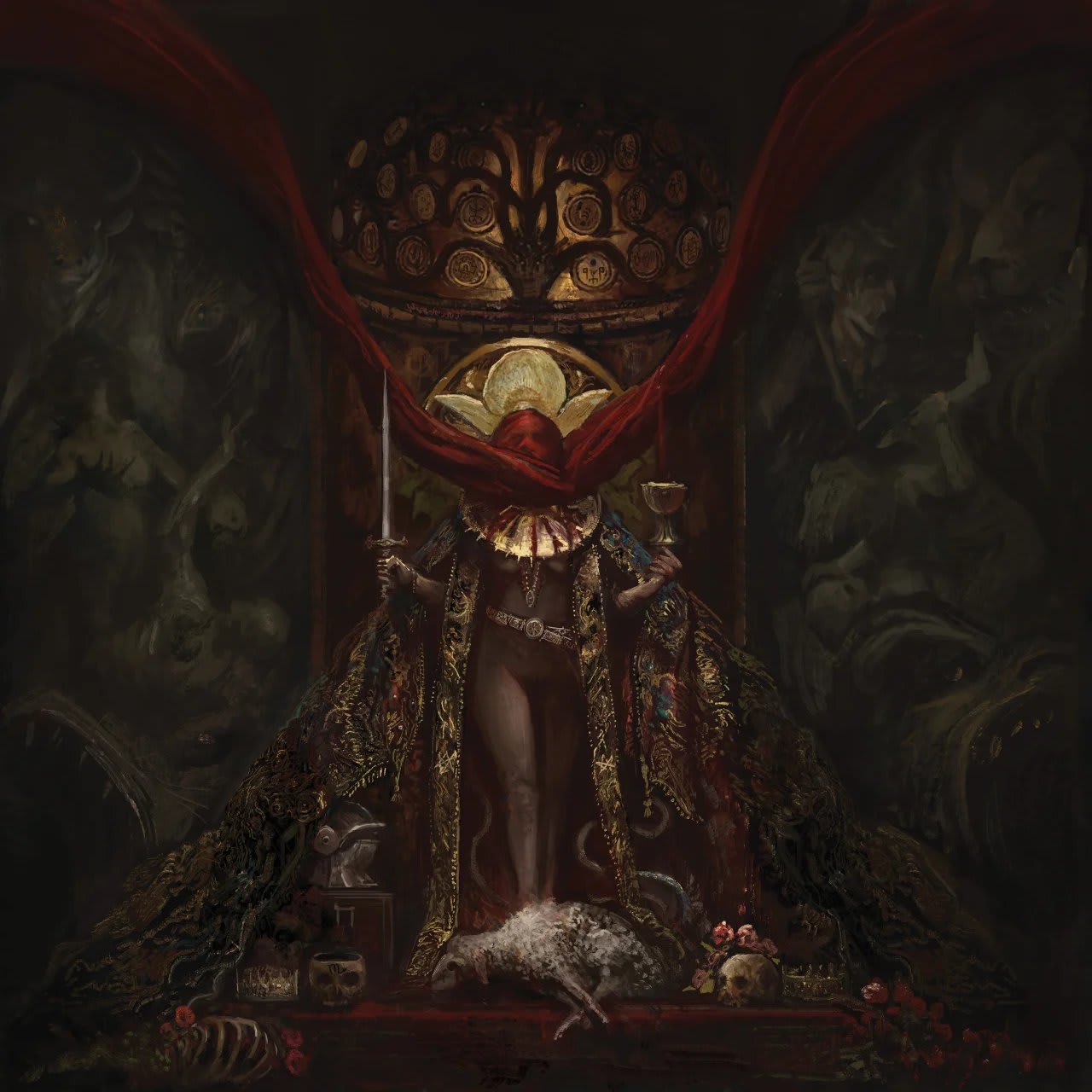 Album cover for Dodsengel's album
Babalon
by Mitchell Nolte
Album cover for Dodsengel's album
Babalon
by Mitchell NolteWill the real Babalon please stand up? In this deep dive, we’ll peel back a century of myth and interpretation to find Babalon’s true face. We’ll explore her original role in Thelema according to Crowley’s own writings, and then see how later writers – notably Peter Grey in The Red Goddess (2007) – revived and, arguably, cheapened her image. We’ll compare Babalon’s fate to that of other dark goddesses like Lilith, once feared as a child-killing demon but now hailed as a feminist icon with scant regard for her sinister origins.
Prepare for a provocative journey beyond the clichés: this is Babalon unveiled, raw, and polemical.
Magick Without Tears with Marco Visconti thrives on reader support. By choosing a paid subscription, you help keep new posts coming and fund ongoing research and writing. Thank you for considering a paid subscription to support this publication.
Babalon in Thelema: The Scarlet Woman UnveiledTo understand the “real” Babalon, we must begin with Aleister Crowley, the eccentric British occultist who introduced Babalon into modern occultism. Crowley’s spiritual system, Thelema, brims with daring reinterpretations of religious symbolism. Babalon is one of its central figures – a god-like being distilled from the Biblical Whore of Babylon, reborn as a sacred archetype of divine feminine power. Crowley did not invent her from whole cloth; he was inspired by the lurid image in the Book of Revelation: the harlot in scarlet and purple, adorned in gold and jewels, drunken on the blood of saints. But Crowley claimed to receive the spelling B-A-B-A-L-O-N in a series of mystical visions in 1909, which he would compile in one of Thelema’s central texts, The Vision and the Voice. This unique spelling set her apart as an esoteric concept rather than the mundane city of Babylon or its Biblical personification.
What, then, is Babalon to Crowley? In abstract terms, Babalon represents the free and unrestrained sexual impulse and the liberated Woman (with a capital W), as well as the receptacle of the ultimate mystical annihilation. She is at once a cosmic principle and an office that could be embodied by actual women. Crowley believed that Babalon had an earthly avatar: the Scarlet Woman, a living priestess who would accompany him in his magical work. In Liber AL vel Legis, Crowley was instructed to find a Scarlet Woman to help channel the new Aeon’s energies. Over his lifetime, Crowley identified several of his lovers as Scarlet Women, seeing them as vessels of Babalon’s force. This was not a romantic honorific, but rather a rigorous, often perilous role. To be Crowley’s Scarlet Woman meant to embody the divine harlot, to stimulate his mystical visions, and sometimes to endure his transgressive spiritual experiments.
Crucially, Babalon is not merely about eroticism or feminine beauty but spiritual transcendence through surrender. In Crowley’s eyes, Babalon personified the mystical ideal of total self-sacrifice. His Liber Cheth vel Vallum Abiegni contains the most vivid doctrine of Babalon. It declares: “This is the secret of the Holy Graal… our Lady the Scarlet Woman, Babalon the Mother of Abominations, the bride of Chaos, that rideth upon our Lord the Beast.”. Babalon is thus identified with the Holy Grail, the cup or chalice that is her primary symbol. And what fills this Sacred Cup? The adept’s own lifeblood. Liber Cheth commands the aspirant: “Thou shalt drain out thy blood that is thy life into the golden cup of her fornication”. In symbolic terms, one must pour out every last drop of one’s ego and lifeblood as an offering to Babalon. Nothing can be held back. “Thou shalt keep not back one drop.” The result of this complete surrender is an ecstatic annihilation: “Then shall thy brain be dumb, and thy heart beat no more… and thou shalt be cast out upon the midden… thy bones shall whiten in the sun.” This is not death in a literal sense but the death of the ego, a prerequisite to crossing the great Abyss of consciousness in Crowley’s initiatory system.
Crowley’s writing grows increasingly brutal to drive the point home. Liber Cheth urges the aspirant to renounce all conventional morals and attachments in the quest for Babalon.
“Divest thyself of all thy goods,” it says. Give up wealth, give up health, even “tear thy mother from thine heart, and spit in the face of thy father.” Trample all familial and social bonds underfoot. In one especially shocking verse, the speaker commands: “Let thy foot trample the belly of thy wife, and let the babe at her breast be the prey of dogs and vultures.”. This grotesque imagery is not an endorsement of actual violence; it is deliberate blasphemy, a ruthless metaphor for cutting every sentimental tie. If you will not do it, says the text, fate will do it for you, so that you may attain the sacrament of Babalon’s Grail in the “Chapel of Abominations”.
Why such horror and transgression? Because Crowley’s Babalon demands everything. She represents the spiritual state where one has given up the self utterly – “when thou art no longer thou.” Only then can one inherit joy, wealth, and wisdom without corruption. It is a paradox: by losing oneself entirely in Babalon, one gains a kind of eternal life and freedom. In Thelemic cosmology, to “fill the Cup of Babalon” with one’s life force is to achieve the Crossing of the Abyss, entering the City of the Pyramids, the spiritual realm of enlightened masters. Those who fail this ordeal become “the lonely ones, the eaters of dung”, lost souls. Clearly, Crowley set the stakes at their highest with Babalon.
She is not a gentle mother goddess to be approached timidly; she is an initiator who forces the adept to confront absolute fear, taboos, and the destruction of identity.
Yet, for all the terror in her rites, Babalon is also portrayed by Crowley as gloriously positive and necessary. In the Gnostic Mass, Crowley’s ritual Eucharist for the masses, the Creed explicitly venerates Babalon as the Mother Earth: “And I believe in one Earth, the Mother of us all… Mystery of Mystery, in Her name BABALON.” She is the fecund womb of all life in which we are conceived and to which we return. There is, therefore, a dual aspect: Babalon is both the Great Mother and the Great Whore. Crowley embraced that paradox. He saw no contradiction in identifying Babalon with Mother Nature’s fertility on one hand, and with the Scarlet Whore of Revelation on the other. In fact, in Thelemic theology, these aspects enhance each other: the idea that all aspects of existence, even the most profane or shocking, are part of the divine play. Crowley often said, “All the gods are one God, and all the goddesses are one Goddess, and there is one Initiator.” Babalon, in a sense, is that one Initiatrix for Thelemites – the gateway to enlightenment through experiences of love, passion, and surrender.
Magick Without Tears with Marco Visconti is a reader-supported publication. You have read only 1/5 of the entire article so far. To read it in its entirety, become a paid subscriber now.