Writing a New Script About Getting Old
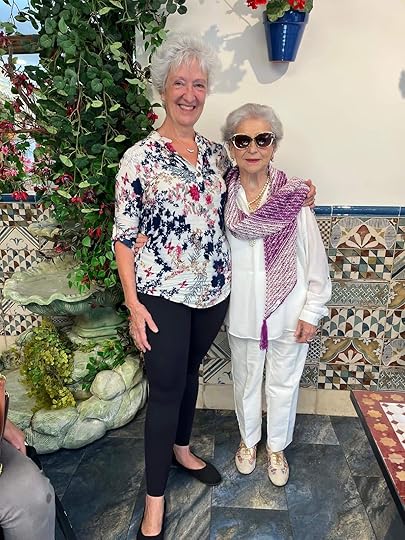
This is my friend Pilar, who’s turning 90 today. I made her that scarf, and she wanted a picture of the two of us with her wearing it.
Look how cool she is. Not only elegant and stylish, but straight and strong as well. She’s tiny, but she’s not frail. When you hug her, she hugs back and her body feels present.
She accuses me, laughing, of having copied her hairstyle. It’s not actually true (my hairstyle is entirely the idea of my peluquero), but it could be — I love her hair.
Pilar has her own apartment, walks all over the city, hangs out with friends, takes classes at the Universidad Popular, does charity work. Since her husband died ten years ago, she says she has grown even closer to her daughter, who also lives in Oviedo, and her husband’s cousin Mirenchu and her husband, who often bring Pilar with them when they travel
She lived through Franquismo (she was born during the Spanish civil war), went to college in the late fifties, and became a high school language teacher. She told me once that she has taught three generations of many local families. Pilar still advises the committee that creates the Spanish language test that college-bound seniors in high school take every year in Asturias (and in all of Spain). I love it when she waxes feisty, telling me about all the ways in which kids today need to be taught the proper usage of their language; how that prepares them to be better professionals, better communicators, better parents.
Why am I telling you all this?Because Pilar is not what society believes — and tells us — about being 90. The depressing, continuous, ageist story we hear about being anything north of 80 is one of weakness, dependence, and increasing frailty both mental and physical.
And Pilar is really not that unusual here in Spain: every day you see men and women who are certainly in their 80s and 90s walking around the city, often on the arm of a younger relative. I see them shopping, eating, laughing, hanging out with each other, taking care of grandchildren and great grandchildren. The mayor of our city of Oviedo is 78, and a more energetic and enthusiastic person would be hard to find anywhere.
I’ve been thrilled to find similarly vital and engaged older people here on Substack: and , to name just a few.
We are what ‘old’ can look like now, and I want society to see and celebrate that. As I noted in The New Old, this is the first time in history that most people will get old — and the first time that old age can be a time of joy, purpose, discovery and fun.
Society needs to catch up to us.
And telling these stories is part of how that will happen. What stories do you have? I’d love to hear about your awesome oldness or that of your friends and family!
The post Writing a New Script About Getting Old appeared first on Erika Andersen.