Guest post: Learning to Breathe
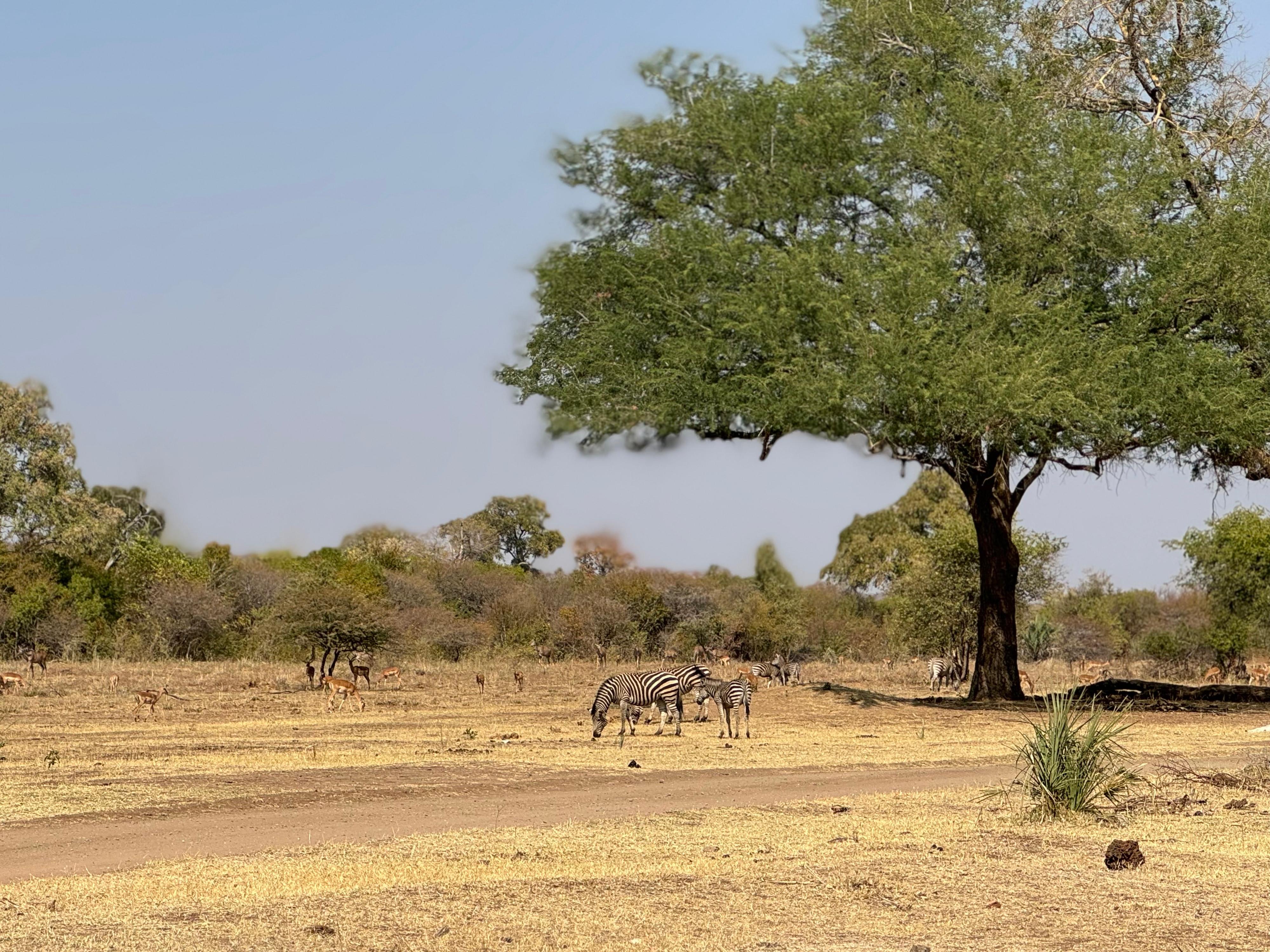
Photo: Zebras gaze under the canopy of one of the many large acacia trees
I first met Laurel Ramey on Mindful Safari a year ago. She and her husband, Bob, embody that rare combination of unassuming warmth and remarkable depth of character and wisdom.
Over our days together, I learned that they were both senior pilots with a US airline. For Laurel, this meant rising in a male-dominated industry through resilience and unswerving commitment. Yet her gifts extend beyond technical, left-brain excellence. As well as being able to pilot aircraft from one continent to another, she also cherishes the aesthetic joys of travel, writing about her journeys and capturing them in exquisite photographs.
I encouraged Laurel to share her work on Substack, believing that there must be many others who, like me, would love to experience the world through her eyes. Since then, she has launched a free-to-subscribe newsletter, delighting readers with wonderful stories so far from India and Europe.
When Laurel joined the Mindful Safari crew again in Africa this August, I invited her to write a piece for me to share with you here.
I hope that you enjoy her beautiful words and pictures - and allow them to transport you from wherever you are sitting to sunrise in the African bush ….
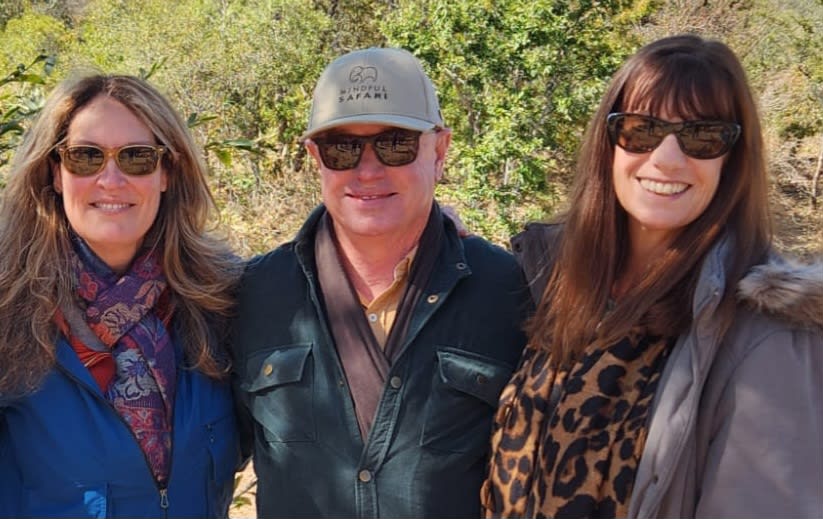
Laurel, left, with Koala and me
The burst of cold air surprises me, stealing my breath as the jeep accelerates. Suddenly, I wish my knitted wool hat were on my head instead of 10,000 miles away, on the counter at home. It’s apparently keeping my gloves company.
It’s winter here in Zimbabwe, and although the afternoons are pleasant with warm temperatures, the mornings can be surprisingly chilly. However, these early mornings, just before sunrise, offer the optimal time to view wildlife.
“Yebo, mfowethu! Sawubona!” Nicholas, our driver and guide, calls out to his colleague at the entry gate. The cold air comes alive with their laughing banter and, after a shuffle of paperwork, we’re moving forward again, into the vast wildlife preserve.
We have arrived at the perfect moment. The sun has not yet fully risen, and we are instantly immersed in the sepia-toned landscape. Although the light in this early morning is muted, it still radiates through the trees. The dirt road ahead is lined with trees on both sides and deeply grooved tracks that cause our jeep to bump along slowly. All around us are trees; small ones lining the road and larger ones beyond. Golden grasses fill the spaces in between. This is the dry season; several trees are bare, while others hang onto brown leaves.
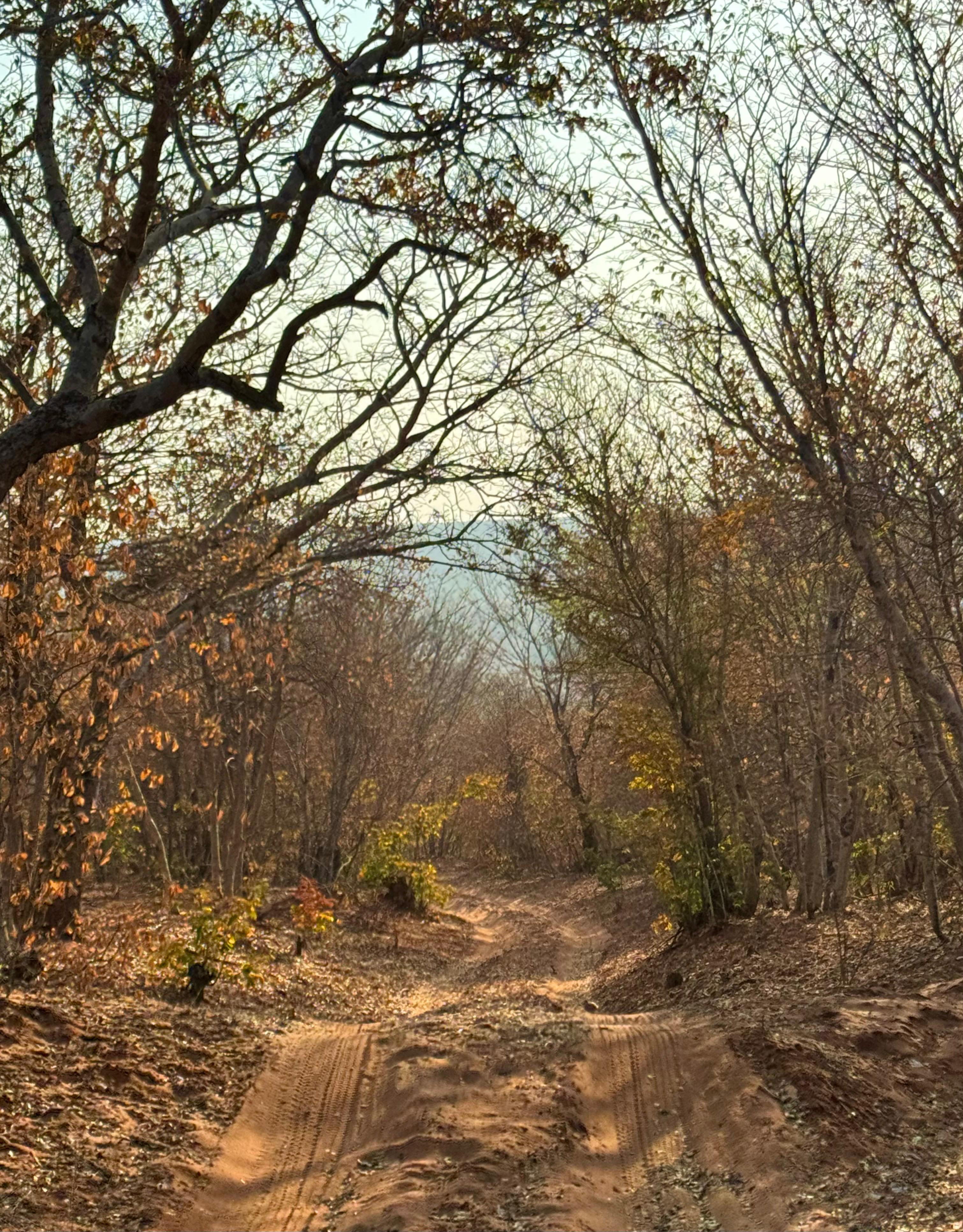
Photo: The road into the reserve, lined with the colors of winter
Even in the low light, color is everywhere. To my surprise, many trees are still green, slowing their transition into winter. The dirt road we’re driving on displays a range of shades; first, sandy brown, then a patch of gravel, and finally, my favorite, the rust-colored dust of the Kalahari sand, which is plentiful in this area.
Tucked under a blanket, hunkering down and resisting the cold, I remind myself to breathe. Differently, however. Not the short, guarded breaths I’d been taking, but instead a slower, more deliberate inhale through my nose, allowing me to draw in the surrounding smells.
Instantly, the scents come alive around me. At first, I notice the dry earthiness of the dirt itself, which quickly gives way to the lingering sweetness of dried grasses. Then, as we continue forward, a subtle, musky trace of the surrounding Zambezi Teak. In that moment, I forget the cold altogether and take a deep inhale once again.
The scent is intoxicating.
We are here to learn to breathe, to experience something new in nature by integrating awareness of all our senses into the experience of Africa itself. Mindfulness, the practice of paying full attention to the present moment, has become an increasingly important area of discussion in recent years. Neurologists have long recognized that incorporating mindfulness practices can help reduce stress and deepen our sense of enjoyment. Yet, while traveling, when time feels scarce and the list of sights is long, slowing down to focus more deeply can feel counterintuitive.
David Michie understands this well. As an author and teacher, he has dedicated years to exploring meditation and mindfulness practices. Combining that knowledge with his childhood home of Zimbabwe, he and his wife, Koala, have created a unique safari experience called Mindful Safari.
The portable radio in our jeep crackles with static, followed by words I do not recognize, with an occasional English word. The sun is just rising over the horizon, and as it touches my face, I can feel its warmth. Emerging from the wooded areas, I am surprised to see that we are now in an expansive clearing. Low-lying shrubs dot the fields of dry, winter grasses. Stately, umbrella-shaped acacia trees with their flat-topped canopies will offer shade later and provide refuge from the afternoon heat. In the distance, we see antelope grazing. Nicholas slows down, pointing out zebras to our right.
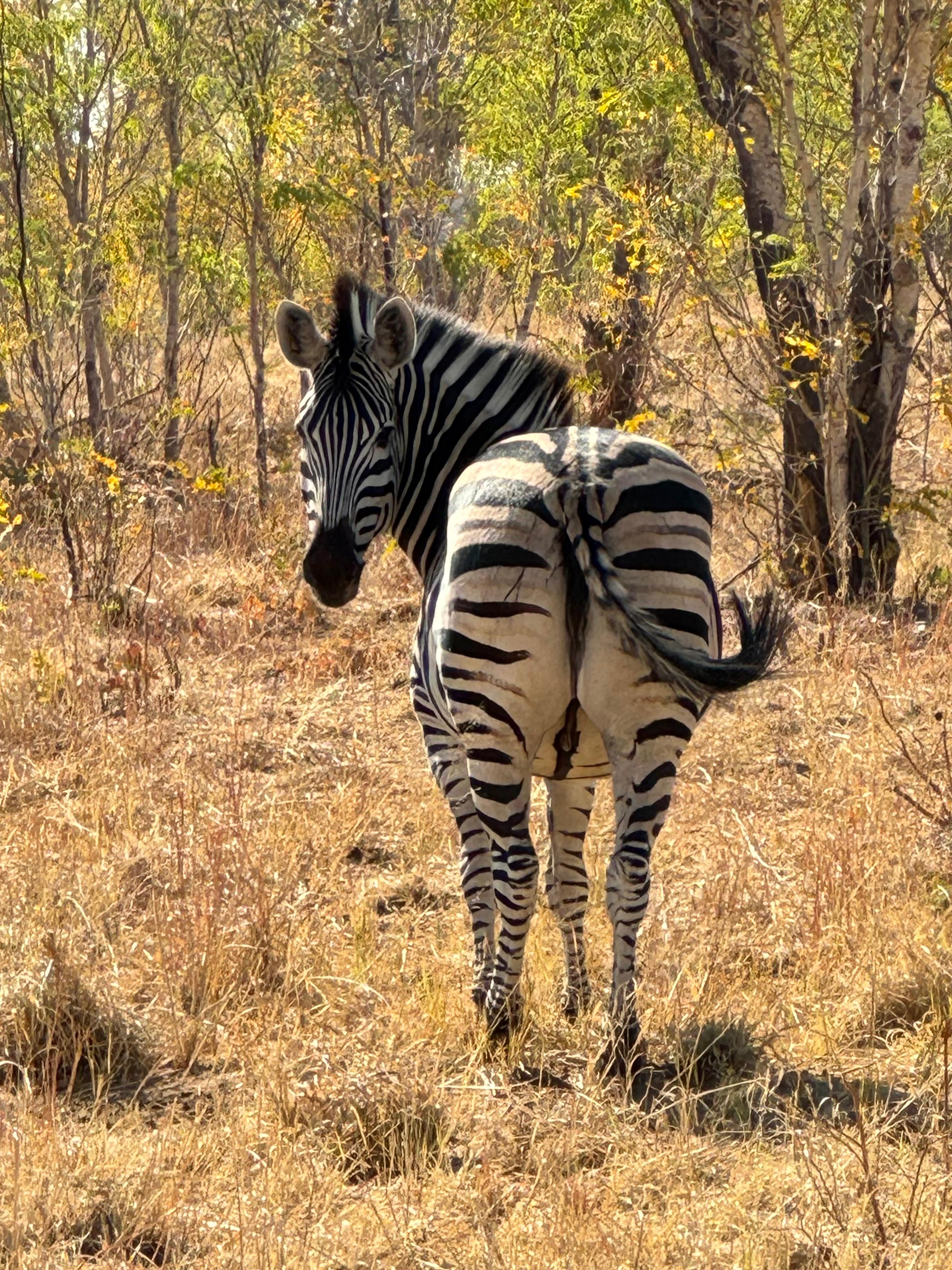
Photo: A zebra regards us with quiet caution
This has been a good year; their numbers have increased, he explains as we pause, watching two young foals staying close, grooming and nuzzling each other.
Continuing forward into another gust of cold air, I remind myself to breathe again: this time inhaling a scent of sage-tinged smoke that lingers briefly before giving way to an unexpected, faint floral aroma that I don't recognize. It’s all around me, alive and present.
Africa is visually stunning on its own, but we are discovering that inspiration reaches far beyond what we see. At Mindful Safari, we are reminded of a simple yet profound skill: noticing the world with all our senses. Breath becomes our entry point; the quiet act of noticing inhale and exhale, an anchor to the present moment. From that stillness, a doorway opens into relaxation, connection, and inspiration.
“The word inspiration,” David explains, “comes from the Latin inspirare, to breathe into.” And here, it feels true. Watching these extraordinary animals, their connection to one another and their world, reminds us of our own. Notice. Look out for one another, protect the vulnerable, and listen. Find the wind. Stop. Smell.
Photo montage clockways from top: Two giraffes stand alert, keeping a curious and watchful eye; Holding on all the way home; young elephants gather in the evening light at Panda masuie’s rewilding center; an elephant pauses at the roadside.
The following afternoon finds us on a guided walk, exploring a different side of the bush: animal tracks, pathways, along with the trees and grasses that support life here. Mopane trees, with their large, butterfly-shaped leaves and earthy, herbal scent, serve as an essential food source for elephants, kudu, and impala. Towering Baobab trees, with their bare branches reaching toward the sky, earn the nickname ‘the upside-down’ tree. These iconic trees are a legendary fixture in the bush, some living a thousand years or more. The fragrant smell of wild sage lingers as we walk beside ‘crows feet’ grasses, named for the circular seed head pattern at their tips. Each has a purpose: food, medicine, and keeper of native legend and history.
Our guide plucks a piece of wild basil and crushes it between his fingers, releasing its sharp, herbal fragrance. In addition to its medicinal properties, he explains that it also serves as a bug repellent, along with other purposes. For those who live close to the land, its scent can also signal recent animal movement that a human might not otherwise hear or see.
In the bush, how we utilize our breath protects life in more ways than one.
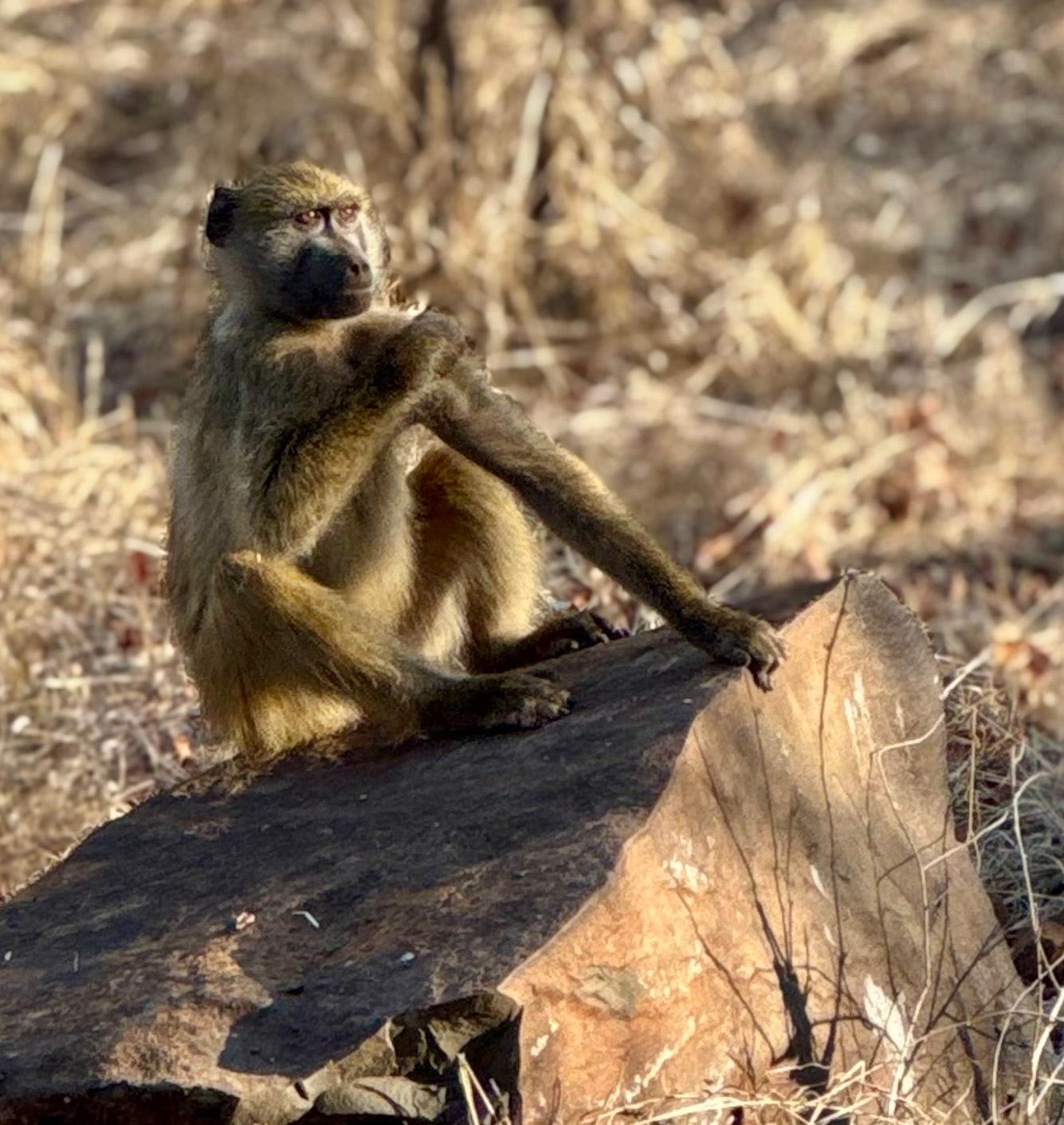
Photo: A baboon sits in the shadows of the early morning
The following morning, it’s 4 a.m., dark and hushed. Outside the canvas wall of my hut, I can hear the hyenas call. Ooo-WHOOP, ooo-WHOOP! Haunting, with a slight rustling in the bushes nearby. Then, once again, but fading into the distance. Ooo-whoop. They are moving away.
After the light dawns, we convene on the deck of Masuwe Lodge, closing our eyes to begin our morning meditation. The sun is shining, and the view is expansive across the plains. Below us, at the water hole, some animals have gathered, and we can hear the elephants shuffling. We laugh as baboons climb through a tree, disrupting the silence as a scuffle erupts. Then quiet again.
It occurs to me that here, in the African bush, we aren’t just learning about mindfulness. We are experiencing it.
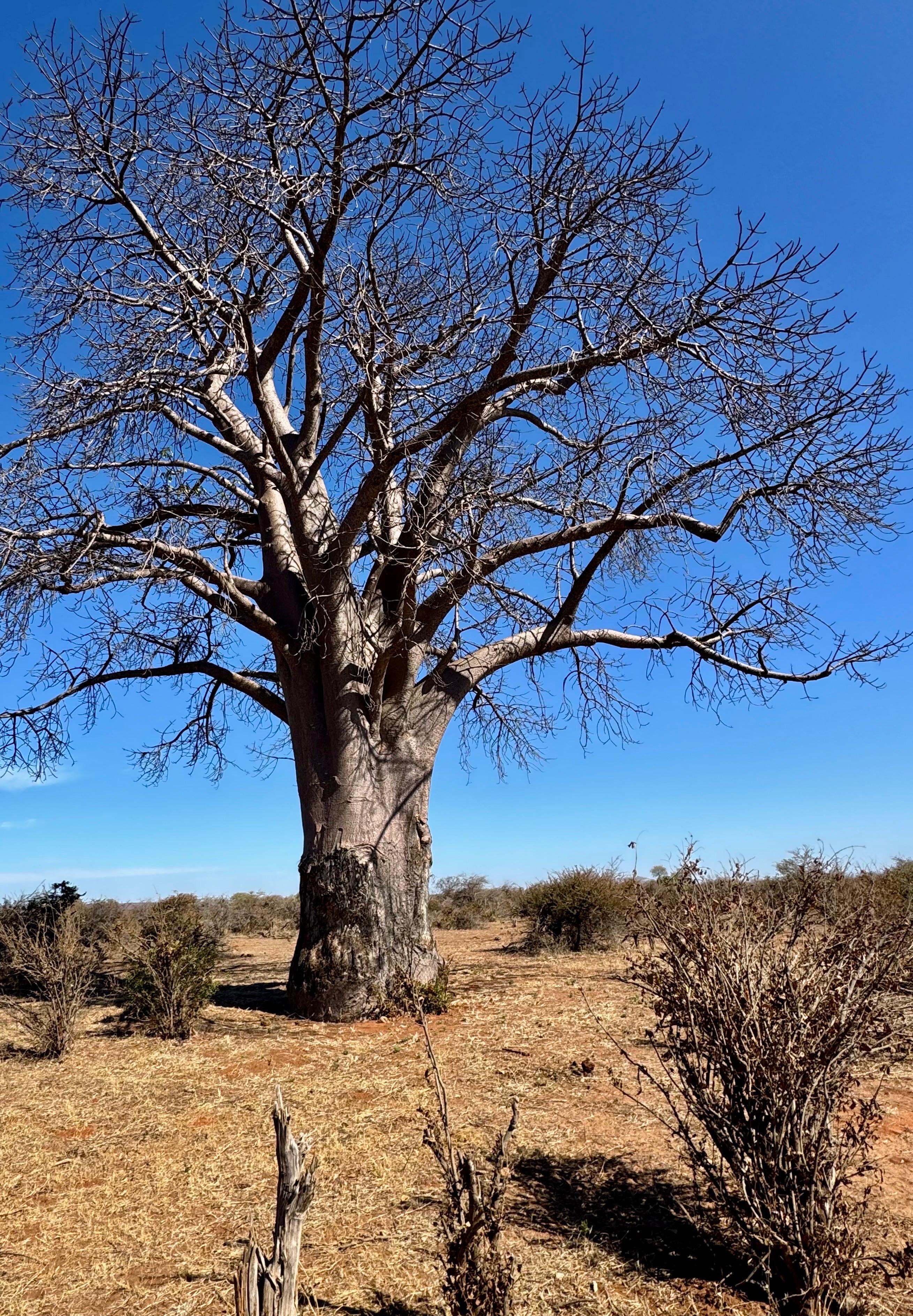
Photo: The iconic, towering Baobab tree, sometimes called the ‘upside down’ tree
Against the backdrop of woody, spiced scents of the bush, the cool mist of Victoria Falls, and the afternoon light spreading over the Zambezi River, our encounters with the animals around us take on a new dimension. Beyond their grandeur, something else, more grounded, begins to emerge. By slowing down and observing, we come to realize, with a new sense of wonder, the commonalities we all share as living beings.
One giraffe bends to drink while another keeps a watchful eye. An infant baboon runs to jump on the back of its mother. A buffalo nudges her calf forward with the herd. An elephant sinks into a mud bath, rolling around with what can only be pure joy. We share in our own version of these experiences: to be safe, to be fed, and to be looked after. To be happy.
We are, in effect, all learning to breathe. Here, in Zimbabwe, and also in life. To slow down. To listen. To connect: with the animals, nature, and one another.
To see more of Laurel’s beautiful posts, including her visits in India, click the button below:
Take me to 'Conversations in Motion"
For more about Mindful Safari 2026
Feel free to share this post with anyone you feel may enjoy it: