The Scarlet Pencil: Dialing Down Dialect
The seventh volume of the Curated Crime Collection will feature all eighteen of Henry A. Hering’s wonderful stories about the Burglars’ Club. After running in Cassell’s Magazine, the first dozen tales were collected in a 1906 book titled The Burglars’ Club: A Romance in Twelve Chronicles. About five years later, Hering wrote six additional tales, and so far as I know, the full set has never been released as a book. That is—until my edition debuts, which I hope will be in a month or two.
I try to use a light hand when editing the Curated Crime books, but I’ve had to raise my hand to signal HALT! from time to time. While Hering uses a very modern language style—closer to the terseness of Hemingway than the “wordiness” of Dickens—his use of dialect can feel pretty clumsy by today’s standards. He does okay when it comes to, say, Cockney characters, but his German characters’ thick accents become downright annoying. This is partly because conventions for dialect have changed between the early 20th- and early 21st-centuries. Indeed, Hering is simply doing what many other writers of his era did. But it’s also because some of his ways to designate a German accent don’t make sense.
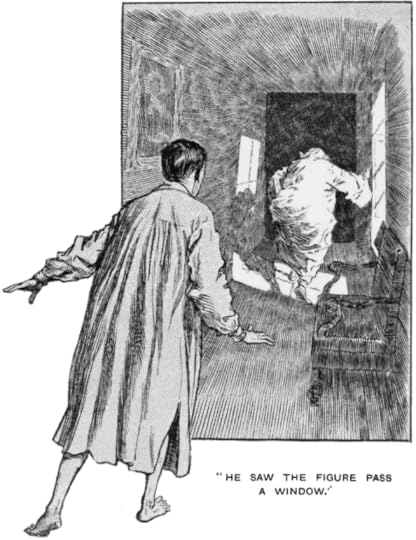 An illustration from Hering’s incomplete collection of Burglars’ Club adventures.Editing for Believability and Consistency
For instance, in “The Holbein Miniature,” Hering has Mr. Adolf Meyer ask Mr. Lucas what he thinks of when he looks out over the sea. The later says he thinks of boating and bathing, and Meyer then reveals himself to be a man of deeper thoughts:
Dat is where you islanders have the advantage over us treamers. But somehow the treams have a habit of outlasting de practice.... I tink of all dat is above it, and below it. On de top, ships carrying men and women and children to continents; below de waves, dead men and women and children, dose who have died by de way, floating by de cables which are carrying words dat make and unmake nations and men. Life and death are dere togedder.Th can be a difficult sound for those whose primary language doesn’t have that sound. Changing “there together,” to “dere togedder” makes for a believable accent (even though a “thin” and a “through” slip by elsewhere in Meyer’s dialog). But if someone can pronounce a d, why would that person turn “dreamers” into “treamers”? They probably wouldn’t. It’s simply a way to reinforce the character’s accent.
This accent-for-accent’s-sake approach can also seen when Meyers changes “photographs” to “photokraphs,” even though he is capable of putting the hard g into “Mein Gott!” And “prescriptions” becomes “brescriptions” even though Meyer can pronounce the b in “bekinning.” And “telescope” becomes “delescope” even though he seems able to pronounce all three t sounds in “shut my window tight.” Such dialect is inconsistent, which makes it unbelievable—which makes it a bit annoying. Look, Hering, I’m loving the story—and I get that the character is German—but if you’re koing to bersist in dransbosing letters, at least, stick to your kuns!
As I say, Hering is simply following dialect conventions of the early 1900s. I’ve seen the same in plenty of other pieces from that era’s fiction. It’s not a weakness. But it is an annoyance for fiction readers today, when the convention has become to gently remind readers of a particular accent. We’ll hear the accent in our imaginations, after all.
What’s more is Meyer, we’re told, has earned both an M.A. degree from London University and a Commander of the Royal Victorian Order from the British monarch. His English should be pretty good! Given these problems, I stepped in and converted everything this character says to standard English, all except for changing the th sounds to d sounds.
A Character Even More GermanA later tale, titled “The Truth Extorter,” introduces another German character. Dr. Bamburger doesn’t have nearly the same familiarity with English as Meyer, but his dialect is virtually the same. It also exhibits many of the same problems of believability and consistency:
Dere is a patch of prown, but not as big or as dark as I should haf expected...Bamburger can’t say “brown,” but he can say “but” and “big”? Weird.
I vill not hand you to dem. Sit down; dat is all I want.Shouldn’t a character who turns “will” into “vill” also turn “want” into “vant”? And then Bamburger says “mitout” instead of “without.” Granted, the film term MOS or “mit out sound” allegedly sprang from a German director mispronouncing “without sound,” but turning w into v and afterwards into m — and elsewhere not doing anything at all with it—asks readers to juggle a lot.
In Bamburger’s case, I again made th sounds into d sounds and turned all w sounds into v sounds. This, I hope, is enough to suggest he has a thicker accent than Meyer along with granting readers’ imaginations the freedom to do the rest.
Despite my qualms about the dialect, I think Hering’s Burglars’ Club series has some really great storytelling in it! It’s engaging, funny, and seems to be saying something about the bored aristocrats who spice up their lives by burgling offbeat items from their almost-always aristocratic neighbors. I hope my dialing down the dialect will make a very enjoyable reading experience a little bit more enjoyable.
— Tim
(Posts identified as “The Scarlet Pencil” chronicle my meandering through the misty and mysterious quagmire of editing books.)