Back In The USSR
When travelling in Eastern Europe and, more specifically, countries that once formed part of the USSR, it can understandably be a pejorative to describe somewhere as "Soviet", "like going back in time", or (even worse) "Russian". However, travelling to Moldova's breakaway republic known as Transnistria in English or Pridniestrovia locally, where this description is not only accurate but perhaps welcomed by locals.
If you're a history buff like myself, you may have heard of Transnistria but for most travellers and tourists alike - Moldova, let alone Transnistria, is unlikely to have ever come across your radar.
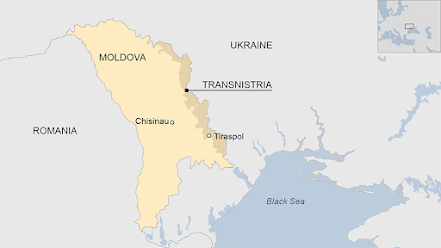 The location of Transnistria, a slither of land between Moldova and Ukraine.
 Transnistria's history is complicated so I'll try to explain it as briefly and easily as possible. Moldova used to be part of Romania prior to World War II and the area that is now Transnistria was part of the Ukrainian Soviet Socialist Republic. Following the Molotov-Ribbentrop Pact, the area of Moldova was given to the USSR, which became the Moldovan SSR. The area of Transnistria was changed from the Ukrainian SSR to the Moldovan SSR, which wasn't an issue until 1990 when the Soviet Union fell, leading to a civil war in Moldova.
Today, Transnistria is a quasi, semi-recognised, state of its own that operates with its own currency and border, although it is evident it has aspirations to join the Russian Federation. Its people speak Russian, are ethnically Russian, and look towards a future with Russia. Russia operates a number of military bases in the area, there for so-called "peace-keeping" missions, although the Moldovan government has some opinions on this I'm sure.
Transnistria isn't even recognised as a state by Russia. It only receives recognition from other quasi-state breakaway regions backed by the Russian Federation - these are the two breakaway regions of Abkhazia and South Ossettia, internationally recognised as sovereign parts of Georgia.
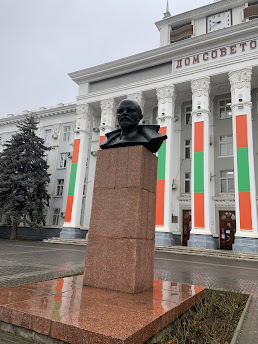 A bust of Vladimir Lenin looks on patriotically in front of Transnistria's government building.
My journey to Transnistria involved a return to Chisinau, Moldova - a place I had been to on my Eastern European travels in 2019, where I spent six weeks travelling from Vienna to Istanbul, the long way round. That time, I spent three nights in Chisinau, resting and recuperating after an arduous journey from Lviv to Odessa, followed by a failed hitchhiking attempt from Odessa to Moldova. I remember at the time not having the energy to do too much travelling within Moldova itself so I spent the time in the city centre, exploring the parks, eating the food, and primarily relaxing before the next left of the trip up to Kiev, Kharkiv, and then down to Georgia.
When I returned in January of this year (2025), my plan was to:
(a) head to Transnistria for the first time and,(b) to explore another lesser-known autonomous region with Moldova, Gagauzia. It would be a quick trip, just two nights, with a lot of exploring, but with a career that I enjoy comes certain restrictions on my annual leave and also in my days off! Nevertheless, what I had planned was do-able in the time I had given myself.I arrived into Chisinau on a Wizz Air flight from London, late in the evening on the 30th January and went straight to my hotel, The Hotel Jumbo, which I must recommend. For a fee, they picked me up from the airport and took me straight to the hotel. My room was huge and I enjoyed a nice hot bath before retiring to bed - quite the change from the last time I was here and stayed in a bunk bed in an 8-person dorm for £10/night with a crazy Australian who yelled at people for opening their phones in the dark (the guy was genuinely mad).
It was an early start the following day and back to my backpacker ways. I joined the early morning commuters on Chisinau's bus network, like sardines in a can as a man with a blue high-viz squeezed his way through the bus, collecting the 6 Moldovan Lei fare, paid in cash only, quite the difference from other European capitals where tickets can be paid on your phone, with a contactless card, but most certainly not cash!
A few stops into the city centre and I arrived near the city's central bus station, nestled in the central market where the vendors were getting their stalls set up for the day. I dropped my bag off in an underground bag storage place, much to the bemusement of the lady working there. Moldova is supposedly Europe's least visited country and I suppose they don't get tourists too much. Thinking back to it - I don't think I remember hearing or seeing any other English-speaking tourists while I was there.
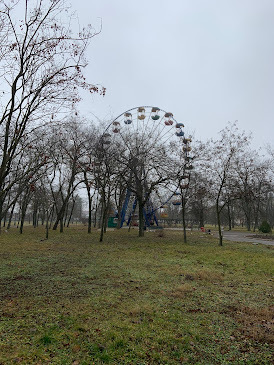 An abandoned ferris wheel in the so-called 'Victory Park'
After a couple of laps of the bus station, I managed to find the bus stand where the bus to Tiraspol, Transnistria's capital, would be leaving. A friendly bus driver asked where I was going, and pointed me in the bus. It was all going smoothly so far.
I was filled with trepidation on the journey - Transnistria is marked as a "do not travel" zone according to the UK's Foreign and Commonwealth Office. Not that it has ever stopped me before when travelling to Iraq, Syria, and parts of Armenia. Nevertheless, warnings of kidnapping, false imprisonment, and more always create increasingly more vivid details and imagery in your head as you get closer to the border.
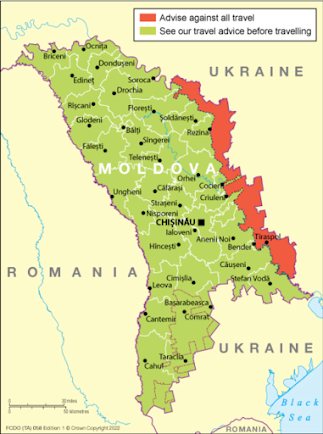 The FCO's map of Moldova, with advice against all travel to Transnistria - a warning reserved for some of the most volatile regions on earth!
Moldova, of course, does not recognise Transnistria's independence and as such has no formal border checks as you leave their area of control. The Transnistrian 'border' was a relative formality. The border guard who dealt with my passport seemingly disgusted at my ineptitude to speak Russian, although he spoke English quite well. I was given a slip of paper which doubled as my 'tourist visa' and back into the bus I went.
The difference between Moldova and Transnistria was extremely noticeable. Even when disregarding the Russian military bases, Russian flags, Russian soldiers, and destroyed tanks from the civil war that took place here in the early 1990s, it truly is like stepping back into the Soviet Union. While the buses in Moldova have not changed in 20 years, the buses in Transnistria have not changed in 40 years. Perhaps due to international sanctions or perhaps due to public officials embezzlement, not a lot of money seems to trickle down into public services.
I'm the last to get off the bus in Tiraspol's city centre. One main high street forms the centre here. I walked to "Victory Park", a common name in former Soviet states - the park is overgrown and a rusty theme park litters the view, although it is the same park used as a thumbnail in a number of Youtube videos. If I didn't know any better, I'd have thought I was in Chernobyl.
On the way back into town I walk past Transnistria's official government building. A bust of Vladimir Lenin looks proudly into the distance, with the brutalist government institution behind it proudly draped in the flag of the People's Republic of Transnistria. To the left is a huge notice board with the mugshots of the republic's most loyal civil servants no doubt. It's when I notice on the second row of people's mugshots that the border guard who allowed me into Transnistria was actually Commissar for Border Security, or something along those lines. How bizarre, but quite cool too.
Tiraspol's city centre is relatively small and, admittedly, quite boring. What makes Transnistria interesting is its history and uniqueness. In the main square are a few flags, one obviously being their own, the other being that of the Russian Federation, and the other two being that of South Ossettia and Abkhazia, a small nod of appreciation for their recognition of the area. I wonder if South Ossettia and Abkhazia have Trasnistrian flags?
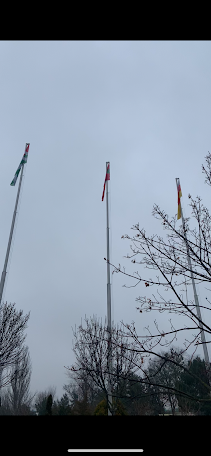 Difficult to see in this photo - but here the flags of Transnistria, South Ossettia, and Abkhazia fly high over Tiraspol's main square.
I grab a couple of souvenirs and head into the town of Bender, one of the few areas west of the Dniester River that the Transnistrian government holds. I want to see Bender fortress but the weather is terribly cold and by this time I'm quite bored of the place! There is very little tourist infrastructure here. I am beyond starving and look for the USSR Cafe, one of the very few tourist traps here but after walking in circles of where it said it was on the map and probably drawing the attention of the KGB, I give up my hopes of finding this place and go to the bus station to return to civili... I mean Moldova.
Is it worth visiting Transnistria? I'd say if you are interested in Eastern Europe, former Soviet states, and unique places - then definitely yes. For the normal traveller there is really not a lot there to do. Even I, a self-proclaimed history buff and enthusiast of visiting places lesser-known, found Transnistria quite boring.