If hell doesn't exist, why did Buddha describe it so vividly?
As the son of church-going Presbyterians, I got off lightly when it came to hell. At Sunday school we were taught of its existence — but mildly. Guilt and eternal damnation were mostly eschewed in favour of all things bright and beautiful.
Catholics, I used to hear, took a much stronger line. Sin and guilt were deeply ingrained. On the other hand, they had confession. My father often told the story of how, as a young teenager, a precocious pair of Catholic girls used to torment him by smoking and swearing — enviable vices strictly off-limits to him — before announcing that they could confess everything that weekend, say a few Hail Marys, and start the next week pure as snow once again. As a Presbyterian, it seemed, the odds were stacked against him!
Hell loomed suddenly front and centre one day when our regular Religious Instruction teacher at school had flu. Her replacement, Mrs Farrow, from a different denomination, possessed a powerful, unnerving charisma. In less than half an hour our class of eleven-year-olds discovered how enmeshed we were in the raging battle between Good and Evil. How unseen legions of dark forces could be summoned by so much as a wondering glance.
I pedalled home as fast as I could that day, rummaged through my Tell Me Why magazines for several articles on ghosts and the occult, flinging them into our fire pit before Beelzebub could place his clammy hands around my neck.
Other kids were equally panic-stricken. When parents inevitably found out, even the Catholic mums and dads thought Mrs Farrow had gone too far. She wasn’t invited back.
I had no interest in religion as a young man. So when I began meditating for stress management reasons in my early thirties, and found my way to Tibetan Buddhism, hearing teachings about hell realms - for the first time in decades - was deeply disappointing. Seriously? Wasn’t Buddhism non-theistic? Hadn’t I left all that belief-based mumbo jumbo behind?
While descriptions of hell are sparse and metaphorical in the Bible, standard Buddhist texts are quite the opposite. They go to town on the breadth and depth of torment. There are great hells, surrounding hells, and cold hells — and within each of these, numerous permutations of misery.
In one, people fight in hand to hand combat to the death. But not even death brings peace. After a while, they are revived, and the fighting starts all over again. In another, beings are so cold that all they can do is howl with pain — for aeons.
Hell, in Buddhism, is not a singular place so much as a vast spectrum of awful possibilities. The saving grace is that none of them last forever. Each experience endures only for as long as the karma that produces it.
These hells aren’t the invention of some errant teacher. Buddha himself described them in The Sūtra Requested by Subāhu.
Only recently I heard how, after delivering this terrifying discourse, the Buddha returned to an audience of very sober faces. Which was when he added his extraordinary qualification.
In Buddhist logic, a syllogism is a structured reasoning statement. It comprises three steps - and sometimes a fourth. In step one, you state the subject. In step two, you make a statement about it. In step three, you give your reason for the statement. Step four, if you wish, offers an example.
What Buddha said about the hell realms has come down to us in this syllogism:
Consider the realms of hell.
They don’t exist,
because they lack inherent existence.
They are, for example, like this very place where we are sitting now.
We can imagine the initial shock in the hearts of his students: Not all that again! Then the flood of relief — They don’t exist! — followed by fresh confusion. So what were all those gory descriptions about?
Until, finally, the deeper revelation lands: They are, for example, like this very place where we are sitting now.
Time and again, the Dharma brings us to this same pivotal point. Even those of us who have been studying and practising for decades — and should know better — still slip into assuming that there is one reality: the one that we happen to be inhabiting. If you and I sit in the same room, your reality must be mine.
Only, it’s not. My delicious meal may be your ordeal. Your thrilling night out may be my idea of hell. Our experiences are shaped by our minds — by our conditioning, our karma.
We may share group karma that makes certain perceptions seem objective. But that illusion — that there’s a world “out there” entirely separate from us — is exactly what both Buddha and modern physics challenge.
“Physical concepts,” said Einstein, “are free creations of the human mind and are not, however it may seem, uniquely determined by the external world.”
“The concept of substance has disappeared from fundamental physics,” said Sir Arthur Eddington.
“An independent reality in the ordinary physical sense can neither be ascribed to the phenomena nor to the agencies of observation,” said Niels Bohr.
“The objective world arises from the mind itself,” said Buddha.
So — do realms of torment exist? Hell yeah! But not as we may think. There are countless hells, because there are countless minds creating and experiencing them. We don’t have to die to go to hell. Some people, surrounded by comfort and wealth, are living in hell at this very moment.
Even so, when our very subtle minds are no longer tethered to our bodies — when we exist only as beings of thought in the bardo — our habitual patterns of mind are empowered. They define our reality.
So perhaps there is a thread that connects the Bible, Mrs Farrow, and the Buddha after all. As we think, so we become.
Our physical lives may buffer us from the full force of our consciousness. But the day will arise when thought alone is our reality. And when it does, if we have cultivated hearts steeped in love and compassion, we can do something glorious with that transcendence.
Not for our own sake — we will already be free — but for the sake of all those who still believe that the very place where we are sitting now is real in a way that has nothing to do with them.
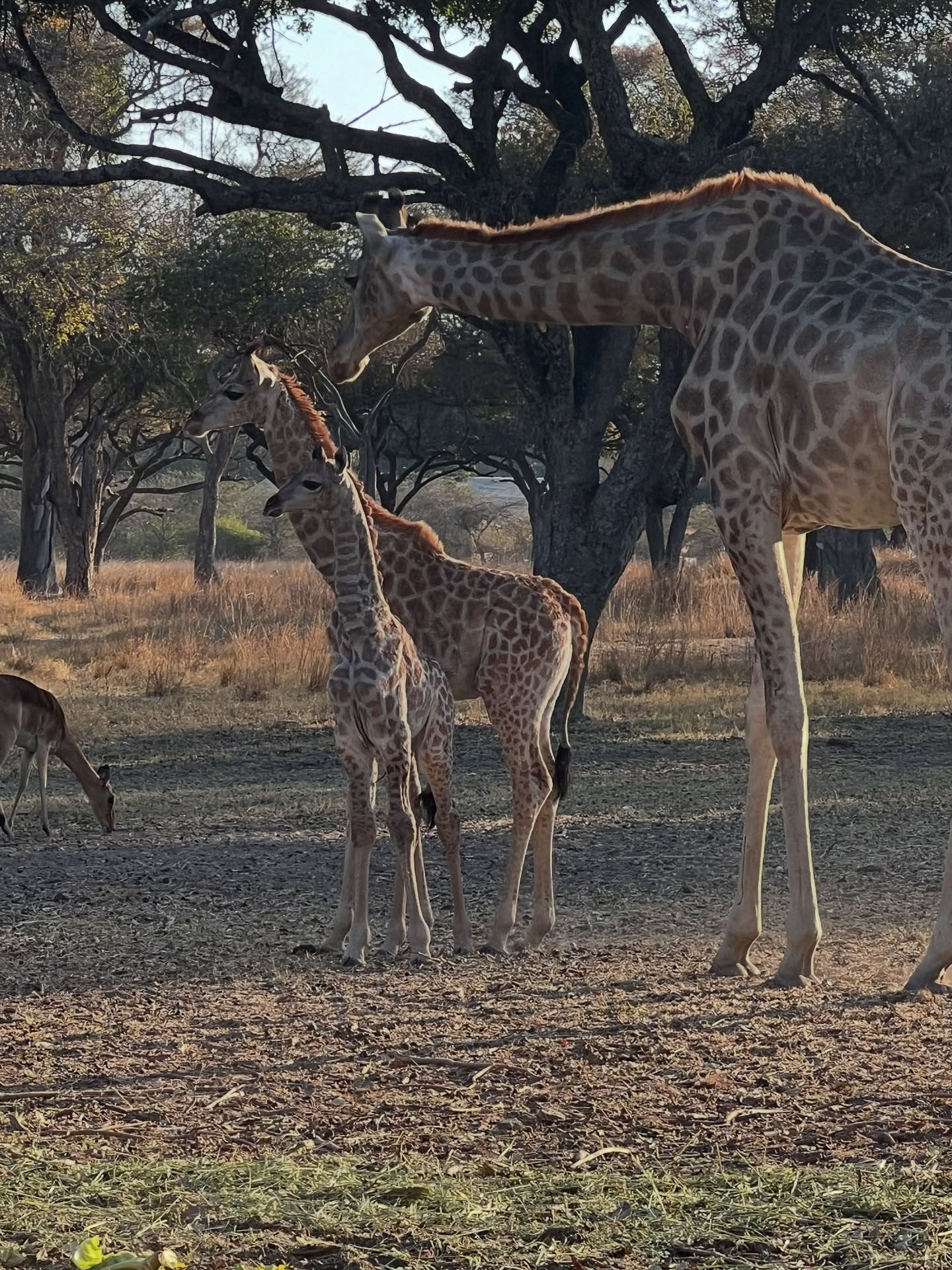
Photo: Mum Catherine with baby George, standing next to Camilla
This week’s photo update is from Wild is Life/Zimbabwe Elephant Nursery, one of the non-profits we support.
Autumn in the northern hemisphere means it is spring in Zimbabwe - the season of new life. From Wild is Life:
“Our newest arrival is this long-legged little treasure — and the very first baby boy born to our giraffe family! George’s mum Catherine (a first-time mama) is doing wonderfully, and with her rich milk he’s growing fast and strong. He can already run, stretch, and do “giraffe things” with such pride.
But just look how little he still is standing next to Camilla — who herself is still so young! It’s a sweet reminder of how fresh and fragile his journey really is. Welcome to the world, George. We can’t wait to watch you grow tall under the ZEN skies.
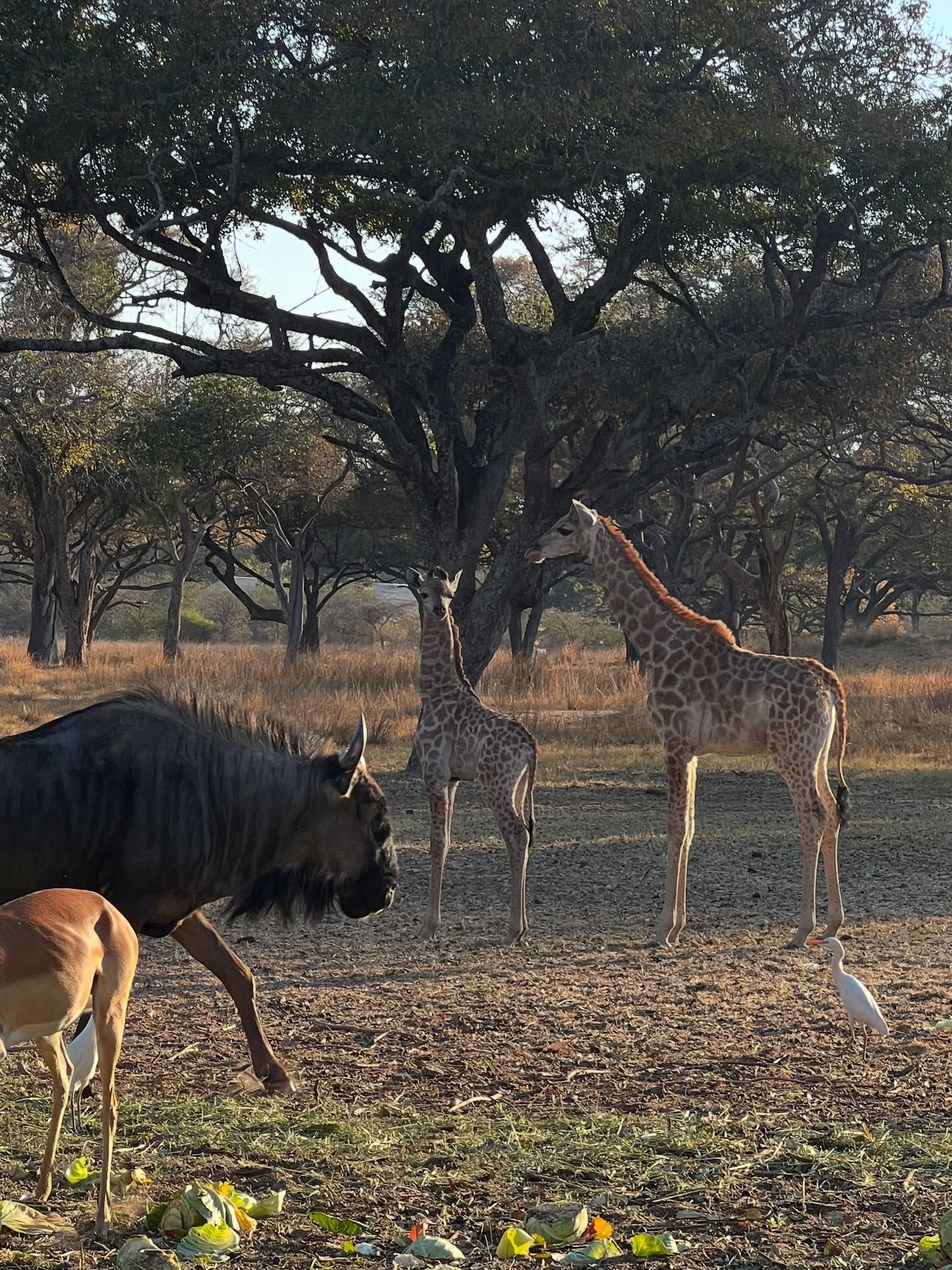
Photo: George and Camilla keep a close eye on Noodle the wildebeest
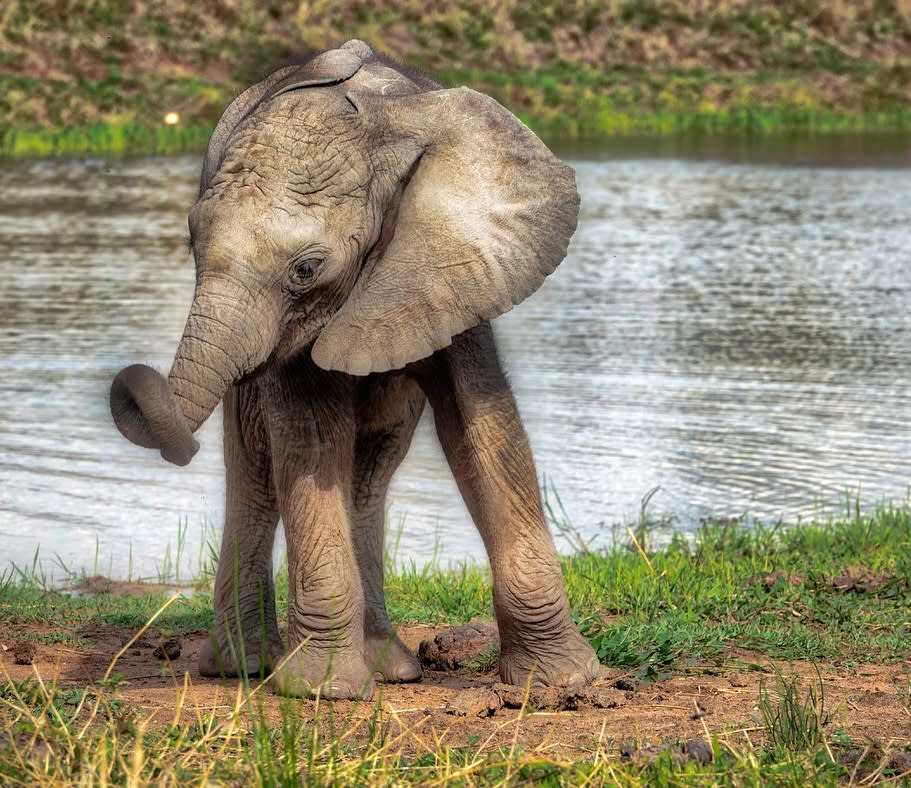
Photo: Elie calf Coco
"Coco’s start to life was one of the most traumatic of our orphans.
She was rescued as a fragile four-month-old after her mum was hit and killed by a bus. Her jaw had been fractured as we suspect she was standing just underneath her mother at the time… When she was discovered she was frantic, injured, screaming and covered in her mother’s blood. She arrived to our care, frightened, injured, and deeply withdrawn.
With patience, love, and the gentle guidance of Moyo - who quite literally taught her to eat, one cube at a time - Coco slowly found her feet again. She has remained sensitive and cautious, but over the years her trust has blossomed.
Now, Coco is a confident young elephant, strong and beautiful. She often spends days at a time venturing out at Panda Masuie, dipping her toes into the wild alongside her best companion Unity.
Her story is proof: from the darkest beginnings can grow the brightest futures. And Coco’s future is shining.
Be the change you want to see in the world:
If you know anyone who you feel may benefit from this post, please do share it!