A Voice Crying in the Desert: Ignoring the Poisoning Effect of CO2
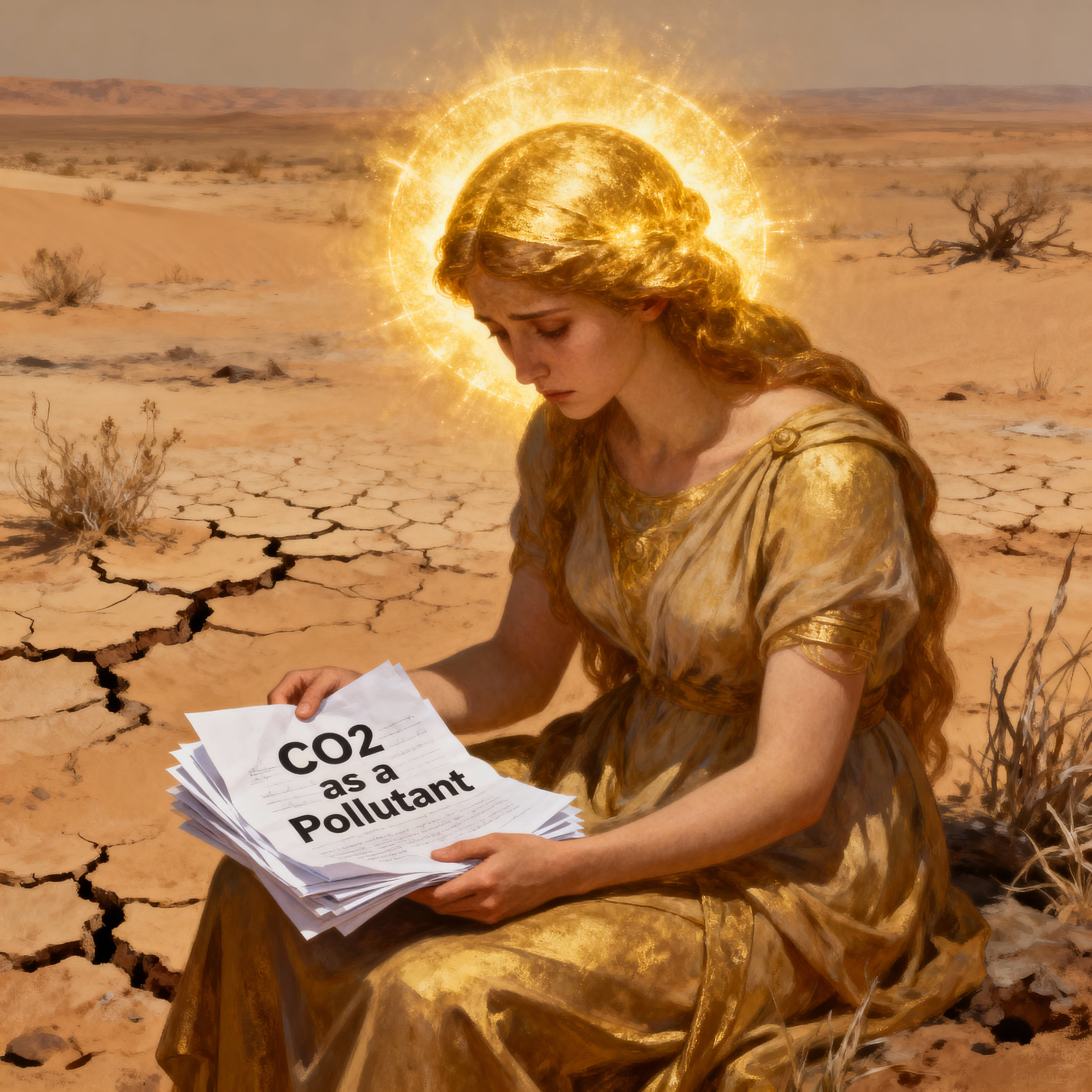
The Goddess Gaia knows that CO2 is a poison, but her human children refuse to believe that.
Guest Post by Olle Hollertz, retired psychiatrist, Oskarshamn, Sweden libbershult@icloud.com
Sometimes I wonder if our desire not to deviate from the norm or the dominant view of the group is a motivation that trumps logic, reason and truth. In some situations this attitude can become unsustainable, especially in connection with crises and disasters, but without external pressure, a majority chooses to align itself with the ranks and sometimes not even then. Convincing reasoning and obvious facts will not be able to change dysfunctional beliefs and outdated conclusions, both in the humanities and the natural sciences, not before the existing system has completely cracked. Changes are difficult and scary, shaking up habitual patterns and therefore triggering various defense mechanisms to maintain the existing.
In those individuals who have seen through this and value truth and reason more than the confirmation of the group/society, it leads to frustration and resignation, and sometimes even to exclusion. It is no gift to be able to draw out the consequences of what is happening today and see what awaits in 5-10 years. Almost always it leads to a feeling of being “a voice crying in the desert”. It is equally painful to intellectually realize that truth, reason and compassion do not even affect people in one’s vicinity and even more so cannot affect the primitive, almost archaic, drives that seem to govern society.
The white haired independent scientists described by Ugo Bardi in one of his posts is an excellent example of a voice crying in the desert. I am sure that many experienced, independent scientists have many experiences, thoughts and hypothesis, which I think someone ought to be interested in. From my own life and work I have some examples of hypothesis, I think are worth to study. One is the connection between hypermobility in joints/skin/connective tissue and adhd, other are lithium as a medication against dementia, animals as therapists, paleoendocrinology and the counterproductive effects of dopamine, AI’s relation to the unknown unknowns and the danger of being locked in a paradigm and of course how to adapt society to Gaia.
Another example is Ugo Bardi’s research about increasing CO2 levels and the possibility that it explains the Reverse Flynn Effect, the decline in intelligence levels observed worldwide, which I find very interesting. I attach here a short comment about CO2 and anxiety. It’s all about balance, homeostasis and equilibrium. Not too much, not too little, in Swedish defined by the word “lagom”, or as the Greeks carved on the temple in Delphi, “Meden agan”.
It is well known that too little CO2 in the blood, due to hyperventilation, creates feelings of panic and anxiety. When stressed or panicked, we tend to hyperventilate and then the CO2 levels in the blood are ventilated down and this reinforces the feelings of panic. A well-tried way to deal with this condition is to breathe into a bag, which normalizes the CO2 levels and relieves the feelings of panic, which I have my own experience with. This is not to say that higher CO2 levels can act as an anti-anxiety agent, but just an example of how important balance is.
In the past, we had rituals that helped us change, transform ourselves mentally in order to meet new challenges and deal with the unknown. My fear today, when rituals have lost their transformative power and AI helps us avoid being confronted with the unknown, is that we have ended up in a mental prison, a so-called paradigm, which is almost impossible to break out of. AI’s rapid access to superhuman amounts of information and human inherent laziness contribute to this. At the same time, there are individuals who sense that there are other alternatives, who are uncomfortable, drawn to confrontation and want to break free, but these individuals are ignored, met with silence or openly opposed. They feel like the crying voice in the desert. The driving force of the majority, who may indeed disagree among themselves, is that the hegemony of the group, regardless of whether it is local or global, must not be threatened. The majority or those in power, regardless of whether it is a dictatorship or a democracy, today also have increasingly greater opportunities for control, surveillance, sophisticated repression, propaganda and often a large capital of violence.
Isaac Asimov had the ability to foresee this political and mental situation and his solution was the second hidden foundation. On the edge of the galaxy, there was the first foundation, which acted openly and opposed the central power. When civilization was threatened with destruction, the task of the second foundation was to preserve, in the hidden and undercover, knowledge, skills, and insights, which are necessary building blocks for a civilization. It is the same challenge that we face today and Ugo Bardi describes in his text about white haired, independent, often retired scientists. Now it is a matter of linking them together in virtual networks and, with the help of AI, preparing the next mental leap into the “unknown unknown”. The German/American philospher Eric Voegelin pays great attention to these leaps of consciousness, “Leaps of Being”, when he explores what the Greeks called Metaxy, or “In Between”.
______________________________________________________
Today I read an article about the same problem from Cambridge Press about how to promote quality before quantity. This inspired me to compare how Einstein and Wittgenstein earned their doctorate.
Merits sufficient for Ludwig Wittgenstein’s doctorate:
Submission of the Tractatus Logico-Philosophicus as a thesis.
A short formal defense with Russell and Moore.
No further research, coursework, or thesis was required.
To obtain his doctorate, Einstein needed to:
Submit a thesis that was reviewed by his supervisor Alfred Kleiner.
Defend the work orally before the faculty.
Pay the administrative fee (which he actually forgot at first!).
Publish the thesis in a scientific journal – which he did later that year (1905) in the Annalen der Physik.
Einstein earned his doctorate through scientific method and empirical testing; Wittgenstein earned his through philosophical originality and intellectual authority. Einstein fulfilled the demands of the system – Wittgenstein made the system bow to him. Despite the differences, I think both, during periods of their lives were voices crying in the desert.
Olle Hollertz, retired psychiatrist, Oskarshamn, Sweden
libbershult@icloud.com