From Space Race to AI Craze: When Wild Tech Dreams Turn Practical
Here’s a question worth pausing over: How did space exploration end up creating real value for everyone on earth? One answer is GPS. It’s a classic case where tech fever dreams—like space colonization—rarely achieve their original goal, but sometimes unleash practical, world-changing magic the whole planet relies on.
Fast forward to today’s tech obsession: Artificial General Intelligence (AGI). The AI bubble, with its soaring valuations and $3 trillion poured into infrastructure, might look like just another wild chase. But history suggests the real breakthrough won’t be AGI itself.
In this article, we explore what practical applications AI has already delivered, and what the next “GPS moment” might look like.
From Space to Everyday Life: The Real ROI of Tech FeverBeyond the hype, AI has quietly found its way into practical, unglamorous applications—far less headline-grabbing than humanoid robots with LLM brains, which, even in 2025, remain firmly in the realm of science fiction.
But first, let’s look at what space exploration actually gave us. Much like GPS, numerous other technologies initially fueled by space exploration have quietly transformed daily life.
MRI and CT Scans — Enabled by space-age advancements, these medical imaging technologies save lives every day.Infrared Thermometers — Precision tools for spacecraft monitoring that found everyday use, from industry to healthcare.Advanced Space-Grade Materials — Durable coatings and composites now common in consumer goods.Water Purification Systems — Originally designed for astronauts, adapted worldwide for clean water access.Autonomous Robotics — Technologies first tested in space environments streamline manufacturing and healthcare automation.Each of these sprang from furious investment cycles driven by geopolitical urgency. Ultimately, these tech fever dreams turned into real-world payoffs.
VC Fever Dreams and the Current AI Landscape: A Familiar Bubble?The current AI bubble resembles past waves of irrational exuberance: massive bets on computing transformations promising an industrial revolution-level payoff. However, most AI pilots and generative AI efforts currently generate negligible returns for firms. According to a MIT study, a staggering 95% of organizations see zero return on their generative AI projects. The massive infrastructure spending dwarfs the actual revenue generated, which is a classic bubble symptom.
Yet, this isn’t a death knell for AI innovation. Beyond the hype, AI has quietly found its way into practical, unglamorous applications—far less headline-grabbing than humanoid robots with LLM brains, which, even in 2025, remain firmly in the realm of science fiction.
Practical Applications: Beyond LLMs to Real-World ImpactBeyond the fancy demos and sci-fi dreams, AI’s practical magic lies in quietly optimizing the ordinary.
While headlines obsess over sentient AIs and humanoid robots, the real AI revolution is quietly unfolding behind the scenes. It’s not always the flashy generative AI, but the reliable, less glamorous machine learning quietly humming across finance, healthcare, and beyond. Consider these everyday wins:
Personalized RecommendationsNetflix credits AI-driven algorithms for about 80% of viewing hours, saving over $1 billion a year by keeping subscribers hooked. Amazon’s product suggestions and Spotify’s playlists run on similar magic: massive datasets quietly shaping billions of daily decisions.
Fraud DetectionBanks and governments use AI to catch scams before you even know they happened. Mastercard scans over 160 billion transactions annually, flagging suspicious activity in milliseconds. The US Treasury’s AI systems saved taxpayers more than $4 billion in fraudulent payments last year alone. These financial watchdogs don’t wear capes (but they could).
Medical DiagnosticsAI quietly assists radiologists, spotting 20% more breast cancers than traditional screening methods while cutting their workloads in half. Across hospital wards, AI monitors vital signs, raising early alarms for conditions like sepsis well before humans would notice. Not flashy, but lifesaving.
Software DevelopmentAI pair programmers like GitHub Copilot help developers code about 55% faster, letting teams ship features quicker and skip tedious boilerplate. A Google exec recently noted that roughly 25% of their code is now AI-generated. Hundreds of thousands of devs rely on AI to spot bugs, generate snippets, and upskill. It’s steady, reliable productivity, not headline-grabbing flash.
Generative Design & ManufacturingAI isn’t just about pixels and text. Airbus shaved 45% off the weight of a plane’s partition panel using AI-designed components, without compromising strength. Scaling this across fleets promises to cut half a million tons of CO₂ emissions annually. From cars to smartphones, clever algorithms are trimming waste and boosting efficiency.
Warehouse AutomationAmazon’s recent “AI layoff” headlines mask a quieter, larger revolution in their warehouses. Their real efficiency leap isn’t an algorithm writing emails but a fleet of over one million robots turning fulfillment centers into semi-automated engines. These bots sort, pick, and move goods faster and cheaper, shrinking the human workforce quietly but relentlessly. While everyone’s chasing the latest AI buzz, real-world job transformations are being scripted by decades of robotic evolution behind the scenes.
Fever Dreams to Future Miracles: AI’s Speculative PayoffsBeyond the fancy demos and sci-fi dreams, AI’s practical magic lies in quietly optimizing the ordinary. No self-aware robots needed—just smarter processes making millions of small improvements in the background.
Yann LeCun’s recent departure from Meta to form a startup focused on building “world models” could hint at the next wave of practical, applied AI that moves beyond flashy demos to domain-specific solutions with real ROI.
If history is any guide, today’s obsession with AGI could spark breakthroughs we aren’t even aiming for—the GPS moments of the AI era. What might this feverish AI investment deliver for humanity decades from now? Here are some speculative, slightly wild possibilities:
Unlimited Clean EnergyThe race for true AGI might never reach its ultimate destination. But if the trillions invested today end up cleaning oceans, teaching billions, or powering cities with fusion, that’ll be magic enough.
AI has recently made surprising strides taming plasma inside fusion reactors, a challenge that has stumped physicists for decades. DeepMind’s reinforcement learning system managed to control superheated plasma long enough to hint at stable fusion power—a potential star power for Earth. It’s a far cry from chatbots. But if AI does crack this, it would be the genuine magic trick that powers the planet cleanly.
Planetary Weather Control CenterThat $3 trillion AI infrastructure isn’t just keeping your chatbot online. It’s building the computing muscle to simulate Earth’s climate in stunning detail. Models now forecast floods, cyclones, and air quality better than national agencies. Imagine a future AI “digital twin” of the planet that spots disasters weeks ahead, advises farmers on drought-safe planting, and coordinates crisis response with surgical precision. An unintended global guardian born from what started as a tech bubble.
AI Tutors for Every ChildTech visionaries predict AI tutors that rival (and someday might surpass) the best human teachers. Imagine a personal, patient mentor for every student, anywhere on Earth, via a simple smartphone. This isn’t robot teachers replacing classrooms. It’s democratizing world-class education for remote villages, shrinking knowledge gaps, and unlocking potential at scale. The AI gold rush might just hand every child a private genius.
Universal TranslatorsReal-time AI translation for over 100 languages is already here. Soon, language barriers might vanish entirely. Picture a “Universal Translator” earpiece making global conversations as effortless as chatting with your neighbor. The Tower of Babel, finally tamed—not by divine intervention but by neural nets.
Accelerated Science & CuresDeepMind’s AlphaFold cracked protein folding predictions years ahead of schedule, accelerating drug discovery and new materials design. Future AI “digital scientists” could speed breakthroughs across healthcare, climate tech, and agriculture, making labs infinitely faster and more creative. We might owe the AI hype not a conscious mind but a legion of tireless, genius assistants revolutionizing R&D.
Beyond the Hype: The Real Legacy of AINone of the above are guarantees. Each somewhat remains a fever dream spinning out from today’s hype. The race for true AGI might never reach its ultimate destination. But if the trillions invested today end up cleaning oceans, teaching billions, or powering cities with fusion, that’ll be magic enough.
Like satellites and GPS from the space race, AI’s legacy might be practical marvels we depend on, while the sci-fi dream waits patiently in the wings. The real magic isn’t just in words or hallucinations, but in real-world efficiencies, savings, and capabilities AI can deliver. Until then, the digital gods of AI remain an enchanting but unproven promise.
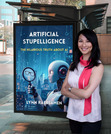
.stk-333c606 {height:50px !important;}For more insights about what AI can or cannot do, check out my book “Artificial Stupelligence: The Hilarious Truth About AI”.
The post From Space Race to AI Craze: When Wild Tech Dreams Turn Practical appeared first on Lynn Raebsamen, CFA.