
Charles Perrault: The Father of the Fairy Tale?
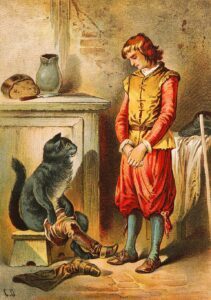

I recently had reason to track down a few details about the story of Puss-in-Boots, which I frequently confuse with Dick Whittington and his cat[1]. Along the way I fell down rabbit hole or two about the story’s “author” Charles Perrault (1628-1703). (Does this surprise anyone?)

Charles Perrault (no cat)
Perrault is best known for the collection of fairy tales known as Contes du temps passé (Stories of Times Past), more widely known by its subtitle, Tales of Mother Goose. But Perrault didn’t come to writing fairy tales until late in life.
The youngest of three sons of a wealthy Parisian family,[2] Charles Perrault trained as a lawyer, like his father before him, but he spent most of his life working as a civil servant.. When his brother older Pierre purchased the position of principal tax collector of Paris in 1654,[3] he became his brother’s clerk. In 1663, he became secretary and cultural advisor to Jean-Baptiste Colbert, Louis XIV’s powerful finance minister, a position that held a certain amount of clout. Among other things, Perrault used his position to successfully argue that the Tulieres Gardens should remained open to the public[4], persuade Colbert to establish a pension fund for writers and scholars, and get his other older brother Claude appointed as architect for the Louvre.
That same year, Perrault became Secretary of the Académie des Inscriptions et Belles Letters, a learned society created by Colbert for the purpose of composing Latin inscriptions for public monuments and the medals issued to celebrate events of the king’s reign. During his years in this position, Perrault was involved in the artistic world of the court in a a number of ways. He wrote a book titled La Peinture (Painting) to honor the Louis XIV’s favorite painter, Charles LeBrun and scripts for royal celebrations. He was responsible for the inclusion of thirty-nine fountains, each representing one of Aesop’s fables, in the labyrinth of the gardens of Versailles. And he built a reputation in the court’s literary circles for light verse and love poetry, the type of thing that was recited as part of an evening’s entertainment at society parties.
Perrault was elected to the Académie Française in 1671,[5] where he played a prominent role in the literary controversy known as the Quarrel of the Ancients and Moderns. The “Ancients” argued that the literature of ancient Greece and Rome was the unchanging model for literary excellence. The “Moderns” believed that just as the science of their day had surpassed that of the ancients[6], modern literature, too, had progressed alongside a more civilized society. Perrault was on the side of the moderns. In fact, he set off the argument when he read a long poem at a meeting of the organization, titled The Siècle de Louis le Grand (The Age of Louis the Great), in which he argued that the modern world was superior to the ancient world in every way, thanks to the enlightened rule of the Sun King.

Frontispiece of Tales From Mother Goose, with Mother Goose herself spinning a tale, and some yarn
In 1695, at the age of 67, Perrault lost his secretarial post. (None of the accounts I read said why.) Left with time on his hands, he began to write stories inspired by existing folk tales, including “Little Red Riding Hood,” “The Sleeping Beauty,” “Puss in Boots” and “Bluebeard.” The stories may have been familiar, but the style was his own[7]. They were embellished, modernized versions of traditional stories, set in a fairy tale version of seventeenth century society that would have been familiar to his readers. (In their own way, the tales were another salvo in the Quarrel Between the Ancients and the Moderns.) Published in 1697, Tales from Mother Goose, was aimed at the same audience that enjoyed his light poetry.. It was an instant and enduring success.
Perrault is often credited with creating the genre of the literary fairy tale, but while he is the most well known and arguably the most important of writers in the genre, he wasn’t the first member of the Parisian literary salons to write such tales. Marie-Catherine Le Jumel de Barneville, Baroness d’Aulnoy (1652-1705) not only preceded him, but she coined the term “fairy tale” to describe the genre.[8]
Making Perrault the genre’s favorite uncle, in my opinion.
[1] And why not, since in both stories a poor orphan boy rises to high estate with the help of his cat.
[2] Sounds like a fairy tale right from the start, doesn’t it?
[3] Buying official government positions (and military commissions) was common in the seventeenth century, without reference to the office holders’ qualifications for the post. That said, the Perrault brothers seem to have been talented and hardworking
[4] Louis XIV wanted to make them private.
[5] A different Académie, originally created to maintain standards of literary taste. It has been in existence since 1634, with a brief interruption during the French Revolution. Today its primary role is to regulate the French language.
[6] There is a lot of stuff packed into that premise that I am not going to touch in this post.
[7] Much like Antoine Galland, who, a decade later, took Arabic street tales and transformed them into the canonical work of Western literature known as The Thousand and One Nights, or the Arabian Nights. A story that I realize I’ve never told here on the Margins. Hmmm.
[8] She may need a blog post of her own soon. I make no promises.


