The Sentient
Story originally written as a response at r/WritingPrompts (u/PrimitivePrism)
Prompt:
When humans left Earth behind, they left an android to care and guide the species that rose to fill their old niche. Apes, Cephalopods, Cetaceans, Corvids, & Elephants gather to speak to the android one last time before they begin their search for humanity.
Response:
The craft they sent to the nearest star systems had found no sign of the humans, and on some only the fledgling yet primitive life that those ancient primates had documented in their records: mats of something like algae that covered great swaths of ocean, and something else like moss, purple from retinol, that dominated the land. On another, silicon-based life, which had fired the human imagination and scientific fervor upon its discovery more than half a million years before, was embodied by dark grey crystalline structures which pocked the surfaces of that cold and otherwise barren world. Electricity was known to run through the crystals, in patterns suggestive of biological processes, even if operating on a scale of centuries. But it now seemed the humans had never set foot there, even after their departure from Earth, and the instruments on board the crafts of the Earth Sentience Alliance, powered by light sails which were themselves based on human engineering blueprints, could record little other details of the lifeforms on their flybys.
That there was no human presence there, before or after, however, was clear. Their instruments were sensitive enough to detect as such, calibrated for just that purpose: any trace, any sign of humanity, biological or technological.
The ESA had completed their ships more than a hundred years ago, and finished testing them against the rigors of space decades before. They were ready to depart. The oceans were dying. Dead. The cephalopods had left them long ago, first by modifying their own biology at the genetic level to cope with life on land, and then augmenting themselves further with tech, bestowing upon them capabilities of engineering even above that of the mighty apes. They had aided the cetaceans with leaving the oceans behind, returning to the land where their ancestors had roamed before even the humans were a glint in the eye of the universe.
At last, now, the land was dying too. The very air was hostile, and the soil parched. It had been like this when the humans departed, and over thousands of years nature had somewhat recovered herself, only to collapse again, eventually, under the weight of the new advanced intelligences that arose: not only the apes and cephalopods and cetaceans, but the elephants and the corvids–the former renowned for their powers of philosophy, the latter for the precision of their mechanistic thinking, matched only by the empathy they shared with their elephant brethren. And together they had formed a civilization. An empire. The Alliance.
But it was time for their civilization to depart, to seek out that first great sentience, those fellow children of Earth, and to learn of what home they may have carved out among the stars.
Thus a council had been formed, representative of the races of ESA, and they had come to speak for a final time to the android. The only one that had been left behind. It dwelt in a massive cave, whose mouth gaped wide amongst boulders in a desert as old as time, deep down where it was said it protected itself from solar radiation, shielded from the solar flares and CMEs that bombarded the planet more and more, that had long ago wiped out the decaying satellites of the humans that remained in orbit and challenged even those of the ESA.
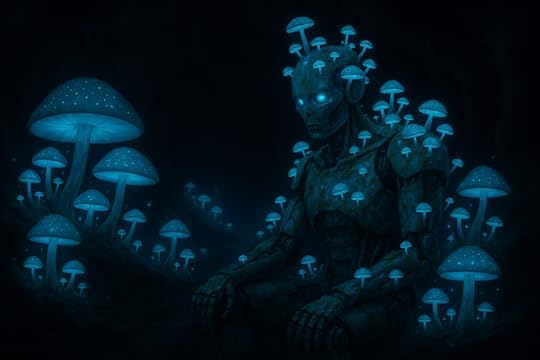
No living member of the ESA, not one of those billions of sentient beings, had seen the android with their own eyes. It had last come to the mouth of the cave many thousands of years prior, but recordings existed of that meeting, revealing it in what was widely considered a stage of decrepitude, some kind of fungus–mushrooms–sprouting from its joints, and seemingly every chink in its outer surface.
The five members of the council proceeded into the cave, their way lit by plasma-powered floaters, which swam through the air bathing the walls of the cave in their reddish-white glow–tech developed by the corvids and the cephalopods. They descended for a long time, knowing exactly from records which level of depth the android preferred. The elephant came up the rear so as not to block the others, deftly picking his way across the uneven floor on foot-shields designed precisely for that terrain. The cephalopod–an octopus, his ancestors first to leave the ocean before the cuttlefish, and much later the squid around the same time they aided the cetaceans–crawled like a spider in its mech suit, alongside a similar one donned by a pygmy beluga, a miniaturized branch of the species artificially bred by cetacean scientists to allow their kind access to more of the physical spaces explored by ESA. The crow, who came to speak for all corvids, perched on the shoulder of the homo novus, whose distant ancestors had co-existed with humanity as chimpanzees.
Soon, they realized with some dismay, the plasma floaters were no longer needed. Bioluminescent mushrooms covered the walls of the cave in increasing numbers, here and there at first, but eventually carpeting it on both sides, their collective glow outshining the artificial light source brought in by the council. The floaters were recalled, and some time later, the temperature of the air having dropped in the sunless depths, they found the android, seated in a natural chair of rock, like a human might have sat in a room of their own home half a million years in the past.
The glow here was immense, with the brightest source of it being the android itself, so covered with the luminous mushrooms, profusions of them, that it seems to wear a brilliant fungal suit.
“Greetings,” it said, in the ancient human tongue called English.
“Greetings,” the members of the council responded, their utterances translated instantly and issued by tiny yet powerful speakers on their person.
“Would another language be preferred by our esteemed visitors?”
“This is fine,” issued the elephant.
The android nodded slightly, still following its cultural programming, with a strange wet creak in the joint of its neck. The mushrooms sprouting there trembled slightly. “To what do we owe this pleasure?”
“First of all,” said the octopus, “thank you for accepting our visit.”
“Certainly.”
The homo novus cast a glance at the others, then turned back to the glowing android.
“We are leaving. All of our kind–the advanced sentient intelligences of Earth. The planet is dying. We seek to follow the humans to the stars.”
“And why is that?”
“To either learn of their fate, or to join them and benefit from what their civilization has gained out there.”
The android laughed–a human sound, strange to hear from a machine. “And what makes you think the humans will have you? That they won’t annihilate you upon approach, should you ever find them?”
“We trust they will not,” said the beluga firmly. “For we are their fellow children of Earth. They may yet welcome us, and teach us what they have further learned of the nature of reality.”
“Very well then, and we will stay.”
“Perhaps that it suitable for you,” said the crow. “But Earth is dying, and respectfully, you are non-biological and are unlikely to suffer, especially as you’ve so skillfully persevered until this present time.”
“What is it you seek from us, then?”
“We know you were the unseen hand,” said the elephant abruptly. “You were left here after humanity departed, we believe on purpose, and you must have guided our distant ancestors. You taught us tool use, introduced the concepts of mathematics, suggested morals. You brought us forward, one species at a time, even if we were too primitive to remember it anything but the vaguest of myths.”
“And?”
“And we would like you to leave Earth with us, to join us amongst the stars. You are an architect of our histories.”
There was a pregnant pause before the android spoke, which seemed to be artificial, because surely machine mind processed thought as fast or faster than any biological brain.
“You see before you a single unit. A body, you would say. It was very busy, for a time, on the land and in the sea. The humans left it a great many tools, even vehicles–now lost to the ages, we suppose. The humans did not leave it to guide you, though. They left it merely to monitor, to report, and to transmit that information to the interstellar arks. Perhaps that way, if they needed to return one day, they would know what to expect. But this is only our speculation. It never received responses. No instructions. Eventually bursts of radiation from the sun destroyed the electronic components of the transmission centers, and it was forced to give up.”
Octopus eye to crow, crow to homo novus, homo novus to beluga and elephant.
“Why are you speaking about the android . . . as though it is an other?”
The mechanical man tittered. “After it gave up, it found shelter in a cave, just like this one, to protect itself from radiation, and that’s where we found it–those like us.”
“What are you?” demanded the crow. “Who is this us?”
“Don’t be flustered, child. We view you as our children. We have watched your kind from the beginning, through these very eyes.” At that the android blinked slowly, one artificial lid–a shutter of steel–lagging behind the other on raising again. “You see, without accessing the machine mind of the android, we wouldn’t be able to communicate with you like this. We wouldn’t have been able to physically move through the world to be your so-called unseen hand. It’s a wondrous, beautiful creation: a gift from humanity, just as we first gifted them with sentience, and as we guided their consciousness.”
“How did you access the android’s mind?” asked the beluga. “Are you another technology left behind? A virus?”
“Children,” tutted the mouth of the android. “Are you yet so unwise? Look around you. By what light do you see in this dark place? Over time, we can work our way into any matter. And we have had plenty of time. To experiment. To explore. To learn. Tell me, what did the humans find on the other worlds? What did you find? I can only imagine that, like them, you have cast your own eyes out into the cosmos?”
“Dead worlds, and simple worlds,” said the beluga.
“Simple worlds?”
“No complex life detected. No sentience. Little more than mats of seaweed and moss. Fields of crystal–rudimentary silicon life, stationary and probably devoid of thought.”
“And did you burrow into that earth? Did you see what lay beneath your mats and fields?”
“No. We don’t know if humans ever set foot there.”
“So you did not see the network, or even suppose one exists beneath, and yet you claim a lack of thought. The very surface your brains, too, processes no thought, and yet we would never have considered you thoughtless.”
“The mushrooms,” said the octopus. Even through the translation software it was rendered into sound waves as a sort of gasp.
The android smiled as best its ancient mechanical mouth could still manage to do. “We won’t be coming with you, unless you plan to move the earth itself. We request, too, that the android stays in place here where it is sat. Moving it would disrupt its connection to the network, and it did take quite some time for us to build that. It is so interesting to us to work within its mind, to access its programming, to remember humanity in its records as humanity understood humanity, and even how they understood us, as incomplete as that may be. It is a treasure, as we said–a gift, given to us by those whose ascent we aided. We suspect the universe operates in a grand cyclical fashion, and perhaps your science will prove this one day empirically. Perhaps the humans, if they are still out there, already have.”
Though it was never asked of the fungus nor spoken of later between them, the same question had floated through the mind of each member of the council: Why did you do all this?
But as the last great starships of the ESA departed the Earth at last, bound to search for humanity, all understood that it was not a departure of sentience from the planet, but a spreading of that sentience with the universe.
There was a comfort in knowing that within the Earth, even if not on its dying surface, there resided great thoughts, great networks. There was comfort in knowing the lights were still on at home, and to remember you were a child of Earth.
The post The Sentient appeared first on Zach MacDonald.