
build
I have mixed but largely unfavorable views of the rise of industrial society, but what prevents my views from being wholly negative is my fascination with and admiration for the enormously complex projects that only became possible after the Industrial Revolution. I want to know how Bazalgette’s sewage system for London was built, the challenges involved with the construction of Hoover Dam, how the world’s system of undersea cables is built and maintained. Can’t get enough of that stuff.
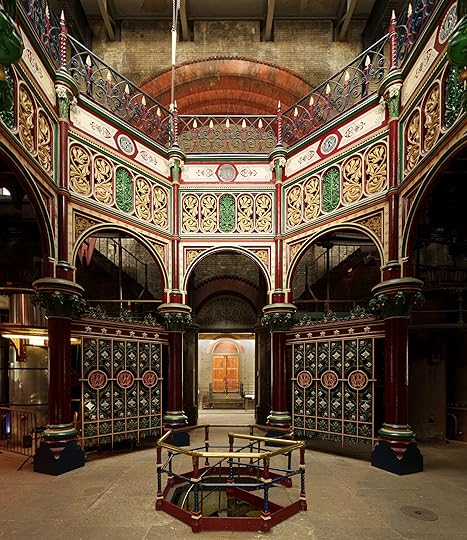
Also, in Victorian London this is what they thought a sewage pumping station should look like:
But my chief interests along these lines focus on two things: the manufacturing and logistical challenges that faced the Allies in the Second World War, especially leading up to the invasion of Normandy, and the studio system in the classic Hollywood era. It’s hard for me to imagine how D-Day did not end in utter catastrophe — I struggle to comprehend how it even got underway; and I still can’t quite believe that movies come together the way they do. Thus one of my favorite books about the Second World War is Paul Kennedy’s Engineers of Victory, and I am mesmerized by detailed accounts of the movie industry like Thomas Schatz’s The Genius of the System and David Thomson’s The Whole Equation.
Maybe my fascination has something to do with the fact that these large collaborative projects are so completely unlike what I do. I once said to a film director I know that I don’t see how movies ever get made, and he replied that in making a movie he has “so much help” from smart and skilled people — he doesn’t understand how I can just sit in a room and write books. But when I’m sitting in a room writing a book I am not accountable to or answerable to anyone else: I only have to manage Me.
By contrast, as the director Sidney Lumet explained in his riveting book Making Movies, in his work he is answerable to and dependent on a whole bunch of people:
But how much in charge am I? Is the movie un Film de Sidney Lumet? I’m dependent on weather, budget, what the leading lady had for breakfast, who the leading man is in love with. I’m dependent on the talents and idiosyncrasies, the moods and egos, the politics and personalities, of more than a hundred different people. And that’s just in the making of the movie. At this point I won’t even begin to discuss the studio, financing, distribution, marketing, and so on.
So how independent am I? Like all bosses — and on set, I’m the boss — I’m the boss only up to a point. And to me that’s what’s so exciting. I’m in charge of a community that I need desperately and that needs me just as badly. That’s where the joy lies, in the shared experience. Anyone in that community can help me or hurt me. For this reason, it’s vital to have the best creative people in each department. People who can challenge you to work at your best, not in hostility but in a search for the truth. Sure, I can pull rank if a disagreement becomes unresolvable, but that’s only as a last resort. It’s also a great relief. But the joy is in the give-and-take.
Lumet makes directing sound like the coolest job in the world — but it’s also a job I could never do. I feel that I’m a pretty good assessor of the moods and attitudes of other human beings, and that I have some skill in responding constructively to those moods and attitudes, but to have to do that all the time would absolutely wear me out.
Lumet defines his job as director in an interesting way: He’s the guy who gets to say “Print.” This is of course a term from film recording: you say “Action” when you want the camera to start rolling, you say “Cut” when you want the camera to stop recording, and you say “Print” when you think the scene you’ve just recorded is successful enough to be saved. The director might in some cases delegate “Action” and “Cut” to someone else, but “Print” is his decision and his alone. Lumet tells an illuminating story about working with an actor who was really struggling and knew he was struggling and whose confidence was therefore steadily declining. After yet another completely unacceptable take Lumet called out “Cut and Print!” He wanted the actor to think he had done a good job and that there was a usable take in the can — so that Lumet could then say That looks great, but why don’t we try it another way just to see if we like it even better? And the actor, freed from his sense of failure, did a brilliant take that Lumet really did want to print. In Lumet’s account, to be a director is to be in this mode of sensitively responding to all the people around you, with all their needs and demands, for weeks on end. I’d die.
And if making a movie poses such challenges, imagine trying to run the largest amphibious military endeavor in human history, which is what General Eisenhower had to do — and he had to do it while dealing with subordinates, most notably Patton and Montgomery, who thought they should be running the show. Montgomery in particular had absolute contempt for Eisenhower, and once, in the lead-up to Operation Market Garden, ranted so wildly at Eisenhower that almost any other commanding officer would have dismissed him on the spot. But Ike just reached out, put his hand on Montgomery’s knee, and quietly said, “Steady, Monty. You can’t speak to me that way. I’m your boss.” Given the pressure Eisenhower was under at the time, I cannot even imagine how he retained his composure under such an assault. And to his credit Montgomery immediately apologized.
(N.B.: the best brief account of the impossibly complicated Montgomery is this 1984 essay by Paul Fussell.)
So far I have only been commenting on the management of people — the most delicate of the boss’s tasks, whether on the movie set or the battlefield, but only one among a great many. Just look at this list of film-crew positions — and then imagine trying to get an army across the English Channel and landing it, with air and sea military support, with medical apparatus and personnel, with food and cooking equipment and uniforms and weaponry and ammunition and radios and jeeps and tanks and bridge-building equipment and road-grading equipment and thousands and thousands of soldiers trained to use all that stuff — and every single element must somehow be coordinated with every other element. It beggars imagination.
Especially the imagination of a guy who sits in a room and reads and writes, and then occasionally emerges from the room to talk to a few people about what he has read and written.
I have written here about war-making and movie-making because they happen to be my two chief obsessions in the realm of Big Project Accomplishment, not because they have any real connection … though perhaps in a way they do. There’s a story I’ve read in several books and articles — here for instance — some of them by reputable scholars, that seems too good to be true but may actually have happened.
When Singapore fell to the Japanese army in February of 1942, almost without resistance, The Japanese leadership felt that they would win the war very soon. The British Lion was actually a paper tiger, it seemed, and to that point the United States had offered but token resistance to the Japanese sweep through the Pacific. (Just one month later General MacArthur would abandon the Philippines.) The conquerors of Singapore decided to celebrate their victory by having a movie night, screening a couple of American films that the British had left behind. So they treated themselves to a long double feature: Disney’s Snow White and the Seven Dwarfs and Gone with the Wind. As the movies unfolded the room was filled with a mixture of great delight and dismay. The movies were astonishing: technologically and artistically they were far beyond anything Japan was then capable of. And if a nation could produce mere movies this magnificent, what resources might they possess for the fighting of a war?
The answer would come soon.
There’s an interesting coda to this story. As John W. Dower explains in his massive account of postwar Japan, Embracing Defeat, the most popular movie in Japan during the occupation was Gone with the Wind. The people of Japan strongly identified with the Southerners whose cities were burned, whose armies were defeated, whose world was occupied by their conquerors. And two lines from the movie became watchwords for the Japanese people, repeated like mantras. One was “After all, tomorrow is another day.” The other was “As God is my witness, I’ll never be hungry again.”


Alan Jacobs's Blog

- Alan Jacobs's profile
- 540 followers

