A False Defender
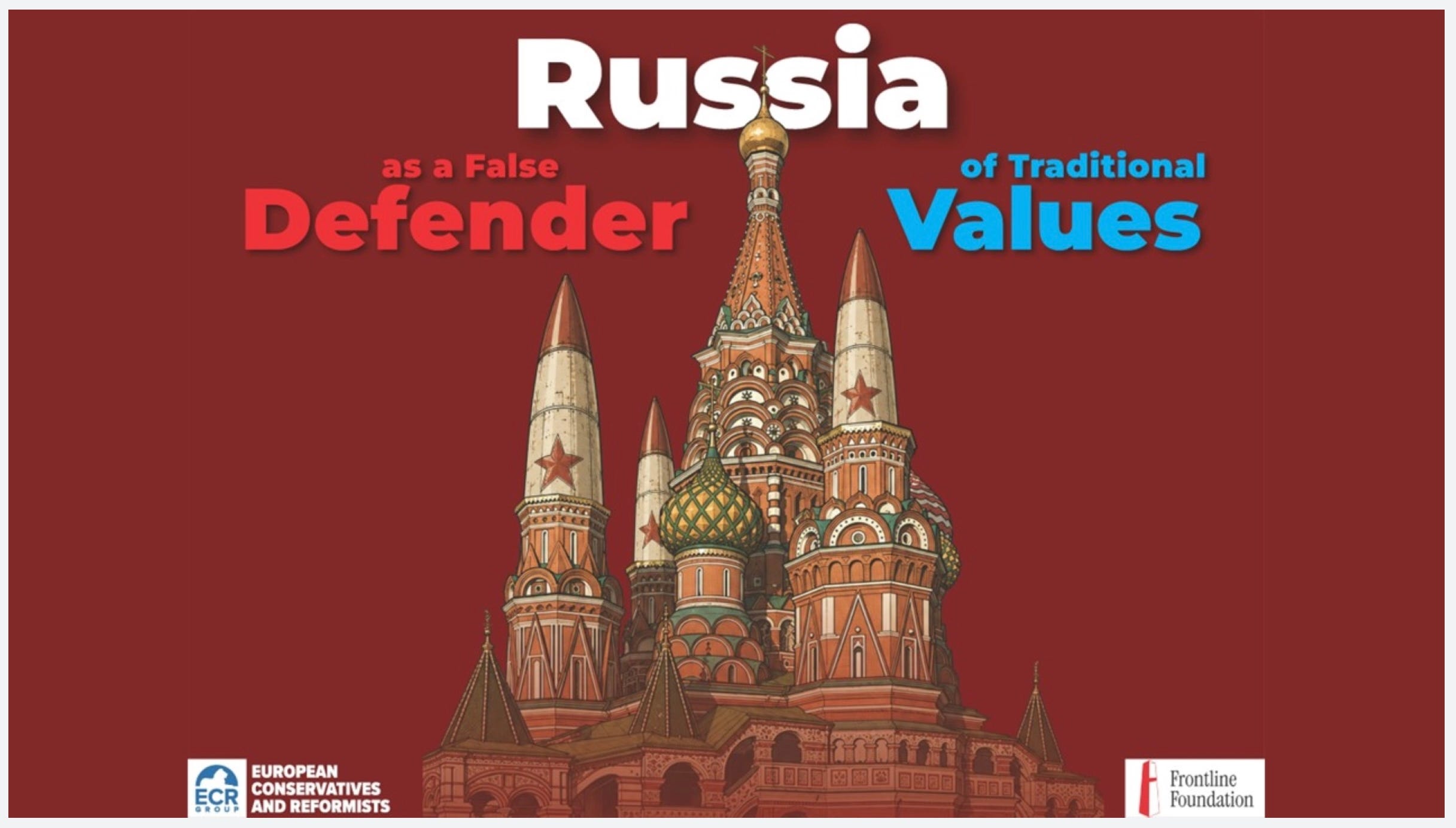
Remarks delivered today by video, in abridged form, at the conference “Russia as a False Defender of Traditional Values,” organized by the ECR Group in the European Parliament in cooperation with the Frontline Foundation (European Parliament, Brussels, 9 September 2026). The full text is published here. These remarks draw on the author’s policy paper Faith Under Pressure (Free Russia Foundation, 2026).
Good morning, America is just waking up. I’m glad to be with you, even if only on a screen.
Let me start with one word.
Picture a church in Moscow. A priest is handed a prayer, written by Patriarch Kirill. The prayer asks God to give Holy Rus’ (Putin’s Russia) victory. The priest changes one word. Instead of victory, he asks for peace. For that one word, the official Church strips him of the priesthood.
Hold on to that picture: a priest severely punished by his own Church for praying for peace. Once you see why that is not an accident, but the system working exactly as it was designed to work, you’ll understand everything I want to say.
I’m telling you this from the inside. For fifteen years I worked in the Moscow Patriarchate. In December 2015 I was fired, on Patriarch Kirill’s personal order, after a lecture at the Carnegie Center in Moscow, where I warned that Russia—both the Church and the state—was preparing to use the language of faith to justify war. People told me I was exaggerating. I wasn’t.
My fellow speakers today map Russia from the outside: the intelligence picture, the disinformation and propaganda, the networks. I come at it from a different place. I’m not a security analyst. I’m a journalist, a scholar, and a Christian, and the only side I’m on is that of the believers this system persecutes, of every confession, not only my own. Now I want to take you inside. Inside the Church that built the doctrine that pro-Moscow conservative networks are selling around the world.
This conference calls Russia a false defender of traditional values. Let me be exact about the charge. The problem isn’t that Russia defends these values badly, or insincerely. It’s that the state and the Church together have counterfeited them, and the counterfeit now gives permission to kill.
Start here. I want to argue that “traditional values” (and even the Orthodox Church itself, as others noted here today) are not decoration on a repressive state. They are embedded in the state’s operating system. And the Russian Orthodox Church isn’t a hired decorator; it’s the co-author. Kirill wrote this TV concept himself, among a few others, in the year 2000, ten years before the Kremlin found it useful. The Church didn’t join the project late. It started it, and sold it.
I’m not going to tell you that caring about family, about children, about continuity between generations, is empty. It isn’t. These are real goods; many of you feel them, and so do millions of Russians. That’s exactly why the forgery works, because you can’t counterfeit what’s worthless.
But under the war, look what that forgery becomes. A doctrine that set out to make the nation and the family holy has ended up making violence holy, and finally death itself. In September 2022, Patriarch Kirill told believers that a soldier who dies in this war does something that “washes away all sins.” He compared it, directly, to the sacrifice of Christ on the cross.
Think about what that inverts. In the Christian tradition, the martyr is a witness, holy because he would rather die than kill. Kirill’s formula makes the opposite man holy: the one who kills. The martyr is replaced by the killer. Mikhail Epstein gives it the right name: a theology of terror.
So the cult of life ends up producing a theology of dying. Russia, as the self-proclaimed defender of Christianity, ends up producing an anti-Christianity. This isn’t a stricter kind of faith. It’s a different religion, wearing Christian clothes.
Once killing becomes a value, the priest who prays for peace isn’t just an inconvenience. He’s a heretic. That’s why he loses his rank in days, and is told to leave the country within hours. Here the Church isn’t following the state. It’s running ahead of it.
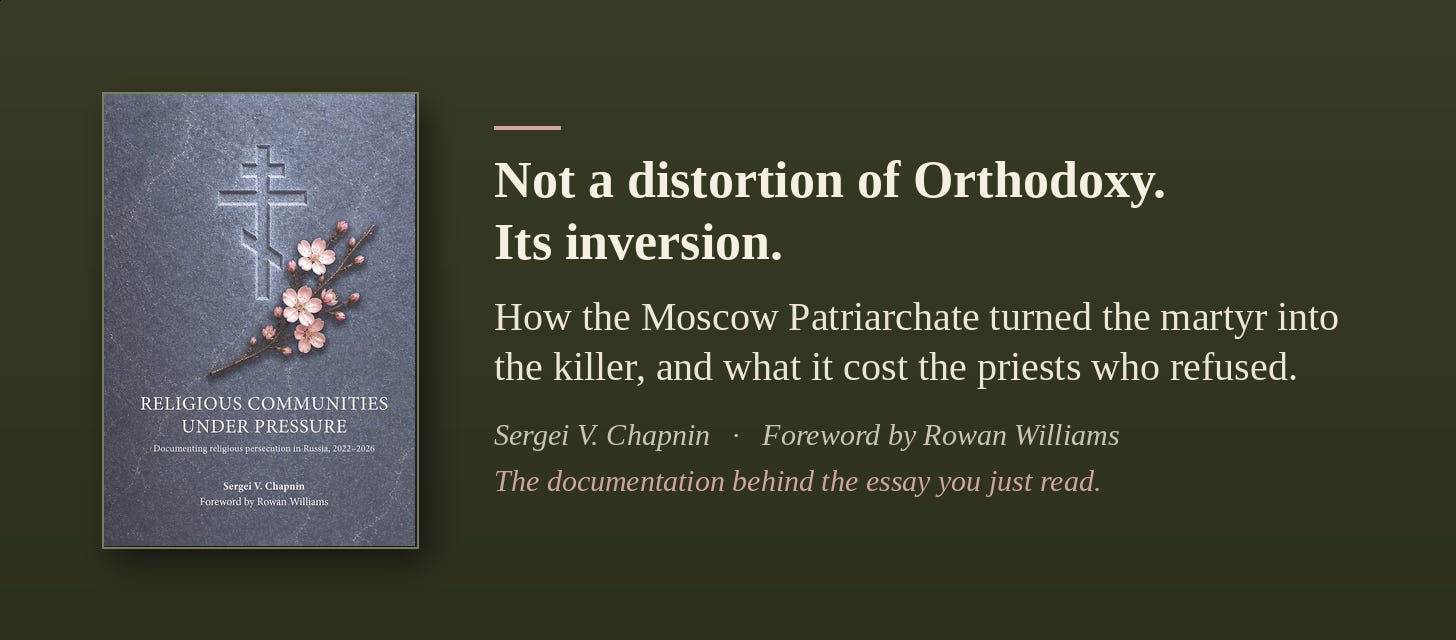
And this isn’t one priest, or one prayer. In my book Religious Communities Under Pressure: Documenting Religious Persecution in Russia, 2022–2026, I document more than a hundred cases, across more than a dozen denominations. In most of them, the state does the persecuting directly. The Orthodox case is different: here the Church punishes its own, its court often moving before the state even acts.
So why does this matter in this room? The easy question is whether Putin’s Russia is sincerely Christian, or just cynical. It’s the wrong question. The answer is neither. It’s one system: the Church supplies the moral language, and that language fuels a war of aggression abroad and repression at home. And yes, it was built for export too, to win admirers in the West, in Africa, in Asia. If you mistake it for a Christian ally, you are not its convert. You are its recruit.
And this is not only a matter of conscience. It’s a matter of your security. My fellow speakers track the delivery system; I’m describing the warhead, the meaning it carries. A doctrine that can bless a soldier’s death can split your societies, recruit your own believers, and hand a war of aggression the language of a divine mission. It’s aimed at you not with missiles, but with meaning.
And let me be clear where I stand. I’m not criticizing the tradition from the outside. George Weigel (the biographer of John Paul II, and no one’s idea of a liberal) and I have discussed these questions directly, and from our two Churches, a Catholic and an Orthodox, we reach the same conclusion. This is not East against West. It’s forgery against the Gospel.
Let me end on the hopeful note, because it’s also the practical one. Do not write off the Russian Church, and do not confuse it with Patriarch Kirill. The alternative to his doctrine isn’t Western secularism. It already exists, inside the Russian tradition itself. Inside the Church there is dissent, and there is resistance, but it has been stripped of its voice: defrocked, jailed, driven out. What Moscow casts out, Constantinople takes in. Father Alexei Uminsky (an old friend of mine, mentioned here earlier today) led the funeral service for Mikhail Gorbachev, and was defrocked for refusing the prayer for victory. He is serving today, back at the altar, in Paris; others like him are now in Turkey, in Lithuania, and in other European countries.
These are the voices to listen for: not the patriarch who blesses the war from the ambo of a golden-domed cathedral, but the priest he defrocked for saying the word peace.
A regime that had really taken Christianity to heart would have nothing to fear from a man who prays for peace. This one is afraid of him, afraid enough to destroy his life in a single day. That fear is the most honest testimony we have. It tells us which faith is real, and which one is the counterfeit.
Thank you.