The Adventures of Augie March by Saul Bellow
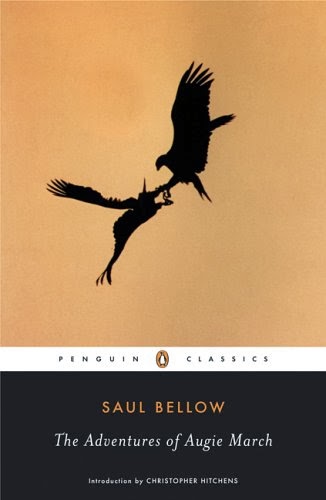 The Adventures of Augie March by Saul Bellow
My rating: 4 of 5 stars
Ever since Humboldt's Gift I've wanted to sit down with another Saul Bellow novel and The Adventures of Augie March, which won the National Book Award for fiction in 1954 when it was published, was my first choice.
This is a fairly large book, coming in at just under 600 pages. Rich in character, deep in detail, the first part of Augie was...close to being a terrible slog. Every bit-parter that enters the fray gets a long physical, historical and personality description, so much so that the details seem to obscure whatever story there is. To find that you sometimes need a magnifying glass and a Sherlockian keenness for hidden clues. I have neither.
The initial buzz from delving into another Bellow novel began to fade, as reading it felt like I was walking uphill. The only thing that kept me going was the style of the prose. I noticed that although 100 pages of very little had passed, they had done so in a serene flow. Then something wonderful happened. All of a sudden Augie's on the move, he's out of school and ducking and diving trying to scratch a dollar to take home to his beloved Mama. The landscape is set – we've had the background in minute detail – so now we can become immersed in the time and characters of depression-era Chicago. "Bellow," I bellowed, "you clever man."
Augie stumbles from situation to situation, following his nose but paying close attention to the "No" in him when folk try to exert too much influence. He knows the game of the people who employ him, and makes an art of stepping away from them before he's lost entirely in their worlds. Then the love bug strikes, and poor Augie goes down pretty hard to Thea Fenchel, the sister of a girl he fell in love with while on holiday. Determined Thea tracked him down and stakes her claim, knocking at Augie's door just as he's finished entertaining a female friend. As soon as this new flattery presents itself the friend and Chicago are forgotten; Augie leaves for steamy Mexico, where more steamy adventures await.
Augie's friends often describe him as a smiling, happy-go-lucky kind of guy without being able to work out why. He's a nice enough fellow, but he's searching for his own place in life, a distinctness he sees in others (such as brother Simon) which he cannot seem to lay hands on for himself. As he becomes older he realises the world is moving on without him, and he looks to women for some sort of foothold in reality. Between adventures he returns to Chicago like a homing pigeon, so the earlier work laid down with regards to characterisation pays off as we meet up time and again with a familiar crowd. A bit like Cheers for the 1920s.
The one thing which doesn't quite ring true is the way in which Augie, who enjoyed a patchy education at best, regularly waxes lyrical with references to historic people and places; to me it felt like the author's own education intruding on the young hero. Later on in the story Augie does play catch-up, reading as much as he can on a wide range of topics to better himself as he realises he's falling behind his peers, but the many references do hang a little heavy early on in the story. I suppose it's a small price to pay for premium language. ("You will understand, Mr Mintouchian, if I tell you that I have always tried to become what I am. But it's a frightening thing. Because what if what I am by nature isn't good enough?")
Saul Bellow's gift for examining character is always at the fore. Throughout this picaresque tale Augie's push-pull relationship with his brother Simon is under the spotlight whenever the two brothers' paths cross. The love/hate relationship with Grandma Lausch and the fate of poor, simple George are very real in detail. His concern for Mama and her failing sight is ever-present, as is his own search for the love that he feels will finally make him. This is Augie's weak spot; he is easily led by those that genuinely like him. "You can't stand up to flattery," one of his girlfriends tells him, and so it is. Augie is pushed from pillar to post without ever understanding what he wants. ("Promise you a joke, a laugh, a piece of candy, or a lick of ice-cream, and you'll leave everything and run. In short, you're a fool," his Grandma tells him.)
There are flashes of the comic brilliance to come, the scene where Augie summons up the courage to ask Thea's sister for a date being one such highlight. The dialogue is rich and colourful ("If he floated down the river with a hard-on he expected them to raise the bridges for him, that's how he was an egotist."), the angst of human relationships very real and thought-provoking. Written in the first person with a sharp-witted narrator, it's the sort of book that film could never do justice. (Although I'd be happy to write the first draft of the screenplay if the right amount of 0s were on the cheque!)
The Adventures of Augie March is beautifully written, Bellow breathes fire and failure into all of the characters, of which there are many. The words cascade down through lines and then pages, the reader glides along like a child on a well-greased sled. Prose like this is enchanting; if it were any smoother it would have to be waxed.
Although already an established writer at the time of publication, this book was Bellow's breakout novel, the one where he trusted the voice. As a reading experience Augie March is all about that voice, if you find it agreeable then you will enjoy the ramble through his many capers, and 600 pages will seem almost not long enough for Augie's adventures after all.


No comments have been added yet.