Be Careful What You Wish For by Simon Jordan
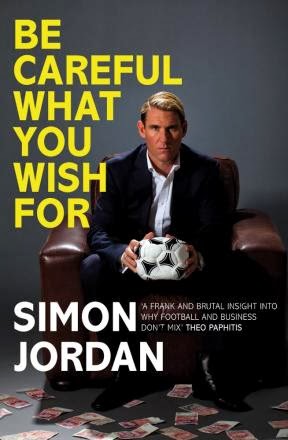 Be Careful What You Wish For by Simon Jordan
My rating: 4 of 5 stars
Simon Jordan, mobile phone king, perma-tanned, loud, silly suits. This was the image the football world was confronted with when Jordan became the youngest ever owner of a football team at the age of thirty-two. He then talked a lot, somehow mistaking the business world with how soccer worked. "Good luck with that" was the popular view at the time.
The book briefly covers the author's childhood and early business endeavours; in IT he became an expert in unplugging computer systems he ought not to unplug. From there he moved/was pushed into mobile phone sales, eventually setting up in business with a friend and striking it rich. When he sold the business he instantly became a multi-millionaire. This should be a happily-ever-after story, but Jordan decided to plough his riches into a new venture, the ownership of his boyhood club in south London, Crystal Palace. This was a dream deal for Jordan, but he soon realised business mixed with football is more like a nightmare.
Brash and outspoken, he didn't mind upsetting a few of the incumbents. Here he doesn't mind dropping a few names and listing the trappings of his good fortune, but he doesn't come across as a particularly flash personality. Of course he spends a lot of money, but who wouldn't if they had the best part of £40 million in the bank?
With regards to the football world Jordan misses no targets. He doesn't care for many of the pampered players (Neil Ruddock and Jamie Pollock get special mentions), other chairmen (Brum, Wigan, Charlton, etc.), rival supporters ("Simon Jordan, what a w**ker!") or even Wayne Routledge's mum(!); and he doesn't mind telling you. Somehow even Sir Nick Faldo gets a put-down. He finds himself at odds with the footballing wisdom "That's how we do it in football" and his problems spiral from there.
A genuine fan (he attended 490 of the 500 games during his tenure) the passion he has for the club often shines through. Jordan obviously struggled to understand the mentality of the managers he employed, finding them to be as interested in money as they should have been in success on the pitch. Even Iain Dowie, who won promotion with Palace, is taken to court after he moves to Charlton, Jordan proving that he was not an owner to be messed with. Neil Warnock, subsequently a hit at QPR, was too little too late at CPFC, although the book insinuates there was light at the end of the Championship tunnel when Jordan brought him in.
The author is candid about his own mistakes, he did almost no research into a lot of the players he was asked to buy, spending millions of pounds in the process. Panic buying was a standard practice. Certainly not a blueprint for success in any proper business. Jordan also has the grace to admit he outstayed his welcome at Palace, he describes a moment in 2009 when he knew that he ought to place the club into administration but couldn't bring himself to do it. By the time a creditor did it for him he was nearly £40 million out of pocket and suffering severe financial cramps brought on by the global recession. It's grim reading for anyone who's been in business and caught in a similar trap. In sports, if the heart is in charge of the money then the money won't be around too much longer, and so it proved for Simon Jordan.
Jordan claims to have written every word, which is probably true as the book is very much a personal viewpoint. There are a few too many exclamation marks used in unexpected places, particularly near the end as it all goes Pete Tong, but that's a sign of exuberance. My only real gripe is that I wished Jordan had finished the book with more details of the aftermath; we're left wondering how badly damaged he really was financially and what the psychological ramifications were, although perhaps the wounds from the experience are still too raw to be explored on the page.
An enjoyable read, certainly not just for Palace fans. 'Cash flow is king' is not a business lesson Jordan should have needed to learn, but he knows he was the architect of his own downfall. When put into administration the immediate debt was only around ten percent of the value of the playing squad, meaning that Jordan lost control of Palace because of poor administration as much as anything else. It must sting to admit that, but admit it he does, describing the loan agreement he signed which brought about his downfall as "...my own death warrant."
I was intrigued to read Simon Jordan's version of events as he'd been so outspoken when he was within the game. During his appearances on Sky TV I'd found myself agreeing with a lot of his views, so I enjoyed this insight into the wacky world of football. It's not a great advert for British football or its people, nor does Jordan cover himself in glory given the amount of errors he admits to. It's said that conflict makes for entertainment, this is a tale which reinforces the aphorism.


No comments have been added yet.