The Irrepressible Conflict: 2015
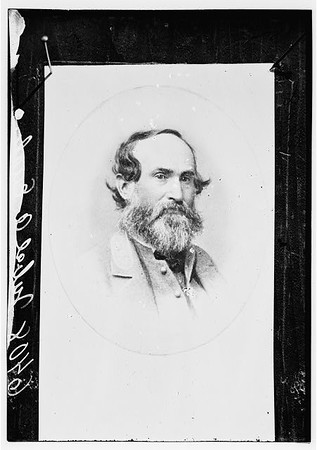
Confederate Lnt.-Gen. Jubal Early, pre-war moderate/post-war zealot. (Courtesy: Library of Congress)
On the military side of my novel Lucifer's Drum, Lnt.-Gen. Jubal Anderson Early (1816-1894) stands center stage. His thrust against Washington, D.C. in the summer of 1864 gave the North a bad scare, and so gives the novel much of its tension. Before and during the war, Early typified an outlook that the war ended up burying—one that prized loyalty to state over national loyalty. It was a feeling and a concept steeped in the past—several steps beyond tribes, a step or two beyond city-states, but well short of full-blown nationalism. Early's chauvinistic love for his home state of Virginia led him to join the Confederate forces. He never missed a chance to extoll Virginia, sometimes at the expense of other states under the Confederate banner—and to the exasperation of fellow officers from those states. Still, for professional military men, birthplace did not necessarily determine which side they chose.
Following the War of 1812, continued reliance on state militias seemed a lousy idea, given that war's many battlefield humiliations for the U.S. Resources were committed to upgrading the Military Academy at West Point and to building a truly national army. This enabled a devastating U.S. victory in the 1846-47 war with Mexico. On the eve of the Civil War, however, the standing army numbered only 16,000—but within its ranks, an identification with country over state or region was inevitably fostered. It may not have prevented Early, Robert E. Lee and 60% of their fellow Virginians from going South, but there was still that 40% who went the other way. Prominent among them was Union General George "Pap" Thomas, one of the ablest leaders of the conflict, who saved the Union position at Chickamauga and shattered John Bell Hood's Confederate force at Nashville. In November, 1863, following the Northern victory at Chattanooga, Thomas ordered a new cemetery laid out for his dead. Asked whether he wanted them buried according to state, the general famously replied, "No—mix 'em up. I'm sick of states' rights." Thomas stood for this dawning nationalist perspective, just as Early stood for his obsolete state-centered one. The two men were fellow Virginians and contemporaries but really signified different eras, an outgoing and an incoming. Ken Burns, in his monumental The Civil War series, observed how the war transformed the country in people's minds from a plural to a singular—from "the United States are" to "the United States is." In that linguistic shift, you hear a new worldview swallowing an old one—something that happens all the time in history, though seldom so suddenly or violently.
In the pre-war years, Jubal Early was no fanatic. As Franklin County prosecutor, he was named delegate to the state convention that had been called to decide on secession, which he opposed until very late in the crisis. He showed little patience for the rabid pro-slavery element. As an attorney ten years earlier, in 1851, he had successfully represented an ex-slave woman named Indiana Choice. (Choice had been freed by her widowed mistress, whose second husband later tried to negate the manumission.) But the war left Early bitter and recalcitrant. Following exile in Canada, he returned to Virginia and resumed his law practice. The mid-1870’s found him virulently white-supremacist, refusing to participate in any commemorative ceremony that included black veterans. In word and in writing, he also did much to promote the cult of Robert E. Lee, which raised that great, now-deceased general to godlike status (much as the cult of Lincoln did for that greatest, most mysterious of Presidents.) Early never married, though he sired four children by Julia McNealey of Rocky Mount, VA. Disdaining the loyalty oath, he died “unreconstructed” in 1894, aged 77.
{A postscript on "Pap" Thomas: During Reconstruction, he commanded occupying troops in the South, often deploying them to defend black communities against the Klan. He also set up military commissions to enforce labor contracts with black citizens, circumventing the bigoted local courts. When he died of a stroke in 1870, aged 53, his Virginia relatives all boycotted the funeral. For his allegiance to the Union and his effectiveness against Southern arms, he had long been dead to them.}
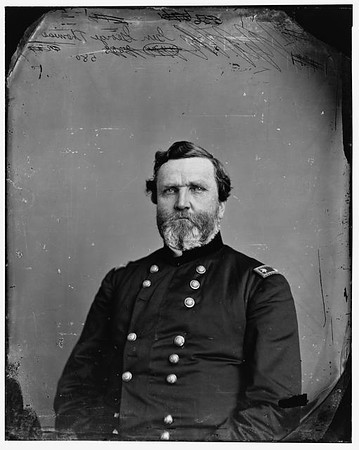
Union Maj.-Gen. George "Pap" Thomas, an American
first and a Virginian second. (Courtesy: Library of Congress)
**************************************************************************
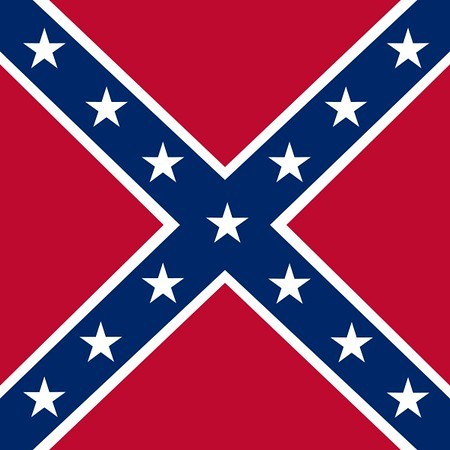
And friends—at this time, like none other, taking on the subject of Jubal Early is like drinking from a firehose. Because wartime Early leads to post-war Early, which leads to white supremacy and Jim Crow. Which leads to desegregation and the Confederate Battle Flag. Which leads to now. How many times has it been said that the Civil War is still being fought, 150 years on? And how much more pertinent could that thought be, with the AME Church in Charleston, SC now hallowed by the blood of the Nine, killed by one who sported the Confederate flag as a purely white-supremacist symbol? And with growing calls for South Carolina—the first state of the Confederacy, the war's Ground Zero—to take down said flag at its State House? And for other Southern states to do likewise? And with debate intensifying over any number of Confederate memorials? For obvious historical reasons, Lucifer's Drum bears on its cover the flag in question. It fits there. But should it be endorsed and flown by any state government? The answer cuts right to the heart of this war that—in spirit, and therefore in fact—we are still fighting.
It is hard to think of another instance where a war's losing side has been given such latitude in the writing (and re-writing) of that war's history. In the years after Appomattox and the aborted Reconstruction, the North had a considerable interest in mollifying its former enemy, recognizing that to further fuel the South's hatred would cause no end of trouble—spasmodic violence, bitter obstruction, further exhaustion. Sentimentality was invoked to cover the nation's raw scars, as in memorial pictures that showed Union and Confederate veterans shaking hands. Slavery's collapse and the emancipation of four million people—the war's biggest consequence, the sorest point for the South—was systematically de-emphasized in favor of Reconciliation, a simple Union vs. Disunion theme. But the violence, the obstruction and the exhaustion came anyway.
Attacks on black voting rights went largely unanswered. Jim Crow laws took root and would get no serious challenge for eighty years. Lynchings spiked and spiked again. Confederate monuments were erected throughout the South, not just to honor brave men but, even more, to frame the Southern cause as a straight-up defense of home and freedom. (In the lovely Oxford, MS town square stands one with the inscription, "To Those Who Died In A Just And Holy Cause.") In 1915, D.W. Griffith's masterful pro-Klan/pro-Confederate fantasy The Birth Of A Nation was honored with a screening at the White House. The film, with the apparent endorsement of Southern-born-and-raised President Woodrow Wilson, stirred anti-black violence across the country and caused a surge in Klan recruitment. (Around this same time, Wilson was busy re-segregating federal buildings and the federal civil service, which had been integrated since the 1880's. He remains to me the template for the Cerebral Racist, a variety that has arguably done more harm than any number of burning crosses—the kind that smiles down benevolently at an oppressed ethnic group and says, in effect, "Let me tell you all about yourself.")
Since the Civil Rights Movement of the 1960's, a mountain of scholarship has placed slavery—and the contributions of black Union soldiers—back at the center of Civil War history, while at the same time cultivating a nuanced, non-glorifying view of the North. The heirs to states'-rights doctrine have not taken this lying down. On the contrary, they have made a concerted effort to obfuscate slavery as the central cause and to sanitize the past. School textbooks have long been a vital part of this battlefield. In Virginia in 2010, a newly published fourth-grade history textbook described massive black enlistment in the Confederate forces, including two battalions that supposedly fought under Stonewall Jackson. But all this happened only in the fevered imaginations of neo-Confederates. Trained historians—of whom the author of this book was not one—fortunately decried the fabrication and had the passage struck. That same year, the conservative-dominated and nationally influential Texas Board of Education endorsed the idea that states' rights, not slavery, should be taught as the war's primary issue. In April of that year, at the request of the Sons Of Confederate Veterans, Virginia Governor Bob McDonnell resurrected Confederate History Month by proclamation, omitting any mention of slavery as a root cause for the war. A national protest caused the governor to back down on this point and make a statement condemning the Peculiar Institution. At that same time, however, Mississippi Governor Haley Barbour declared Confederate Heritage Month ("Heritage"—such a comfy term compared to "History," which so often proves dark, slippery and nervous-making.) Barbour defended McDonnell and stood by his own silence on slavery as a root cause: We all know it was bad, so why bring it up?
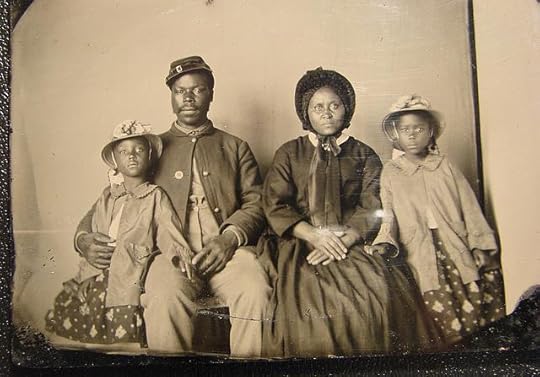
Sgt. Samuel Smith of the 119th USCT (United States Colored Troops) and family.
(Courtesy: Library of Congress)
Of those white Southerners who deny or downplay the connection between slavery and the Civil War, I think a majority do so mainly out of an understandable defensiveness. Defensiveness not just against hard-to-swallow historical fact, but against Northern snobbery on the subject. And as a Northern transplant, I can confirm that this snobbery persists—flattering those who indulge in it, while projecting responsibility for American racial ills ever southward. Vanity and easy judgment always seem to go together. Up North, Southern transplants routinely squeeze the Dixie accent out of themselves, just to deflect the pompous, soul-killing assumptions of Northern strangers. And I recall one particular Yankee megabrain bragging to me about snubbing an airplane seat-mate because she was from North Carolina. There were many terms to describe this action of hers, none of them nice, and maybe I should have offered her a few of them. But I swear, I was just too gob-smacked to speak.
Going farther: the most vicious, unabashed racial invective I have ever heard from whites I heard up North. It's instructive to recall that the most intense hatred that Martin Luther King said he ever encountered was not in Alabama or Mississippi but in Chicago, when he marched for housing rights; also, that slaves had a major role in building that great Northern economic engine, New York City; also, that at the Ku Klux Klan's peak in the 1920's, it boasted claverns from Maine to Washington State (where a highway was named for Jefferson Davis) and was most powerful of all in Indiana, where maybe 30% of white male residents wore the hood. Nearly 40,000 Klansmen lived in Detroit alone.
That said, the portrayal of "states' rights" as the war's main point has always left a gaping question: What state right are we talking about? Which one was perceived as being under threat? The right of who to do what—and to whom? Another question pretty much flushes it out: What was it about Abraham Lincoln that triggered secession? The well-documented answer: not that he proposed to abolish slavery, but that he opposed its expansion. That and not any plausible threat of Emancipation was enough to make eleven states secede and launch four years of slaughter. True it might be that most Confederate soldiers owned no slaves (about one in ten—they were young, after all, and didn't own much of anything; for white Southern households, though, the figure was nearly one in three) and fought primarily "because ya'll are down here." But little guys only fight wars, they don't start them. For starting them, credit nearly always goes to wealthy non-combatants—those who effectively dress up their material interests as "custom" or "tradition," as chivalric honor or regional pride.
Some demonstrably noble men fought for the Confederacy. On the subject of race, a few of them were even several clicks ahead of the average Caucasian, North or South. One of them was surely Major-General William Mahone, whose counter-attacks at the Battle of the Crater inflicted a heavy federal defeat and killed a lot of Union boys, many of them black. In the early 1880's, however, he formed the Readjuster Party in Virginia, a bi-racial coalition of liberal Republicans and Democrats, meant to reduce the state's crushing debt but also to oppose the white planter elite. It advocated public funding for both black and white schools and an end to the poll tax. Though he was elected Senator, Mahone's party enjoyed only a few years' success before the forces of white supremacy crushed it. And there was Major-General Pat Cleburne, "The Stonewall Of The West," about whom I have written previously: (https://www.goodreads.com/author_blog...). Observing the South's dire manpower shortage and admiring the performance of black Union troops, Cleburne proposed that male slaves be freed in exchange for their enlistment in the Confederate cause. Irish-born and a relative outsider, Cleburne had never realized how intertwined that cause was with slavery and with white-supremacist doctrine—which is why his proposal met with awkward silence and complete inaction. No argument and no arithmetic concerning manpower could overcome the narcotic of racial hegemony.
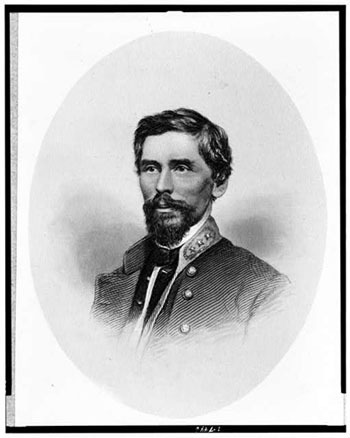
Maj.-Gen. Pat Cleburne, out of step with
his fellow Confederates on the subject of
slavery. (Courtesy: Library of Congress)
Recently I was perusing a friend's book of family history and came upon this entry: "Captain Thomas Ebenezer Cummings was killed on Sept. 11, 1864 in the battle of Jonesboro near Atlanta, Georgia, after fighting three years for states' rights, not for slavery." It made me recall a bumper-sticker I saw a decade ago, bearing the image of the battle flag: "Sons of Confederate Veterans Against Racism." There is real poignance to this belief, no doubt utterly sincere—that a man's motivating fire can be kept separate from the general conflagration, and that his descendants can point to it as if this were all that mattered. Still, if the South's cause was based just on lofty notions of self-rule, it must be asked . . .
Why did South Carolina's statement of secession—the very first—complain that the North had "denounced as sinful the institution of slavery" and "encouraged and assisted thousands of our slaves to leave their homes?" Why did it blast Lincoln as someone "whose opinions and purposes are hostile to slavery?" And why did Mississippi's statement of secession declare, "Our position is thoroughly identified with the institution of slavery—the greatest material interest in the world?" And why did Texas's statement of secession target the very notion of racial equality, blowing hard about the North's "unnatural feeling of hostility to these Southern States and their beneficent and patriarchal system of African slavery, proclaiming the debasing doctrine of equality of all men, irrespective of race or color—a doctrine at war with nature, in opposition to the experience of mankind, and in violation of the plainest revelations of Divine Law?"
Why in his infamous "Cornerstone Speech" did Confederate Vice-President Alexander Stephens feel it necessary to affirm "the great truth that the negro is not the equal of the white man; that slavery—subordination to the superior race—is his natural and normal condition"—and to declare his government "the first, in the history of the world, based on this great physical, philosophical, and moral truth?" And why, in the post-war years, were prominent ex-Confederates like Jubal Early so bent on imposing Jim Crow laws, meant to approximate black slavery as closely as possible? Thus there should be no wonder at all why the Confederate Battle Flag enjoyed a resurgence in the late 1950's-early 60's, when resistance to the Civil Rights Movement had it flying all across the South, including the grounds and domes of state houses—or that before hometown crowds, segregationist politicians liked nothing more than to invoke their Rebel forebears.
Nothing is more subjective than a cultural symbol, flags in particular. That is why we'd never expect a Nicaraguan to feel the same swell of emotion that an American does before the Stars 'n' Stripes, or a Pakistani to feel as an Englishman does before the Union Jack. Emotions are fully real to whoever is feeling them; they are not subject to rational justification. But when you choose to fly a flag—or build a monument, or name a park, or name a school, or design a license plate—you are publicly honoring whatever it represents. You are implying that the whole community should do likewise, if only by acquiescence. And that is when something more than sentiment is required. That is when you need a factual basis that justifies the honor.
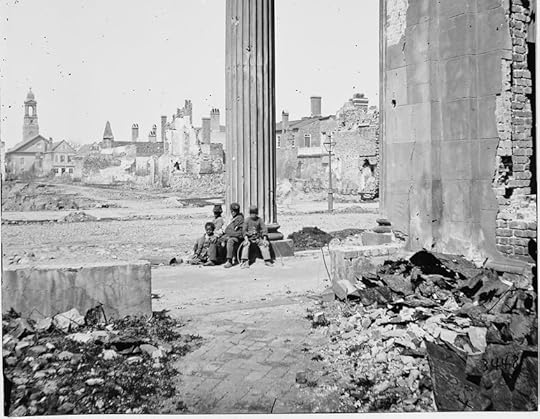
Children in the ruins of Charleston, SC, 1865. (Courtesy: Library of Congress)
For many white Southerners, the Confederate flag conjures proud defiance and the image of a magnificent gray army. Well, that's factual enough—the South was proudly defiant, its army one of the greatest in world history. Over the decades, along with dyed-in-the-wool racists, plenty of people have displayed the emblem without nasty intent—for nothing more specific than that prideful jolt, or a poke in the North's judging eye (think Lynyrd Skynyrd). It's when we go deeper and wider that the trouble starts. There are tons more quotes like the ones I gave above, each of them reinforcing a bedrock truth: slavery and white supremacy were central to the Confederacy's aims, the main reasons for its birth. Its banners were soaked in a poison wellspring. The battle flag did not "come to stand for racism" in recent times, as some in the media have suggested, but stood for it from the get-go—whatever benign meanings were projected onto it later. Long-term unawareness of this requires a truly impressive degree of denial and avoidance.
The Klan and the neo-Nazis require no such denial and avoidance. They embrace the flag's historically based meaning and wave it all the time—it represents their whole program, after all. They are tapped into its dark essence, as is the Charleston shooter, as are the toxic websites that inspired him. In the wake of the massacre, defenders of the flag complained that the murderer had "misused" or "hijacked" it. Far more accurate it would be to say he blew the cover on it, tore wide open a sentimental falsehood. Whenever the flag is hoisted over some state house—that is when it's being misused.
"Political correctness" has long been the right's go-to explanation for anything it doesn't like, a rubber stamp for easy dismissal. In lefty enclaves, PC culture does exist with its simplistic assumptions, its censoring reflex and attendant smugness. (I think every college freshman orientation should include discourse on the First Amendment and its historical relevance.) But the right has its own, better-funded and more conspicuous brand of PC—whole sets of received wisdom, zealously guarded—of which spotless Southern triumphalism is just one aspect. When a government endorses a flag with this kind of documented historical baggage, it promotes that baggage, whether or not it denies the existence of same. How welcome and respected is a black resident supposed to feel, with his/her home state's government so visibly celebrating an epic pro-slavery enterprise? "It's complicated," you often hear—and if they're talking about the whole tragic saga with its social mosaic, political cross-currents and personalities, it sure is. The South itself is complicated—downright byzantine, in ways that are both endearing and exasperating. But there's nothing complicated about what should be done here. That part is pretty straightforward.
As for private citizens who keep flying the battle flag—yes, that's free speech, no way around it. But it's telling that it has become less and less common, no longer mainstream. To be born white in the modern South is, for a great many, to be born up to your eyeballs in black culture, with black friends and acquaintances never far. Some awareness of their feelings and perspectives is bound to seep through eventually, and often has. And sometimes that awareness reaches a tipping point, as I believe it did in 2001, when Georgia voters erased the Confederate emblem from their state flag. Or just two weeks ago, when the State of Alabama quietly ran it down the pole and stashed it away.
Whatever the case, 2015 finds us way past the point where the flag can be plausibly defended. Anyone who chooses to display it should not be (or act) surprised—and above all, should not act somehow persecuted—when fellow Americans of all races react against it, white Southerners included. They will do so from solid historical fact, something that no amount of fabrication and propaganda can ever bury. Apart from the memory of the Charleston Nine and apart from the Declaration of Independence, if there is just one thing we can focus on to guide us, I would suggest that Alexander Stephens quote about the Confederacy's founding truths, so self-evident to him: "the negro is not the equal of the white man; slavery—subordination to the superior race—is his natural and normal condition." Let that one echo, and the whole flag issue will be an easy call.


date newest »
newest »
message 1:
by
Patti
(new)
Jul 10, 2015 06:43AM
 You and your knowledge and good, good sense continue to amaze me. Thank you for this - all of this!
reply
|
flag
 Nice, quite eloquent in arguing against use of the Confederate Flag.