
Discover new books on Goodreads
Meet your next favorite book


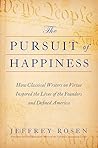


“Today, of course, the idea that new media technologies might be deployed by an enlightened class of literati to calm and refine public opinion seems quaint. In an age of social media, the opposite dynamic occurs, as journalists, scholars, and public officials pander to the most extreme and passionate voices on social media rather than slowly diffuse reason across the land. Madison believed the print media should promote cool deliberation; the social media model is “enrage to engage.” At the same time, new media are undermining the speed bumps of time and space that Madison thought would make it difficult for mobs to mobilize and act impulsively. The passions, hyper-partisanship, and split-second decision-making that Madison and Hamilton feared from large, concentrated groups meeting face-to-face have proved to be even more dangerous from exponentially larger, dispersed groups that meet online.”
― The Pursuit of Happiness: How Classical Writers on Virtue Inspired the Lives of the Founders and Defined America
― The Pursuit of Happiness: How Classical Writers on Virtue Inspired the Lives of the Founders and Defined America
“Madison followed Condorcet in expressing faith that a class of enlightened journalists and public officials, whom he, too, called the literati, could serve as “cultivators of the human mind,” using the new media to teach the public how to pursue happiness through reason rather than passion. As Madison put it in a crucial passage: “The class of literati is not less necessary than any other. They are the cultivators of the human mind—the manufacturers of useful knowledge—the agents of the commerce of ideas—the censors of public manners—the teachers of the arts of life and the means of happiness.”68 When he wrote about the literati, Madison had in mind elite journalists such as Benjamin Franklin’s Poor Richard or his own essays in The Federalist; the modern equivalent would be essays in the Atlantic or the New Yorker. Madison was confident that the literati could teach the public to converge around shared principles—such as a national attachment to republicanism, the Constitution, and the Bill of Rights—rather than descending into “prejudices, local, political, and occupational, that may prevent or disturb a general coalition of sentiments.”
― The Pursuit of Happiness: How Classical Writers on Virtue Inspired the Lives of the Founders and Defined America
― The Pursuit of Happiness: How Classical Writers on Virtue Inspired the Lives of the Founders and Defined America

Bill’s 2025 Year in Books
Take a look at Bill’s Year in Books, including some fun facts about their reading.

426 books
|
99 friends

43 books
|
8 friends

637 books
|
103 friends

497 books
|
5 friends

912 books
|
21 friends

221 books
|
65 friends

720 books
|
74 friends

14 books
|
108 friends
More friends…
Polls voted on by Bill
Lists liked by Bill