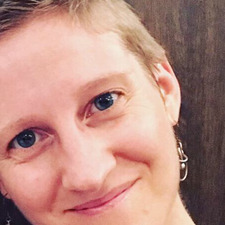
Tricia Friedman

Add friend
Sign in to Goodreads to learn more about Tricia.


Book cover for The Uninhabitable Earth: Life After Warming
In fact, more than half of the carbon exhaled into the atmosphere by the burning of fossil fuels has been emitted in just the past three decades. Which means we have done as much damage to the fate of the planet and its ability to sustain ...more
Loading...
Robin DiAngelo
“Scholar Marilyn Frye uses the metaphor of a birdcage to describe the interlocking forces of oppression.16 If you stand close to a birdcage and press your face against the wires, your perception of the bars will disappear and you will have an almost unobstructed view of the bird. If you turn your head to examine one wire of the cage closely, you will not be able to see the other wires. If your understanding of the cage is based on this myopic view, you may not understand why the bird doesn’t just go around the single wire and fly away. You might even assume that the bird liked or chose its place in the cage. But if you stepped back and took a wider view, you would begin to see that the wires come together in an interlocking pattern—a pattern that works to hold the bird firmly in place. It now becomes clear that a network of systematically related barriers surrounds the bird. Taken individually, none of these barriers would be that difficult for the bird to get around, but because they interlock with each other, they thoroughly restrict the bird. While some birds may escape from the cage, most will not. And certainly those that do escape will have to navigate many barriers that birds outside the cage do not.”
Robin DiAngelo, White Fragility: Why It's So Hard for White People to Talk About Racism

Rebecca Solnit
“Asked how decades of studying disaster had influenced her political beliefs, Tierney responded, “It has made me far more interested in people’s own capacity for self-organizing and for improvising. You come to realize that people often do best when they’re not following a script or a score but when they’re improvising and coming up with new riffs, and I see this tremendous creativity in disaster responses both on the part of community residents and on the part of good emergency personnel—seeing them become more flexible, seeing them break rules, seeing them use their ingenuity in the moment to help restore the community and to protect life, human life, and care for victims. It is when people deviate from the script that exciting things happen.”
Rebecca Solnit, A Paradise Built in Hell: The Extraordinary Communities That Arise in Disaster

Gena Cox
“Listen and analyze. You may be champing at the bit and your first instinct might be to implement implicit bias training, to educate about diversity, and to make enterprise-wide proclamations. Avoid this approach. After your initial communications and support, look at data that can inform your subsequent actions. That data will come primarily from the listening sessions, focus groups, surveys, and your human resources information system. Your employees will respond more positively if your actions are driven by data and insights that align with their experiences.”
Gena Cox, Leading Inclusion: Drive Change Your Employees Can See and Feel

Jenny Odell
“As Gordon Hempton, an acoustic ecologist who records natural soundscapes, put it: “Silence is not the absence of something but the presence of everything.”23 Unfortunately, our constant engagement with the attention economy means that this is something many of us (myself included) may have to relearn. Even with the problem of the filter bubble aside, the platforms that we use to communicate with each other do not encourage listening. Instead they reward shouting and oversimple reaction: of having a “take” after having read a single headline.”
Jenny Odell, How to Do Nothing: Resisting the Attention Economy

Pema Chödrön
“Is this feeling permanent?” “Is it transient?” “Is it solid?” “Is it fluid?” “Is it fixed?” “Is it dynamic?” “Is it finite or infinite?” You can also ask: “Is this feeling me?” “Is it not me?” “Is it an obstacle?” “Is it a portal?” Or you can touch the feeling, completely free of storyline, and say, “When experienced directly, this very feeling is basic goodness,” or “Basic goodness is found right here.” In other words, you don’t have to wait until the feeling is gone to find basic goodness.”
Pema Chödrön, Welcoming the Unwelcome: Wholehearted Living in a Brokenhearted World

166430 #EagleEd — 11 members — last activity Jun 02, 2016 07:45AM
For the ISZL Eagle Readers
170468 TEN 15-16 — 17 members — last activity Oct 29, 2015 06:46AM
This is where we will celebrate our reading endeavors for the year.
25x33 8-2 ENG 2014 — 22 members — last activity Apr 18, 2015 09:18PM
Grade 8 English Class Reading Group
170765 Grade 9 ISZL With Ms. Friedman — 28 members — last activity Aug 24, 2015 01:46AM

This is where we will meet to chat all things books!
25x33 #langNlit — 1 member — last activity Nov 24, 2015 11:29PM
Logging our Paper 2 notes
More of Tricia’s groups…
year in books
Book Ri...
1,823 books | 6,318 friends

Penguin...
894 books | 4,959 friends

fathero...
2,006 books | 4,259 friends

Shannon
1,699 books | 78 friends

Susanne...
1,896 books | 93 friends

Christa
663 books | 101 friends

James D...
1,140 books | 21 friends

Mrsrais...
1,688 books | 50 friends

More friends…


Polls voted on by Tricia

Lists liked by Tricia