Pamelia Chia's Blog
October 22, 2026
laksa lemak
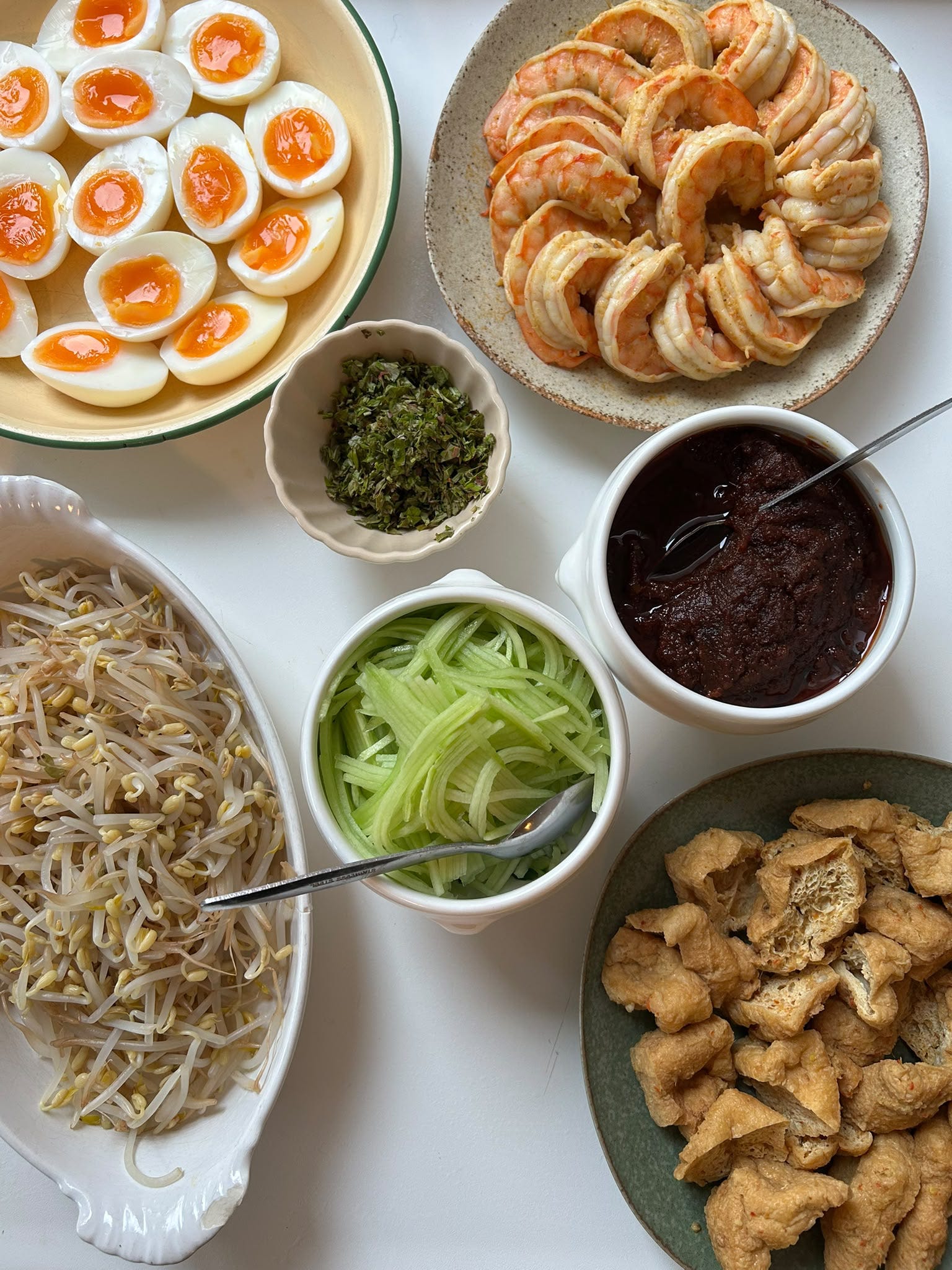
Laksa is one of those iconic dishes that has become synonymous with Singapore and our hawker culture, but it does require quite a bit effort so I never really cook it at home. Recently, though, our Japanese friends asked if I could make it for them because they had it once many years ago and have missed it since.
There is, of course, not just one type of laksa — it exists in multiple incarnations throughout the Malay Peninsula, and just in Singapore, we have a few variants, such as laksa siglap, katong laksa, assam laksa, and so on. The one that I assumed they were craving for is laksa lemak, the variant known for its coconut milk-enriched gravy. Even though it resembles curry in appearance, the main difference lies in its texture, as suggested by its name which means “spicy sand” in the Hokkien dialect. The mouthfeel comes from ground dried shrimp, which also reinforces the flavour of prawns in the broth.
What makes a good laksa? The most memorable bowl for me was from my church’s canteen. It was so good that I had it every Sunday for lunch. It had a masterful depth of flavour from prawn stock and liberal use of dried shrimp, fragrance from a homemade rempah (spice paste), and richness from coconut milk, yet was light enough for me to drain the bowl each time.
The heart and soul of laksa comes from homemade prawn broth. It’s important to get head- and shell-on prawns for this reason. I always get mine frozen, from the Asian grocer. Compared to other types of stock, prawn broth takes considerably less time. You remove the shells and heads from the prawns, stir-fry them in oil to tease out as much umami as possible, then add water to deglaze the pan. Bring it to a rolling boil before simmering for an hour.
When preparing a multi-component dish like laksa at home, it helps to make the rempah in advance. I use my multipurpose rempah (which I keep in my freezer) and this has the standard ingredients of fresh chillies, dried chillies, red onions/ shallots, turmeric, lemongrass, garlic, and galangal. For laksa lemak, a few additional aromatics are required: the aforementioned dried shrimp, belacan (fermented shrimp paste), and freshly toasted coriander seeds. As for coconut milk, I know some cooks who swear by using only fresh coconut milk but I’m happy enough with Kara coconut cream / milk.
The traditional noodle used in laksa is fresh thick rice vermicelli (thick beehoon) but in a pinch, you could use other types of fresh rice noodles, such as silver pin noodles (bee tai mak). I used thin horfun from the Asian grocer, because that was the only rice noodle option in the refrigerated aisle. If there are no fresh options available to you, you could go for dried beehoon.
Common toppings for laksa include hard-boiled eggs, finely chopped laksa leaves (Vietnamese mint), taupok (deep-fried tofu puffs), cockles, and fish cakes. I see the last two as optional, though some may disagree. While beansprouts and cucumber are less commonly seen in hawker versions of the dish, I add them so that it’s a balanced meal and I don’t have to prepare a separate vegetable dish to accompany the laksa.
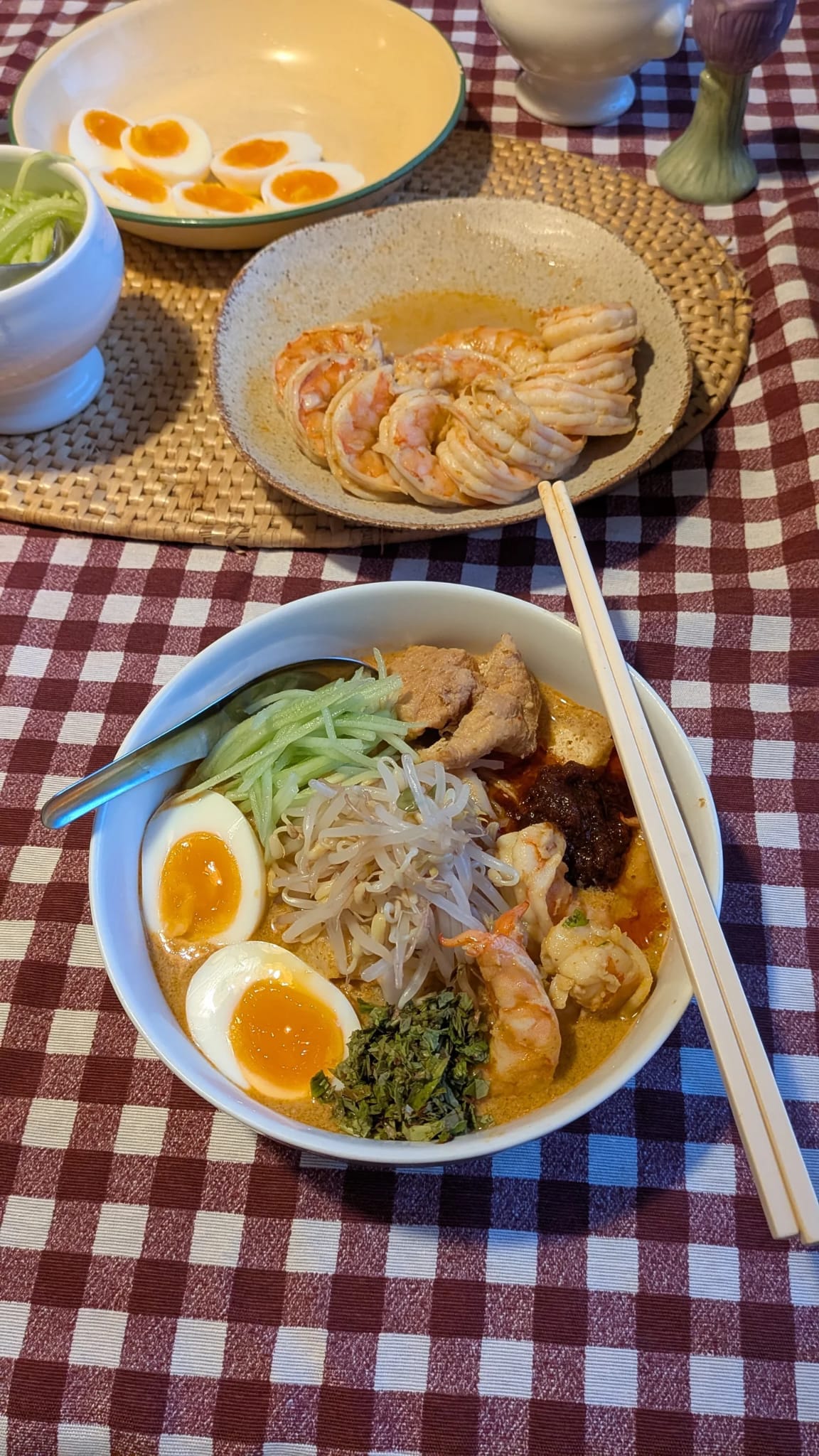
Laksa
Serves 4


October 15, 2026
a few things i’ve been cooking lately
The weather’s turning cold in the Netherlands and our scarves and jackets are out. Figs are in season and I’ve been enjoying them so much — both the leaf and the fruit. If you have never tasted or cooked with fig leaves, it tastes similar to the fruit, but with a vegetal note. On occasions where I’ve been lazy to make a trip to the Asian grocer to get pandan for desserts, I sometimes use fig leaves instead — its intensity of colour and ability to pair well with coconut makes it a remarkable substitute.
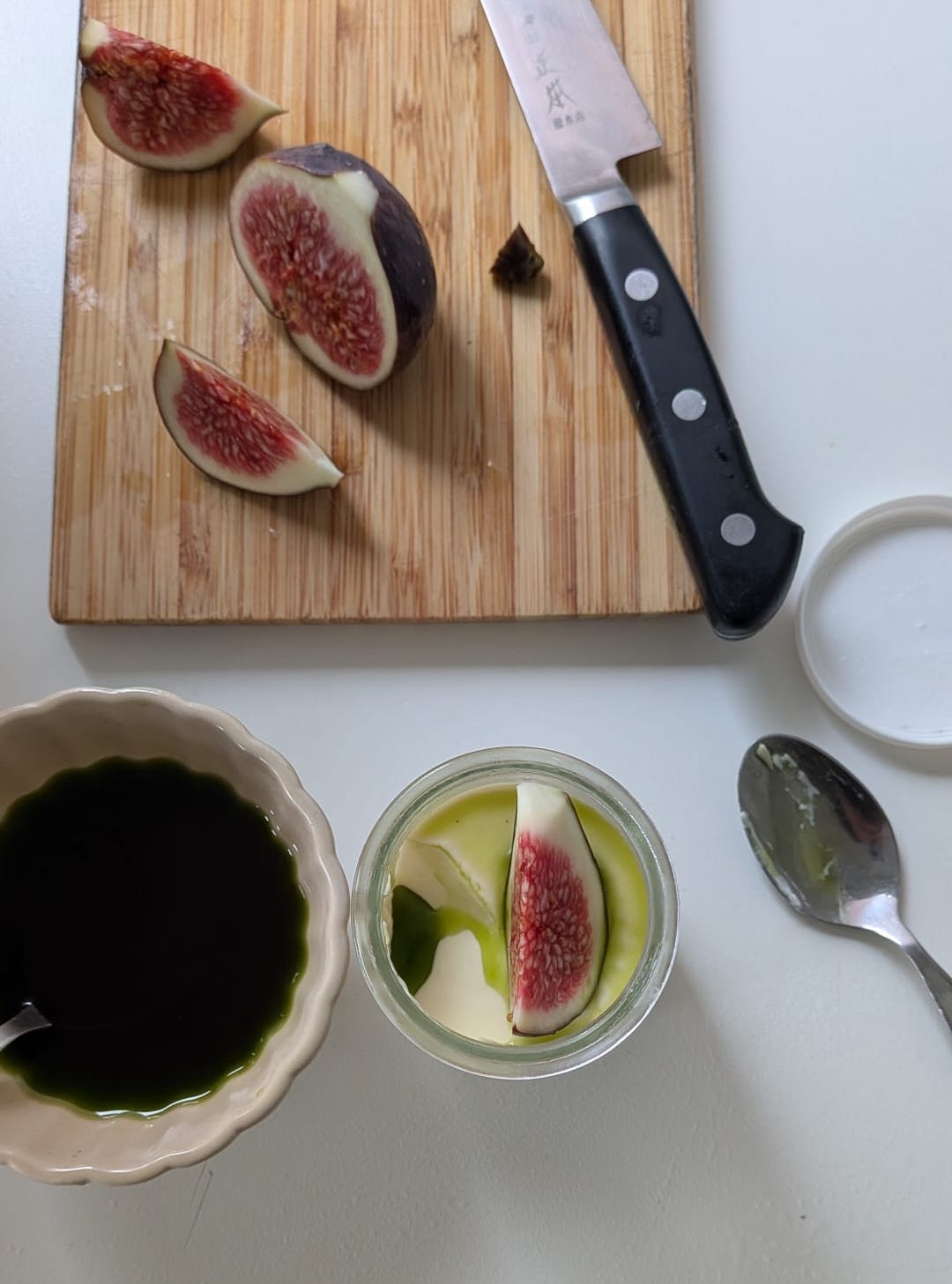
Because the season is so fleeting, I always order fig desserts when I see them on menus. One of best in recent memory is from Planque in London: a comforting plate of rice pudding drizzled sparingly with fig leaf oil and topped with slivers of fresh fig. The combination of dairy and fig is dreamy, a flavour combination that could take so many forms. Here’s one way that also happens to be very portable, if you do decide to share it with friends or neighbours like I did:
Fig leaf panna cotta with fig leaf oil & fresh figs
Makes 6 small servings
For the panna cotta:
360g cream (35% fat)
120g milk
50g sugar
Pinch of salt
Tiny squeeze of vanilla bean paste
2 fig leaves
2 sheets of gelatine (4g total)
For the assembly:
2 fig leaves
120g oil
Slices of fresh fig
Combine all the ingredients for the panna cotta except the gelatine in a small saucepan. Bring to a simmer. Meanwhile, soak the gelatine in cold water until softened. Squeeze out excess water and add it to the pan. Stir until the gelatine melts completely and turn off the heat. Remove the fig leaf when its flavour has infused into the cream, and before it gets bitter. Pour into little cups (I used 6 glass yogurt pots). Refrigerate overnight or until set.
To make fig leaf oil, blend the fig leaves with oil until smooth. Transfer to a small saucepan and heat until the oil is warm to the touch. Pour the oil through a cheesecloth set over a sieve. Do not press. Serve the set panna cotta with a drizzle of the oil and slices of fresh fig.
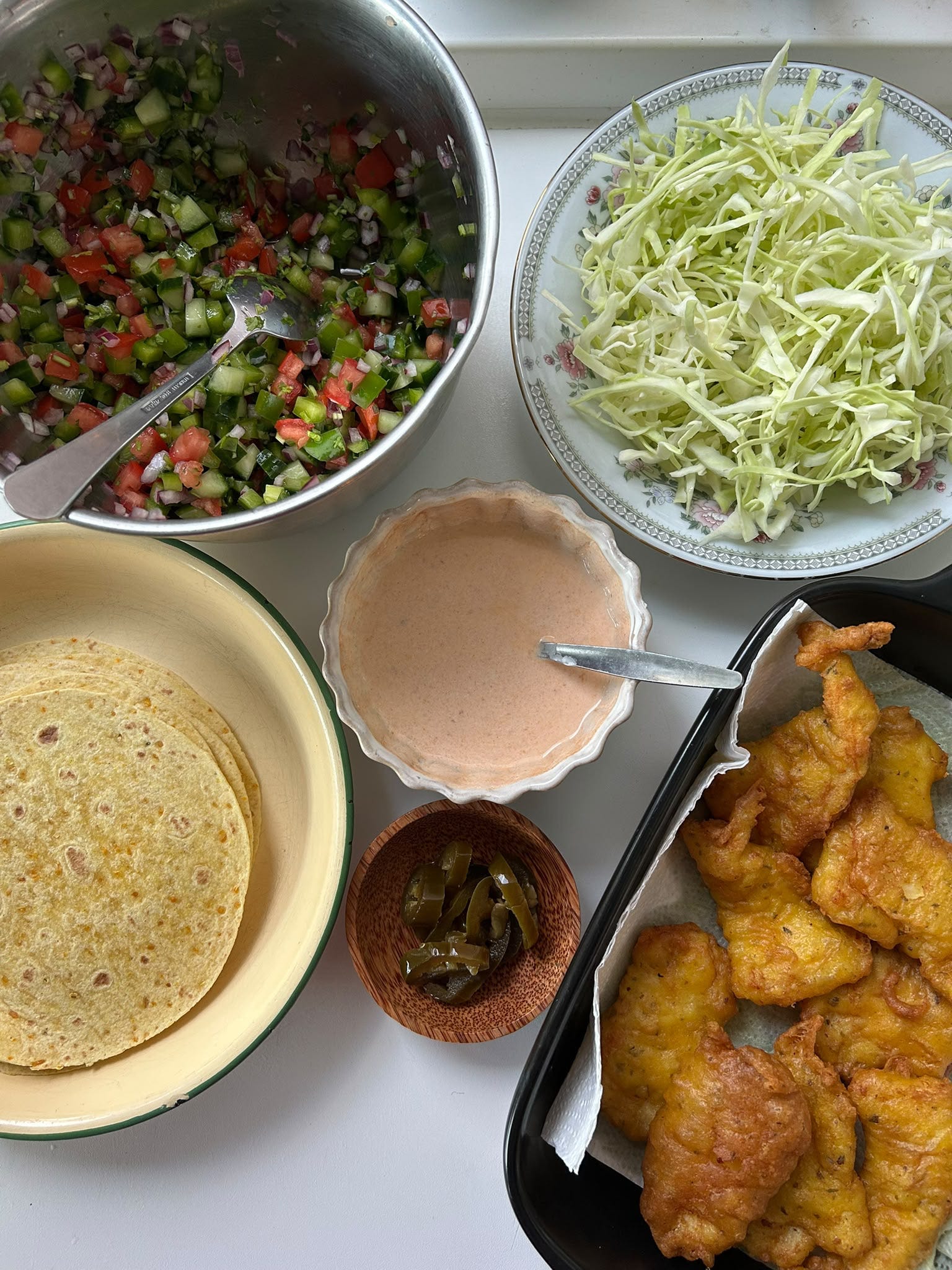
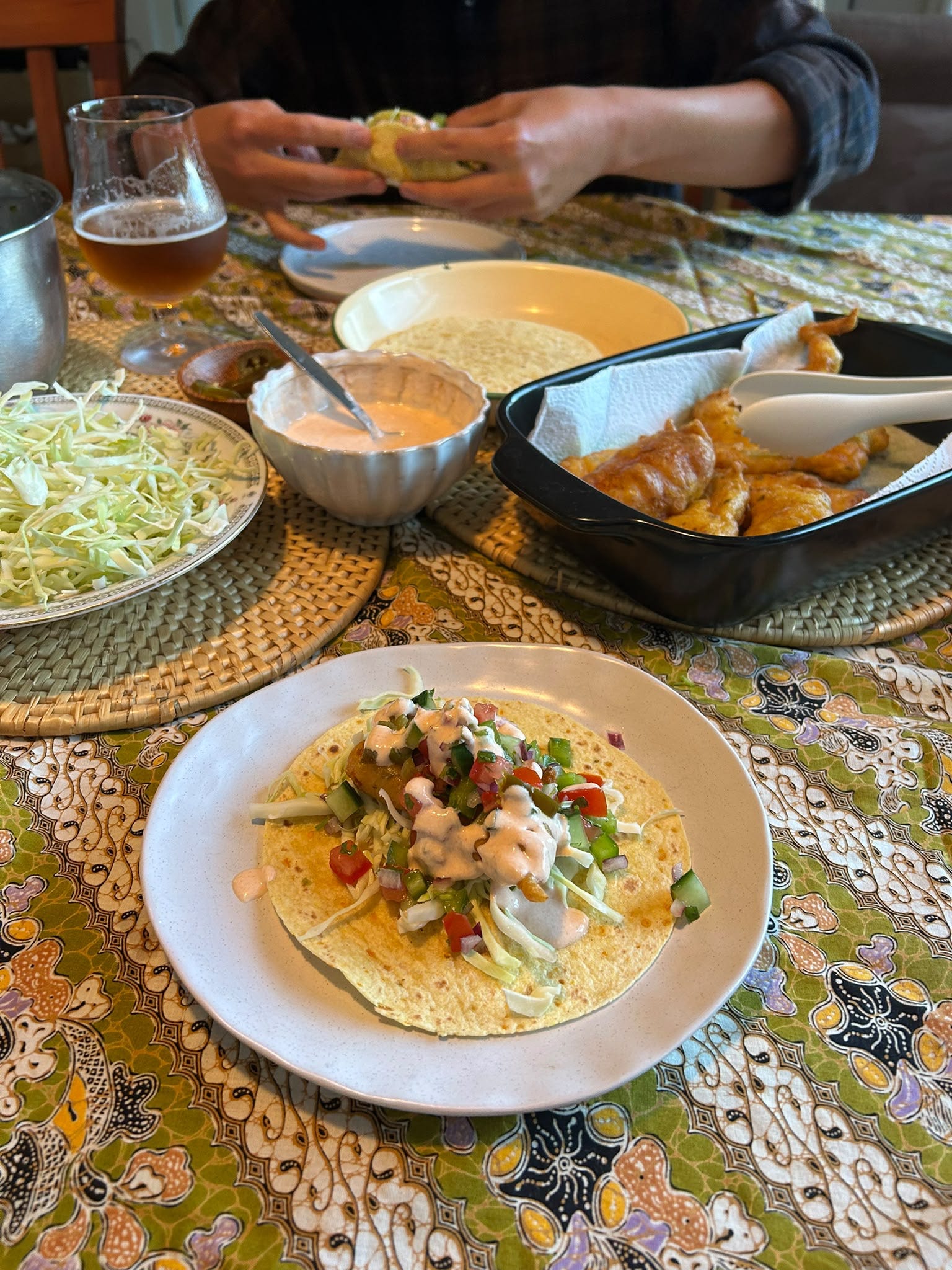
Fish tacos also made an appearance on our table recently. It’s no secret how much I love Mexican food. It’s remarkable how well this cuisines jibes with my Southeast Asian palate: the liberal use of coriander, lime juice, and raw onion is all very familiar to me.
A couple of months ago, a friend had mentioned that she uses kibbeling — a Dutch snack of bite-size pieces of battered fish that one can purchase frozen in supermarkets or freshly fried from fishmongers — in her fish tacos. I thought it was such a brilliant idea that makes getting dinner on the table quicker and easier, especially if you’re just cooking for two. The idea has been percolating in my mind and I finally got around to making it.
If you do choose to make your own battered fish, one thing I’ve learnt is that the fish you use for fish tacos is not terribly crucial. A popular taco street vendor who recently retired disclosed his recipe — he uses Vietnamese catfish (pangasius), which is very affordable. What matters more is a flavourful batter that fries up crisp. To mine, I add a squeeze of yellow mustard, a sprinkle of dried oregano, and a cheeky dash of dashi powder for oomph. My batter recipe is not yet as crispy as I’d like it to be (I’ll share it when I crack it), but I’ll leave you with the rest of the recipe:
Fish tacos
Serves 2
2 tomatoes, seeded and finely diced
1 green pepper, finely diced
1/2 red onion, finely diced
1 small bunch of coriander leaves and stems, finely chopped
1/3 cucumber, finely diced
1 jalapeno, finely chopped
1 lime’s juice
1 + 1/2 teaspoon salt
2 tablespoons jarred chipotle sauce
1 teaspoon sugar
125g sour cream
White corn or flour tortillas
350g cabbage, thinly sliced
600g battered fish (homemade, frozen and fried, or store-bought)
Jarred pickled jalapenos
Make the pico de gallo in a large mixing bowl by combining the tomatoes, green pepper, onion, coriander, cucumber, jalapeno, lime juice and 1 teaspoon salt. Mix well and season to taste with more lime juice or salt if desired. In a small bowl, make the crema by mixing the remaining 1/2 teaspoon salt, chipotle sauce, sugar, and sour cream. Taste and adjust the seasoning if needed. To serve, top the tortillas with cabbage, then with a piece or two of fish, then spoon over the pico de gallo, crema, and jarred pickled jalapenos.
September 24, 2026
drunken chicken
Welcome to Singapore Noodles, a newsletter where I share recipes from my kitchen in the Netherlands. Archived recipes and other content can be found via the index. My cookbooks, Wet Market to Table and PlantAsia: Asia’s Vegetable Wisdom in Recipes, Stories, and Techniques, are available for purchase. Thank you for being here, and enjoy this week’s post! ✨ — Pamelia
DRUNKEN CHICKEN
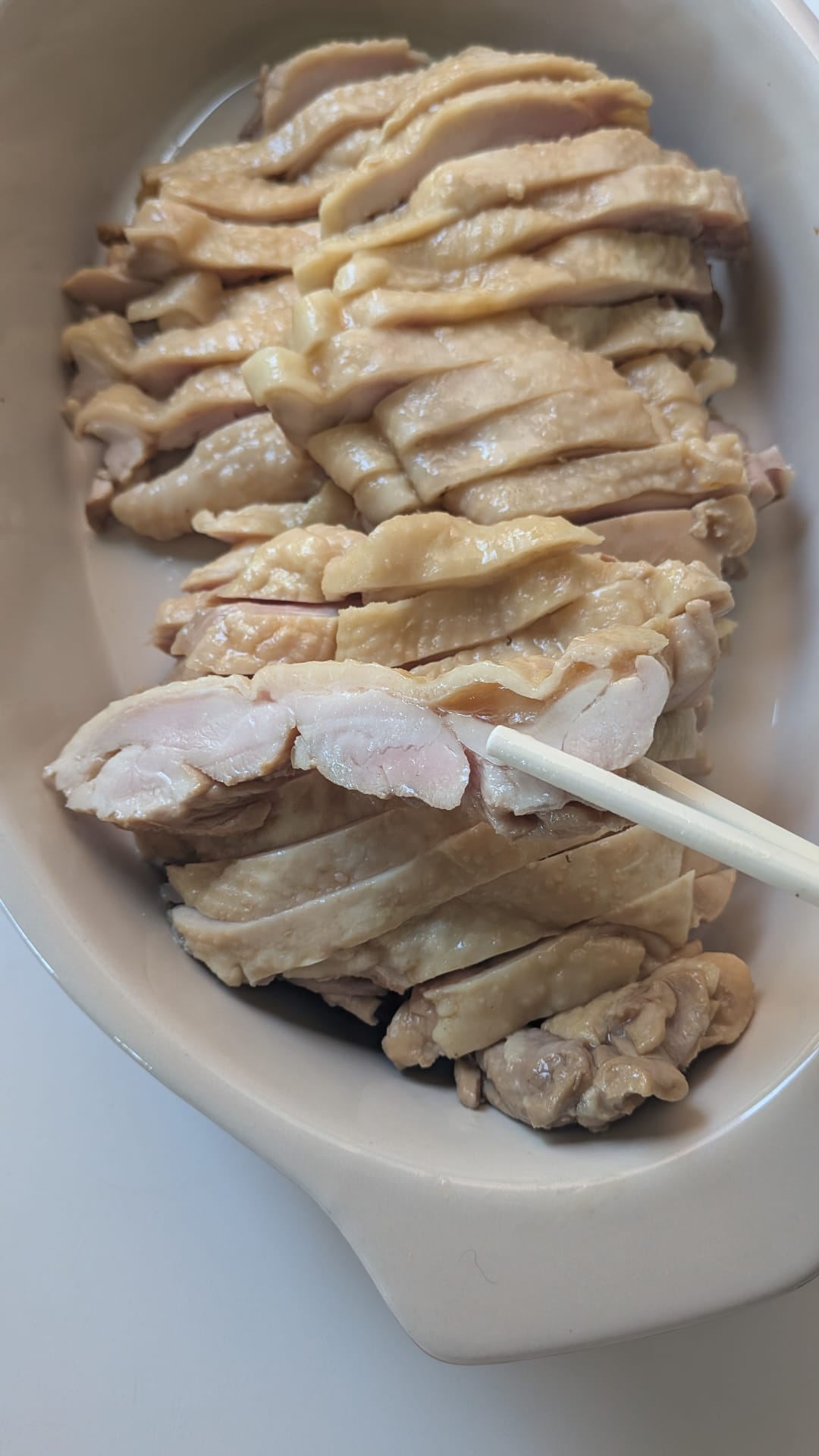
Drunken chicken is a traditional chicken dish that is commonly served cold — this makes it an appealing dish on warm days, or for entertaining, since it can be prepared in advance and kept in the refrigerator. The star ingredient of the dish, as suggested by its name, is Shaoxing wine, a rice wine that hails from Shaoxing and is a common ingredient in Chinese cooking.
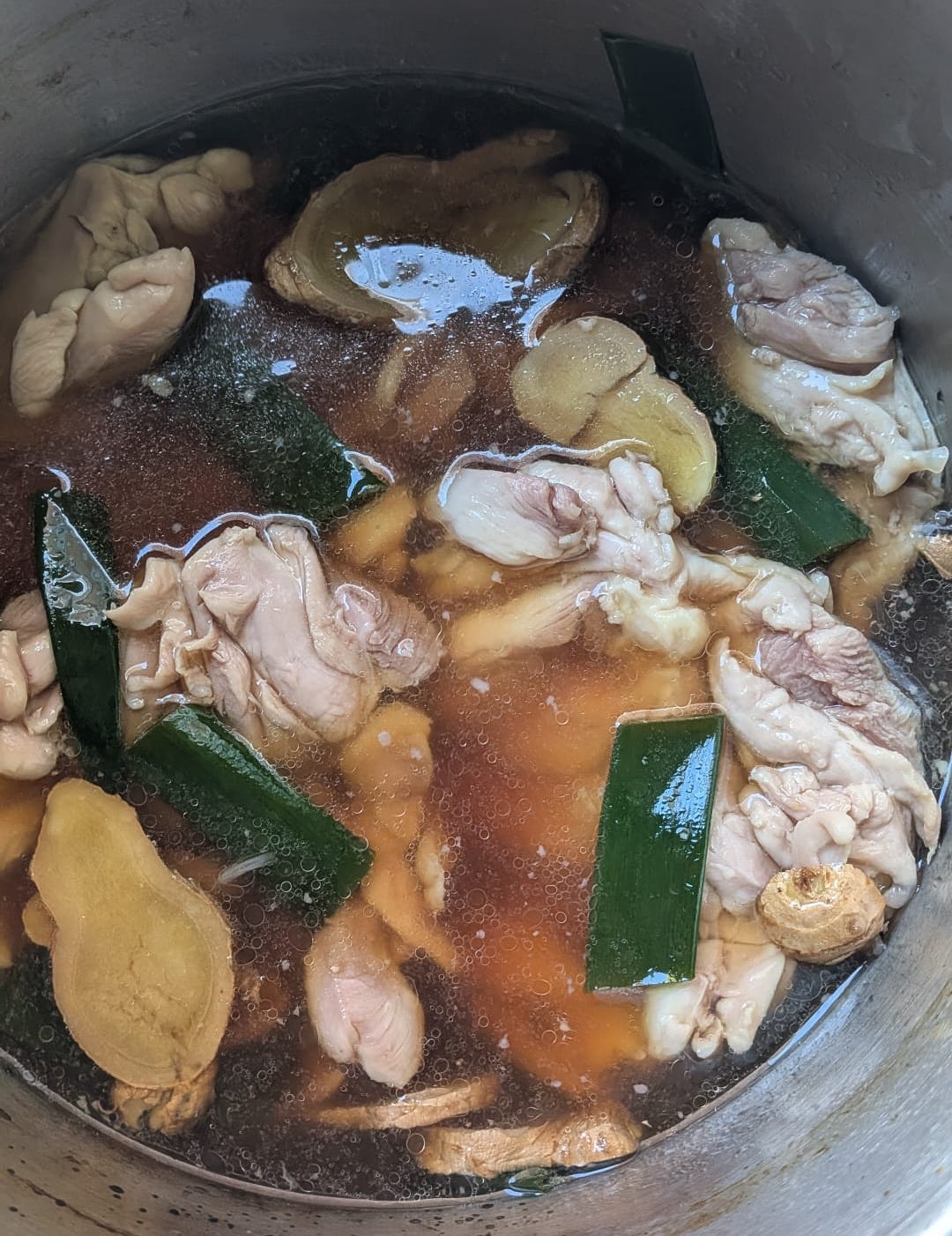
The dish is typically prepared by steaming the chicken, cooling it, then allowing it to steep in a Shaoxing wine-rich liquid overnight so that the wine can permeate the chicken. My preferred approach is the poaching method used in Hainanese chicken rice, which is to say plunging the chicken into the boiling Shaoxing wine liquid, clamping on a lid, and turning off the heat. The chicken is left to poach gently in the residual heat as the liquid cools down. By the time the liquid reaches room temperature, the chicken flesh should be just-cooked and succulent. This goes into the refrigerator to chill. Overnight, the chicken continues to absorb flavour from the broth, while the juices trapped under the skin turn into a delicate jelly.
When I order drunken chicken in restaurants, it usually comes simply sliced and unadorned. But, inspired by MasterChef Australia contestant Alvin Quah and seeing that I had some beautiful ripe cherry tomatoes in the garden, I paired my drunken chicken with a green mango salad and the two dishes go surprisingly well together. (Instead of going to the Asian grocer for a green mango, I tend to grab the hardest, least ripe mango from the supermarket and it works a treat.) As the main carb, either jasmine rice or blanched and rinsed wheat noodles are great.
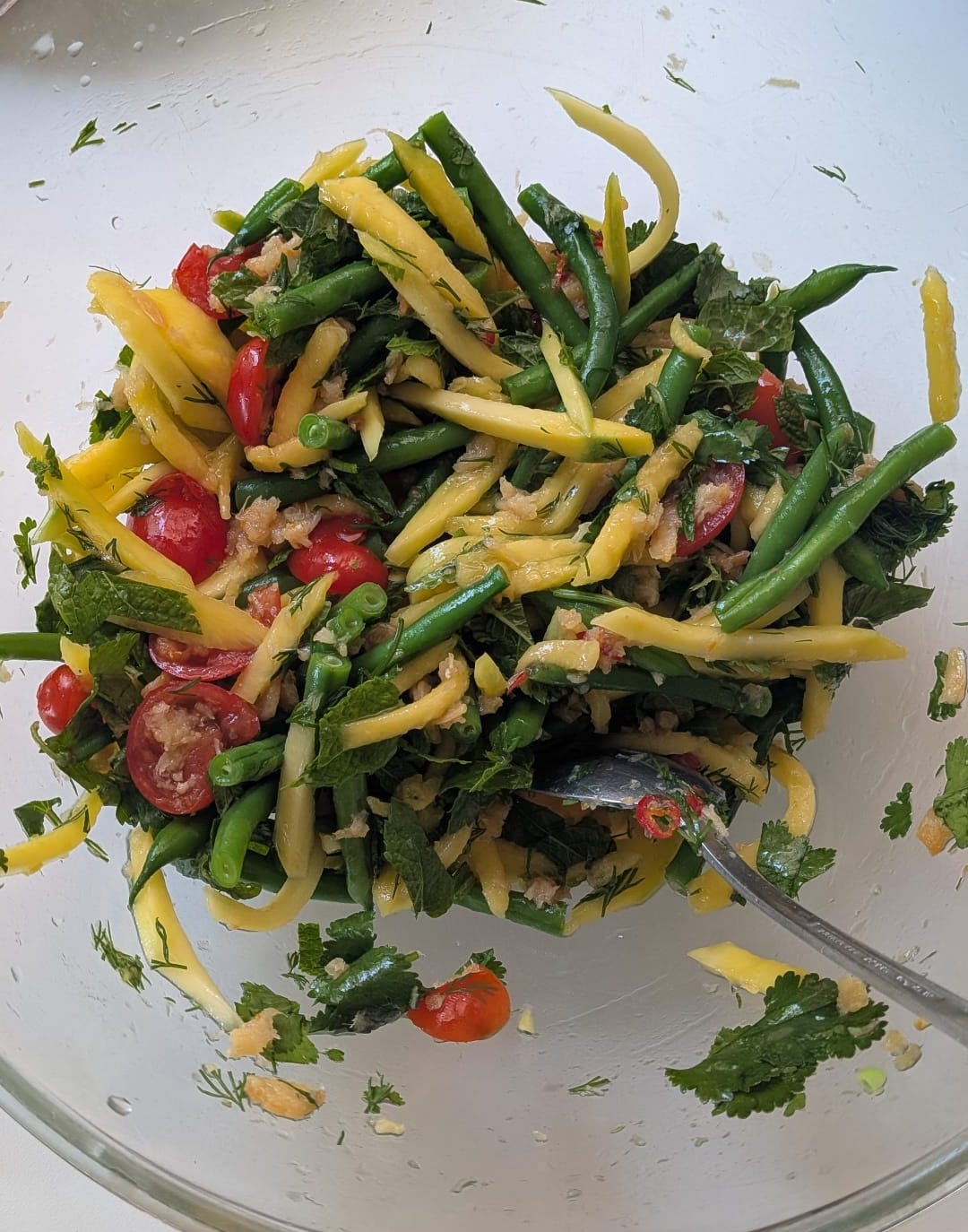
Green mango salad
Makes 4 servings
4 tablespoons dried shrimp
A handful of cherry tomatoes, halved
3 tablespoons sugar
4 tablespoons fish sauce
3 tablespoons lime juice
1 bird’s eye chilli, thinly sliced
1 unripe mango, cut into matchsticks
160g green beans, trimmed and halved, blanched or cooked in the microwave
1 handful of coriander, roughly chopped
1 handful of mint, roughly chopped
1 handful of dill, roughly chopped
4 tablespoons roasted peanuts
Soak the dried shrimp for 2 minutes, then drain and discard the liquid. Pound it coarsely with a mortar and pestle and transfer the shrimp to a large mixing bowl. Add the tomatoes to the mortar and bruise it firmly to release the juices. Transfer the tomatoes to the bowl, leaving the juices behind. Stir in the sugar, fish sauce, lime juice, and chilli. Taste and adjust the seasoning as desired. Pour it into the bowl, and add the mango, green beans, coriander, mint, and dill. Toss well and transfer to a serving dish. Scatter the peanuts over and serve.
Drunken chicken
Makes 4 servings
September 11, 2026
laab ลาบ
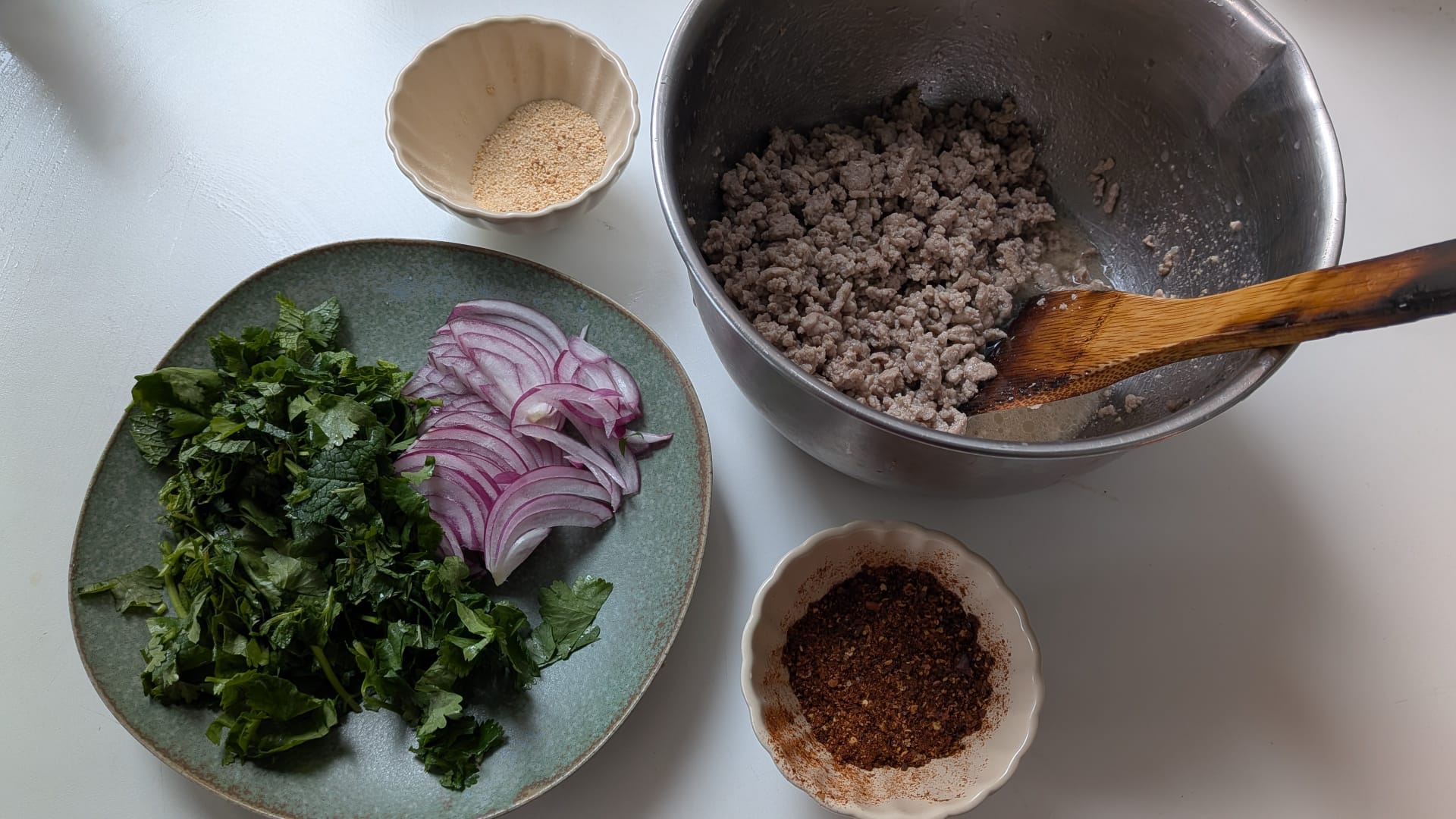
Laab is hands down one of my favourite dishes. There are two distinct styles — the Northeastern (or Isaan) version, which is fresh and herbaceous, and the Northern version, which is made with dried spices such as cumin, coriander, and prickly ash seeds. The former is more commonly found in Thai restaurants outside of the country, and is the version I’m more familiar with.
I first encountered Isaan laab in my early twenties, when the very first head chef I worked with — a devout Buddhist who occasionally went on spiritual retreats in Thailand — cooked it for staff meal. He brought a little sachet of rice powder to work and used it to season a mélange of herbs and minced meat. Simultaneously robust, rustic, and appetising, it was a revelation and expanded my ideas on what Thai food was — beyond the usual menu stalwarts of Thai restaurants in Singapore, such as tom yum, pineapple fried rice, and pandan chicken. I began seeking it out in the now-demolished Golden Mile Complex, also known as Little Thailand in Singapore, when my chef friends and I went there for supper. Years later, when my husband and I moved in Melbourne, we frequently visited Soi 38, a little Thai restaurant located in a carpark. Their laab, studded with slivers of liver and boiled pork skin, remains the gold standard to which I compare all other laab.
Even though laab generally refers to a ground meat salad, its popularity has inspired cooks to get creative; it’s now more a genre than a written-in-stone dish. Soi 38 serves a raw tuna laab, a midpoint between ceviche and laab that makes terrific sense. Vegan versions made with mushrooms or deep-fried and chopped tofu are also common. The common denominator of laab dishes, according to Pailin Chongchitnant in her book Sabai, is the inclusion of toasted rice powder, mint, fish sauce, lime juice, and roasted chilli flakes.
I’ve made laab countless times in my kitchen (there’s also a recipe for cauliflower laab in PlantAsia), and along the way, I’ve picked up a few finer points on making the dish.
1. Make your own toasted rice powder (khao khua ข้าวคั่ว) and chilli flakes (prik pohn พริกป่น).
It might seem unnecessary, especially since every supermarket stocks some version of chilli flakes. However, trust me: the difference between laab made with the fresh homemade stuff versus store-bought versions is night and day.
Khao khua refers to rice that is toasted slowly in a wok until it takes on a rich, nutty quality and a subtle crunch when ground. As for what type of rice to use, I’ve seen recipes that call for jasmine rice and others that call for glutinous rice. On her website, Chongchitnant writes that traditionally, glutinous rice is used since it is the most commonly eaten rice in the Northeast, though she uses jasmine rice. Kris Yenbamroong, author of Night + Market, exhorts readers to use whatever is on hand — both glutinous rice and jasmine rice are suitable.
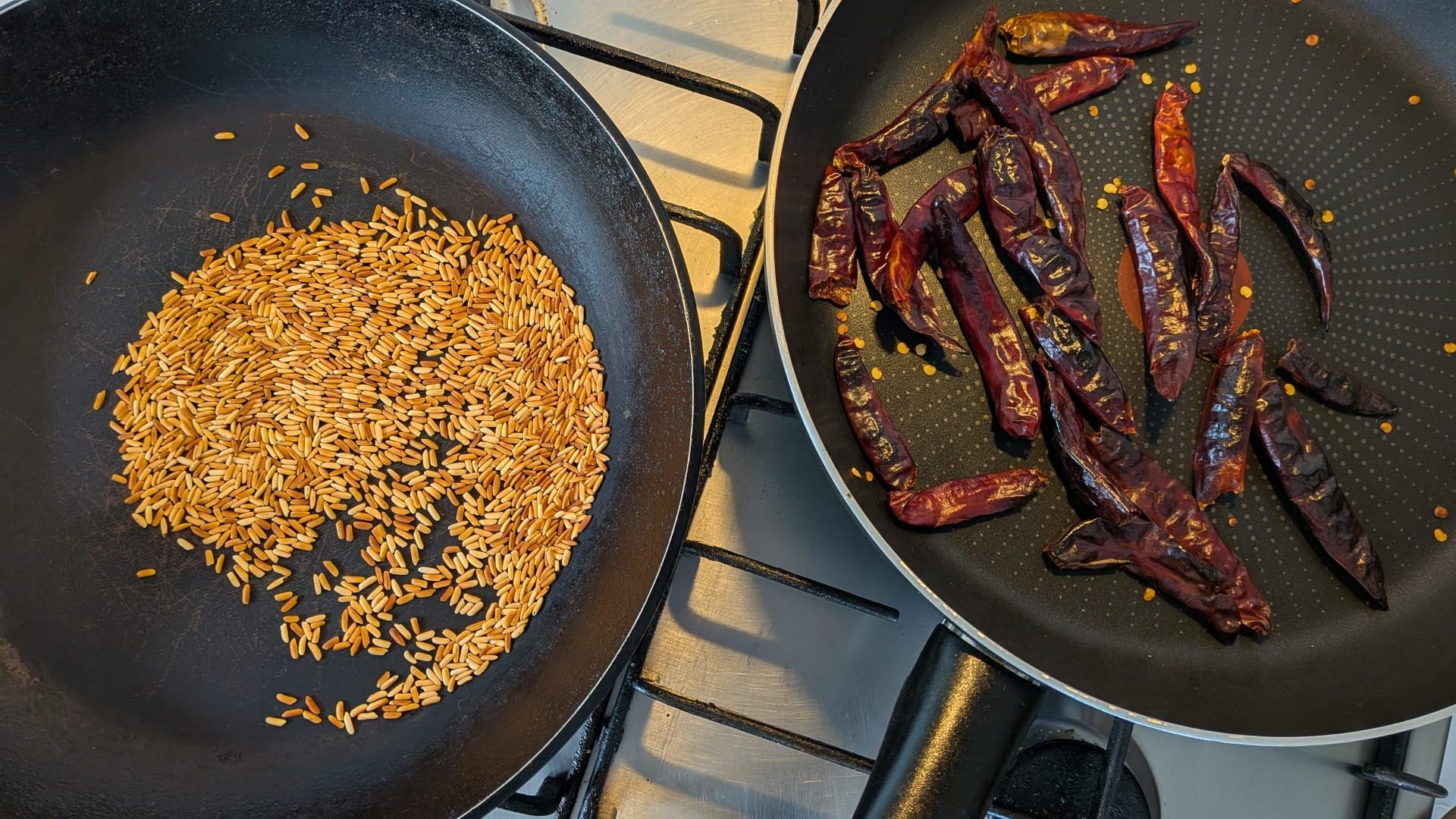
To make khao khua from scratch, place about 3 tablespoons of raw, dry rice (or more) into a frying pan and toast over low heat for 10-15 minutes, or until the grains turn a rich golden brown. Allow to cool completely, then grind to the gritty texture of fine sand (not a flour) using a spice grinder or pestle and mortar.
As for prik pohn, if you have eaten at a Thai restaurant — especially one that serves noodle dishes — chances are you would have come across these chilli flakes in a small condiment tray, alongside fish sauce, and sugar for seasoning your meal. They provide not just heat but also a deep, earthy fragrance. While you can use dried Thai bird’s eye chillies, I prefer using the larger dried red chillies from the Asian supermarket which are milder. Place them in the pan and toast over low heat for 5-10 minutes, shaking the pan frequently. Colour is not a good indication of doneness, especially if the chillies are darkly coloured. You’ll know they’re done when you can smell their fragrance even without putting your nose to the pan. They should feel dry, almost crisp to the touch once cooled. Allow to cool then grind until you get fine flakes (but not powder).
I typically toast both the dried chillies and rice at the same time, in separate pans. While it seems like a long time to be watching them, I frankly find this the best time to do some errands around the house, circling back to the pans every now and then to give them a good shake.
2. Allow the mince to cool completely before adding herbs and aromatics.
Laab recipes vary in terms of the range and type of herbs and aromatics employed — I’ve seen recipes featuring mint, coriander, spring onion, lemongrass, lime leaves, and culantro. For me, mint and coriander are enough to make an incredible laab. But if you have them, a few julienned lime leaves kick things up a notch. Thinly sliced red onions or shallots are also key, adding a bit of crunch and sweetness.
Because Isaan laab is all about freshness, it is imperative that you let the mince cool completely before adding the herbs. If you add them while the mince is still hot, the herbs will wilt and lose their potency. The red onion will also soften and lose its crispness.
3. Assemble the salad right before serving.
In Night + Market, Kris Yenbamroong writes that, when making laab, the essential thing is to dress it in the moment and serve it immediately. If added too early, lime juice can lose its sharp freshness, and the toasted rice powder can absorb too much moisture and lose its characteristically crunchy texture. Also key is not to follow a recipe slavishly, but to taste and adjust the seasonings according to your personal preference. I always like my laab slightly stronger, so that it goes nicely with the rice (sticky or jasmine) that I’m eating it with.
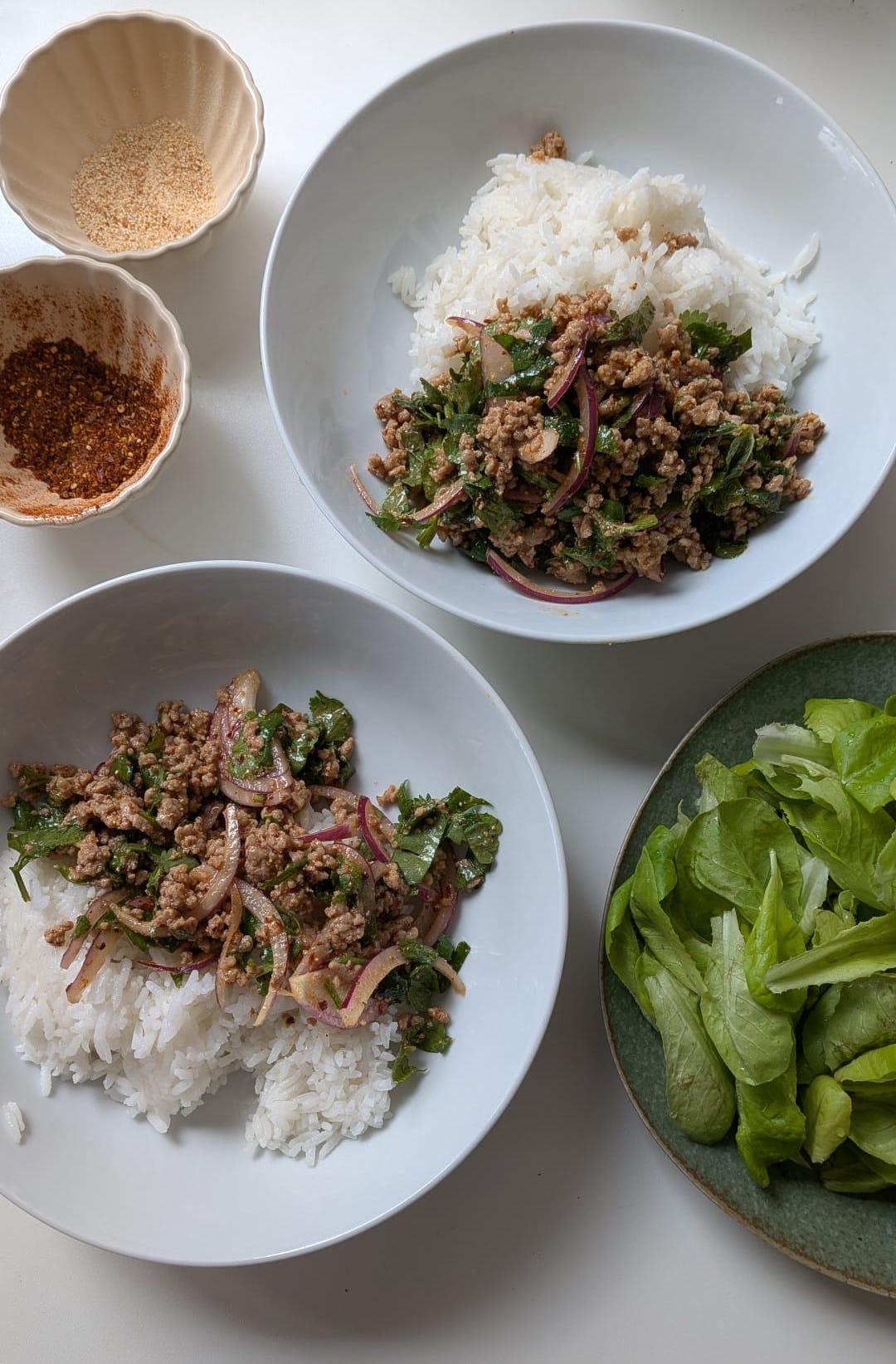
Laab
Serves 2 as a main or 4 as part of a larger meal
August 24, 2026
tomato sambal
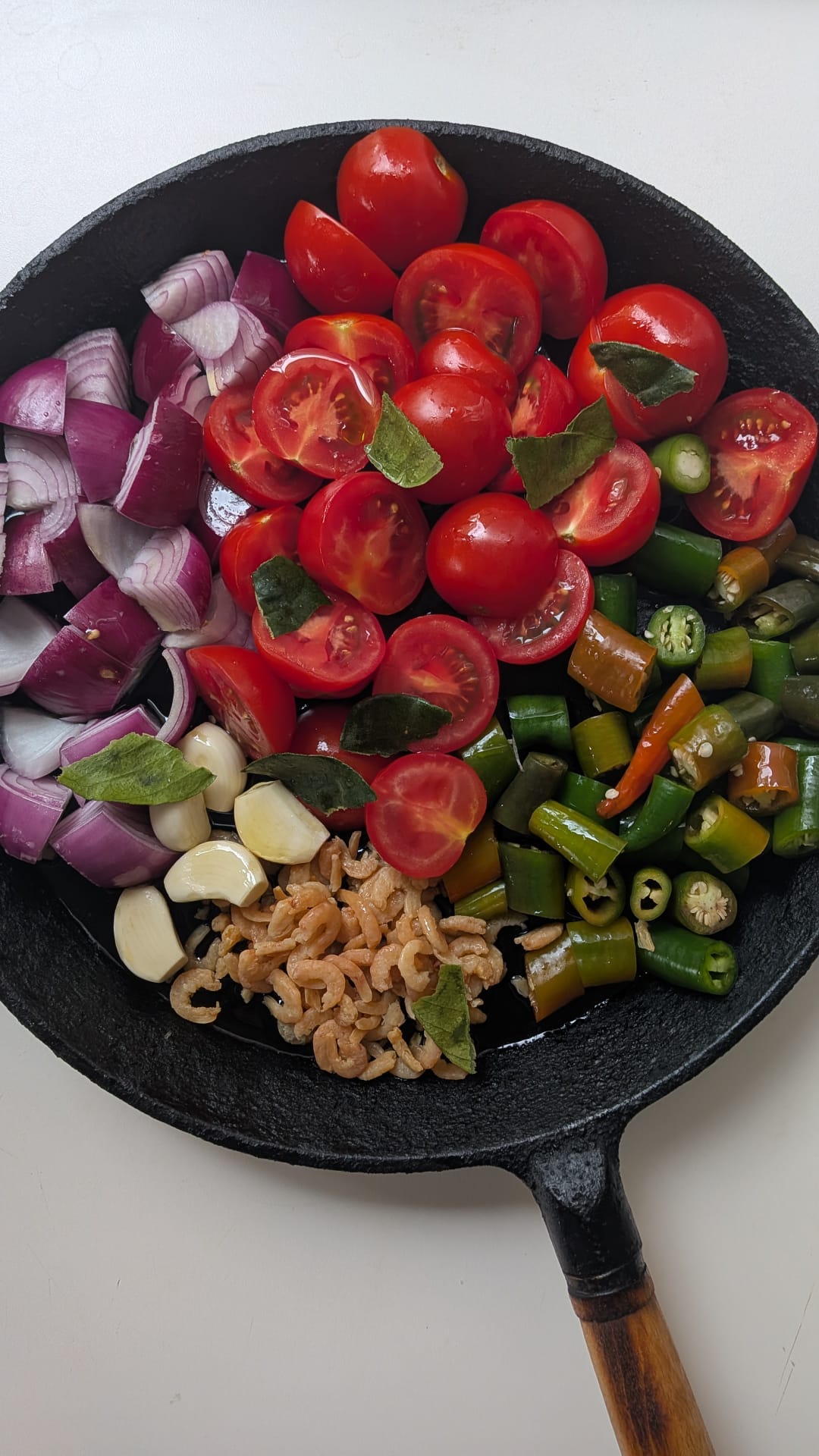
We’re on the last leg of summer — it’s still beautiful and sunny, but the weather’s definitely cooling down now. I want to make the most of summer while we can, so I’ve been buying the best-looking cherry tomatoes I can get my hands on whenever I make a trip to the supermarket. And when you have tomatoes so sweet, one of the best things to do with them is make tomato sambal. Unlike other types of sambal that I typically make at home, you don’t need a blender to make tomato sambal. It is, after all, a rustic sambal whose allure lies, at least in part, in its texture.
The idea is that, rather than rendering the vegetables and aromatics to a smooth paste in a blender, you cut everything roughly — small enough that they soften easily, but not so small that you lose textural interest. After cutting, I place the ingredients in a pan wide enough to accomodate them in a single layer and drizzle in some olive oil. A few years ago, I would have shuddered at the thought of olive oil in sambal, but ever since my trip to Croatia last year, where I learned that olive oil isn’t nearly as delicate as I’d imagined, I’ve been replacing my usual vegetable oil with it. It’s better for you (not inconsequential, given the abundance of oil in sambals) and the flavour of the olive oil is surprisingly unobtrusive.
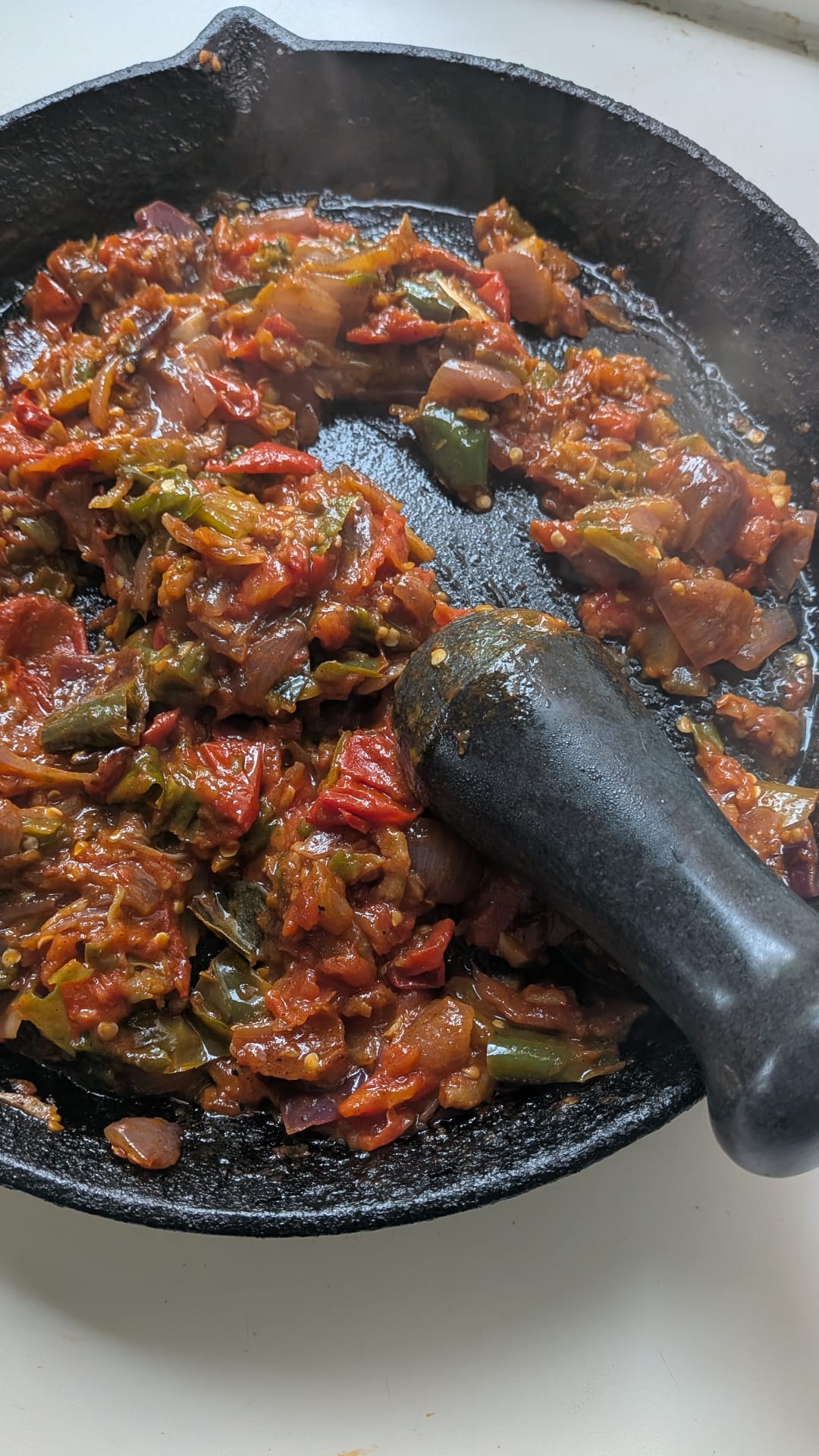
After 10 minutes of stir-frying, the tomatoes burst and give up their juices, while the onions and chillies become tender. I take the pan off the heat and start grinding the vegetables with a pestle until I arrive at a consistency that I like. This was easy because my pan, being made of cast-iron, is textured. You could also use a cobek and ulekan (pestle and mortar that is shallow and wide enough to facilitate this type of grinding). You don’t want everything to be a smooth homogenous mixture, but a sort of chunky relish that you can spoon over everything.
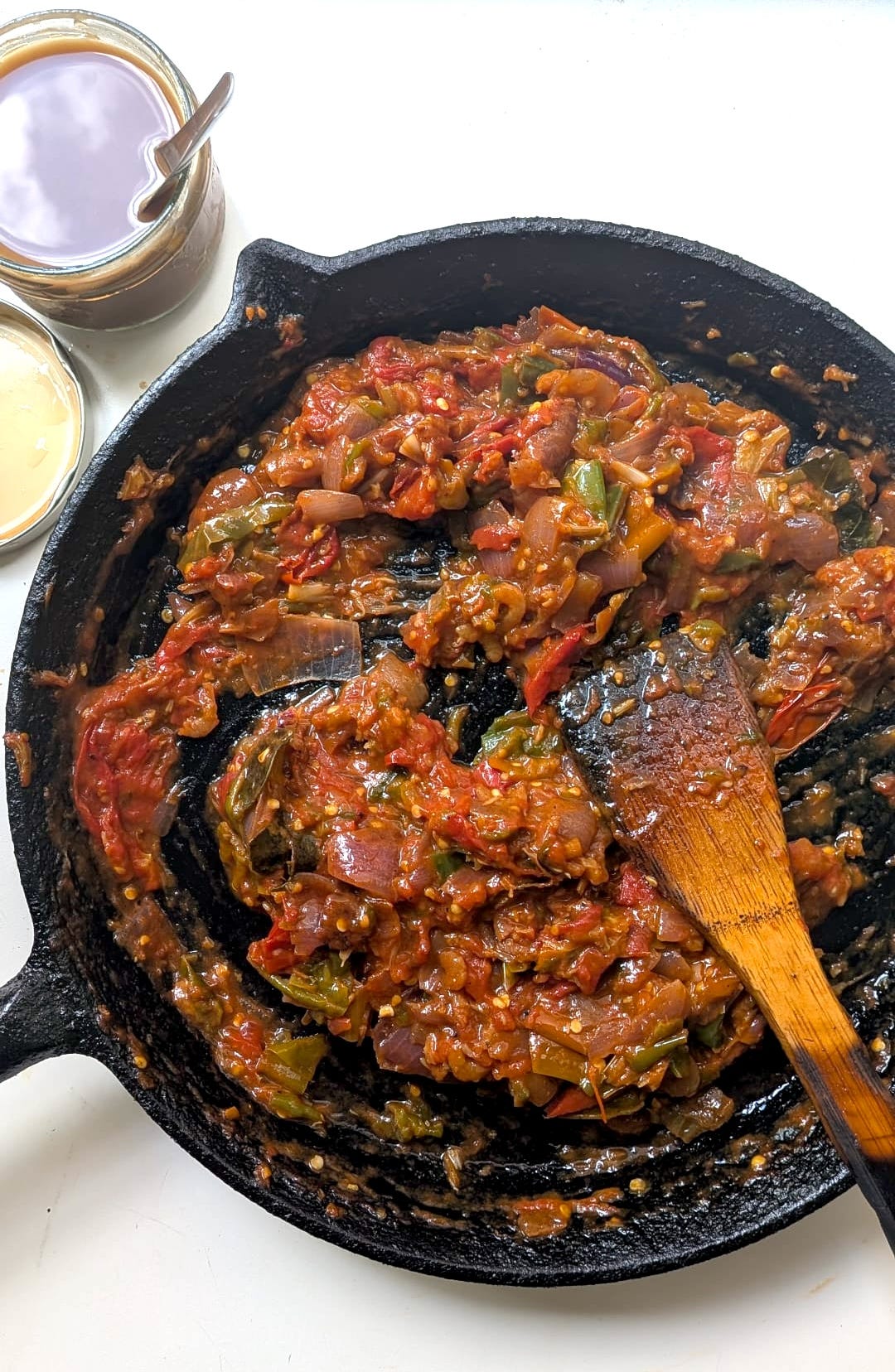
Once the texture is to your liking, all that’s left to do is season the sambal. Because the tomatoes I had were so naturally sweet, the only seasonings required for mine were tamarind pulp for tanginess, and salt. At this stage, I also taste to see if the sambal is spicy enough for my liking. If it isn’t, I stir in some finely sliced bird’s eye chilli. To me, that’s a more sensible approach than starting a sambal off with bird’s eye chillies and then realising after cooking that the resulting sambal is too spicy.
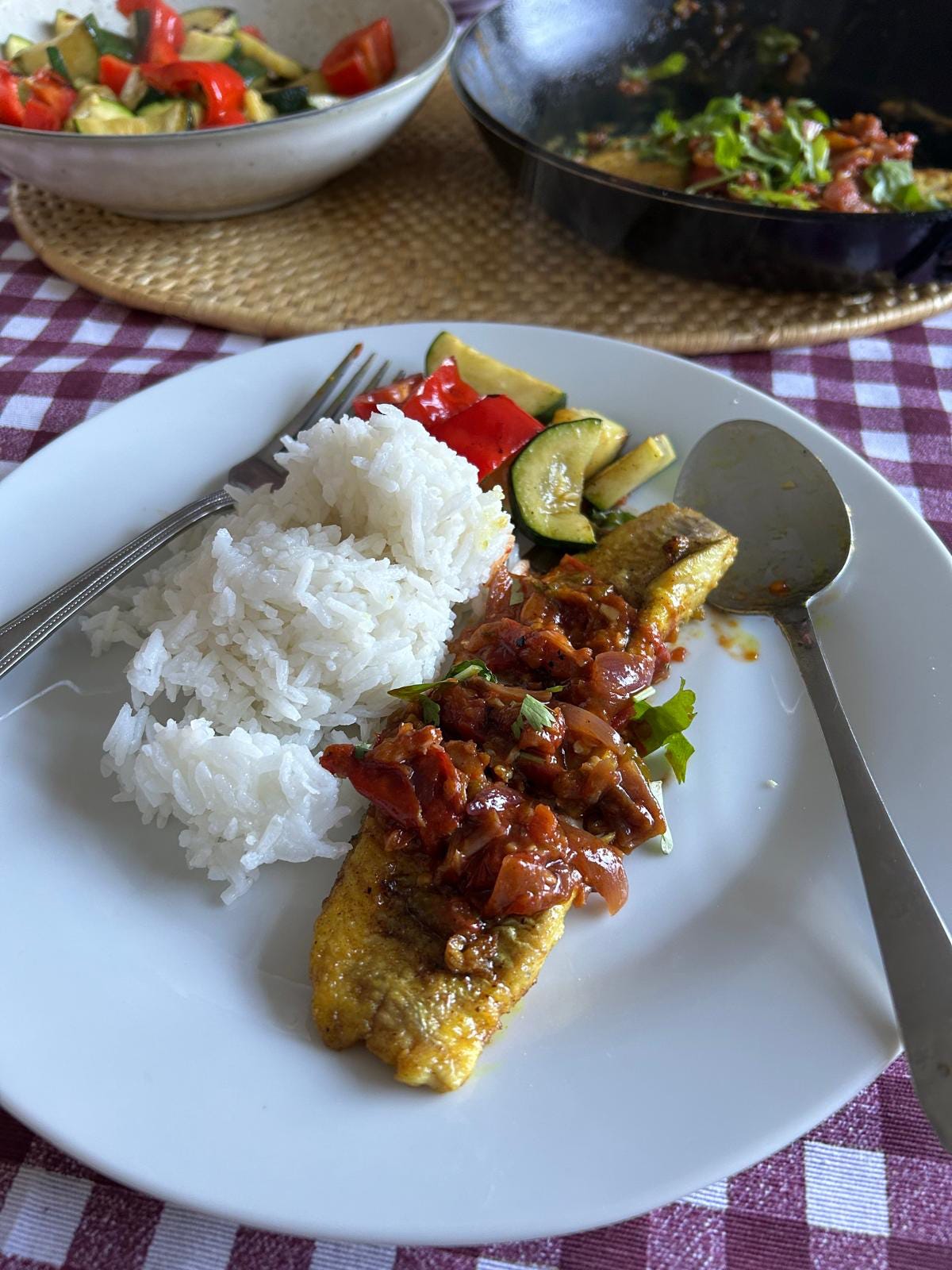
There are many ways to enjoy tomato sambal: as a dip for raw crunchy vegetables like cucumber, spooned over boiled or grilled vegetables, or as a condiment for meat and fish. I coated some fish fillets in flour, fried them in a bit of olive oil until golden brown on both sides. I then added salted butter and curry powder to the pan (spice blends like ras el hanout also work well) and basted the fish with this fragrant butter. Spooned the tomato sambal over and topped with a handful of chopped coriander. Delicious with rice.
Tomato sambal
Makes a jam jar’s worth | Vegan option
August 17, 2026
pani puri
Since I moved to the Netherlands, I’ve been teaching cooking workshops. Most of the time, people who sign up are there for a company team bonding session, a bachelorette party, or celebrating a family member’s birthday. The focus is not so much about the food, and more about allowing food and cooking to be the conduit to having a wonderful time. I really enjoy the social element of it, but recently, I went for a few events that made me realise how much I miss grounding food in stories, personal histories, and cultural exploration.
Late July, I was invited by a chef friend Leow Shichao for a very special private dinner. For years, he’s been on a journey of rediscovering his Hakka roots through food (you can follow along here), and this time, he was in the Netherlands for a few events. This dinner was a collaboration between him and a Surinamese Hakka Pearl Tjin, author of Thuis in de Hakka Chinese Keuken. Prior to the dinner, I was frankly unaware that a Surinamese Hakka community existed!
Some of what we enjoyed:
Abacus seeds: An emblematic Hakka dish where taro is steamed and formed into a dough with tapioca starch, before being shaped individually to resemble the seeds of an abacus. A popular dish to serve for Lunar New Year as the auspicious shape of the abacus seeds symbolises good fortune.
Salt-baked chicken: A whole bird is wrapped and buried beneath a heap of scalding hot coarse salt. Apart from the cooking technique, what makes the dish special is the use of sand ginger. Once cooked, the bird is chopped up, but here it was reimagined: shredded then served atop a lettuce cup with garnishes of Surinamese pickles, fried shallots, and fried garlic.
Hakka chicken soup: Made with home-fermented glutinous rice wine in the Singaporean context, but we enjoyed it with Madeira wine this time, as per Surinamese Hakka tradition.
Stuffed pork belly: A show-stopper of a dish, this was a whole roulade of pork belly stuffed with dried goodies such as lap cheong and dried shrimp, and slow-roasted.
Hakka yong tau foo: Meaning “stuffed tofu”, the stuffing for Hakka yong tau foo is usually pork mince. However, since mince of half pork and half beef is more common in Dutch supermarkets, that’s what Pearl and Shichao used to make their version.
Beyond the food, what I especially loved was the intimate setting and how it allowed for stories to be shared — not only from Shichao and Pearl, but also among guests.
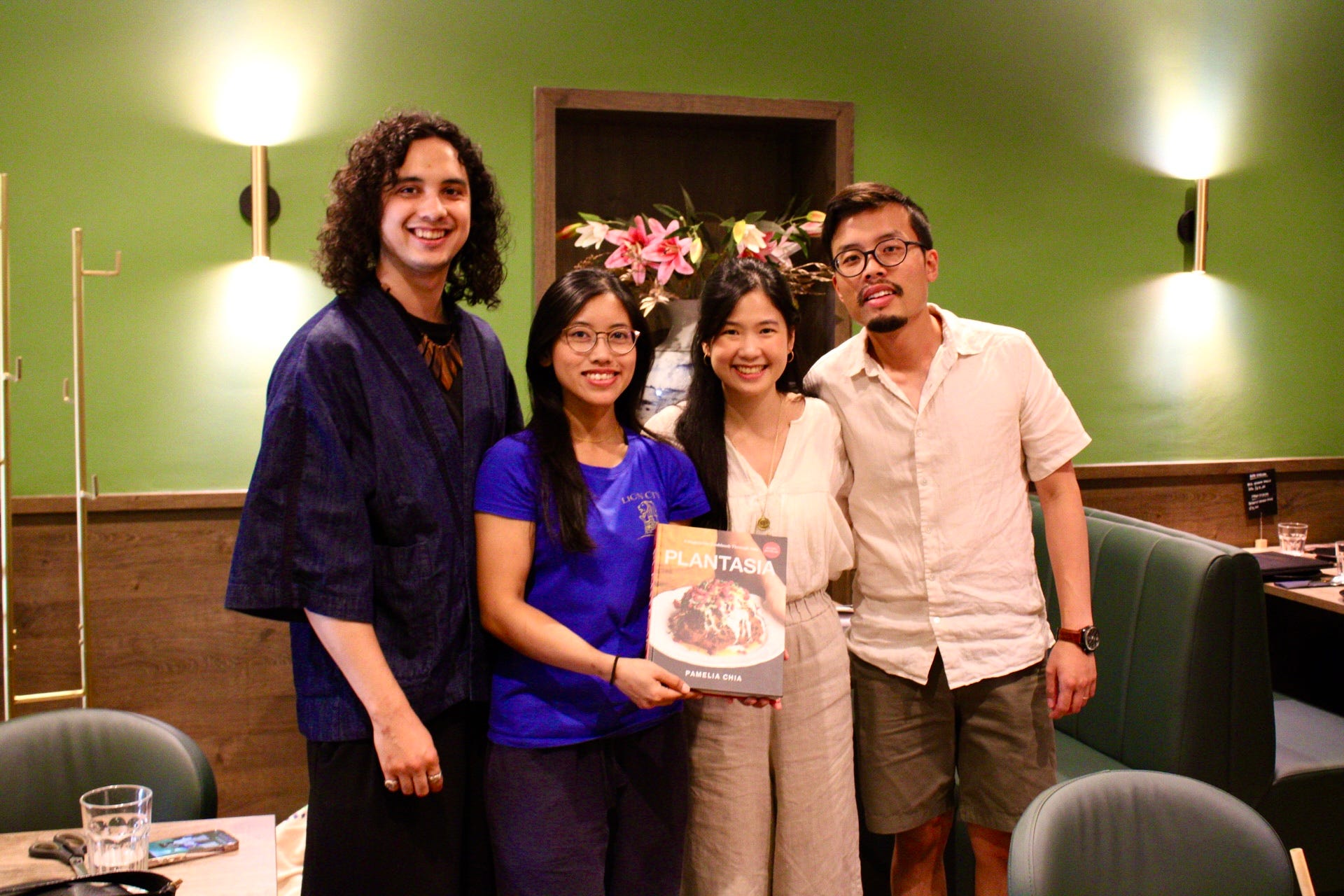
A few days later, I had my book signing event at Lion City restaurant in Rotterdam. It was a Q&A session centered on food traditions, migration, and identity. It’s been awhile since I’ve done a book event, and it was lovely getting to meet so many from the diasporic community who share similar experiences. Thanks for everybody who turned up for the event!
I picked up salsa dancing as a hobby at the start of the year, and my friends decided to organise a potluck party yesterday. The weather’s beautiful, so it was a great time to spend time in the balcony and share some finger food.
I brought pani puri which is, in my mind, the perfect party food. The two words that make up the name of the dish refer to the two core components: “puri” is the vessel, and “pani” (or “water”) refers to the fragrant herb water that you’re meant to fill the puri with. Alongside the herb water, I also prepared a boiled potato filling seasoned with chaat masala, a tamarind date chutney, and yoghurt thinned with water to a runnier consistency.
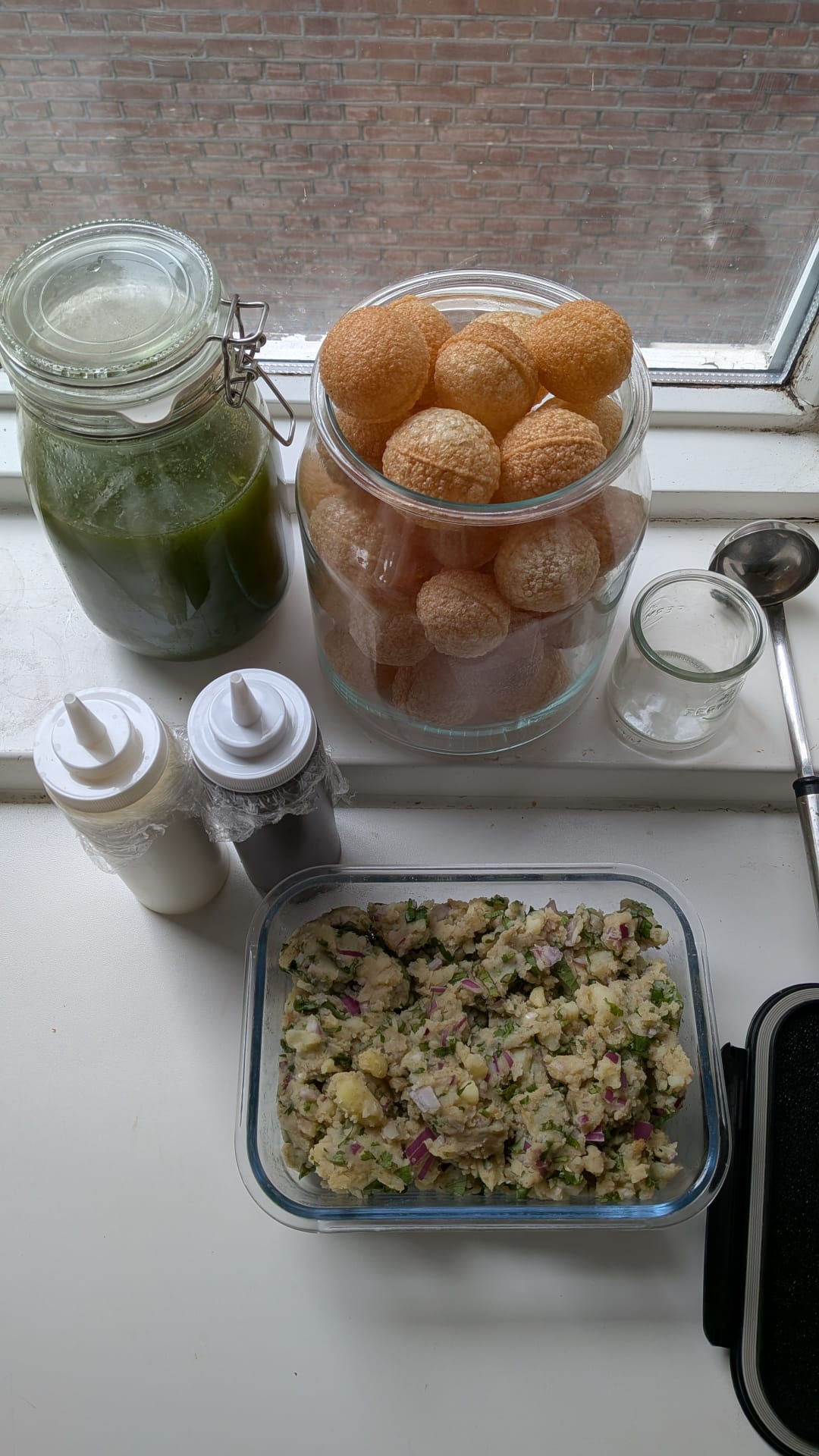
The idea is to crack a hole with your thumb in the crisp shell, fill it with potato, spoon (or squeeze if you use a squeeze bottle like me) in some chutney and yogurt, saturate the puri with the herb water, then pop the whole thing in your mouth in one bite.
It is vegetarian, or vegan without the yogurt — so it’s perfect for those with dietary restrictions. As for the prep, it does take a bit of work, but everything can be prepared in advance, including the puri shells. I bought the dehydrated coins of dough from the Indian grocer and once fried, these stay crisp for a long time. It is such a fun and interactive dish, where everyone gets to assemble it together and, in so doing, break the ice.
Subscribe to my newsletter to get recipes, cooking tips, and more, sent right to your Inbox!
Pani puri
Serves 6 | Vegan option
For the date chutney:
80g tamarind pulp + 160ml water
100g date paste (**you can also use dried dates; just soak them in boiling water till soft, before removing the pits. Discard the soaking liquid.)
1 teaspoon chilli powder, or to taste
1/2 teaspoon cumin powder
2 tablespoons lemon juice
Salt and honey to taste
For the herb water:
500ml water
2 green chillies, deseeded and roughly chopped
2.5cm piece of ginger, peeled and roughly chopped
1 lemon’s juice
1/2 tablespoon honey
1 large handful of mint leaves
1 bunch of coriander (stems and leaves)
1/2 teaspoon salt
For the filling:
4 large potatoes, peeled and boiled
1/2 red onion, chopped
1 bunch of coriander (stems and leaves), chopped
2 tablespoons chaat masala, or to taste
Salt to taste
For the assembly:
Oil for deep-frying
A packet of dried puri (if you prefer to make this from scratch, there’s a recipe in my cookbook Wet Market to Table)
200g yoghurt, thinned with water if necessary to a pouring consistency (optional)
Make the date chutney: In a bowl, combine the tamarind pulp and water and knead the pulp with your fingers to dissolve. Pass it through a sieve set over a small blender and discard the seeds. Add the date paste, chilli powder, cumin powder, and lemon juice. Blend until smooth. Taste and add salt and honey to taste.
Make the herb water: Place all the ingredients in a blender and blend until smooth. Transfer to a pitcher.
Make the filling: In a large bowl, mash the potatoes. Mix in the onion, coriander, chaat masala, and salt to taste.
Fry the puri: Heat the oil for deep-frying in a pan. Test the oil by adding one puri; it should float and puff almost instantly. Fry the puri in batches, submerging them into the oil with a kitchen spider from time to time. When they are puffed and golden, transfer them to a paper towel-lined dish.
Assemble the pani puri: To serve, crack a hole in each puri with your thumb. Stuff the cavity with the filling three-quarters of the way up. Spoon in a bit of date chutney and yogurt as desired, then pour some herb water into the cavity. Pop the whole thing in your mouth immediately and enjoy!
July 24, 2026
naan at home
Welcome back to the Singapore Noodles newsletter! Before we get to this week’s recipe, two small announcements:
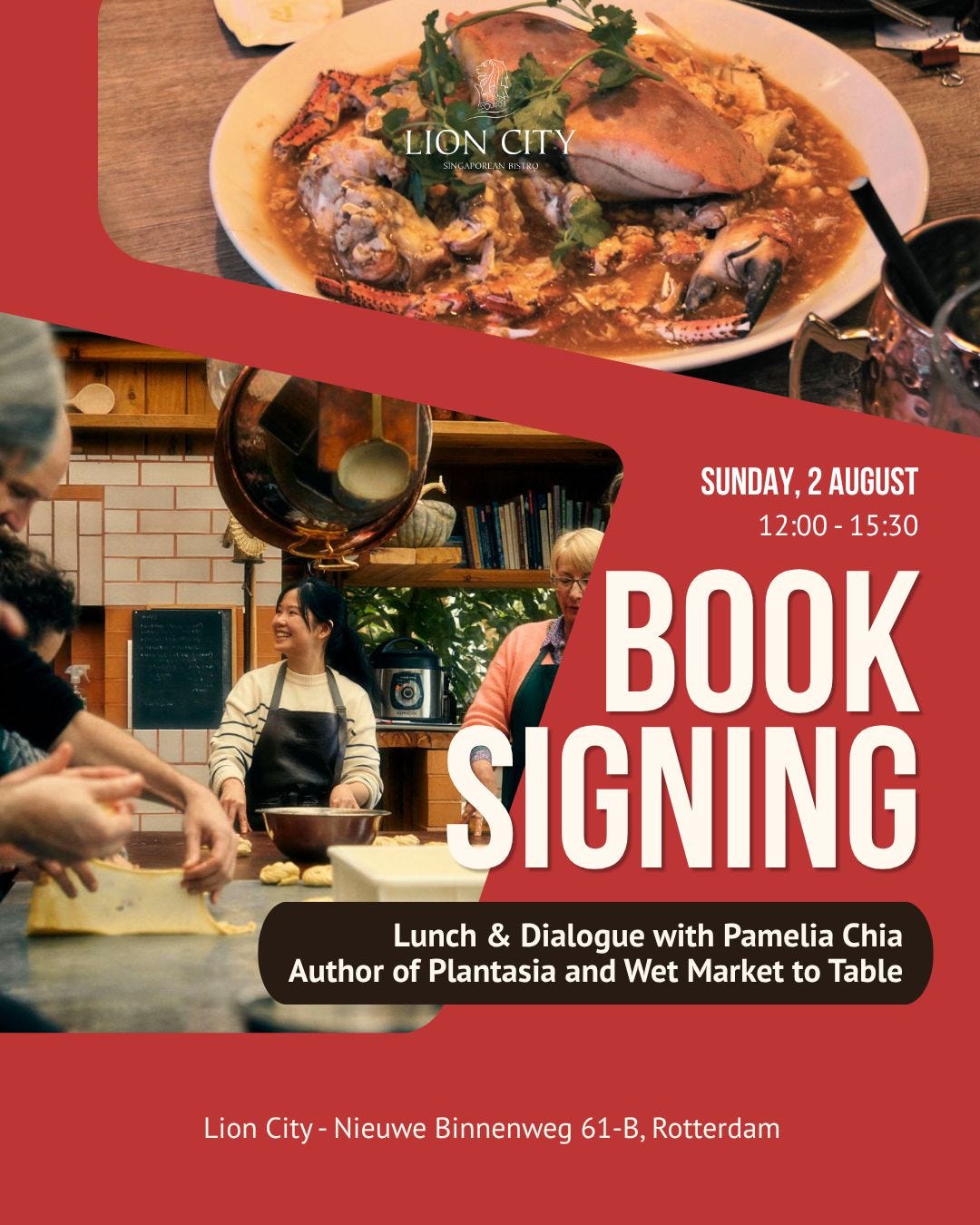
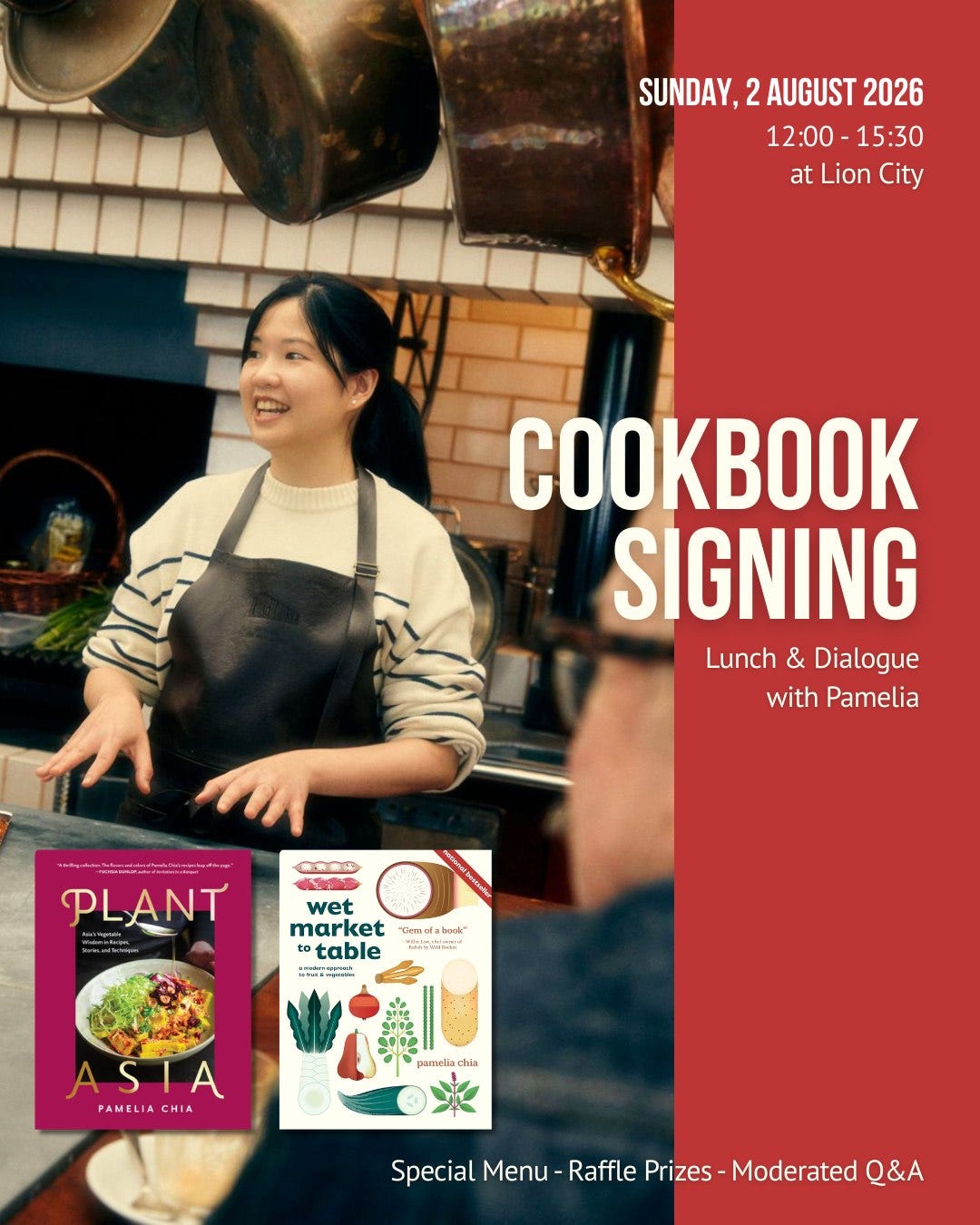
Book event in Rotterdam: I’ll be signing books and speaking about food heritage at Lion City in Rotterdam on 2 August 2026 (12:00-15:30). The event is free — to sign up, reserve your spot via the Lion City website. I’ll have my cookbooks Wet Market to Table and PlantAsia available for purchase.
Final copies of PlantAsia in Singapore: If you’ve been enjoying these weekly newsletters, you’ll probably enjoy my second cookbook PlantAsia: A Vegetarian Journey Through Asia as well. The original edition is still available for purchase and won’t be reprinted once the current stock is sold. Order your copy here.
Thank you for reading, and now onto this week’s recipe.
NAAN

Derived from the Persian word for bread (nān), naan is a flatbread that is spotted with smoky blisters, and slathered all over with melted ghee fresh from the oven. According to Preena Chauhan and Arvinda Chauhan’s New Indian Basics, naan was brought to India by the Moghuls from Central Asia. The locals bake the bread in a tandoor oven, a traditional piece of cooking vessel in Indian cooking which can reach incredibly high temperatures. The dough is stretched then slapped along the inner wall of this ferociously hot clay container, resulting in rapid puffing and charring. When torn into, it boasts a crumb that is pillowy yet chewy, blistered yet tender.
THE DOUGH
Naan is made with maida, which is a refined wheat flour. The closest supermarket substitute is plain flour. This is ideal compared to bread flour because for naan, you’re looking for enough gluten for stretch and structure, but not so much that it becomes tough. I use all-purpose flour of 10% protein content.
The next ingredient comes as no surprise: yeast. Naan is leavened bread, and it is the fermentation which gives naan its characteristic soft, airy texture and complex flavour.
Beyond the usual flour, yeast, salt, and water that you’ll encounter in almost all bread recipes, naan is notable for containing dairy. Yogurt is a common ingredient in many recipes, contributing mild tanginess and complexity, but more importantly fat. Fat coats flour proteins, weakening gluten formation and resulting in a more tender flatbread.
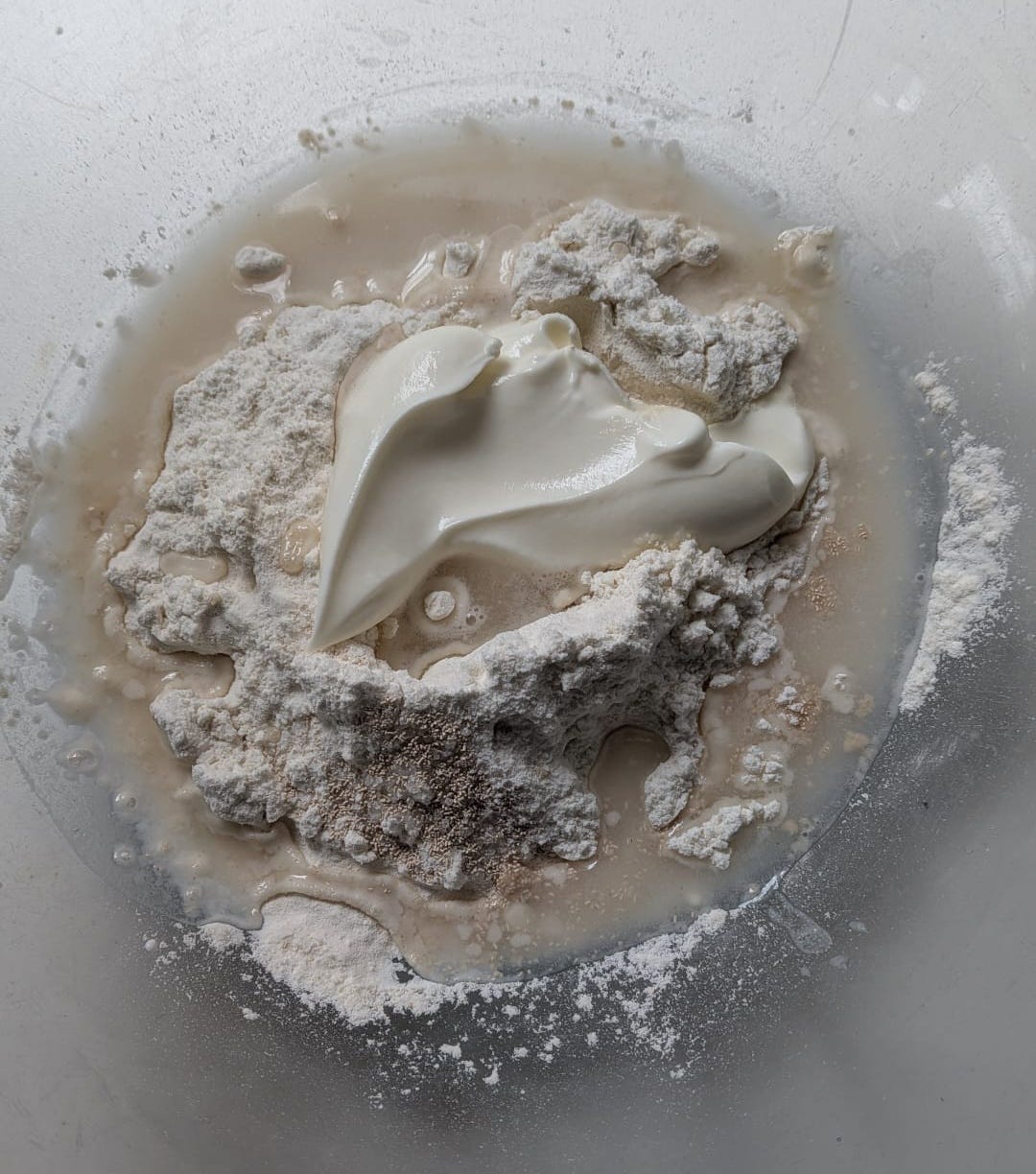
As an experiment, I made three different doughs:
Dough 1 (Flour, water, Greek yogurt, salt, sugar, dry yeast): A fairly lean dough that serves as the baseline.
Dough 2 (With oil added): Fat helps keep naan soft and pliable rather than stiff and crisp. By adding oil alongside the yogurt, I wanted to see how much I could inhibit gluten development and produce an even softer dough.
Dough 3 (With oil and baking soda added): Although traditional naan is leavened with yeast, baking soda appears in many modern recipes. It reacts with the acidic yogurt to release carbon dioxide, creating additional bubbles that contribute to a lighter, airier texture. It also partially neutralises the yogurt’s acidity. By raising the pH, baking soda can reduce some of the tightening effect that acidity has on gluten.
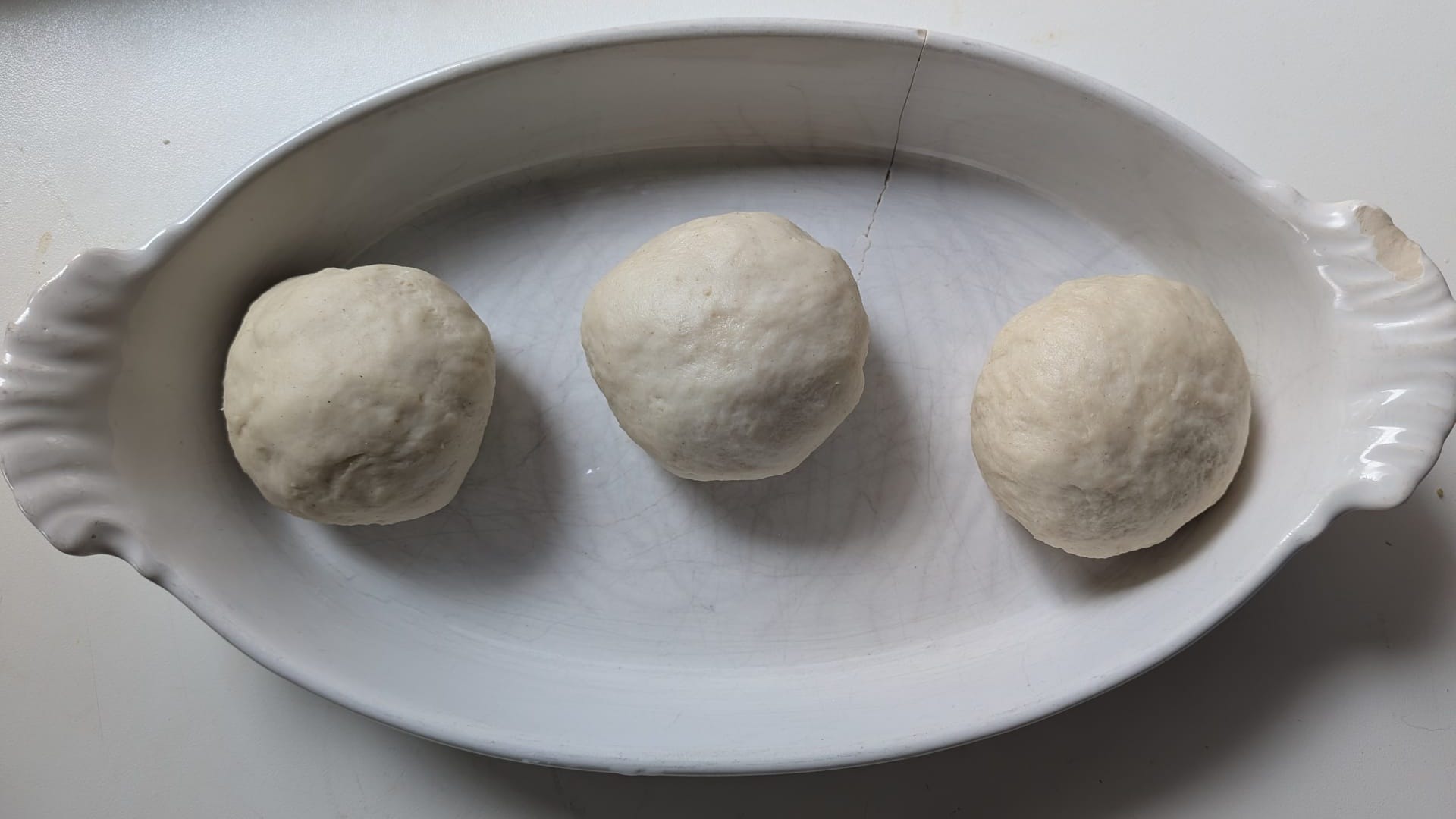 Left to right: Dough 1, 2, and 3.
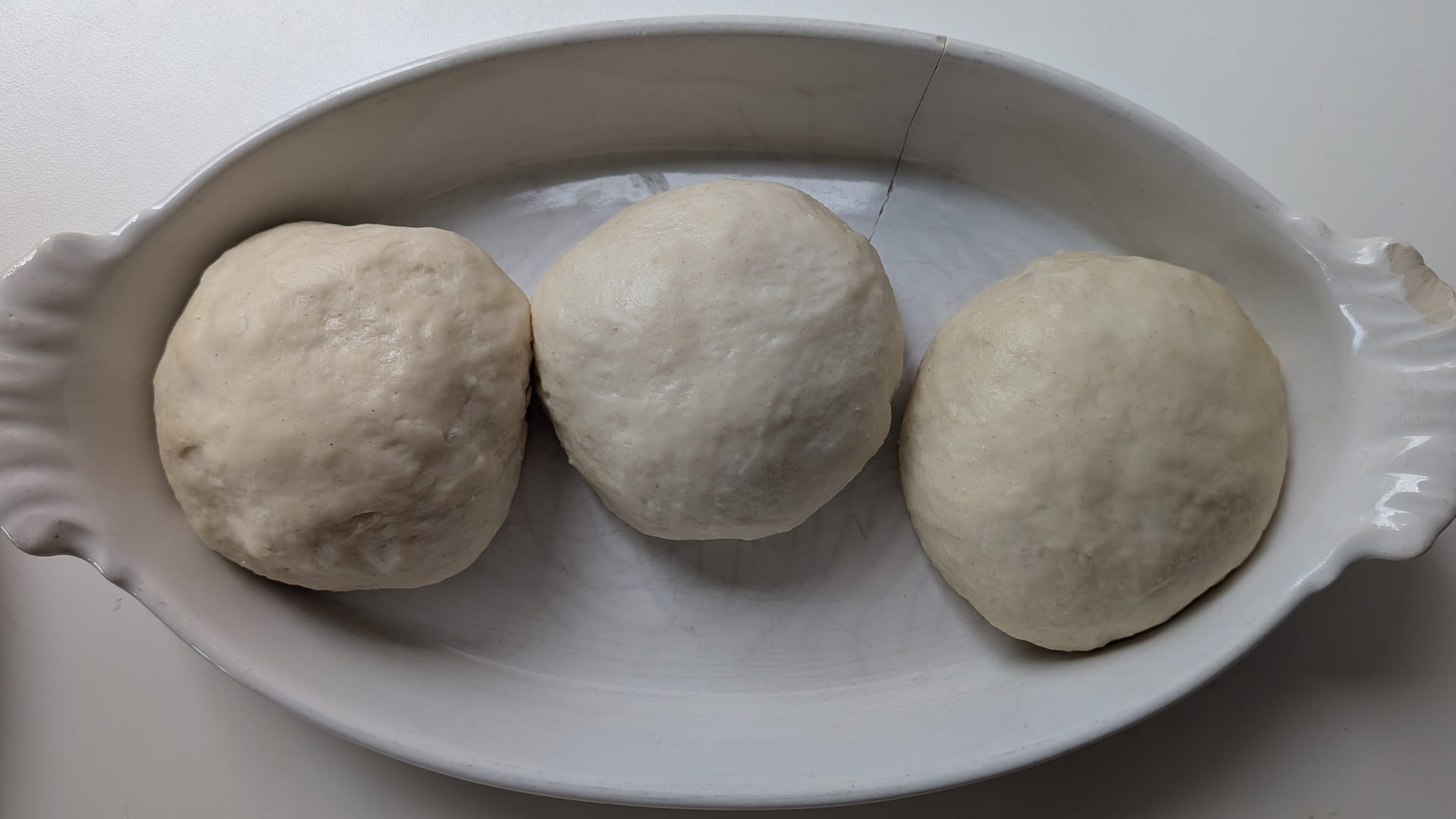 The three doughs, post-rise.
COOKING
A tandoor cooks naan at extremely high temperatures — this intense heat is what creates oven spring and blistering. I’ve seen some home recipes that try to replicate this with a regular oven, but a domestic oven simply doesn’t get hot enough to achieve the same effect. A thoroughly preheated pan is a better option. It is essential to heat the pan thoroughly so that you get maximum blisters and puffing. A hot pan also means that you prevent overcooking and thus dryness as much as possible, while maximising char.
I’ve seen a method on Youtube, where the dough is moistened on one side so that it sticks to the pan and cooked until the dough bubbles and puffs. The pan is then flipped upside down over the flame so that you get nice colouring all over the flatbread rather than only on the blisters. I find this method overly complicated and not effective when using a non-stick pan because the dough slides off. A cast-iron pan works better, but the pan is too heavy and unwieldy to flip. I much prefer cooking the naan on both sides in the pan, then swiping the flatbread over a flame to replicate the tandoor naan look.
The most delicious part of naan is the butter that’s slathered all over it while it is still piping hot. You could use regular melted butter, but a compound butter makes it ten times more delicious. I went with finely grated garlic and chopped coriander leaves. Using a butter you love is also key — mine is Kerrygold.
THE RESULTS
All three doughs tasted great, reminding me of restaurant naan flavour-wise. I loved that so much flavour was present in the naan with so little effort. That said, there were noticeable differences in texture between the three doughs:
Dough 1 was chewy, almost dry.
Dough 2 had a good balance of tenderness and chew. Wex’s favourite.
Dough 3 was the softest, almost shreddy and cake-like. My favourite.
I also experimented with allowing the doughs to ferment overnight in the refrigerator instead of at room temperature. They did not taste much more complex from the overnight rise, but it is nice to have that option of cooking the naan on another day if you don’t have the time for it. We enjoyed the naan for dinner with butter chicken and roasted vegetables and it was a cracking meal.
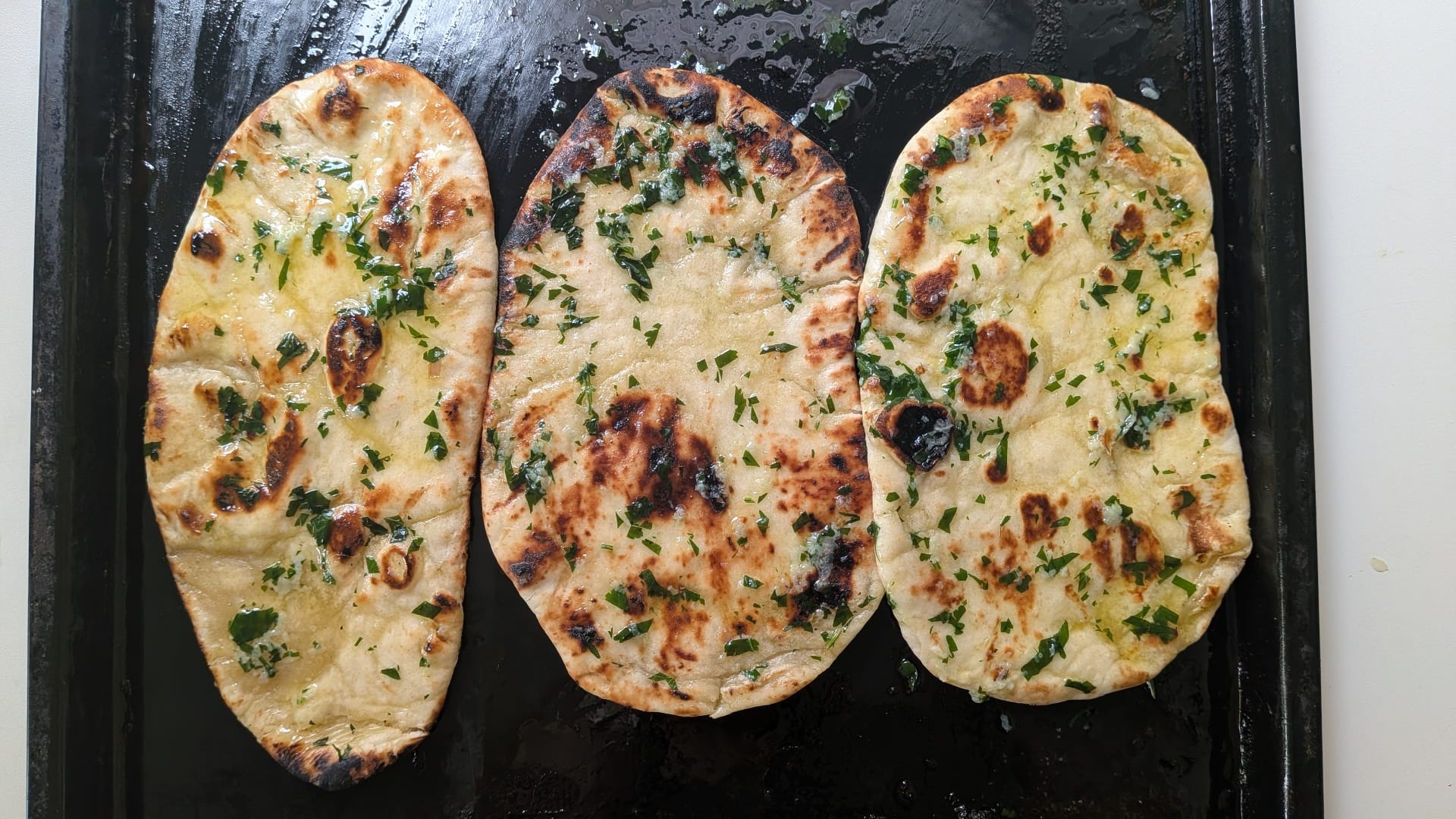 Naan 1, 2, 3.
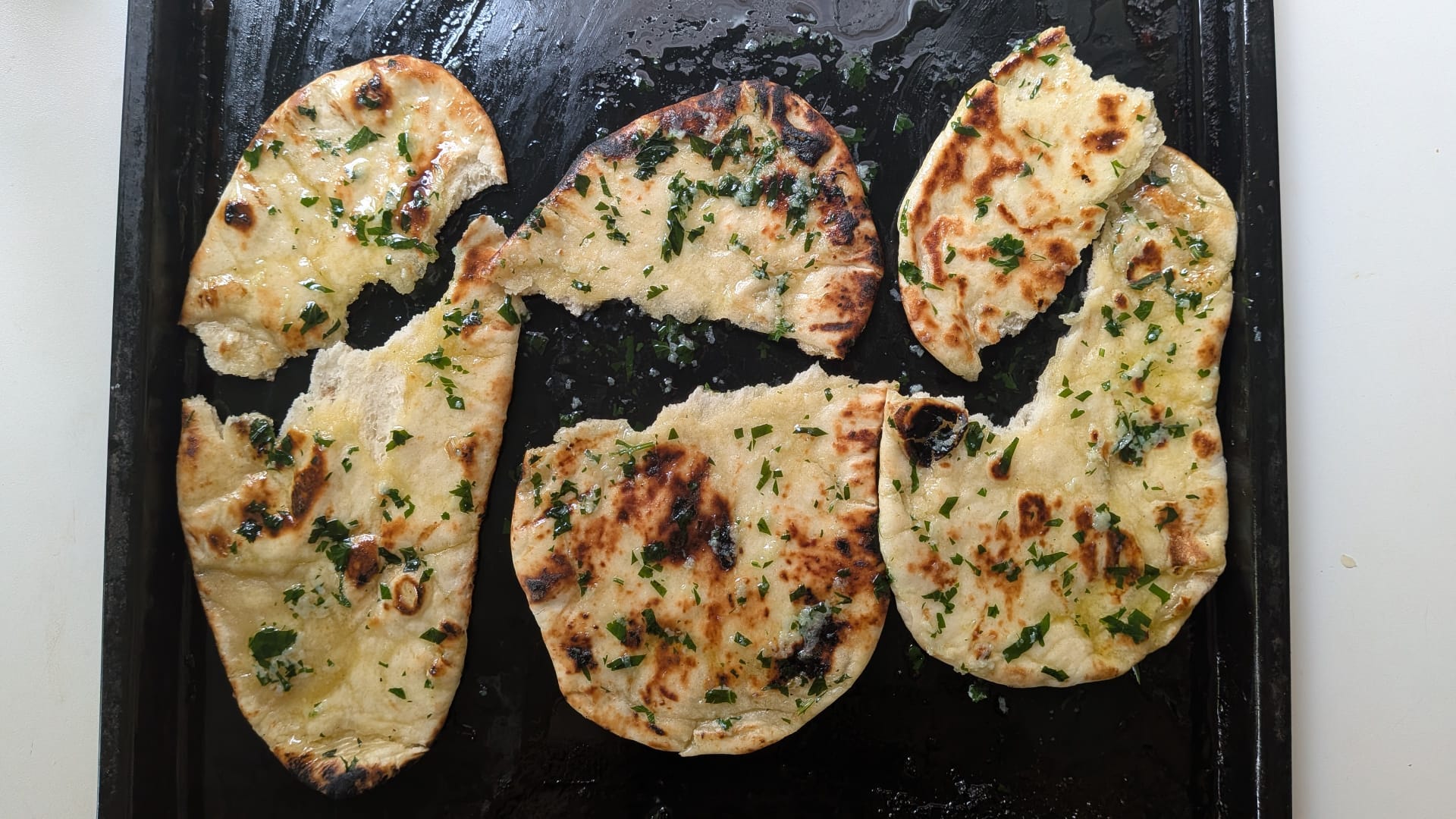 Naan 1, 2, 3 when torn into.
Naan
Makes 10 naan
July 17, 2026
taro toast
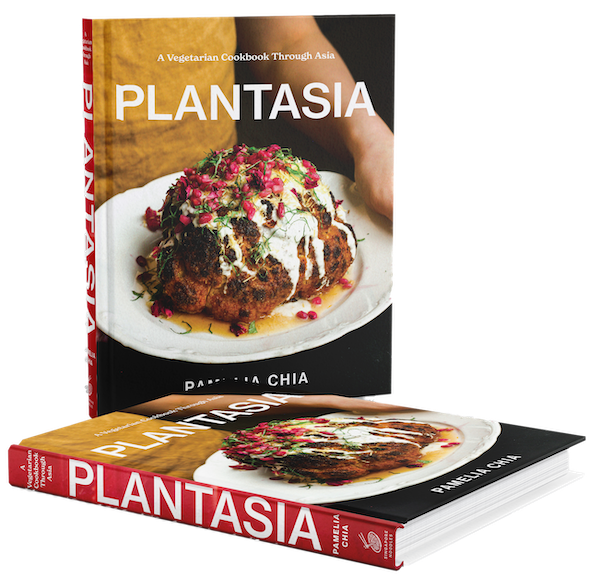
Welcome back to the Singapore Noodles newsletter! Before we get to this week’s recipe, a note on PlantAsia. If you’ve been enjoying these weekly deep dives into recipes, techniques, and food history, you’ll probably enjoy PlantAsia as well. The book follows the same curiosity — combining recipes with stories, ingredients, and the cultural traditions behind them. The original self-published edition is still available on my website. Once the remaining copies in Singapore are gone, I won’t be replenishing stock, and this edition will not be reprinted.
Thank you for reading, and now onto this week’s recipe.
TARO TOAST
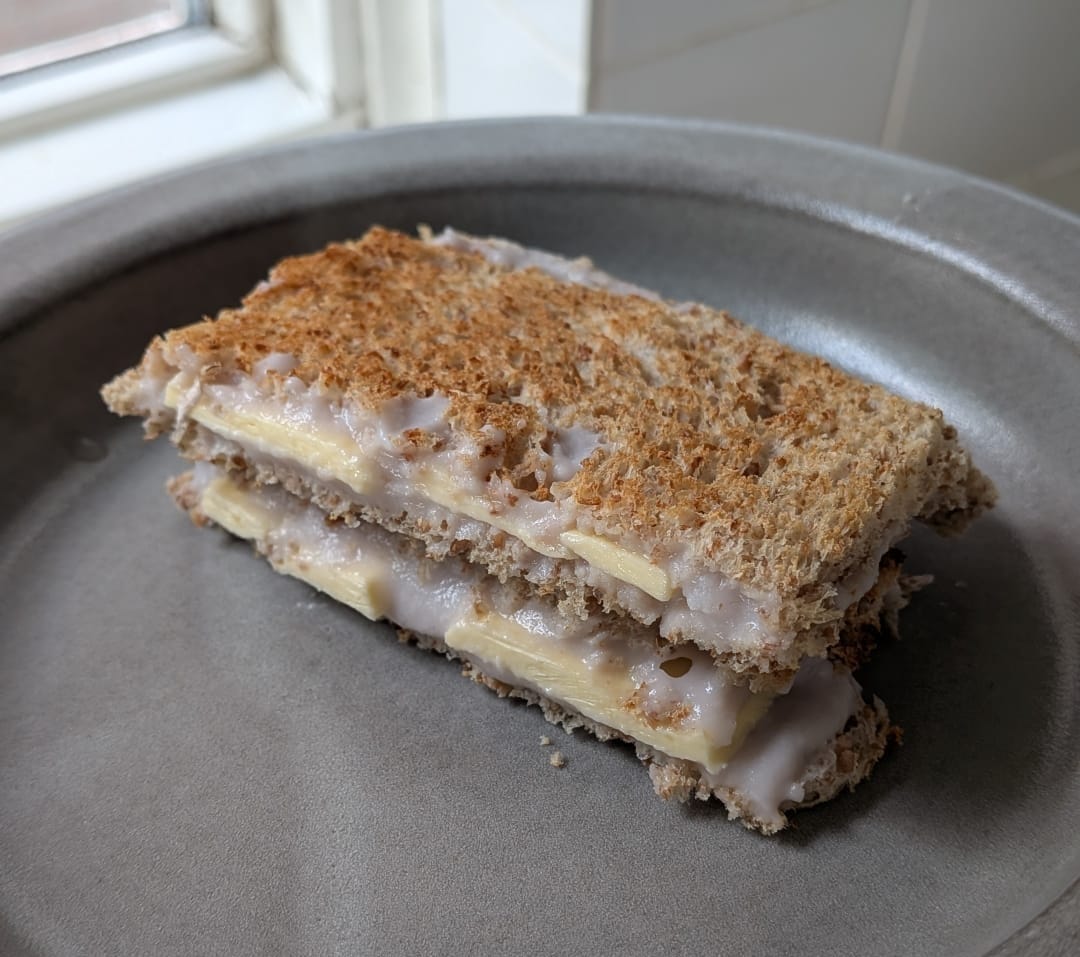
In Singapore, the national breakfast is kaya toast — toast filled with eggy, pandan-scented curd and shards of cold salted butter. The textures are lovely together: a single slice of bread toasted until it is so crunchy it is almost cracker-like, the oozing kaya, and smooth slabs of butter usually thick enough to leave teethmarks. Since moving abroad about 8 years ago, I’ve noticed a modern interpretation appearing in cafés which features a taro spread (orh nee 芋泥) instead.
Taro is an edible corm. It has ivory flesh with purple striations which, when steamed, has a powdery mouthfeel and sweet earthiness that works well in both savoury dishes and desserts. It is the star ingredient in orh nee, a traditional Teochew dessert where steamed taro is rendered into a luxuriously smooth paste with sugar and lard or shallot oil. While the traditional accompaniments for orh nee are pumpkin puree, fried shallots, and gingko nuts, some eateries also serve it with lashings of coconut milk.
Making taro spread is easy. I sliced up the frozen taro I’d bought from the Asian supermarket and steamed it until fork tender. While the taro steamed, I infused some water with pandan leaves. I then blended the taro with the pandan-infused water, sugar, oil, and salt. While the quantity of sugar to add is up to you, for the purposes of taro toast, I recommend a higher amount to approximate the sweetness of kaya. I stir in coconut cream at the end; if you blend coconut cream, sometimes it can lead to an off-smell from the coconut heating up and breaking down.
All that’s left to do is to simmer the mixture until it reaches your desired consistency. For maximum ooziness, I’ve kept it quite runny — just until you can see the bottom of the pot as you stir. Refrigerate the spread until it is thoroughly chilled.
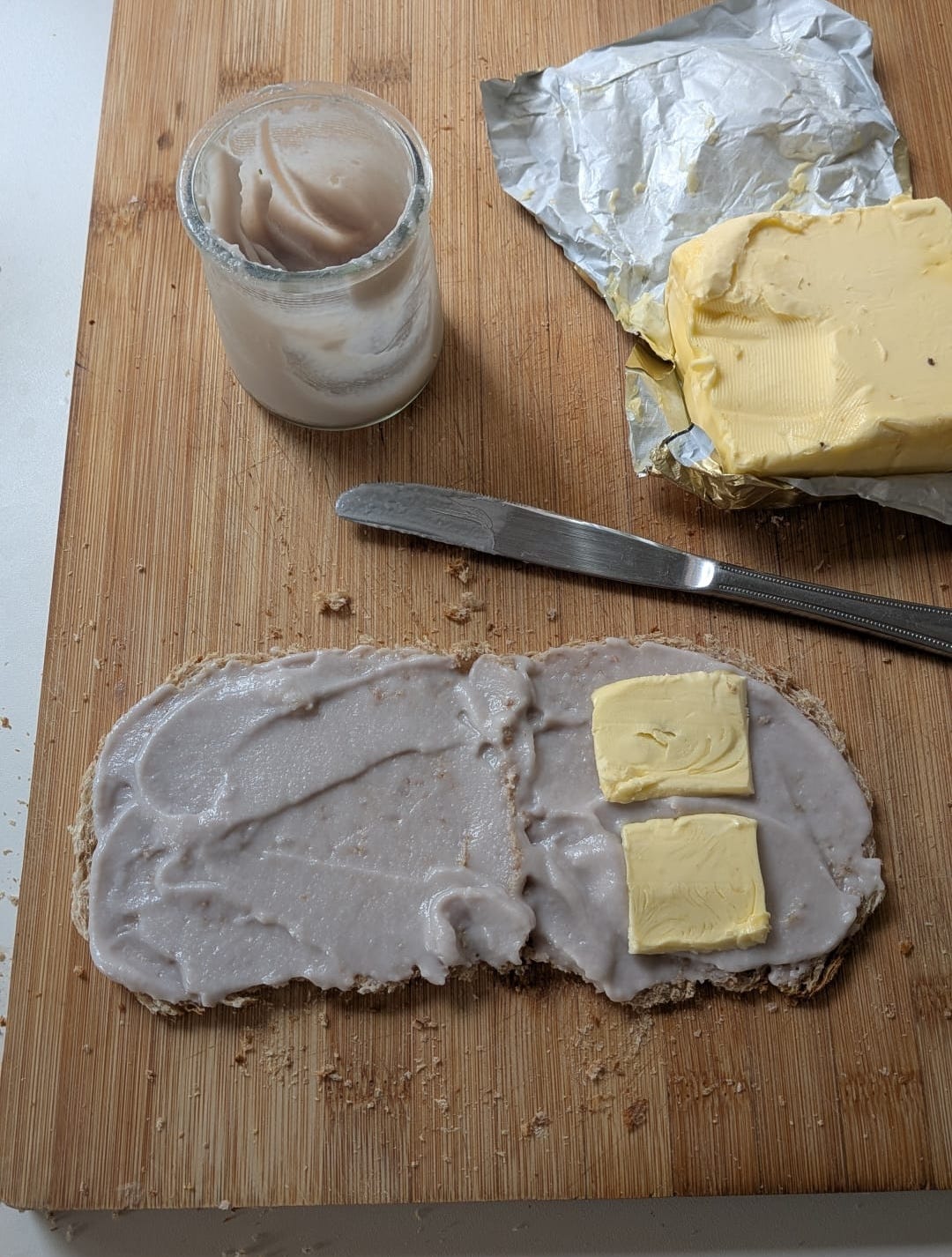
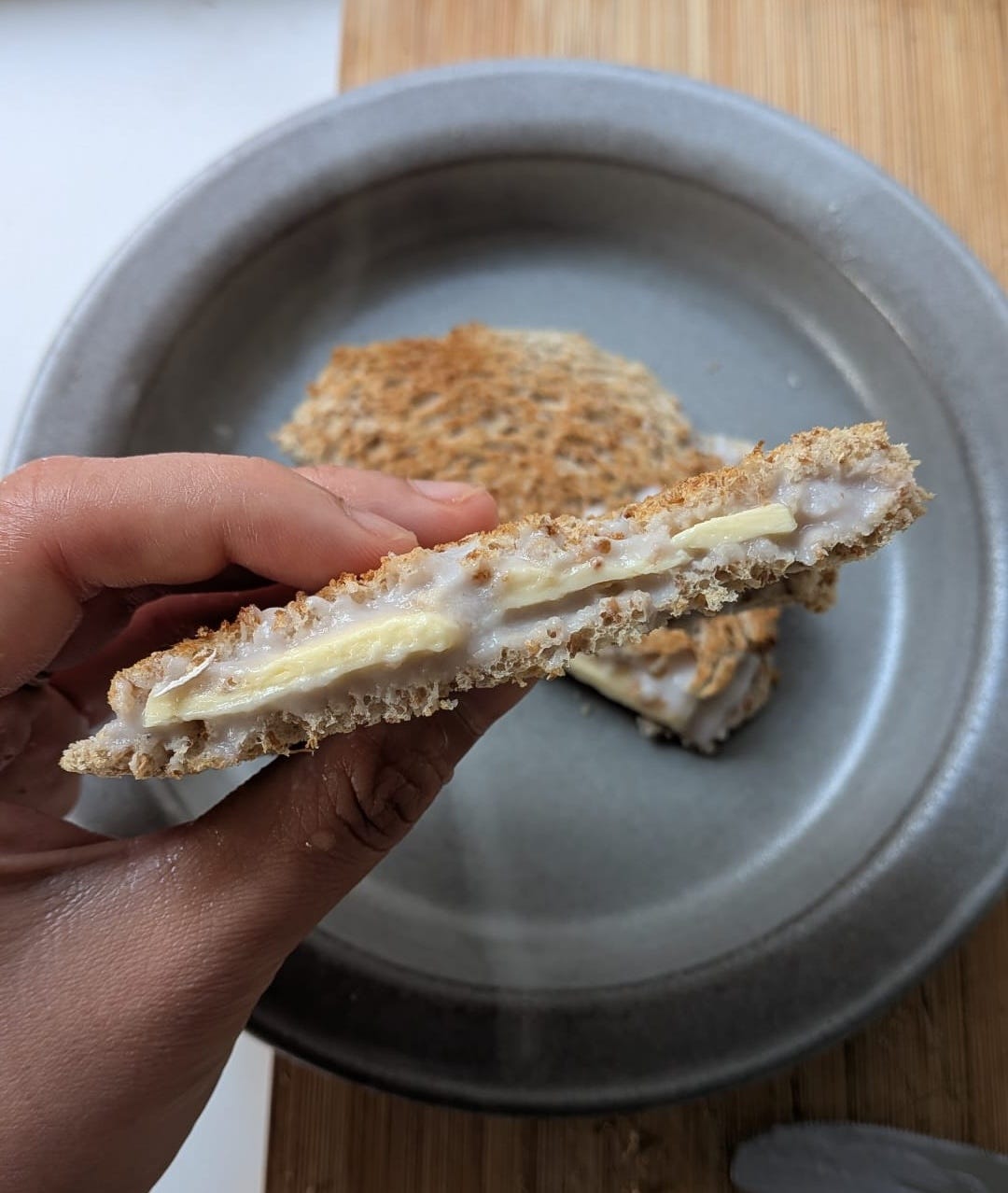
For the taro toast, any sandwich bread will do — white or brown both work. The key is to toast it really well and cut off the crusts. Slice it in half with a serrated knife and slather the taro spread generously on both sides. Top with as much butter as you dare. It is important that the butter is good quality (I like Kerrygold). Close the sandwich and slice it in half to expose the oozing cross-section and enjoy.
Taro toast
Makes about 1/2 jam jar’s worth
July 3, 2026
scallion pancakes 葱油饼
Welcome back to the Singapore Noodles newsletter! Before we get to this week’s recipe, a note on PlantAsia. If you’ve been enjoying these weekly deep dives into recipes, techniques, and food history, you’ll probably enjoy PlantAsia as well. The book follows the same curiosity — combining recipes with stories, ingredients, and the cultural traditions behind them. The original self-published edition is still available on my website. Once the remaining copies in Singapore are gone, I won’t be replenishing stock, and this edition will not be reprinted.
Thank you for reading, and now onto this week’s recipe.
SCALLION PANCAKES 葱油饼
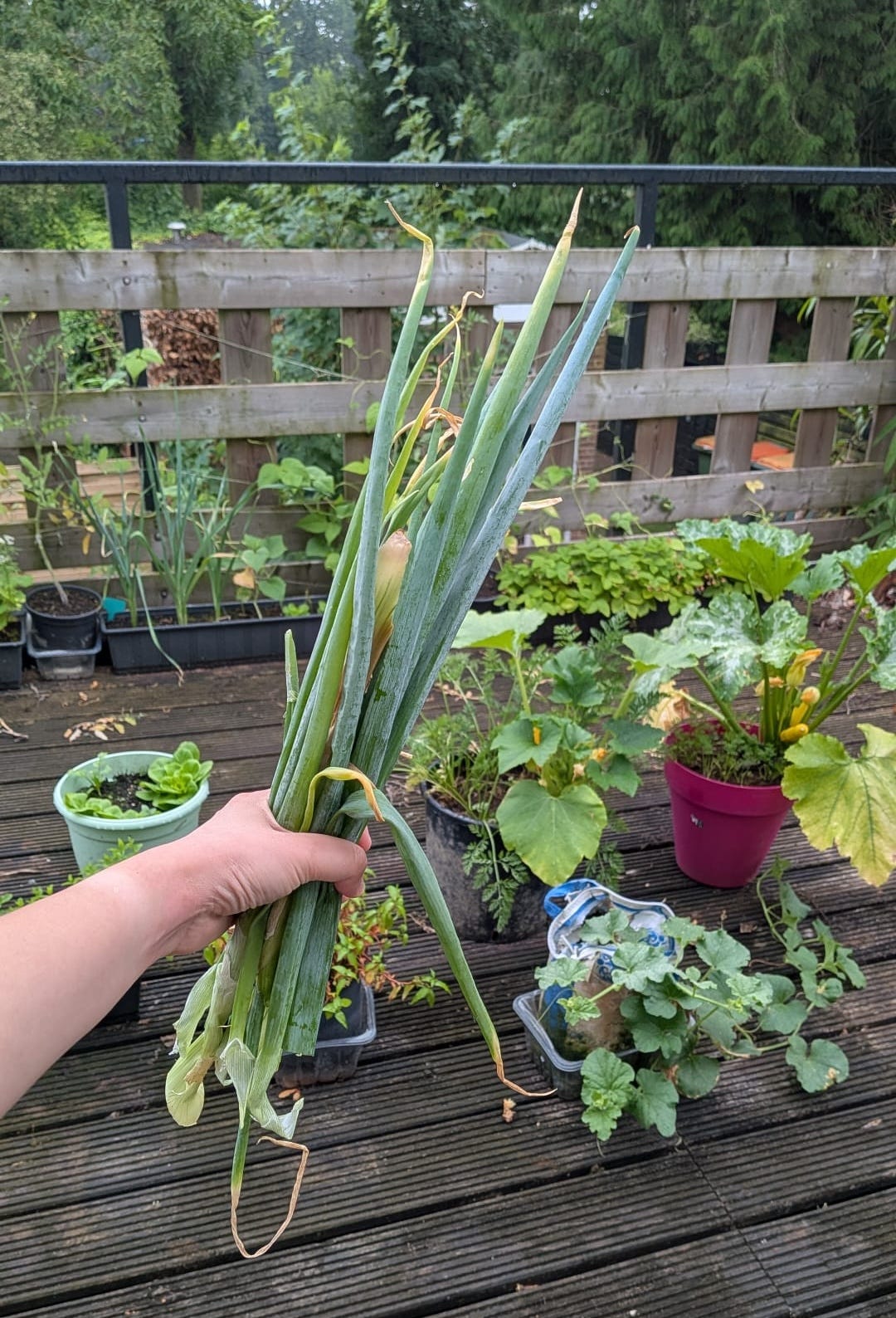
The pleasant weather of late has meant that our garden is now in full bloom. Our spring onions, in particular, are thriving, so Wex proposed some scallion pancakes. These are not true pancakes in the Western sense — they are studded with sliced spring onions, and come closer to crisp flatbreads with tissue-thin, tender layers within.
Like other food items that involve simple ingredient lists and cooking techniques, scallion pancakes go so far back in time that it is difficult to pinpoint their origin. That said, Chinese Menu: The History, Myths, and Legends Behind Your Favorite Foods by Grace Lin suggests a connection to Shanghai. As a trading port with a large population of South Asian descent, the flaky, layered scallion pancake might have emerged here, inspired by the paratha that the Indian immigrants were accustomed to eating.
Unlike paratha, scallion pancake traditionally relies on a hot water dough. The goal is to achieve a dough that is easy to roll out, so that you get lots of thin, tender layers within each pancake. Adding boiling water to flour limits the formation of gluten, which is what causes toughness and elasticity.
Another way to reduce gluten presence in the dough is to use flour of a lower protein content. In fact, many recipes for scallion pancake online call for a mix of cake flour and plain flour. Unfortunately, cake flour isn’t at all common here in the Netherlands, so I replaced part of the flour mix with cornstarch, which contains no protein.
Once the dough is made, it has to rest overnight in the refrigerator so that the gluten has a chance to relax. Given the long rest in the refrigerator, brushing the surface with oil is key to prevent the surface of the dough from drying out.
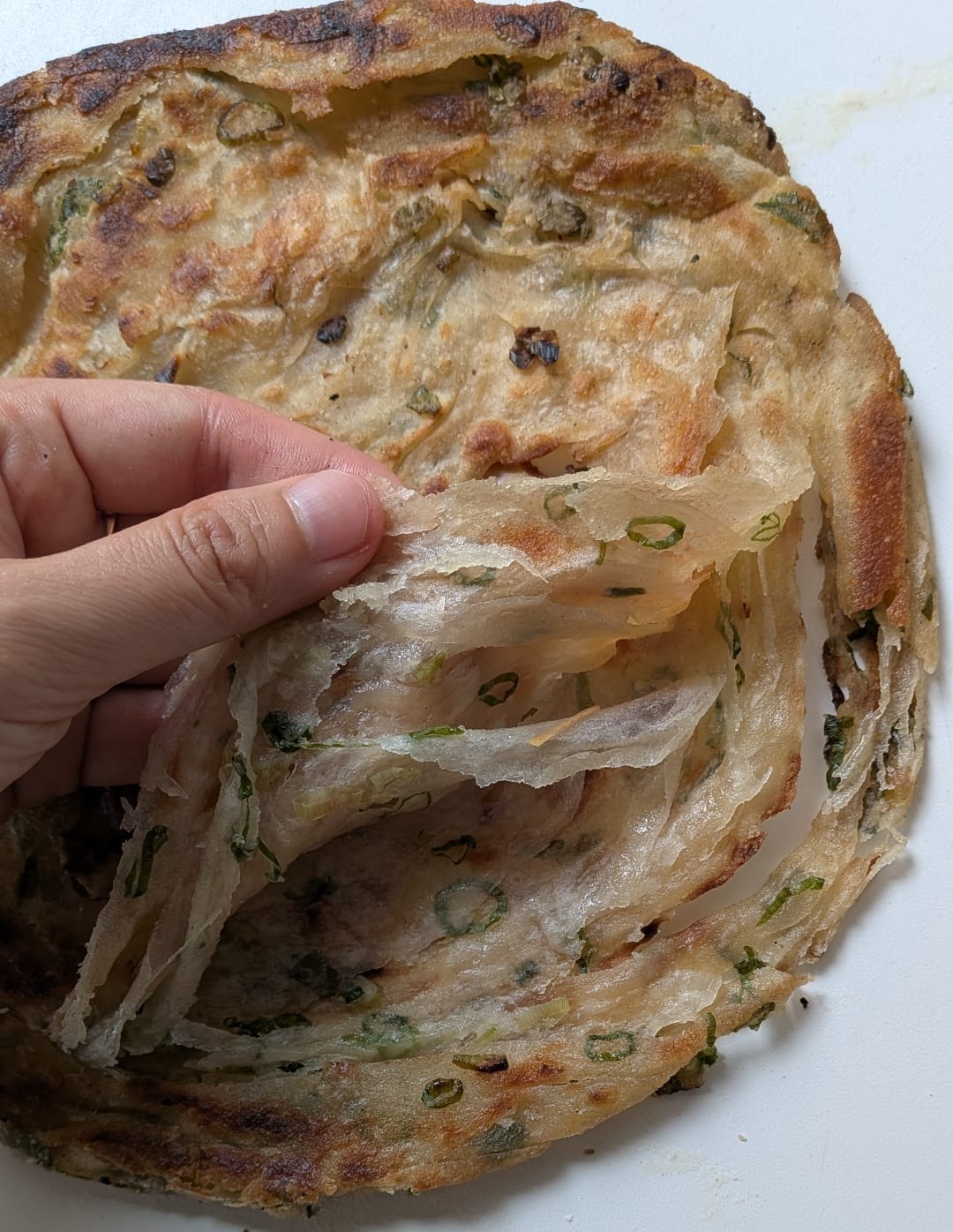
Scallion pancakes are a sort of laminated pastry — the dough is rolled out into a thin sheet, then fat and spring onion is spread all over, and the sheet is then rolled up and coiled to create many thin layers. I’ve seen two approaches: the first distributes oil and fresh spring onion between the layers, while the other uses an “oil roux” (油酥). At its core, the oil roux is flour scalded with hot oil, resulting in a thin, fragrant paste that can be spread over the dough. For fragrance, the spring onion can be added to the mixture to be scalded as well.
I was curious about the differences between the two approaches, so I prepared two pancakes using the same dough — one layered with oil and fresh spring onion, and the other with the spring onion-infused oil roux.
Once fried, the results were astounding. The pancake with fresh spring onions didn’t roll out into as neat a circle compared to the pancake with the oil roux, and the flavour of spring onion was greener and more pungent — which could be a good thing, depending on your personal preference. That said, the layers stuck together rather than being separated, so the overall texture was tougher and gummier.
The pancake with the oil roux really surprised me — the presence of flour allowed the layers to be clearly defined and the the pancake was super crispy and pastry-like. That said, the spring onion flavour was a little more subtle. This was an easy fix: I added some chopped fresh spring onion to the wilted spring onion and oil roux mixture for a stronger fragrance without the spring onion getting in the way of rolling the dough out.
Scallion pancakes vary widely in thickness, depending on the variant (thicker pancakes offer a chewier, more substantial bite). I experimented with two different thicknesses: thin (with the pancake measuring approximately 24cm across), and thick (13cm across). While thin pancakes could simply be fried uncovered on both sides until they turned brown and crisp, the thicker ones had to be cooked covered and over low heat, so that they could cook through thoroughly. For the latter, it was crucial for the oil roux to be spread thinly to avoid a sandy mouthfeel.
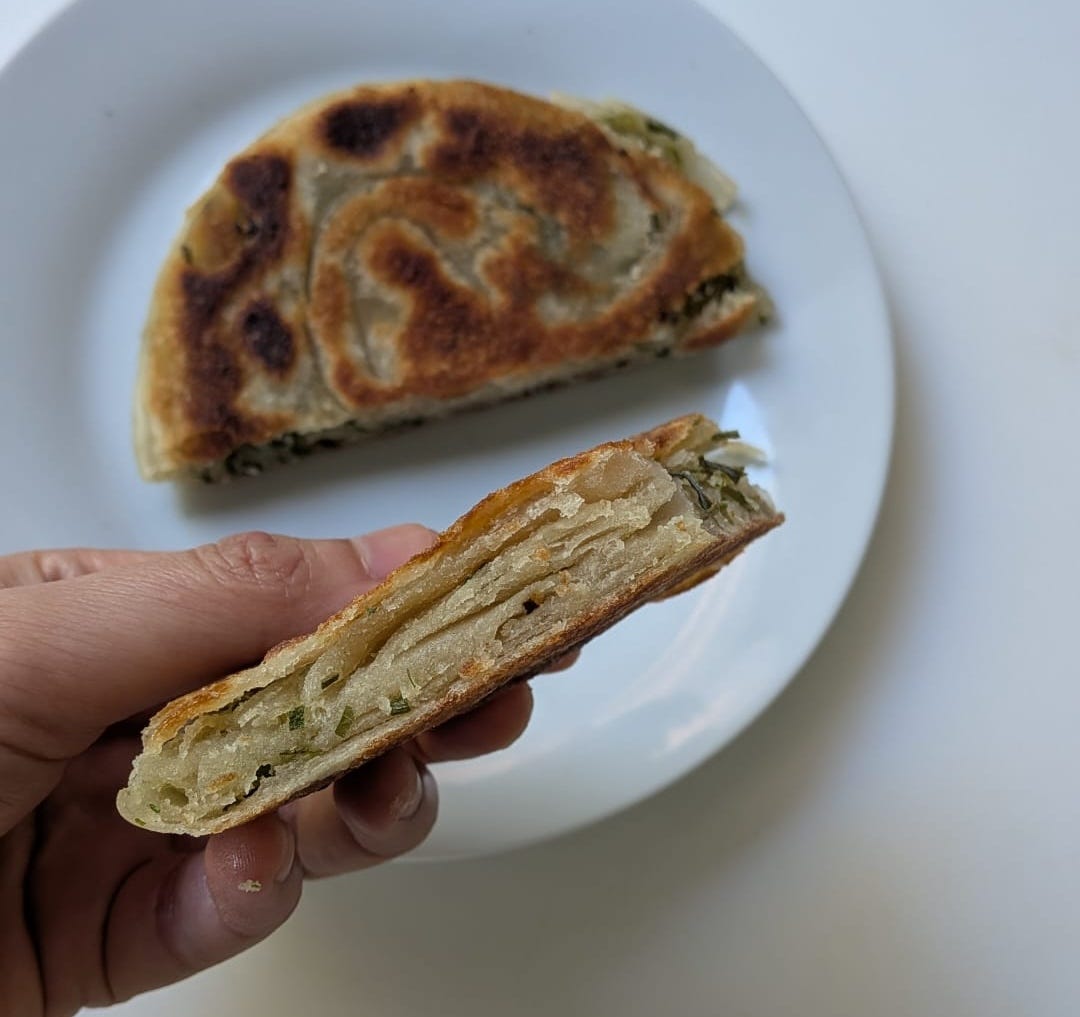
In the end, my preference is for the thinner pancakes. Once you have them rolled out between parchment sheets, you could freeze them if not enjoying immediately. Simply pop them into a pan with a bit of oil, over low heat, without defrosting.
Scallion pancakes 葱油饼
Makes 6 pancakes | Vegan
June 27, 2026
tempura soba
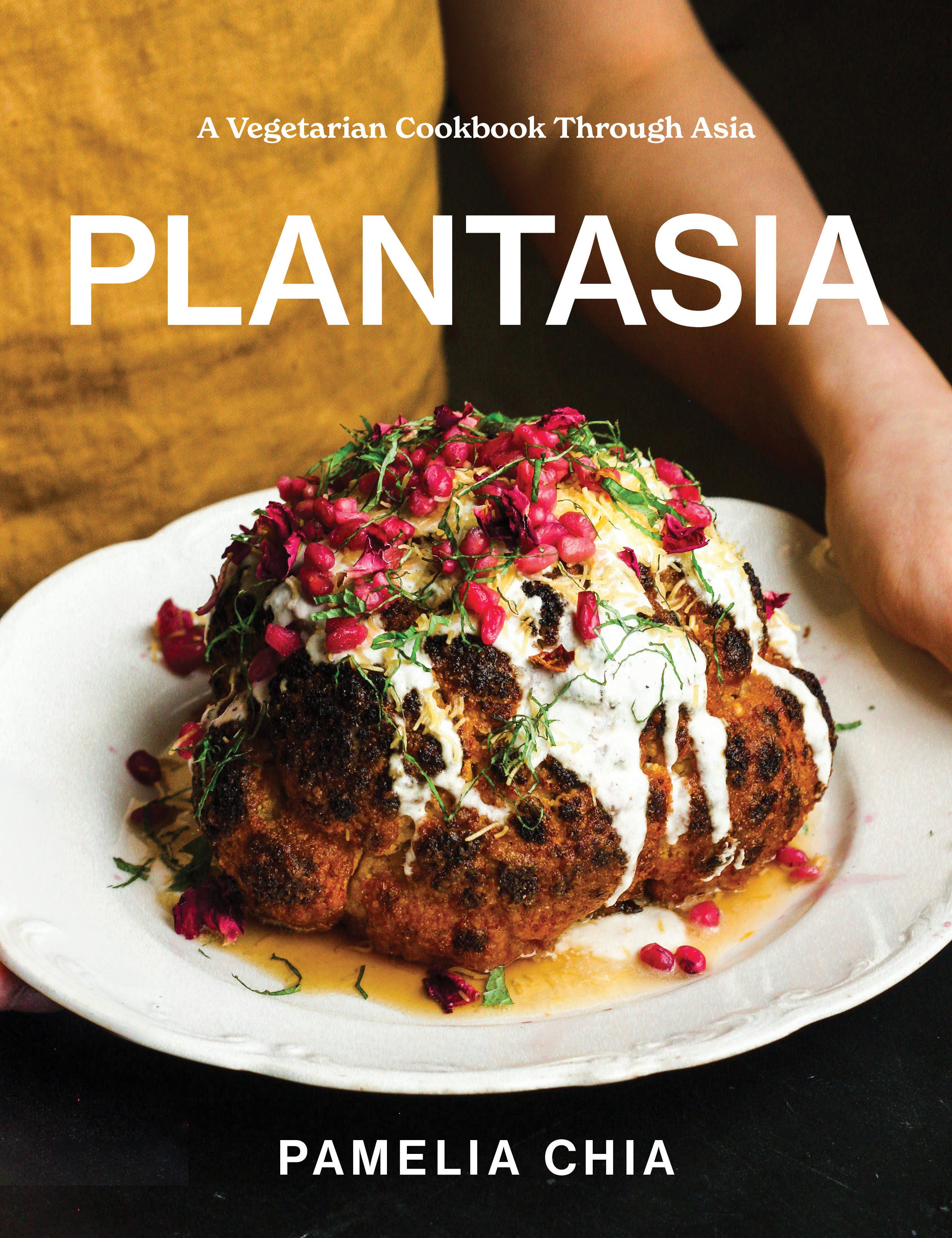
Before I get to this week’s recipe, I want to share an update on my second cookbook, PlantAsia: A Vegetarian Cookbook Through Asia. I published PlantAsia in 2023 because I believe that part of eating sustainably is reducing our overconsumption of meat. As someone who does eat meat, I wanted to explore the ways in which Asian cuisines make vegetables as delicious and satisfying.
What began as a self-published passion project has since found readers around the world, and last year I signed with a publisher to bring a new global edition to bookstores internationally.
It’s been incredibly rewarding to see the book take on a new life. But it also means that the original edition — the one I independently created, edited, and published — is approaching its final chapter. There are now just 175 copies remaining in Singapore, and once these are gone, I will not be reprinting this edition.
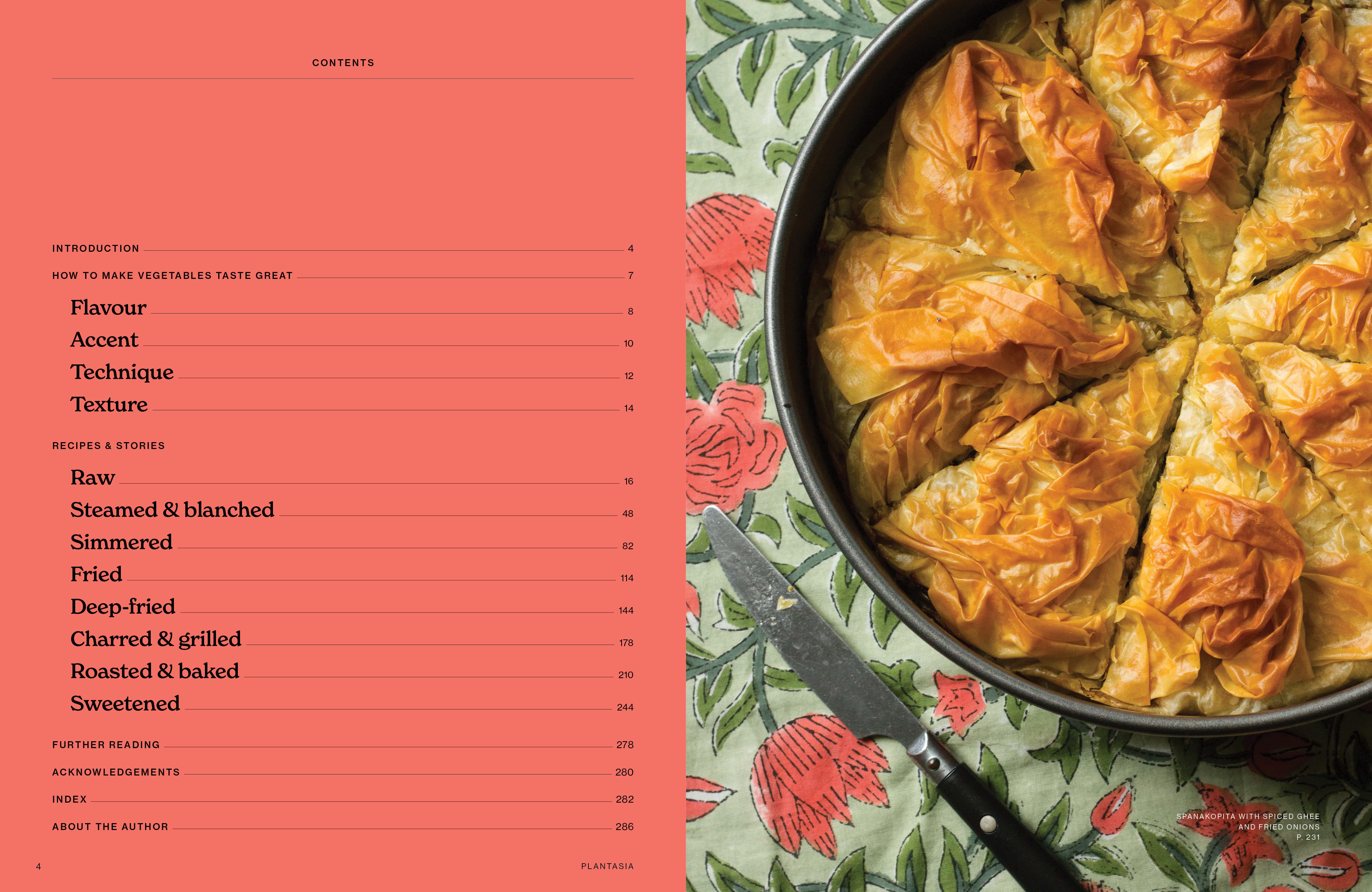
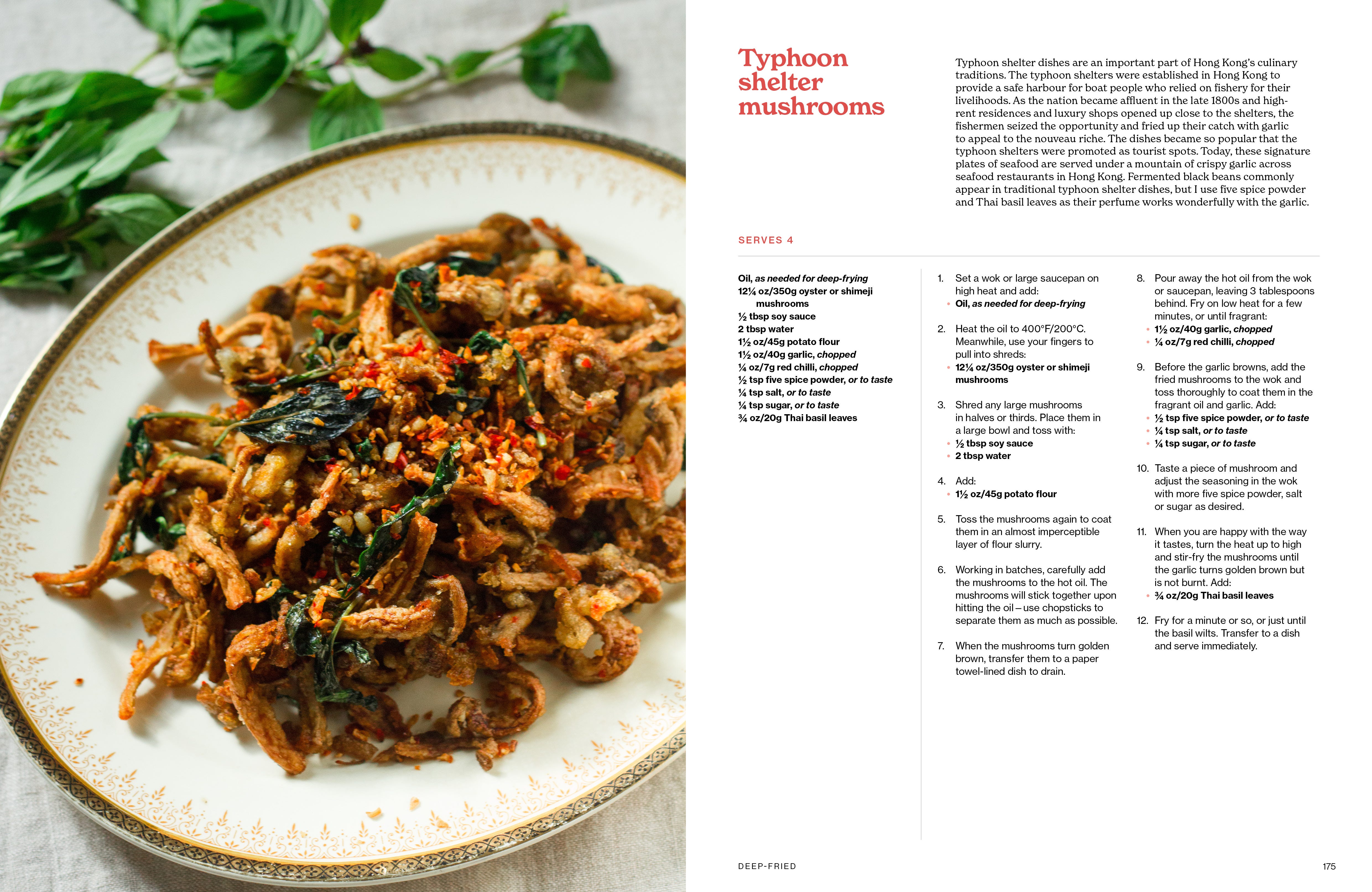
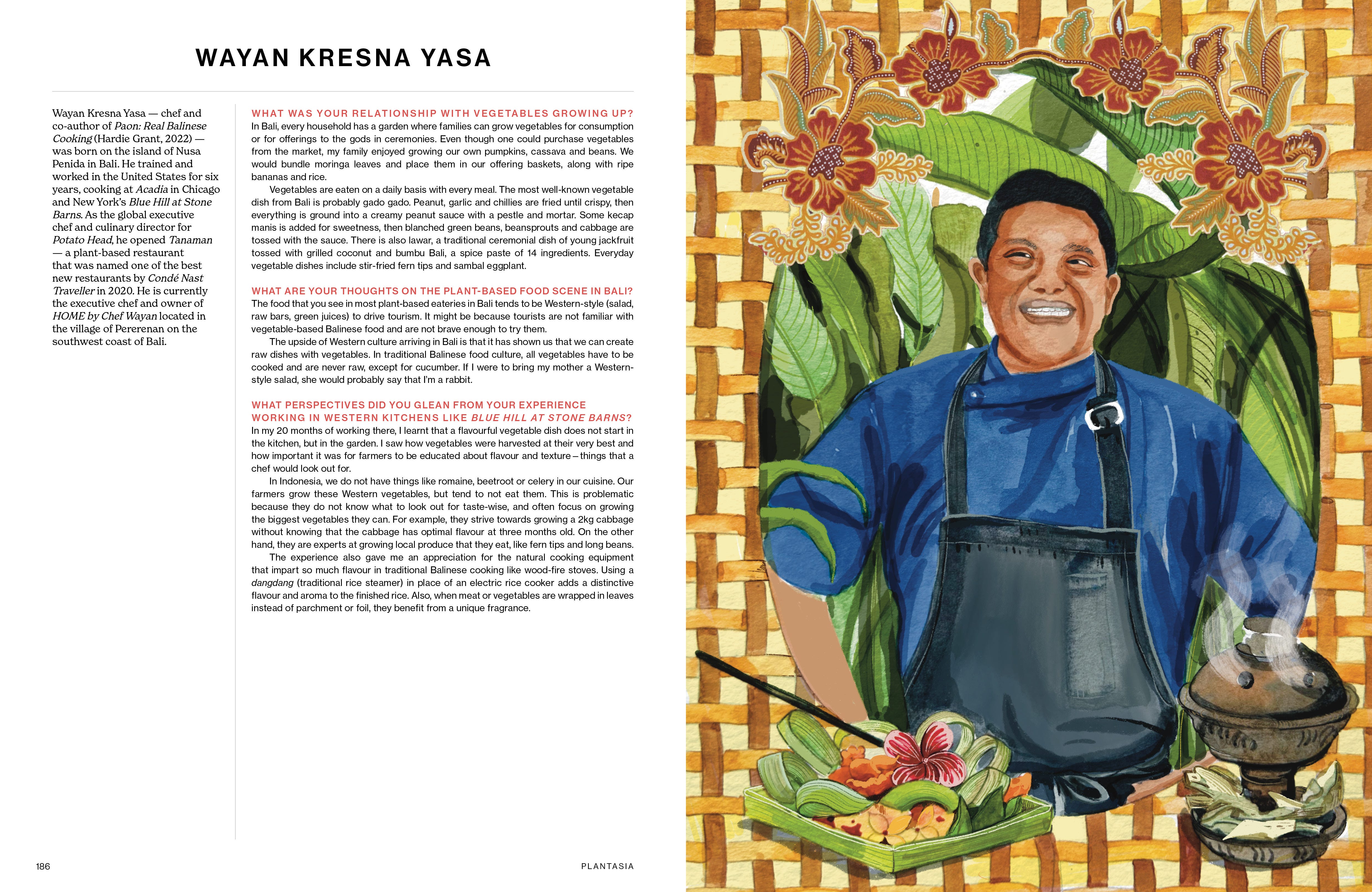
If you’ve been meaning to add PlantAsia to your bookshelf, or if you’d like to own the original edition that started this journey, order it while stocks last (free shipping for Singaporean addresses).
Whether you bought the book, cooked from the ebook, or have simply followed along on this journey, thank you. Your support has made it possible for this self-published cookbook to grow into something bigger than I’d imagined.
TEMPURA SOBA
We’re right smack in the middle of a heatwave right now. You’d think that as people who grew up in Singapore, we would be adjusting better to this sudden spurt of heat but we’re not! For one, air-conditioning in homes and public spaces are the norm; and two, after having living in the Netherlands for the past three years, our bodies are now slightly more adapted to the cold. In the absence of an air-conditioning unit at home, the way we’ve been coping is through chilled beverages and meals.
I am a huge fan of cold / cool noodles, such as this chicken rice-inspired glass noodles and cold noodles with peanut butter dressing. Recently, for dinner, we had tempura soba, which was not only a way to beat the heat, but also a way to clear my fridge of all the bits and bobs of vegetables I had.
Funnily enough, I couldn’t find tempura flour at the Asian supermarket or regular supermarket, so I made my own really quickly with pantry ingredients and it turned out well. The main thing to note is that the batter should be closer to the consistency of heavy cream than pancake batter, so that it fries up as a wispy coating than a thick shell. Deep-fried food might be the last thing on your mind in hot weather, but tempura is so light and delicate that it doesn’t weigh you down, and it’s absolutely delicious when dipped briefly in that iced sauce.
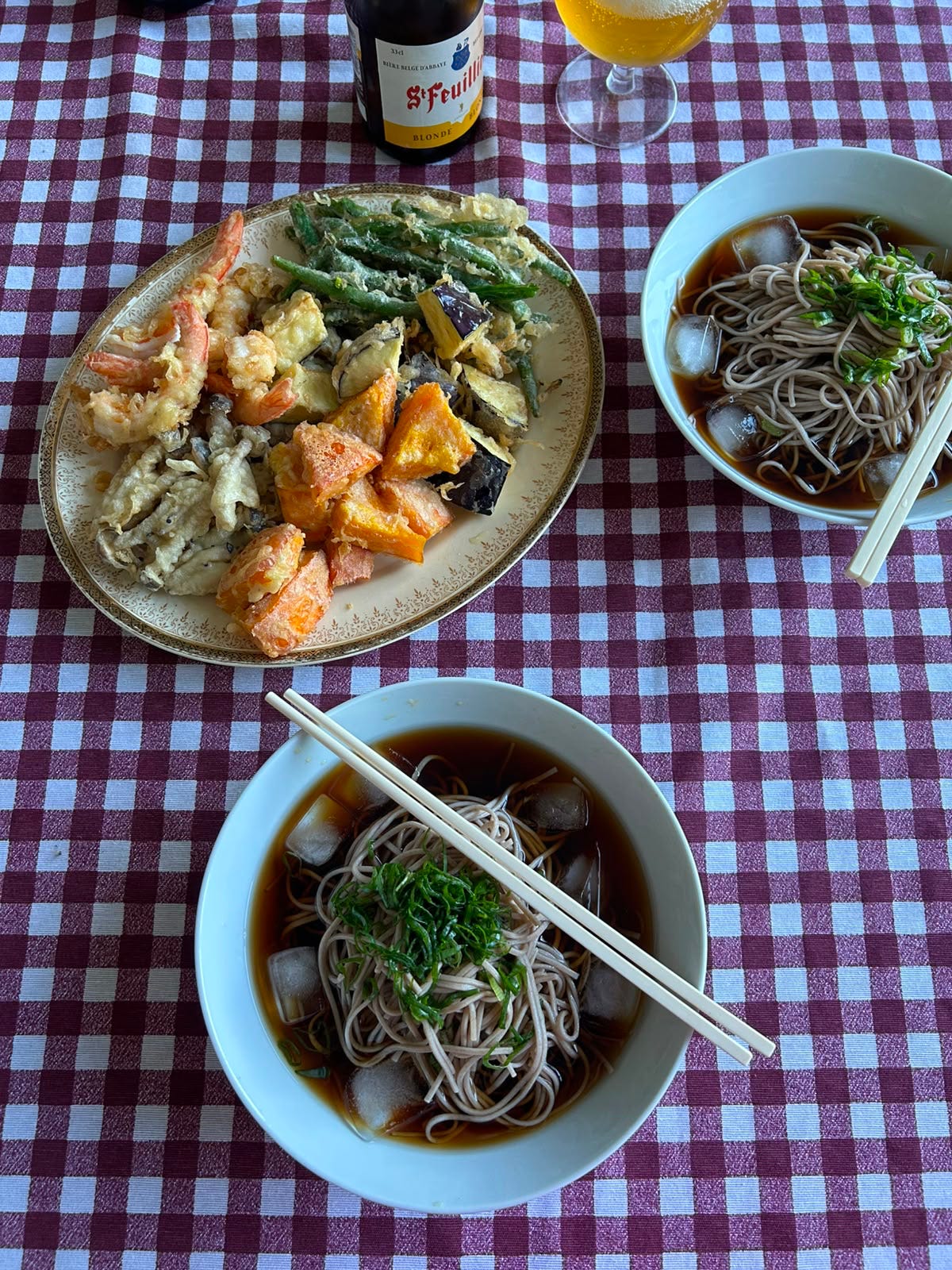
Tempura soba
Serves 2
For the soba and sauce:
200g mirin
120g soy sauce
1 teaspoon dashi powder
Squeeze of lemon or yuzu juice
400g cold water
2 bundles dried soba
For the tempura:
Oil, for deep-frying
125g plain flour
2 tablespoons cornstarch
1/2 teaspoon baking powder
1/2 teaspoon salt
240g sparkling water
1 egg yolk
A few shelled prawns, deveined (score the underside to prevent from curling up)
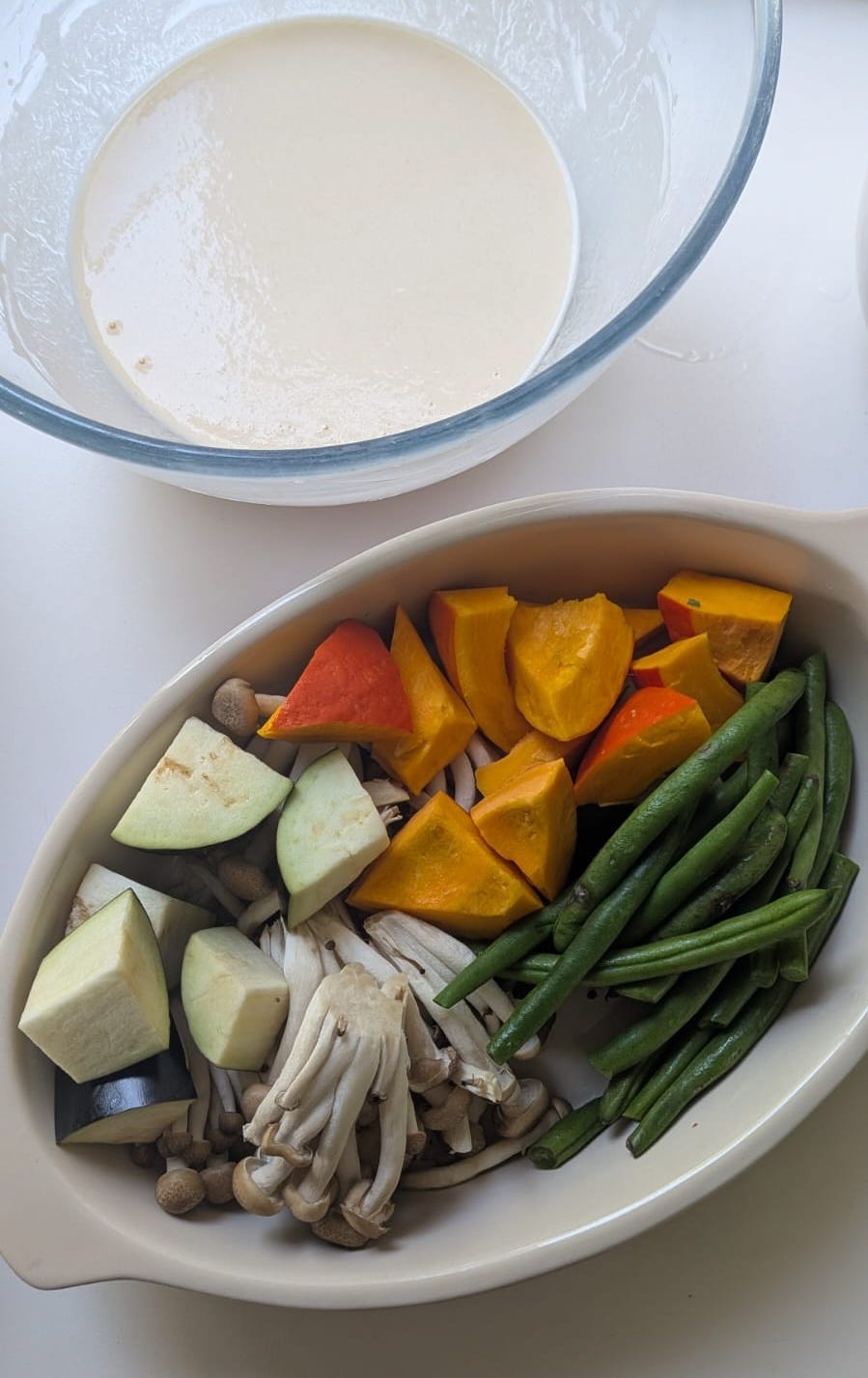
Assorted vegetables of your choice, such as a few pumpkin slices, shimeiji clusters, trimmed French beans, bite-size pieces of eggplant etc.
For serving:
Thinly sliced spring onion
A handful of ice cubes
Wasabi paste (optional)
Make the sauce: In a bowl, combine the mirin, soy sauce, dashi powder, lemon or yuzu juice, and cold water. Place in the refrigerator to chill.
Boil the soba: Fill a pot with salted water and bring it to the boil. Add the soba and cook for 2 minutes, or until al dente. Drain and rinse in cool running tapwater to get rid of excess starch. Drain very well and set aside.
Prepare the tempura: In a wide saucepan, heat the oil for deep-frying. In a bowl, whisk together the flour, cornstarch, baking powder, salt, sparkling water, and egg yolk to form a watery batter that still coats your finger when you dip it inside. When the oil is hot, dip the prawns in the batter, allowing excess to drip off, then add them to the pan. When golden and crispy, transfer the prawns to paper towels to drain. Repeat this with the vegetables.
To serve: Arrange the vegetables attractively on a sharing platter. Divide the soba between two serving bowls (if the soba sticks together, rinse and drain again). Top with the spring onion. Pour over the sauce and add the ice cubes. Serve with wasabi and the tempura on the side (they are delicious dipped into the sauce).
If you’re in the Netherlands...
I’ll be signing books and speaking about food heritage at Lion City in Rotterdam on 2 August 2026 (12:00-15:30). The event is free to attend — to sign up, reserve your spot via the Lion City website. I’ll have copies of both my cookbooks (Wet Market to Table and PlantAsia) available, and you’re also very welcome to bring along your own copy for signing. See you there!