Eva Chatterji's Blog
September 17, 2026
The Bombay Presidency
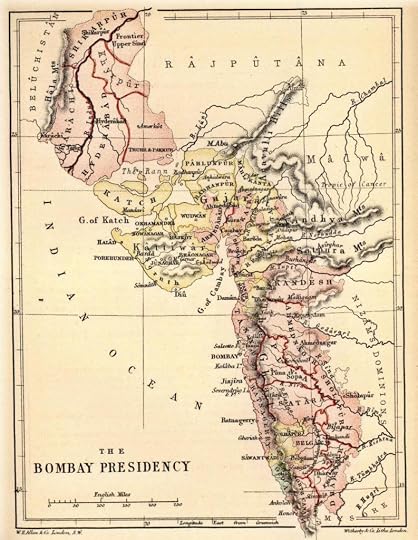 The Bombay Presidency
The Bombay Presidency spanned a long western coastal strip from Sindh (now in Pakistan) down to parts of Gujarat, western Maharashtra, north-western Karnataka, and Aden. The headquarters of the Bombay Presidency was Bombay, which in 1857 was under the governorship of John Elphinstone, 13th Lord Elphinstone. Operating as a semi-autonomous provincial unit, the presidency was directed from Bombay by the Governor and an advisory council managing revenue, political relations, and military affairs.
Stretching nearly 1,500 miles along the western rim of the Indian subcontinent it encompassed:
1. Sindh
2. Gujarat & Kathiawar
3. The Konkan
4. The Deccan & Carnatic – traversed by the Western Ghats (Sahyadri mountains) which separated the coast from the inland plateau.
5. Aden – the outpost of Aden, located over 1,600 miles away across the Arabian Sea, served as a vital coaling station for British steamships routing toward the Red Sea.It was administered directly by the Bombay Presidency.
The administration directly governed around 134,135 square miles of territory with roughly 14 million inhabitants, divided into 13 main districts and the non-regulation province of Satara. The numerous native princely states under political supervision included:
Region / Political AgencyPrincely StatesBaroda (Independent Residency)Baroda State (ruled by the Gaekwad dynasty)Kathiawar AgencyBhavnagar, Nawanagar, JunagadhCutch AgencyCutch Kolhapur Agency & Southern Maratha CountryKolhapur, Sawantwari, Sangli, MirajMahi Kantha & Rewa Kantha AgenciesIdar, Rajpipla, Chhota UdaipurSindh RegionKhairpurWhile internal governance remained in the hands of hereditary local rulers, the British managed their foreign affairs, defence, and succession through local British administrative units known as Political Agencies.
Mutinies in the Bombay Presidency did occur, however, they were sporadic affairs rather than wholesale uprising and lacked not only the ferocity but the structure of the mutinies in Bengal and all of them were swiftly supressed.
Bombay, 1857
The Southern Maratha CountrySindh


September 15, 2026
In the Kaimur Hills
By the time November 1858 rolled about, the situation in India had changed. No longer was the directive to seek out and destroy mutineers. The attitudes in Britain had changed and what had been seen in 1857 as a justifiable punishment of mutineers was now being seen more as unnecessary, hard-hearted retribution.
Men returning home, expecting to find themselves lauded for their bravery were increasingly finding they were looked upon with some disdain instead. While attitudes in India had not changed greatly, the public in Britain was starting to view the actions of the government in this far-off land as wantonly cruel.
Much of this was down to the sudden and radical change in the administration of India. The East India Company was no longer the mighty arm of Britain abroad – it was now a defunct company whose officials were to blame for the mutiny. As of August 1858, the East India Company had ceased, essentially to exist on paper with the passing of the India Government Act and by November 1858, it was made official when Lord Canning at Allahabad, read out the Queen’s Proclamation. Everything the army now did was no longer with the approval of a board of directors, but at the discretion of Queen Victoria herself.
As soon as the proclamation was read, and copies translated and distributed, much now changed for the mutineers. While the ringleaders such as Tantia Tope, the Nana Sahib and Begum Hazrat Mahal could not expect to benefit from the amnesty promised in the proclamation, regular sepoys and zamindars (amongst others) with a good excuse could. Their necks were not longer in fear of the hangman’s noose. The provisions set out were clear – surrender and behave. The effect of the proclamation would be seen on a large scale in Bihar, where rebels tired of running and fed up of being chased, did lay down their arms without the fear of retribution. However, news did not travel quickly in India and Brigadier Douglas, in early November, still had to deal with the rebels now hiding in the Kaimur Hills.
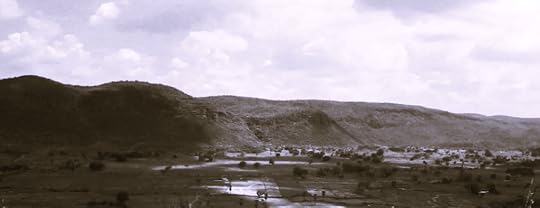
It calls to mind, at this point, that it is necessary to point out that the men Douglas was now instructed to chase, had been defeated. Their chances of joining a larger rebel force had been shattered, and those hiding in the hills were no longer launching attacks on the British. Douglas was not interested in sending any more of his men on long marches nor did he have the need to prove his might in Bihar. By December 1858, in light of the Queen’s Proclamation, the government was implementing rules for returning sepoys that would in effect, curb the hanging powers of the district magistrates and allow for a certain amount of clemency.
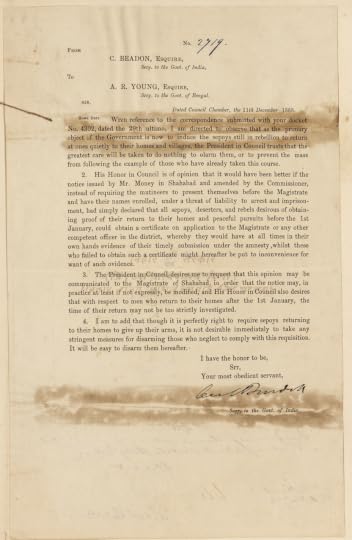
No. 2719
FROM C. Beadon, Esqure
Secy. to the Govt. of India
TO A: R. Young, Esquire
Secy. to the Govt. of Bengal
Dated Council Chamber, the 11th December 1858
Sir
Home Dept
With reference to the correspondence submitted with your docket No 4302, dated the 29th ultimo, I am directed to observe that as the primary object of the Government is now to induce the sepoys still in rebellion to return at quietly to their homes and villages, the President in Council trusts that the greatest care will be taken to do nothing to alarm them, or to prevent the mass from following the mass of those who have already taken this course.
2. His Honor in Council is of the opinion that it would have been better if the notice issued by Mr. Money of Shahabad and amended by the Commissioner, instead of requiring the mutineers to present themselves before the Magistrate and have their names enrolled, under a threat of a liability to arrest and imprisonment, had simply declared that all sepoys, deserters and rebels desirous of obtaining proof of their return to their homes and peaceful pursuits before the 1st of January, could obtain a certificate on application to the Magistrate or any other competent officer in the district, whereby they would have at all times in their own hands evidence of their timely submission under the amnesty, whilst those who failed to obtain such a certificate might hereafter be put to the inconvenience for want of such evidence.
3. The President in Council desires me to request that this opinion may be communicated to the Magistrate of Shahabad, in order that the notice may, in practice at least if not expressly, be modified, and His Honor in Council also desires that with respect to men who return to their homes after the 1st January, the time of their return many not be too strictly investigated.
4. I am to add that though it is perfectly right to require sepoys returning to their homes to give up their arms, it is not desirable immediately to take any stringent measures for disarming those who neglect to comply with this requisition. It will be easy to disarm them hereafter.
I have the honor to be,
SIR,
Your most obedient servant
(Cecil Beadon)
Secy. to the Govt. of India
However, it was also the insistence of Sir Colin Campbell, that no mutineer should remain in any of the districts and for that Brigadier Douglas would now have to launch a final campaign.
September 14, 2026
The Death of the East India Company
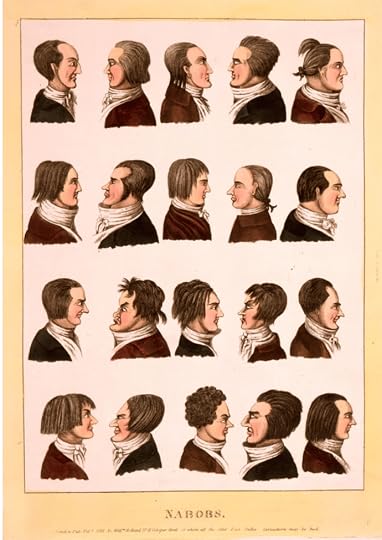 The Nabobs ca 182092 Years, 11 Months and 21 Days of Company Rule
Before we can begin exploring the final stages of the India Mutiny, we must first understand that another revolution was happening, one that would lead not only to the end of the East India Company but to the creation of the British Raj, when Indians became direct subjects of Queen Victoria and subsequent monarchs until independence, 90 years later, in 1947. It was a turning point in Indian history and one that continues to be debated today, for it can be said, with the creation of the Raj, the definition of what we see as colonialism had arrived.
Before 1858, the EICo was trading company – their motivations were not the well-being of the Indian people even in the broadest sense of the word, but financial gain and profit. Their rule in India can be broken down in three phases:
1: Commercial Trading (1600 – 1740s)
2: Militarised Protectionism (1740s – 1757)
Defending trade interests through military force.As the Mughal Empire began to fracture, local instability threatened Company profits. To protect their warehouses from rivals (specifically the French) and local rulers, the Company began fortifying their bases in Calcutta, Madras, and Bombay, and hiring private armies—including recruiting local Indian soldiers (sepoys).Military survival and securing political leverage with local Nawabs to protect their trade monopolies.3: Territorial Extraction & Revenue Farming (1757 – 1813)
Territorial conquest to fund trade.Following Robert Clive’s victory at the Battle of Plassey (1757) and the Battle of Buxar (1764), the Company shifted from merchants to rulers. They forced the Mughal Emperor to grant them the Diwani (the right to collect land revenue) over Bengal.At this point, the Company stopped bringing silver from Britain. Instead, they used the taxes collected from Indian peasants to buy Indian goods, which they then sold globally. They used the surplus to fund a massive private army to conquer more territory.
4: Administrative Imperialism & Subjugation (1813 – 1858)
Governance, Westernisation, and land annexation.As Parliament stripped the Company of its trading monopolies in 1813 and 1833, the Company’s sole purpose became ruling India as an administrative proxy for the British Empire.Maximising land tax revenue, imposing Western laws, education, and social reforms, and aggressively annexing independent Indian states (The Doctrine of Lapse and other nefarious annexations, such as declaring a ruler incompetent as in Oudh). Aggressive land settlements, the destruction of customs in regard to zamindars and landowners by stripping them of their power among other poorly thought out ideas, caused the structural friction that would eventually come and bite them when the mutiny broke out.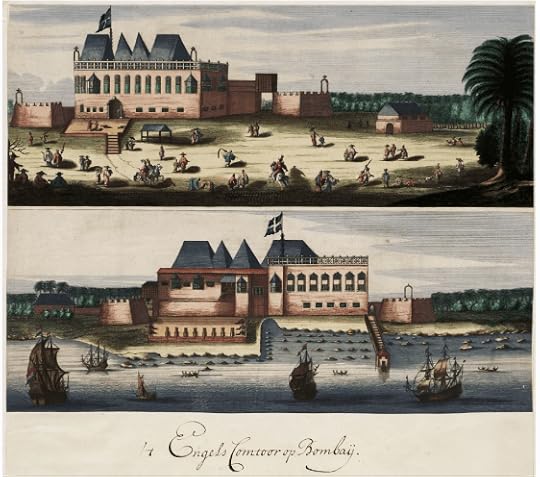 The EICo fort at Bombay
However, it is necessary to point out that the EICo was neither universally hated from day one, nor was it genuinely liked; rather, it was tolerated, manipulated, and resisted based on self-interest. Public sentiment was deeply fractured because India was not a single nation at the time, but a patchwork of competing kingdoms. Whether the Company was seen as an oppressor or a useful ally depended entirely on who you were, where you lived, and what time period you were in. For a long time, many Indian nawabs, rajas, and merchants did not see the EICo as a foreign invading empire, but simply as a powerful mercenary force or trading partner that could be used to defeat their local rivals. Put crudely, a friend with benefits.
Under the Subsidiary Alliance system, rulers of states like Hyderabad and Awadh willingly accepted EICo troops to protect them from aggressive neighbours like the Marathas or Tipu Sultan. For these rulers, the EICo was a shield that kept them on their thrones.Wealthy Indian bankers and merchants (like the Jagat Seths of Bengal) initially thrived under the EICo. The Company provided a stable legal system for contracts and a massive global network for trade. In fact, Indian bankers frequently financed the EICo’s military campaigns because the Company paid its debts with interest, unlike some local rulers. The EICo often placed compliant rulers on thrones after deposing rebellious ones. These puppet nawabs enjoyed immense luxury and British protection, completely detached from the struggles of their citizens.In the 1700s, the EIC was tolerated and even embraced by specific Indian elites who used British power to advance their own wealth and security. However, by the 19th century, as the power of the Company grew and evolved from trade to governance, the groups that once benefited or tolerated them, were changing their minds. In many respects the EICo was indeed a false friend who frequently broke treaties, and then used excuses or the Doctrine of Lapse to seize their territories regardless of how long they had been allies. In their defence, it must be admitted that the EICo did attempt to forge an assimilation of the various systems in India, borrowing much from the Mughal system of governance having realised very early on that ruling a vast population required continuity, not sudden change.
Administrative AreaLocal Rulers / Mughal SystemEast India Company (EIC)Tax InfrastructureRelied on Zamindars (local tax collectors) and existing Mughal land records.Adopted the exact same Zamindari infrastructure and Mughal revenue terms (e.g., Diwani).Legal SystemUsed a mix of Islamic law (Sharia), Hindu customary laws, and royal decrees.Retained and codified local personal laws, utilizing traditional scholars (Maulavis and Pandits) to advise British judges.Currency & LanguageMinted coins in the name of the Mughal Emperor; used Persian as the official language of administration.Continued minting Mughal-style coins until 1835 and kept Persian as the official government language until 1837.Primary IncentiveDynastic survival, status, and local political dominance.Corporate profitability, stock dividends, and financing global trade.AccountabilityLocalized and personal. Rulers lived in the territory and faced immediate local rebellion if they pushed too hard.Absentee and institutional. Ultimate accountability was to shareholders and Parliament in London, thousands of miles away.Flexibility of DemandsVariable based on seasonal performance and personal negotiation.Fixed and standardized based on legal contracts, legal deadlines, and corporate targets.When the EICo won the Diwani (the right to collect revenues) over Bengal in 1765, they didn’t alter the tax collection network. They kept the existing Mughal tax collectors (zamindars) and used the exact same revenue books. In the early decades, the EIC did not impose British common law on daily Indian life. In their newly established courts, they kept Hindu and Muslim personal laws intact for matters of marriage, inheritance, and religious custom. EICo officials initially adopted the lifestyle, court etiquette, and gift-giving customs (nazar) of Mughal nobles to legitimize their authority in the eyes of the public. Despite borrowing the framework, the EICo altered the foundational philosophy of how that framework operated.
Under local rulers, governance was highly personal and open to negotiation. A local landlord could plead his case directly to a Nawab for a temporary reprieve. The EICo replaced this personal touch with rigid, written statutes. If the law said a tax was due by sunset, the system enforced it automatically, regardless of personal relationships or excuses. In the Mughal system, the state had a right to a share of the harvest, but the peasant or landlord had an ancestral right to occupy and work that land. The EICo fundamentally changed this by turning land into private property that could be bought, sold, or foreclosed on like a commercial asset. When a local Nawab collected taxes, that wealth generally stayed within the local economy. It was spent on local armies, palaces, monuments, and services. Under the EICo, much of the collected tax revenue was converted into trade goods and shipped out of India, creating a one-way financial drain.
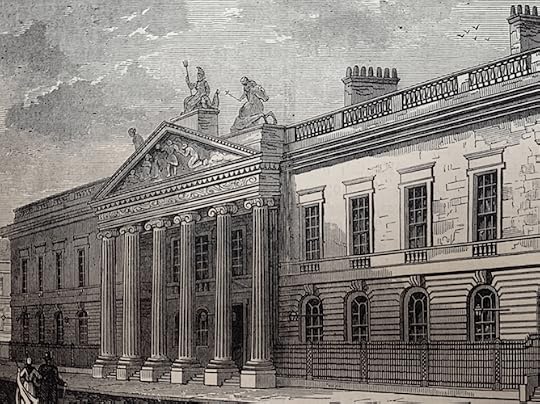 The East India Company’s Leadenhall Street headquarters in London
As the EICo grew and its territories in India expanded, they fell more often than not foul with the government back in Britain. For nearly 90 years before the mutiny even became an idea, the East India Company had been facing scrutiny – its corruption, territorial control and the nearly consistent financial crises the EICo found itself had already forced the British Government to intervene. The Regulating Acts, primarily anchored by the landmark act of 1773 were supposed to have established formal government control over the EICo in India.
The 1773 Act called for the creation of Governor General and in one stroke, elevated Warren Hastings from Governor of Bengal to Governor-General of India, with the subordinate presidencies of Bombay and Madras under his control. A Supreme Court of Judicature at Fort William in Calcutta was established to administer British law, while a four member Governing-Council was elected to assist the Governor-General, requiring a majority vote for decisions to be passed; the act further prohibited Company servants from engaging in private trade or accepting bribes. This, in essence, was not a bad idea.
Company employees returning to England, the so-called Nabobs, had indeed been filling their coffers, their fortunes were not only unexplained but large enough to buy political influence at home. However, corruption and mismanagement, despite vast territorial gains, had left the EICo facing bankruptcy. The Company even requested a bail out to the tune of £1.4 million. This was hardly an acceptable state of affairs. Unfortunately, the 1773 Act did nothing to define the actual power balance between the Governor-General and his Council, leading to a near constant political gridlock. In essence, nothing was getting done and the government back in England, while footing the bill, still had no actual control over the EICo. So in 1784, Pitt’s India Act was supposed to fix this with a dual system of control. The EICo kept its commercial operations but the government-appointed Board of Control took definitive charge of all political, military and revenue affairs.
However, Pitt’s India Act was hardly the cure – it was a bandage that for a time, stopped the patient from bleeding to death. The Act had successfully established dual control – separating trade from politics – but as a result, created new inefficiencies and failed to curb the EICo’s aggressive, rogue behaviour in India.
The division of power between the Crown’s Board of Control and the EICo’s Court of Directors was vague and the two bodies frequently clashed, deliberately delayed decisions and wrapped everything up in enough red tape to ensure that nothing could be done until someone relented. Pitt had insisted that the EICo desist from engaging in wars in India – aggressive territorial expansions and unprovoked wars against Indian princes were to cease. The EICo simply ignored Pitt and followed their own path regardless. However, the largest failure of the Act was that it completely neglected the welfare of the very people of India. With the focus heavily on who got the wealth in London and Calcutta, provisions for the welfare, rights and protection of the millions of Indian subjects under EICo rule were at best half-hearted, and at worst, simply not implemented. In other words, India was a cash cow for the British government, the problem was the EICo was not interested in sharing. The act did nothing to stop greed, corruption and exploitation; and neither the Government nor the EICo particularly cared about the Indian people. As Pitt’s Act had left so many loopholes, the British Parliament enacted a series of escalating measures – Charter Acts – every 20 years in an attempt to strip the EICo of its autonomy and transform this behemoth of trading company into a mere administrative department, subject to the British government.
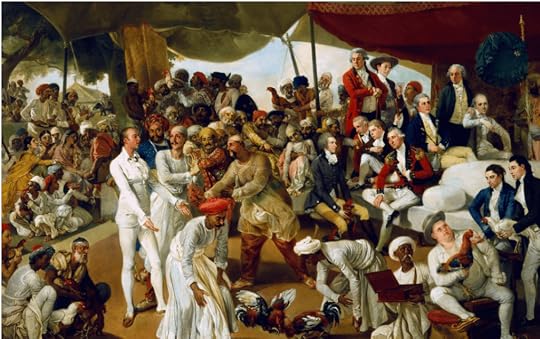 Colonel Mordaunt watching a cock fight at Lucknow, India, 1790 by Johan Zoffany
While the Charter Acts successfully solved problems for Britain — opening up trade to British merchants and asserting government control — they completely failed to fix the structural, economic, and social issues plaguing India. In fact, the acts often swapped old problems for much larger ones, directly creating the volatile conditions that exploded into the 1857 Indian Rebellion.
1. Economic Ruin Instead of Fair Trade
The 1813 and 1833 Acts ended the Company’s trade monopoly, opening India to the free market. However, this did not benefit Indian merchants. Instead, it allowed cheap, machine-made British textiles to flood the country duty-free, while heavy tariffs were placed on Indian goods entering Britain. This “de-industrialised” India, destroying the world-renowned local handloom industry and plunging millions of weavers into poverty.
2. Social Friction
The 1813 Act lifted the ban on Christian missionaries. Driven by a belief in British cultural superiority, the government and missionaries began aggressively introducing Western education, legal reforms, and religious proselytising. While some reforms (like the ban on Sati) were positive, the aggressive manner in which they were pushed made the Indian public deeply suspect that the British government was planning to forcefully convert the entire population.
3. Reckless Expansion and Legal Loopholes
Because the 1833 Act stripped the Company of commercial profits, its officials turned to a new way to make money: annexing land. Since they could no longer trade, they generated revenue by conquering independent Indian states and taxing the land. Under policies like Lord Dalhousie’s Doctrine of Lapse, the British seized states like Awadh, Jhansi, and Nagpur on flimsy legal grounds, deeply angering the ruling Indian aristocracy.
Ultimately, the Charter Acts created a highly centralized, detached, and racially arrogant government. By trying to reform the Company piece by piece rather than addressing the grievances of the Indian people, the British Parliament allowed systemic anger to build across every layer of Indian society—peasants, soldiers (sepoys), and princes alike. Eventually, the rebellion would force the Parliament to admit that the system they had sought to establish in India was broken and the only way forward was to abolish the Company for good.
September 11, 2026
The Last of the Shahabad Rebels- October 1858
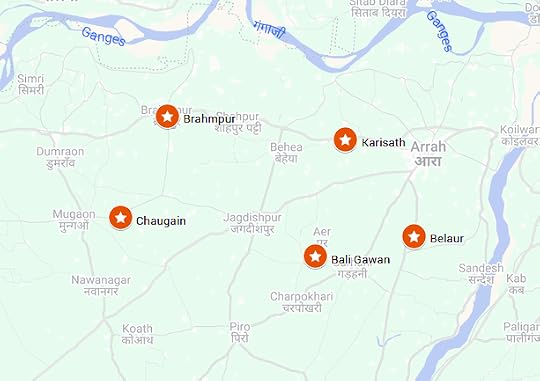
By October, the rebels had established themselves at Chaugain, Brahmpur, Karisath and Belaur, with another post at Jagdispur. From these points, they were able to launch their punitive expeditions on most of the Douglas’ positions, leading to skirmishes which had, in the end, the same result – a significant amount of marching for the Bihar Field Force with little success, as the rebels continued to disappear into the surrounding countryside as soon as they had finished harassing the British. On more than one occasion, when the information received from their spies and informants was considered true, Douglas sanctioned punitive counter-expeditions against the rebels. These were successful, insofar as they halted, for a short time, the rebels’ plundering excursions, giving a little relief to the hard-pressed local population. However, as a general course of action, it was not a sustainable alternative.
The Karamnasa River Expedition
Just such an expedition took place on 6 October 1858 on the The Karamnasa River, a tributary of the Ganges which flows along the boundary between what is today known as Uttar Pradesh and Bihar.
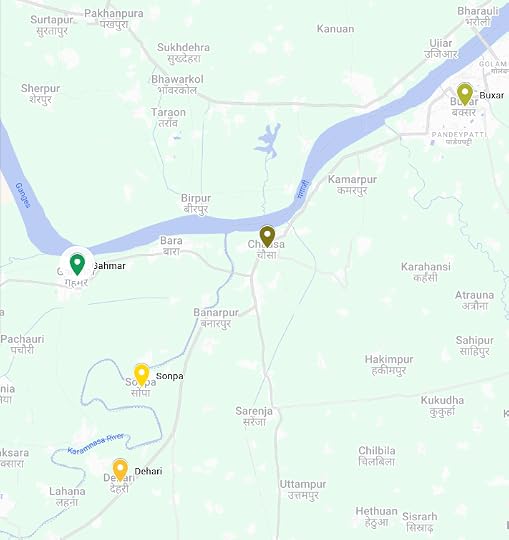
The objective of this expedition was the arrest of Meghar Singh Sakarwa, a zamindar of Gahmar whose
nvolvement in the rebellion had begun on 6 June 1858 with Amar Singh and 500 of his men arrived at Sakarwa’s ancestral holdings at Gahmar. Sakarwa had until then held off taking an active part in the troubles but with Singh’s arrival, this changed. The zamindar now actively sought out Amar Singh and sent him a letter proposing an alliance, something Singh was most willing to accept. As a promise of good faith, Sakarwa further offered him a gift 0r nazrana of Rs 20,000 – when Singh left Gahmar on 10 June, he had not only supplied the zamindar with arms, but had received supplies for his army. Throughout the rest of the summer, Meghar Singh Sakarwa would continue to add trained sepoys to his army while keeping the British busy along the Ganges and Karamnasa rivers from his stronghold at Gahmar and his village of Keree. Having received credible information at the beginning of October that Sakarwa was now levying contributions in and around Chausa, Lieutenant-Colonel Dunsford decided it was time to pay the wily zamindar a visit.
With the river’s water level still high from the monsoons, Dunsford believed he could sail from Buxar to effect the zamindar’s arrest with little worries. For this, he sent Mr Browne, then commanding the Benares – a river steamer that had been fitted with guns – to reconnoitre. Browne reported the river would serve admirably for the cause and he could safely take 200 men as far as Dehri (Dehari). So on the evening of 6 October, Dunsford sent off:
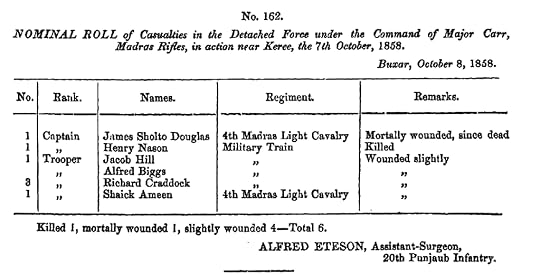
Military Train, 1 troop, commanded by Captain Nason;
4th Madras Cavalry, 1 troop, commanded by Captain John Sholto Douglas, and afterwards by Lieutenant Galloway;
Her Majesty’s 84th, 100 bayonets, commanded by Captain Snow;
Madras Rifles, 32 bayonets, commanded by Captain Barclay,
68th Regiment Native Infantry;
20th Regiment Punjab Infantry, 53 bayonets, under command of Lieutenant Jarrett.
The whole commanded by Major Carr, of the Madras Rifles.
The infantry would proceed by steamer while the cavalry would ride via Chausa from Buxar and meet the infantry at Dehari.
Unfortunately, not everything went to plan, and this time it was not clear who was at fault. The infantry did sail as expected but were set on land just south of Sonpa and still three miles short of Dehari. Major Carr sent word to Captain Douglas that he and the cavalry should not wait at Dehari but push on to Keree, the village where Megha Rao Singh had his residence. The problem is, Carr was not aware just how far Keree actually was. Instead of only three miles from Dehari, it was fully nine miles. Douglas pushed on with orders from Carr to surround the village and wait for the infantry to come up.
As such, Captain Douglas, thinking the infantry was no great distance behind him, proceeded towards Keree only to find, at just two miles short of the village, Singh’s men were ready for him. A complement of some 300 men, just returning from a plundering excursion, fell on the cavalry in one fell swoop. There was nothing for it but to charge. Douglas and Nason, both in front, with a great shout, led the charge over the swampy ground, and paid for it with their lives.
Nason was shot dead in the first minutes of the battle, charging the man who “stood to receive him with a loaded musket and bayonet.” The shot was fired at such a short distance; Nason fell off his horse, his clothes scorched and skin burned. Captain Douglas, without a moment’s hesitation, ran the man through with his sword, but another, hard by, shot him. Douglas, off his horse and badly injured, still managed to cut down two men before he received his final wound. He would be carried off the field by his men but died shortly after.
By the time Major Carr arrived at Keree, the rebels had disappeared, and the action was over. Pursuit was pointless. When Mr Garstin, the magistrate who had accompanied the cavalry, counted the bodies, he found 35 dead on the field where the cavalry had charged and a further 5 in the village itself. Carr advanced with the infantry on Keree, forming the detachment in regular order, dividing the cavalry into two parts on the left and right of the village, while he proceeded forward. He found the village was empty and ordered it to be burned to the ground. As many of the houses had tiled roofs, it was not the inferno he had hoped for, but by the time he was getting ready to leave, Keree, which had previously not been on any of their maps, would never be found on any in the future either. By 2 pm, with the work of destruction over, Carr marched his men the 12 miles back to the steamer, a distance that would take them 6 hours to cover. Several men of the HM’s 84th were struck down by the sun, but Assistant Surgeon Eteson, of the Punjabis, ensured none of them died. The steamer arrived at Buxar the following day at 3 am. As for the cavalry, they would arrive shortly before Carr, having covered a distance of 50 miles in a little more than 24 hours.
For Brigadier Douglas, the situation in Bihar was far from satisfactory. Without any tangible success to show for his efforts, he decided it was to time, like Eyre, Le Grand and Lugard before him, to take Jagdispur which once again, had become a rallying point for the rebels. This time, he had a much loftier plan for Douglas intended to launch his own campaign with the goal to rid Bihar of insurgents once and for all.
September 9, 2026
Mr Wake and the Siege of Arrah
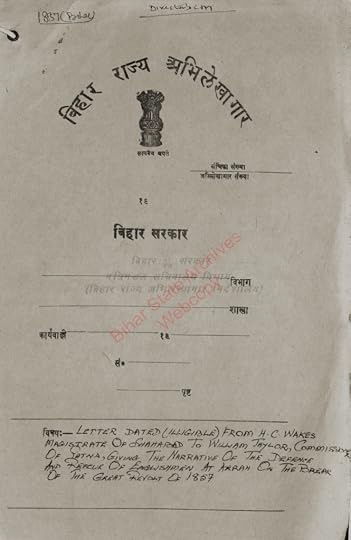
In the Bihar State Archives are various documents pertaining to the mutiny in the district. They range from court proceedings to reports and letters. Among the latter was a handwritten report written by Hewald Wake to William Tayler following the Siege of Arrah.
The letter is transcribed here in full.
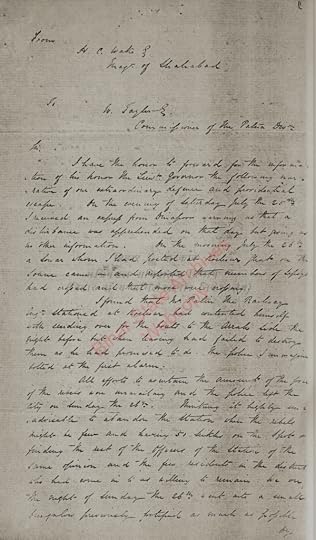
From
A. C. Wake Esq
Magt. of Shahabad
To
W. Tayler Esq.
Commissioner of the Patna Division
Sir,
I have the honor to forward for the information of his honor the Lieut. Governor the following narrative of our extraordinary defence and providential escape. On the evening of Saturday July the 25th I received an express from Dinapore warning us that a disturbance was apprehended on that day, but giving us no other information. On the morning July the 26th a sowar whom I had posted at Koelwar ghat on the Soane came in and reported that numbers of Sepoys had crossed and that more were crossing.
I found that Mr Palin the Railway Engr. stationed at Koelwar had contented himself with sending over for the boats to the Arrah side the night before but when leaving had failed to destroy them as he had promised to do. The police I imagine bolted at the first alarm.
All efforts to ascertain the amounts of the force of the rebels were unavailing, and the police left the City on Sunday the 26th. Thinking it highly unadvisable to abandon the Station when the rebels might be few and having 50 Sikhs on the spot & finding the rest of the Officers of the Station of the same opinion and the few residents in the district who had come in to us willing to remain we on the night of Sunday the 26th went into a small bungalow previously fortified as much as possible by
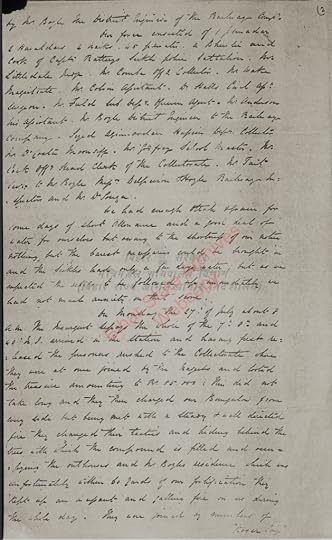
by Mr. Boyle the District Engineer of the Railway Comp.
Our force consisted of 1 Jemadar, 2 Havildars, 2 Naiks, 45 privates, a Bhustie and cook of Captn Rattrays Sikh police battalion. Mr. Littledale Judge, Mr. Combe Offg. Collector, Mr. Wake Magistrate, Mr. Colvin Assistant, Dr. Halls Civil Ast surgeon, Mr. Field Sub Depy. Opium Agent, Mr. Anderson his Assistant, Mr. Boyle District Engineer to the Railway Company, Syed Azimooddeen Husein Depy. Collector, Mr. D’Oyley Moonsiff, Mr. Godfrey School Master, Mr. Cock Offg Head Clerk of the Collectorate, Mr. Tait Asst to Mr. Boyle, Messr. Delpeirou & Hoyle Railway Inspectors and Mr. De Souza.
We had enough stock of grain for some days of short Allowance and a good deal of water for ourselves but owing to the shortness of our notice nothing but the barest necessaries could be brought in and the Sikhs had only a few days water; but as we expected the rebels to be followed up immediately we had not much anxiety on that score.
On Monday the 27th of July about 8 A.M. the insurgent Sepoys the whole of the 7th 8th and 40th N. I. arrived in the station and having first released the prisoners rushed to the Collectorate where they were at once joined by the Nujeebs and looted the treasure amounting to Rs. 85,000; this did not take long and they then charged our Bungalow from every side but being met with a steady & well directed fire they changed their tactics and hiding behind the trees with which the compound is filled and occupying the outhouses and Mr Boyles residence which was unfortunately within 60 Yards of our fortification they kept up an incessant and galling fire on us during the whole day. They were joined by numbers of “Koor Sings”
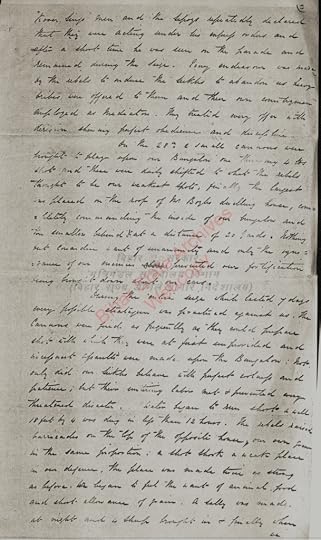
“Koor Sings” men and the Sepoys repeatedly declared that they were acting under his express orders and after a short time he was seen on the parade and remained during the siege. Every endeavour was made by the rebels to induce the Sikhs to abandon us heavy bribes were offered to them and their own countrymen employed as mediators. They treated every offer with derision shewing perfect obedience and discipline
On the 28th 2 small cannons were brought to play upon our Bungalow one throwing 4 lbs shot and these were daily shifted to spots the rebels thought to be our weakest spots, finally the largest was placed on the roof of Mr Boyles dwelling house, completely commanding the inside of our bungalow and the smaller behind it at a distance of 20 Yards. Nothing but cowardice & want of unanimity and only the ignorance of our enemies prevented our fortification being brought down about our ears.
During the entire siege which lasted 7 days every possible stratagem was practiced against us. The cannons were fired as frequently as they could prepare shot with which they were at first unprovided and incessant assaults were made upon the Bungalow: not only did our Sikhs behave with perfect coolness and patience, but their untiring labor met & prevented every threatened disaster. Water began to run short & a well 18 feet by 4 was dug in less than 12 hours. The rebels raised barricades on the top of the opposite house, our own grew in the same proportion: a shot shook a weak place in our defense, the place was made twice as strong as before. We began to feel the want of animal food and short allowance of grain. A sally was made at night and 4 sheep brought in & finally when
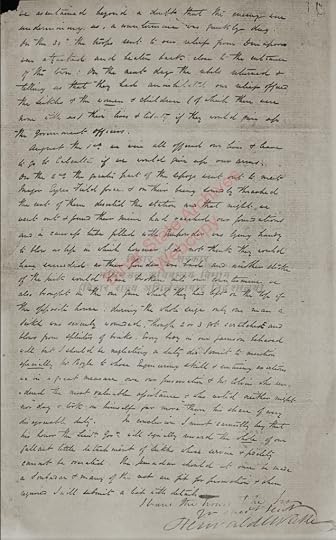
we ascertained beyond a doubt that the enemy were undermining us, a countermine was quickly dug.
On the 30th the troops sent to our relief from Dinapore were attacked and beaten back close to the entrance
of the town; on the next day the rebels returned & telling us that they had annihilated our relief offered the Sikhs & the women & children (of which there were none with us) their lives & liberty if they would give up
the Government officers.
August the 1st we were all offered our lives & leave to go to Calcutta if we would give up our arms. On the 2nd the greater part of the Sepoys went out to meet Major Eyre’s Field force & on their being soundly thrashed the rest of them deserted the station and that night we went out & found their mine had reached our foundations and a canvas tube filled with Powder was lying handy to blow us up in which however I do not think they could have succeeded as their powder was bad and neither stroke of the pick would have broken into our countermine we also brought in the one gun which they had left on the top of the opposite house; during the whole siege only one man a Sikh was severely wounded, though 2 or 3 got scratches and blows from splinters of bricks. Everybody in our garrison behaved well but I should be neglecting a duty did I omit to mention specially Mr Boyle to whose Engineering skill & untiring exertions we in a great measure owe our preservation & Mr Colvin who rendered the most valuable assistance & who noted neither night nor day & took on himself far more than his share of every disagreeable duty. In conclusion I must earnestly beg that
his honor the Lieut. Govr. will signally reward the whole of our gallant little detachment of Sikhs whose service & fidelity cannot be overrated. The Jemadar should at once be made a Soubadar & many of the rest are fit for promotion of whom asymmetric I will submit a list with details.
I have the honor to be Sir
Your most Obedt Servt
H. C. Wake
Sources:
Bihar State Archives – unfortunately, the sub-site “Independence Day” is currently down but while it was accessible, the documents were available as Webcopys with no attached copyright. With any luck, the site will be up and running again in the future.
https://archives.bihar.gov.in/independenceday
September 4, 2026
A Brash VC – George Bell Chicken, Esq.
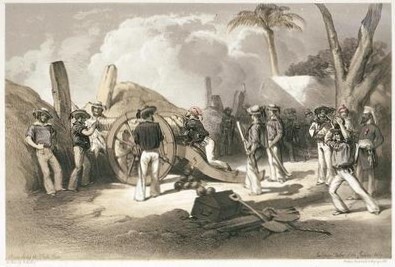 The Naval Brigade in India
Born on 2 March 1833 at Howden Pans, Northumberland, to George Chicken, Master Mariner and his wife Elizabeth (née Bell). Baptised at Wallsend St. Peter’s on 8 December 1833, George would spend his formative years, along with his three elder sisters, at Saugh House, Howden Pans (parish of Wallsend). The village originally took its name from the salt pans used to boil river water and extract salt from as early as Tudor times. In the 16th and 17th centuries, it was also known for extensive glassworks. By the 1800s, the industry had shifted towards shipbuilding and coal mining.
Considering his father’s profession, it was little wonder that young George would take to the sea. His Seaman’s Register Ticket informs us he was an Apprentice at Sea in 1847, having been first ticketed at the age of 14. It is also the only physical description we have of George Bell Chicken – brown hair and eyes, of “dark complexion with a scar on his right cheek.” He could write and had never served in the Royal Navy. It appears Mr Chicken was determined to have an eventful career, no matter what.
He served as 2nd Mate aboard the Anna on 24 February 1852, bound for America; by July of the same year, he was 1st Mate aboard the Darlington, having joined up at Valparaiso, Chile. In 1853, he was still with the Darlington, serving on the Baltic Routes and in Copenhagen. A year later, Master Chicken obtained his Master’s Certificate and was appointed skipper of the Darlington on the Baltic routes.
Then things changed. In 1855, Master Chicken first sighted Madras from the good ship, the Hastings, and something must have appealed to the young man, for as soon as he arrived in Calcutta, he turned his back on the Merchant Navy and joined the Country Merchant Service. From here, we must proceed with a little caution, as there have been many misconceptions regarding Master Chicken, the first being that he was part of the Naval Brigade, which unfortunately has been given to mean he served with the Shannon or the Pearl brigades. Master Chicken did neither. When we put aside these two glorious ships and their crews, we have the Indian Naval Brigade.
The Indian Naval Brigade
The first Detachments of officers and seamen of the Indian Navy, landed at Calcutta in June and July, were from the ‘Auckland,’ ‘Punjaub,’ ‘Semiramis,’ ‘Zenobia,‘ and ‘ Coromandel’, and further bodies were drafted up-country on the requisition of Sir Frederick Halliday, Lieutenant-Governor of Bengal.
In May, 1858, an important change took place in the control of the Indian Naval Brigade employed in assisting in the suppression of the Mutiny, or holding military posts in order to free the British troops for service in the field. During the interval between June, 1857, and the 22nd of May, 1858, a period of twelve months, large numbers of officers and seamen, had been landed from the ships of the Indian Navy, and bodies of men, recruited from the merchant ships and trained and officered by the Service, were despatched up-country as fast as they were disciplined and supplied with arms and equipments from the Indian Navy depot at Fort William. These Detachments, of from one hundred to two hundred men, each with two or more 12-pounder howitzers, were scattered over Bengal…” (Low)
It was just such a detachment that was sent to Dacca in 1857 to act in the capacity of policemen and augment the Europeans at that station. With them went one Arthur Mayo who, in November, would win his VC. Under Lieutenant Lewis, they would then see service in the Abor territories in 1859, when they were sent to replace Lieutenant Davies and the crew of the Zenobia.
“One of the first Detachments of the Indian Naval Brigade to land for service at Calcutta, if not the first, was No. 2 Detachment, drawn from the ‘Auckland,’ which had done such good service in China, and commanded by Lieutenant George O’Brien Carew, First-Lieutenant of that ship. In consequence of representations made by this officer to a member of the Governor-General’s Staff, that there was on board his ship a body of seamen drilled to use the field-piece and rifle equally well, a party of a hundred sailors and marines — Bombay European artillerymen — with Midshipmen H. W. Brownlow, of the ‘ Auckland,’ and H. G. F. Cotgrave, of the ‘Semiramis,’ was drafted for duty on shore under his command, and proceeded to Barrackpore, where it was attached to No. 20 horse field-battery (Capt. Hungerford’s).‘
In April 1858, Lieutenant Carew finally received permission to proceed up country, joining Brigadier Corfield in the Jagdispur District of Bihar. One detachment of sailors remained in Calcutta for the entirety of the mutiny, known as No. 1 Detachment, forming up to one-third of the European soldiers guarding Fort William, the state prisoners and Calcutta. However, with need for troops still pressing, in December 1857, Lieutenant Duval proceeded to Gaya in Bihar with No. 5 Detachment, two hundred men with a complete field battery of six guns. Further detachments left Fort William in April and in July 1858 to take up posts in Chota Nagpur, Muzaffarpur, and for a time in Patna. Hazaribagh, Ranchi (or Dorundah), Purulia, Chyabassa, and Sumbulpore. However, the longest in the field was No. 3 Detachment (100 men, four guns) under Lieutenant Batt. They would see action in the Patna Division, having proceeded up country in the latter part of July 1857. Batt would subsequently take command at Buxar, where he relieved Captain Sotheby and the Pearl Naval Brigade. This is where we now find Mr Chicken.
Mr Chicken VC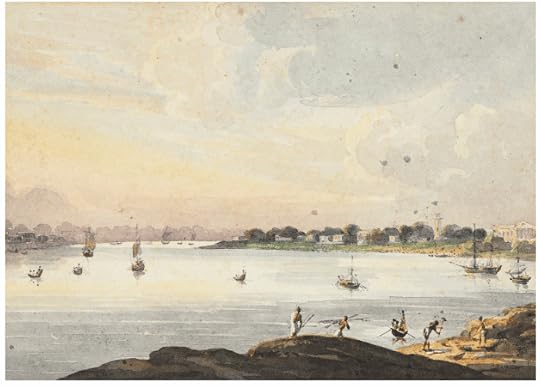 On the Hooghly
 It is also, however, where the estimable Rathbone Low throws a spanner in the works.
” Captain Campbell appointed Mr Chicken to the Service on the 31st of July, 1858, and after doing duty at Fort William for eight months, on the 23rd of March, 1859, he left for Buxar to join No. 3 Detachment, taking with him a party of seamen to replace the sick and dead of No. 7 stationed at Dehree.” (p. 483, History of the Indian Navy, Vol II)
The problem is, Mr Chicken won his VC on September 27, 1858, a full six months, before, according to Mr Lowe, he had even left Calcutta. As we do have a letter written by Master Chicken to his uncle in February 1859, we may attempt to clear up this discrepancy.
My Dear Uncle,
your truly welcome letter dated February 7th 59 I had the pleasure to receive on the 2nd inst. Need I say how truly pleased I was to find that at least one of my relatives had not forsaken me. How thankful we poor mortals ought to be to Almighty God for giving us health and strength and the means also through the medium of pens, ink and paper of having an interchange of thoughts and sentiments of friends and relatives when separated, however distant that may be. Now that a correspondence has been opened, I trust that it may always remain so. I would only be too happy to receive and answer any letter of my cousins.
You say that you would like to know a little of my history since I have been in India. It is not very interesting but however I will give you the outline. I arrived in Calcutta per ship Hastings some time in August 1855. After I left the Hastings I entered the Country Merchant Service when I made the voyage to Batavia, Singapore, Penang, Malacca etc. etc. During the last voyage I lost money with speculation which disgusted me with Merchant Service so I left and entered the Govt. River Surveying Service where I had remained nearly two years when the Mutiny broke out. When the news of the massacre at Cawnpore came down to Calcutta, I laid down my sextant and entered the navy as Master on condition that I was to serve on those against the rebels. This was the commencement of 58.
It would appear that Mr Chicken had remained in the River Survey throughout 1857. He first appears on the books of the HMS Calcutta on 31 July 1858, appointed by Captain Campbell as Acting Master. Chicken states in his letter, he was in Calcutta when the mutiny broke out; the news of the Cawnpore massacre did not reach the city until July 1857. Until he joined the Naval Brigade “at the commencement of 1858”, there is a possibility that Mr Chicken was, for a time, part of the many gentlemen volunteers in Calcutta, which would account for Lowe’s “eight months service in Fort William”. Their duties would have ranged from patrolling and local policing, to attachments with the regiments stationed in Fort William. If we look at the mistaken dates presented to us in Rathbone Lowe’s book, it would make more sense that he joined the Indian Naval Brigade in March 1858, which would tie in with Chicken’s own letter (and not as Lowe states, sent up country in March 1859), he then completed his mandatory training and was taken on the books of the Calcutta in July 1858.
“I was sent up country 2nd in command of a Bengal unit. From that time up to last one it was one campaign; marching and countermarching, advancing and retreating and fighting whenever we met or overtook the enemy. To write the particulars of what happened in that time would be impossible. Suffice to say that retribution has been terrible I will now proceed to give you some account of the action in which I had the honour of winning the Victoria Cross. I will do so because you have asked me, but do not think me an egotist when I have occasion to speak of myself.”
Here, Mr Chicken leaves us in a conundrum. No official appointments exist that state Mr Chicken was nominated as 2nd in command of a Bengal unit. The only Bengal unit per se at the time was the Bengal Military Police, but their second-in-command was very clearly Lieutenant Charles George Baker. As we cannot say for sure when Mr Chicken left Calcutta, nor do we know what mode of travel was employed. He was not an officer of importance so he would not have been given sanction to use a dak gharry, nor due to the dangerous state of the Grand Trunk Road would this have been deemed advisable As we know he was proceeding upcountry, he would either have travelled by Ganges river steamer via Allahabad, a journey of 3 to 4 weeks, or by bullock train, which again would take 3 to 6 weeks. Since Captain Rattray comes across Chicken at Dehri, it is likely the bullock train was in effect for his journey. Chicken leaves his letter vague, and likely this deception is deliberate – we have to consider that he was likely not in his family’s best books, nor had he been for some years. A little hamming up for the family back home might have been his way of improving their opinion of him. Second-in-Command of a Bengal Unit sounds preferable to Second-in-Command of a bullock train transport. He was assigned to No. 3 Detachment, Indian Naval Brigade, which at the time was in Buxar, where he would serve as an artilleryman. At the time No. 7 was at Dehri and the men travelling with Chicken were being sent as new replacements for the sick and dead of that detachment. It was here that Lieutenant-Colonel Turner was assembling his force to take to the field and Master Chicken volunteered his services to Captain Rattray, who states Chicken applied, “with a determination as he expressed it, to win his medal.“
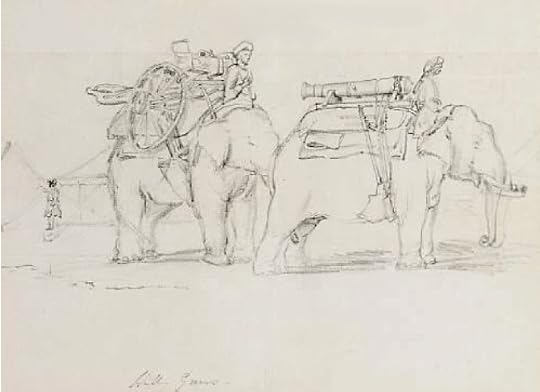 Cannon being transported by elephant in India – drawing by Major Vincent Eyre
We return now to Mr Chicken’s letter:
“On the morning of the 27th of September at 1 a.m., we were awoken by strains of a bugle. We were soon upon our legs, thinking that the enemy was coming down upon us. I had the command of the guns so it was my duty to get them ready in order to receive the rebels with all honour, but we soon learned that the Col. had got information that the enemy was encamped some 18 miles from where we were., Certainly this was good news, but we had been disappointed so often that we did not place much faith in it but however, that was not the thing: we had to obey orders which were to prepare for marching across country. I got my guns upon elephants’ backs; in about 40 minutes we were all ready. So the march commenced. At noon we halted for breakfast; when that delightful performance was about half over, a spy came and said the enemy was only 4 miles off. The Col. gave orders for the Cavalry to mount. He then came down amongst them and told them that they had to start at once and engage the enemy on the left and to keep them in play until he came up with the infantry and guns, but as the guns were upon elephants’ backs I asked permission to go out with the cavalry and to join the guns upon the field which was granted. The Colonel gave the last order, which was, ‘If you cannot play with them for God’s sake go right through them and kill as many as you can.’ Wishing us success, he left us.”
Unfortunately, neither Mr Chicken nor the despatches tell us from where they were starting on 27 September; however, we do know that Lieutenant-Colonel Turner breakfasted his men at Kharauna. Turner then received news that the rebels were encamped in and around Piro; he split his force into two columns, with him leading the infantry in the direct road to Piro and the cavalry sent around the rear of Piro. We can now read the account of the action that followed directly from Chicken himself.
We then started, raining fearfully. After 45 minutes march we came upon them. They, seeing our small force (100 strong), came out into the open. We then had an opportunity of counting them, which was 1000 foot and 50 horse. They then threw out skirmishers and advanced in line. The firing being very hot we relocated about a mile, saw no signs of the Col. coming and called a Council of War. The majority agreed to charge their centre. The enemy seeing us coming at a hand-gallop did not think it worthwhile to form Square; intending I should say to crush us with one volley. When we were within 20 yards of them they fired. I was wearing my sword at the time a ball struck the hilt and sprained my right wrist. The volley did very little execution, it did not check our speed, so we went right through their centre and in a moment they were a flying mass.
There was a small river on their left into which hundreds plunged hoping to escape in that way. I called upon my fellows to follow and jumped in after them. The slaughter there was tremendous but forward was the cry. When I got to the opposite side of the river (under a heavy fire) and was climbing up the bank, my horse got his first wound. A fellow after us shot at me and missed me, clubbed his musket and hit my horse over the left eye, which sent us both rolling back again into the river. After a short time I again mounted the bank and succeeded in getting across and after a short struggle forced the passage. By this time 10 of my men got across, we then continued the chase. My horse being the swiftest I soon distanced the men. At the entrance of Jugdespore jungle (where) the road is narrow, the enemy was forming square.
I saw at once that if they did so they would rally, and as we were all broken up it would be a case with us all. So I again called upon my fellows to follow and I rode right at it and sprang into the centre. I then had to fight for my life which I was determined to sell as dearly as possible. My pistol miss fired twice and when I got my wound on my shoulder my sword was through a fellow’s skull and I could not liberate it. The struggle lasted five minutes when they fled, leaving 16 dead on that spot. There were 5 men came in after me, one was killed; the rest all severely wounded.
In the process, George Bell Chicken was severely wounded, and he did not spare his uncle any of the details.
My wounds were as follows:
My left shoulder cut into the joint and across the breast, 7 inches. Severe bruise on the left arm, ditto on the back with clubbed musket; a slight wound on the right side of the neck where a musket bullet had just missed me. My horse was wounded on the left side of the neck with a sword cut 10 inches long, two bullets in his foreshoulder; his forelegs cut across, a severe contusion over left eye.
So you see both master and horse were wounded not a little. This was the last affair, and happy was I to see the enemy flying, for just as they did so I fell from my horse, fainting, caused by loss of blood. After a short time our main body came up, and I was picked up and carried into camp with the rest of the wounded, where my wounds were dressed. So ended this eventful day. In fair hand-to-hand encounters, I killed seven men that day, which I consider a very fair day’s work.
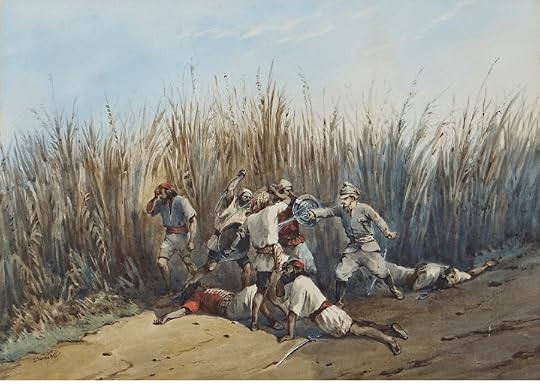 G.B. Chicken, Naval Brigade, winning the Victoria Cross at Suhejnee, 1858, during the Indian mutiny – watercolour by Orlando NoriGeorge Bell Chicken of the River Survey
Sadly, here is where Mr Chicken’s letter ends, and we must return to all that we know of the remainder of his life.
 At the Sandheads
The severity of his wounds would exclude George Bell Chicken from any fighting in the immediate future, and he likely remained on garrison duty with No. 3 Detachment at Buxar. In November 1859, No. 3 Detachment was returned to Calcutta from disbandment. “On their quitting Buxar, a correspondent of an Indian paper writes: — ” On the departure of No. 3 Naval Brigade, upwards of one half were hors de combat from fever, and the chaste obelisk which these gallant, well-conducted fellows raised in generous sympathy to the memory of their lost shipmates, and which adorns the Buxar burial ground, tells too truly how the brigade suffered.”
In March 1860 a new opportunity presented itself to Mr Chicken when he was given command of the schooner, HM Emily. It would appear he had returned to the River Survey Service for the Emily and was a part of the river surveying and coastal flotilla. She was designed with a shallow draft to navigate shifting sandbars and the shallow river mouths, operating with a small crew, the complete complement not exceeding 30 men. She also carried 2 guns, most likely either light brass or iron pieces (3- or 6-pounders) meant for signalling and for basic defence against local piracy. Considering the mutiny was still very much in living memory, there might well have been some law enforcement involved in Emily’s work. However, there is perhaps another reason why the work would have appealed to Chicken – it was, after all, perilous.
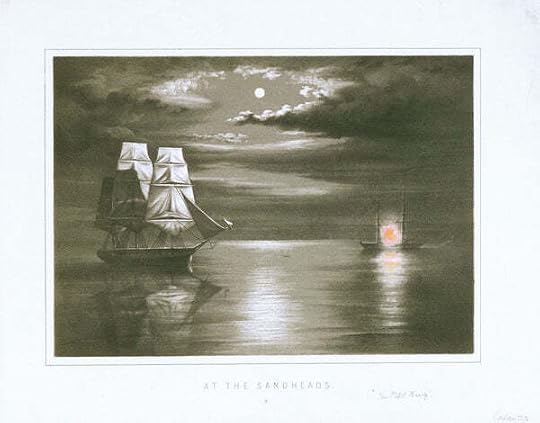
The main focus of the river survey was Sandheads — a convergence of sandbanks deposited by the river system extending roughly 212 miles downstream from Calcutta into the open Bay of Bengal. As the Hooghly River is a shifting distributary of the Ganges, underwater channels could completely change position after a single monsoon season. Surveying ships had to drop anchor in volatile, shallow waters to take depth soundings, and just about anything could happen. Extreme tidal flows, fast ebbing waters and even tidal bores were a threat; poor visibility, especially in the winter months due to fog or during the monsoons, undoubtedly added some further interest to any day’s work. If this was not enough, the area was also prone to sudden storms and severe cyclones.
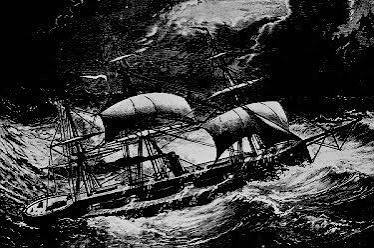
It was just such a violent squall in the Sandheads that ended the life of George Bell, Chicken VC, in May 1860. The Emily went down with all hands, and although an attempt was made to find her, neither the schooner nor the crew were recovered.
The Victoria Cross
Like Lieutenant Charles George Baker, Chicken was gazetted some years after his act of valour and the citation did not appear in the London Gazette until April 27, 1860, shortly before his untimely death. As we have seen from the letter to his uncle, he was well aware that he had received the Victoria Cross, as it had already been revealed in a letter to Lord Canning, in which Sir Colin Campbell directed his Adjutant-General, Lieutenant-Colonel William Mayhew, on 6 October 1858, to write:
“I have the honour to request, on the part of his lordship, that you will have the goodness to direct the attention of the Right Honourable the Governor-General to the brilliancy of the exploit performed by Lieutenant G. C. Baker, of the Bengal Police Battalion, which is deserving of the highest encomium, on account both of conception and execution. His lordship is of the opinion that the Victoria Cross should be awarded to Lieutenant Baker, and to Mr Chicken, of the Indian Navy, and he will take immediate measures for the execution of his intention in this respect.“
The despatch from the Government of India conveying Lord Clyde’s recommendation was not forwarded to the India Office in London until 21st December 1859. This again might seem like a long time; however, we must bear in mind that, like the VC of Charles George Baker, the request was an unusual one. Chicken was a volunteer, so technically a civilian, doing duty with the Indian Naval Brigade and attached for this one action to Rattray’s Sikhs. He was not officially a part of the battalion, nor was he considered a seaman. In the end, Chicken’s VC was officially classified as a civilian VC and not a military one, making him one of 4 men to receive just such a cross for the Indian Mutiny.
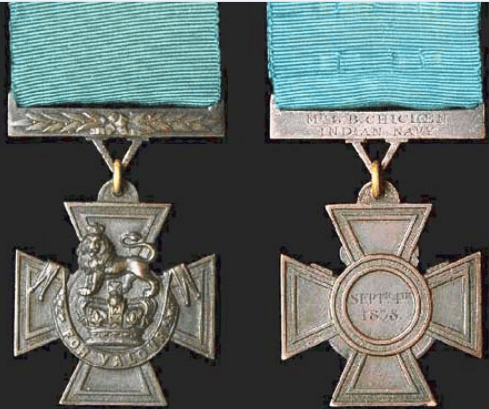 The First Victoria Cross
Two Victoria Crosses were produced for Chicken – the first medal was incorrect, stating on the reverse,
“Mr G. B. Chicken, Indian Navy, Sptr 4th 1858.” It is unclear if it was ever presented to him or if he received it by post, but regardless, the cross was either lost in India or deliberately returned due to the erroneous date. It only turned up again in 1922 when it was discovered in the collection of one John Sandford Saltus after his death. It is this first VC that now forms part of the Lord Ashcroft Medal Collection.
Hancocks therefore produced a second, or technically, a replacement VC for George Bell Chicken. However, as news of his death had already reached home, the medal was sent to his father, as next-of-kin, in the post. The reverse text now read:
GEO. BELL CHICKEN ESQE
INDN NAVL BRIGADE
SEPTR. 27TH. 1858
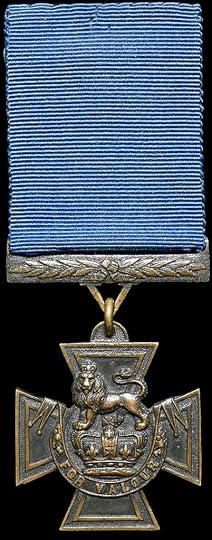 The Second VC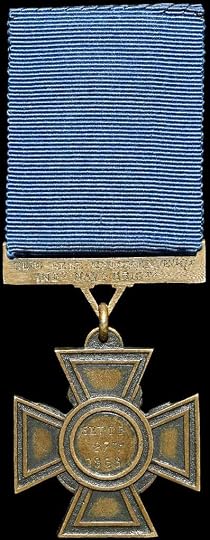
The medal was received by his father in 1862 and was accompanied by a letter from Sir Edward Lugard, dated 4 March 1862:
Sir,
I am directed by Secretary Sir George Lewis to transmit to you the decoration of the Victoria Cross [which] would have been conferred, in accordance with Her Majesty’s intentions, upon your son the late Mr George Bell Chicken, of the Indian Naval Brigade, had he survived, in recognition of his gallantry at Suhejnee, near Peroo, on the 27th of September 1858, as recorded in the enclosed extract from the London Gazette of the 27th of April, 1860. This award is sent to you by The Queen as a memorial of your late son’s gallant conduct on that occasion. You will be so good as to acknowledge the receipt of it.
I have the honor to be, Sir,
Your most obedient servant,
Edward Lugard.
It is believed to be the only VC in existence with the Esq.e suffix and is the only one to be issued to a civilian volunteer of the Indian Naval Brigade.
George Chicken Snr held on to not just the cross in its original box, but Lugard’s letter, his son’s correspondence and his sword (which had been returned to him) for the remainder of his life. Shortly before his death, he gifted the relics to his daughter, Elizabeth. The medal remained with the family and was passed on to a cousin, Mr Rupert Chicken of Nottingham, upon Elizabeth’s death. However, for reasons unknown, the whole lot – medal, box, sword and letters turned up at auction in 1923. The items were sold again in 1932 to a private collector, supposedly from Canada. Either he was somewhat lackadaisical about his collection, or his relatives were clueless, for the next appearance of the medal and the letters would be 55 years later, when they turned up in a suitcase, along with other medals, in a basement in Alberta, Canada. The medal was sold in 1987 and bought once again by a private collector. It came up for auction (with all the letters and the box) once again in 2022, when it was sold by Morton and Eden in London for the price of £280,000 to an unnamed purchaser. The sword, however, vanished somewhere along the way and has never been found. If George Bell Chicken had received the India Mutiny Medal, it likely went down with the Emily; like his sword, it too has disappeared.
Sources:
Low, Charles Rathbone. History of the Indian Navy (1613–1863). 2 vols. London: Richard Bentley & Son, 1877.
Supplement to the London Gazette 22224, 31 January 1859
“London Gazette”. No. 22380. 27 April 1860. p 1596
https://vcgca.org/our-people/profile/1155/George-Bell-CHICKEN
https://freepages.rootsweb.com/~chicken/genealogy/belltree.htm
https://www.invaluable.com/auction-lot/the-unusual-indian-mutiny-‘naval-brigade-victoria-846-c-bd44a34b04?srsltid=AfmBOoo8sMg0OfPogisbDdE5R1Y0pDPi25aqGAO9KfmiIz2BrfYBEi3W
https://www.victoriacross.org.uk/bbchic22.htm
https://www.memorialstovalour.co.uk/vc279.html
September 3, 2026
Lieutenant Charles George Baker, VC
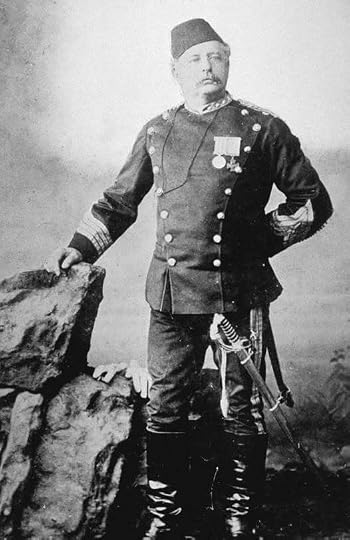 Major General and Lewa Pasha Charles George Baker VC
Charles George Baker was born on 8 December 1830 at Noakhali in East Bengal, to John Baker, a surgeon of the East India Company and his wife, Lydia. His early life was likely spent in the climes of this once remote backwater of what is today south-eastern Bangladesh, and perhaps it was here that young Charles first heard the call of the sea.
George was sent to England for his education, attending schools in Halesworth and Lowestoft in Suffolk. Our next glimpse of Charles comes not from the army, but as a midshipman in the EICo Maritime Service, with the intention of transferring to the military. However, the waves led him to the Peninsular & Oriental Company instead. By 1854, he was serving as second officer aboard the SS Douro.
Unlike Baker, who was destined for a long and illustrious career, the Douro would have a very short life and ignoble end. Built by Tod & McGregor in the Partick Yard, Glasgow, she was launched on 25 June 1853 and was noted, on 13 August 1853 on her arrival at Southampton, as “One of the few P&O ships of her time to be given painted ports; barquentine rigged, she looked very smart.” She was registered on 23.08.1853 as Douro for The Peninsular and Oriental Steam Navigation Company for £28,050. After two voyages between Southampton and Constantinople to iron out any remaining issues (it turned out her compasses were faulty, causing “poor landfalls”), she was finally assigned to the “China Run” on 27 December 1853 to carry passengers, mail and cargo between the ports of Bombay, Singapore and Hong Kong. At 810 tonnes, she was an iron-hulled, wooden-decked ship with a single screw, a steeple-geared steam engine, capable of achieving 10 knots in ideal conditions. However, as it turned out, she was no match for the China Sea and her storms.
WRECK OF THE “DUORO” STEAM-SHIP.
(From a Singapore Correspondent)
Illustrated London News, No. 696, Vol XXV,
Saturday, August 5, 1854
One of the fine steam-ships of the Peninsular and Oriental Company, the Duoro, has just been wrecked under the following distressing circumstances on her voyage from Hong Kong to Singapore. On the night of May 24, the Duoro encountered a a typhoon, in which she lost her funnel and her boats, and was wrecked on the north shoal of the Paracels, a group of islands and shoals in the China Sea, as shown by the accompanying illustration:
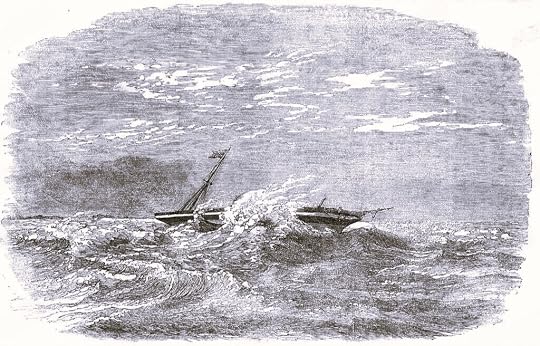 The Grounding of the SS Douro
The following is a detailed account of the wreck by another of the passengers of the vessel:-
“We left Hong Kong, with all the mails and passengers, for England, on May 22nd at 2pm, with fine weather and a fresh breeze from N.E., making a capital run for the first forty-eight hours. A heavy sea then began to set in, with more wind, which gradually increased to a typhoon, on the night of the 24th: we were in the middle of it.
Our lifeboats were washed away, sails blown from the yards, and eventually our funnel blown overboard. This was about one a.m. of the 25th. The engines were stopped, and the ship lay very well until daylight, the gale rapidly moderating. The captain deemed it advisable to bear up for Hong Kong, which was accordingly done, and the day was spent in repairing damages, shifting sails, disconnecting the screw, &c. At noon by observation we were in lat. 15.15 N., long. 110.3 E., course steered N. by E., afternoon.
Shortly after midnight we were all startled from sleep by feeling the ship grating on the rocks, and very soon bumping heavily and sea washing over her. The foremast was cut away, and we soon became a helpless wreck, but getting more firmly fixed on the rocks, as each sea struck her. We anxiously awaited daylight, which, when it came, showed us our position on a reef, without any land in sight. This we concluded to be the north shoal of the Paracels, (which proved to be correct by observation at noon), distant from the nearest land, Woody Island, over 25 miles; and from Hainan, east of China, 120 miles. By eight o’clock, the ship lay comparatively quiet – the sea having gone down in a wonder manner in so short a time. A consultation was held, in which it was resolved to send our small six-oared boat to Hainan, in charge of Mr Baker, second officer, and Mr Norie, late commanding officer of ‘Lady Mary Wood’ to endeavour to get assistance. They were accordingly started off, with the prayers of all hands, for their success, as all our hopes depended upon so frail a chance.
Too much praise cannot be given to these gallant fellows, who, after eight days of great hardship, danger and privation, succeeded in reaching Hong Kong, having travelled over a distance of 500 miles in a small jolly- boat, encountered a gale of wind, and being nearly taken prisoners by the pirates of Hainan. The ‘Malta’ and the ‘Tartar,’ Peninsular and Oriental Company’s steamers, were immediately dispatched to our assistance. We remained in this helpless condition for 10 days, constructing rafts, building a boat, and making preparations in case the ship should break up; but the weather remained beautifully flat and the sea smooth during the whole time, a thing very unusual in the China Sea, particularly during the change of the monsoon. We were very much cheered and comforted by the prayers offered up every morning by the Rev. Mr Young, a missionary, and which all Europeans, without exception, attended. Two Chinese junks were seen at different times. With one we succeeded in communicating, but her captain refused to take anybody on board, and would not go to Hong Kong though offered 1000 dollars. We could not catch her, or under these circumstance we should have taken her by force, and sent a part of the passengers and crew to Hong Kong. Only one life was lost – as Lascar, who, with some others rushed for our only serviceable boat, when we struck, and in attempting to lower her down he fell overboard and was drowned.
The mails and passengers were put on board the Malta on the 6th of June, and turned over to the ‘Pekin’, which left Hong Kong with the mails, with orders to call at the North Shoal. Great hopes were entertained of getting the Douro off, should the weather remain fine. The barometer during typhoon was down to 28.35.”
It is a misconception to think only Baker and Norie set off in the jolly-boat; it had six oars and, as such, six further passengers. Besides the two officers (Norie was not serving on the Duoro; he was an officer of the P&O, but was proceeding home on sick leave), there were two quartermasters, two lascars and two passengers. It was, as described, a perilous venture. They first encountered a Chinese junk and endeavoured to get assistance. A passenger, who happened to be Chinese, boarded the ship, but he was swiftly robbed of what little he had on him and sent off. For days on end, heavy seas would make their lives miserable; running low on provisions, they arrived on Hainan Island, only to find, according to Baker’s log, they were unable to find any signs of habitation. Now, they could have given up, but instead, it was decided to push on towards Hong Kong. On this leg of the journey, they would encounter pirates who refused them food and water unless they allowed themselves to be robbed – providentially, they managed to escape their clutches, returning to the sea to face not only bad weather but a jolly boat that was rapidly taking on water. They finally arrived in Hong Kong and the rest, as they say, is history.
As for the SS Duoro, she was never recovered and remains to this day a wreck in the China Sea.
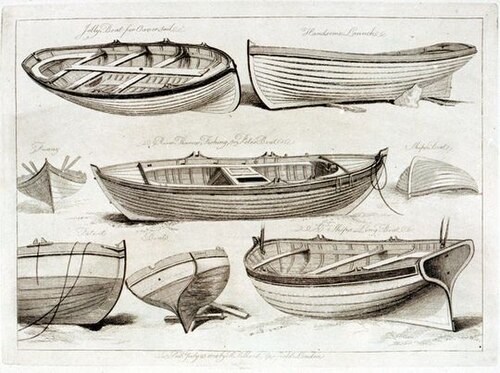 Top left a jolly boat Jolly boat for oars or sail, 1808
It would seem that Charles had seen quite enough of the sea and made his way back to India. To his surprise, when he had arrived in Calcutta he found he had erroneously been reported as dead from smallpox, with
his “untimely end was lamented by a numerous circle of credulous friends.” However, there was certainly much life ahead of Charles Baker. He joined the Freemasons and was initiated in into the True Friendship Lodge, No. 218, in Calcutta on 13th August 1855 and in 1856 he was commissioned as a lieutenant in the Bengal Military Police, the very year the regiment was raised at Lahore.
He was appointed its second-in-command, and at the age of 26, he was off on his next adventures with Rattray’s Sikhs.
His chance at command came at Sahejani, when Lieutenant Broughton suddenly decided to hand it off to him in the field – accustomed to taking swift decisions, accompanied by the brash and the headstrong Sikhs of his detachment, Baker charged a massed army of some 1000 men, over rough ground, through watercourses and over broken fields, to win the day. He was not specifically recommended for the Victoria Cross by Captain Rattray, who wanted some sort of a commendation for his actions, which would certainly be a boost for the morale of the regiment; it was Sir Colin Campbell, who notoriously despised the VC and all it stood for, who decided Baker was an ideal example of derring-do in action. In a letter to Lord Canning, Campbell directed his Adjutant-General, Lieutenant-Colonel William Mayhew, on 6 October 1858, to write to Lord Canning:
“I have the honour to request, on the part of his lordship, that you will have the goodness to direct the attention of the Right Honourable the Governor-General to the brilliancy of the exploit performed by Lieutenant G. C. Baker, of the Bengal Police Battalion, which is deserving of the highest encomium, on account both of conception and execution. His lordship is of the opinion that the Victoria Cross should be awarded to Lieutenant Baker, and to Mr Chicken, of the Indian Navy, and he will take immediate measures for the execution of his intention in this respect.“
However, the citation would not appear in the London Gazette until 1862 and would consist not only of Sir Colin Campbell’s recommendation but Baker’s entire despatch. (London Gazette, 25 February 1862, Issue: 22601 Page: 957). It is unclear why it took so long to publish. Part of the problem might have been Baker’s lax attitude towards dates, for his original dispatch gives the date of the action as 26 September and not the 27th. It was also an unusual VC that did not fall into the regular clauses – neither Rattray (who recommended him for a reward) nor Sir Colin (who commended him) had seen the action. As such, there was only Baker’s word for it. The other issue was that Baker was not part of a regular unit, but was serving with the Bengal Military Police, which at the time was still an irregular force. It would take time to figure out if Baker was indeed eligible or not. Then there came the bureaucratic hoops – gathering formal dispatches, securing the necessary eyewitness statements and then clearing them. The mutiny had thrown India into something of an administrative quagmire, with delays in the postal service and communication. Once the file was cleared in India, it would then travel to England for some more work, including a review by the Secretary of State for War, until it was ultimately approved by Queen Victoria.
By the time Baker received his VC, he had already had further adventures.
In 1859, he was appointed Second-in-Command and Officiating Commandant of Cavalry within the Bengal Military Police, overseeing the reorganising and managing of local irregular horse units following the aftermath of the rebellion. In 1861, we find him taking part in the punitive Sikkim Expedition (under Lieutenant Colonel John Christopher Gawler). A year later, Baker was back in England – he received his Victoria Cross in the post and married Charlotte Campbell Ashmore, the daughter of Major William Ashmore, on 25 November at Holy Trinity Church in Bath. He then returned to India in 1863, taking the post of Officiating Deputy Inspector of Police at Dacca, coming, as it was full-circle spending the last year of his India career in East Bengal where he had been born. It was a short posting; in 1864, in poor health, Baker retired and returned to England. For a time, he settled in Malvern with his wife and four children, but also spent some time in the United States, visiting relations, in particular his brother William, who had settled in Iowa.
However, it was hardly the end of his career. In 1877, during the Balkan Campaigns, Baker served with the Turks under Valentine Baker Pasha and would spend some time as a prisoner of the Russians. The Sultan, like Sir Colin Campbell, all those years ago, was suitably impressed with Baker and, for his services in Turkey, granted him the rank of Major General and appointed him Lewa Pasha. In 1882, he transferred to the Egyptian police, and finally retired as Major General (Egyptian Gendarmerie) in 1885 and as Chief of the Public Security Department for the Egyptian Ministry of Interior. Following his return to England, Charles George Baker and his wife Charlotte took up residence in Southbourne, living at South Cliff Hotel on Belle Vue Road. Here he died on 19 February 1906 and lies buried at Christchurch, Christchurch Borough, Dorset, England.
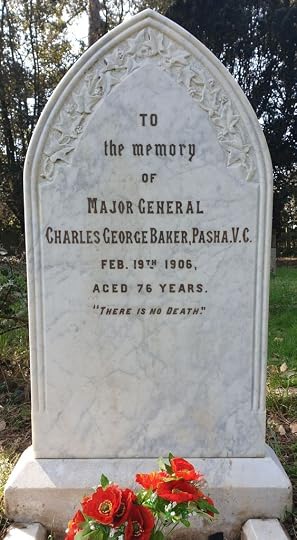 https://www.findagrave.com/memorial/8108502/charles-george-baker
Sources:
Illustrated London News, No. 696, Vol XXV, Saturday, August 5, 1854
Supplement to the London Gazette 22224, 31 January 1859
London Gazette, 25 February 1862, Issue: 22601 Page: 957
https://victoriacrossonline.co.uk/charles-george-baker-vc/
https://vcgca.org/our-people/profile/1154/Charles-George-BAKER
https://www.findagrave.com/memorial/8108502/charles-george-baker
https://poheritage.com/wp-content/uploads/ship-data-pdfs/DOURO%20(1853).pdf
https://www.bulwer1068.org.uk/history/eminent-members/major-general-charles-george-baker-v-c
https://gw.geneanet.org/
Christchurch History Society:
https://web.archive.org/web/20150418003817/http://www.historychristchurch.org/connected-to-christchurch/
In the Disturbed Districts
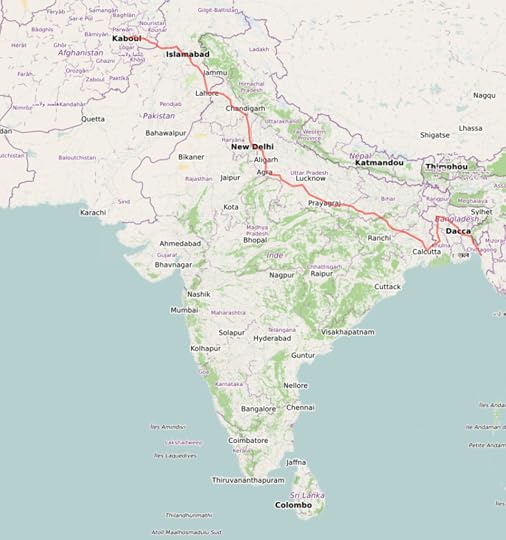
Built along a trade route that for at least the last 2,500 years has linked Central Asia to South Asia, the Grand Trunk Road is one of the oldest and longest road systems in Asia. It runs west from Teknaf (Bangladesh) on the Myanmar border, passing through Chittagong, Calcutta, Cawnpore, Allahabad, Agra, Ghaziabad, Delhi, Amritsar, Chandigarh, Lahore, Rawalpindi and Peshawar to reach the final destination of Kabul, a distance of 2’271 miles. Between 1833 and 1860, the EICo carried out a massive reconstruction project to convert this ancient route into raised and metalled road, which, when complete, would connect Peshawar and Calcutta. It was an engineering project of vast proportions, costing roughly £1’000 per mile. The roadway was built on an elevated earthwork embankment up to 40 feet wide, to protect it from seasonal floods and featuring a central metalled surface made of broken stone or kankar. With deep side-drains and shade trees along the slopes, it was not only stable, but travellers could receive some succour from the heat.
The building of the Grand Trunk Road was not a vanity project, nor was it altruistic. Although the benefits were obvious in easing the rigours of travelling, it served as a commercial artery, allowing merchants to move goods quickly from interior regions to river ports and trading hubs. The dak and official communication could now operate more efficiently, helping the EICo to maintain centralised control over newly annexed territories, and of course, it enabled the rapid transit of troops, artillery and supplies.
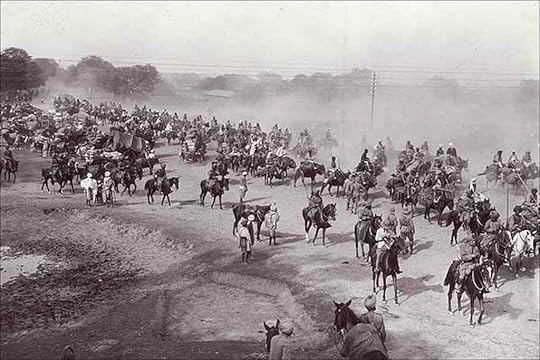 Troops on the Grand Trunk Road, 1940
During the mutiny, the Grand Trunk Road, although as yet unfinished, played a vital role in not just easing the transport of troops but to carry supplies from the Punjab, first and foremost, to Delhi. However, it was not only being crossed by the British as they sent troops further down the roads towards Cawnpore, but it was also a route regularly used by the rebels. A part of the road traversed Bihar; it was of immense interest to their leaders.
Throughout the remainder of 1858, Amar Singh, who was operating a parallel government in the Shahabad District, routinely sent out mobile rebel columns, numbering upwards of 7000 men, to harass British supply lines, ambush patrols, and force the British to keep garrisons stationed permanently along the Grand Trunk Road. For their part, the British deployed immense resources to clear and fortify the road and, under the directives from British commanders, punitive columns marched along the corridor, employing scorched-earth tactics such as burning adjacent villages and executing suspected rebels—to deter attacks on British logistics. The European mounted police were actively moving through the Bihar districts to suppress lawlessness and were augmented by an array of volunteers, planters, civilians and, in one case, a sailor. The requisite to join up was the ability to ride, shoot and, as it would seem, a certain disregard for personal safety, as we shall see.
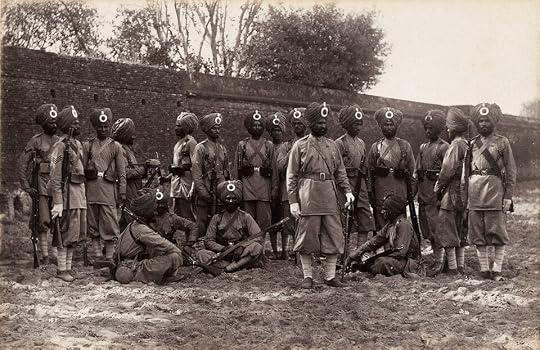 Rattray’s Sikhs at Delhi, 1886
The backbone of operations continued to be the Bengal Military Police Battalion, or as they were colloquially known, Rattray’s Sikhs. The unit had been raised in 1856 by Captain Thomas Rattray in the Punjab. Amongst the recruits were ex-soldiers of the recently disbanded Sikh Khalsa, but it was not exclusively Sikh. The force consisted of both cavalry and infantry and was intended to be an armed mobile police force (as the name implies), accountable to the civil authority in the Bengal Presidency. Before the mutiny, their main purpose was to maintain law and order in the Raj Mehal Hills of the Santal Parganas, in the Lower East Provinces of Bihar. Then came 1857.
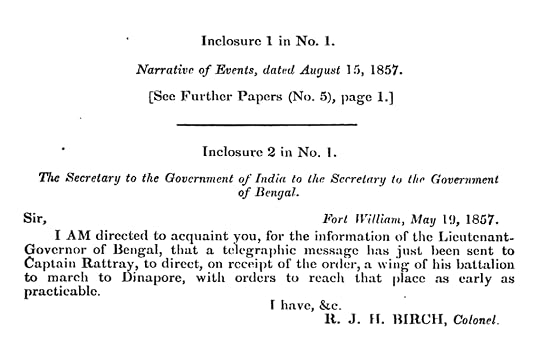
The Bengal Military Police Battalion was suddenly in great demand in Bihar – as we have seen, they were mobilised by William Tayler at Patna, and it was through his foresight that 50 of the men were present at Arrah for the siege. Over a period of 14 months, the battalion would record 30 engagements against the rebels and several minor skirmishes while on escort duty with civil officers. Unlike other forces, Captain Rattray placed his confidence wholly in his native officers, and one of them was Havildar Major Hedayat Ali. On forming the battalion, Rattray had specifically asked for Ali to be transferred to the new corps, for at the time, Ali was known as one of the best drill-sergeants in the country. Along with fifty drill instructors on loan from the Lahore Division, Rattray and Hedayat Ali strove to raise the corps into one of the finest and best trained in India.
Hedayat Ali was raised to subedar and appointed to command C- Company, Infantry, and was not only a close confidant but a personal friend of Captain Rattray. Throughout the mutiny, Subedar Hedayat Ali acted as Rattray’s right-hand man and was often given opportunities of leadership and trust rarely given to native officers. More often than not, it was Ali who acted not only as an intelligence gatherer but as a political officer and a negotiator between the military authorities and the rebel leadership. Even William Tayler had relied on Ali, for he was one of the men who tried to persuade General Lloyd, on more than one occasion, to disarm the Dinapore troops in June 1857. It was also Hedayat Ali, accompanied by six troopers, who assisted Mr Wake in keeping calm in Arrah before the siege began, covering the 35 miles from Patna to Arrah in six hours and on his orders Jemadar Hukum Singh and the 50 men of the battalion (of the 100 on escort duty) then remained behind as the Arrah garrison.
When the Mohamedan troops in Patna began their rumblings of mutiny, Subedar Hedayat Ali not only uncovered the plot but together with Captain Rattray and Mr Tayler, “revolvers in hand”, went to the house where the ringleaders slept and put them all under arrest. A few days later, Ali rode with speed into Patna to inform them that Dinapore had mutinied.
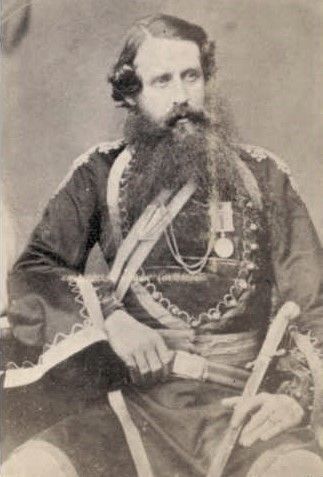 Captain Colonel, Thomas RattrayPage 1/2
August 28, 2026
In the Disturbed Districts of Ghazipur & Bihar
June 12 1858 – Camp Buxar – Dispatch, Brigadier John Douglas to Brigadier Lugard
Force detailed as:
3 guns Royal Horse Artillery;
3 troops Military Train;
1 troop 4th Madras Cavalry;
Her Majesty’s 84th Regiment.
“Sir,
I HAVE the honor to state, for the information of Brigadier-General Sir Edward Lugard, K.C.B., that according to his instructions I proceeded on the evening of the 7th instant, with a force as per margin, en route to Buxar. I arrived at Shahpoor at 11 p.m., and bivouacked;
8th, marched to Saumgunge, 12 miles, and encamped. Two men of the 84th died from sun-stroke this day.
9th. Marched to Buxar, 14 miles, and encamped.
10th. Understanding that the rebels occupied the village of Ghamur, I advanced to attack them; at 3 miles from Buxar, crossed the Sarronuddy by a plank bridge; when within a mile of the Korumnassa river, I received information that a body of the enemy had crossed to this side of the river. I sent forward the cavalry and horse artillery, under command of Major Mitchell, Royal Horse Artillery; the artillery advanced to the river side, marked by the cavalry, and discovered the enemy, who had re-crossed the river, in a tope at some 500 yards; they fired about twelve rounds, dispersed and killed several of the enemy. The river not being fordable, and there being no bridge, the cavalry and artillery returned to the main body; the force then proceeded to Chawsa, 9 miles from Buxar, and encamped during the afternoon a bridge of boats was thrown across the Korumnassa by Captain Wilkinson, Deputy Assistant Quartermaster-General, and a guard sent over for its protection.
11th. No certain information of the enemy’s movements could be obtained; crossed the river at 4 a.m., and advanced through Barra to Ghamur; a thick tope of trees surrounds the village; at about 1,200 yards distance, a number of people were seen in the tope; two companies of the 84th advanced in skirmishing order and drove them off. I then moved to the rear of and round the village, sending skirmishers through it, but could not discover the enemy; the accounts of his movements were very conflicting. I sent the cavalry and artillery forward to Sheopoor Ghaut, to intercept them if they were crossing the river, having heard that the main body had taken that direction; but they did not see them. I heard afterwards that they had gone south and south-west. I burned the villages of Ghamur and Barra, re-crossed the Korumnassa and encamped near Chawsa. Three men of the Royal Horse Artillery died during the night from the effects of the sun, and 1 man of the 84th, 1 horse, and 1 trooper of Rattray’s Seikhs were slightly wounded while burning the villages; the detachment of this regiment joined me on my marching out of Buxar. The heat during the operations was intense, and the troops suffered much, particularly the 84th Regiment, who have now been thirteen months in the field. I consider this regiment at present to be quite unfit for active service; the men have no positive disease, but they are so exhausted that they can neither eat nor sleep.
12th. I returned to Buxar, and encamped. In the village of Ghamur, 4-5 brood mares belonging to Government were recovered and handed over to Mr Jackson, of the stud establishment here, who accompanied the force. In conclusion, I beg to state that I have every reason to be satisfied with the way in which all did their duty.”
This was just a taste of what was facing Brigadier John Douglas, for shortly after he sent off his dispatch, Brigadier Edward Lugard left India for the last time. On 21 July 1858 he boarded the Hindostan at Calcutta and set sail for home, leaving Douglas in command of the “Disturbed Districts of Ghazipoor and Behar.” The area under his command was vast, and although it did not include Dinapore, the government stud farm at Buxar fell under his jurisdiction. Douglas was expected to keep open the river routes and the roads and ensure that some semblance of peace was kept up in the towns and villages. As it was, even as late as July 1858, the British had not been able to re-establish their rule in Bihar and the local population, either pestered by the continued infractions by rebel bands, or harassed by the British, was not in the mood to be forthcoming. It was clear to Douglas that establishing his command in Ghazipur and Bihar was going to be a complicated task.
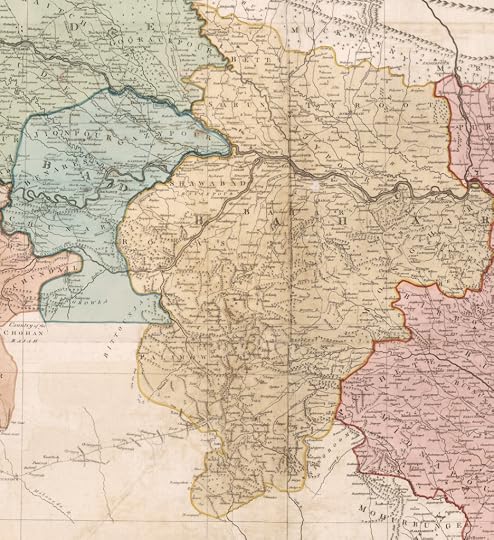 Map of Ghazipur (blue) and Bihar (yellow) districts
His first move was to establish posts throughout the districts, each manned by a small but mobile detachment of men, who could, at a moment’s notice, act against any incursions by rebels in their immediate vicinity. From the trusted sepoys he had at hand, he chose men to infiltrate the ranks of the rebels to bring him information about their movements; as for the rebel leaders, they now had a price on their heads and anyone bringing in just such a man, dead or alive, would be liberally rewarded. To make things easier to move his troops, Douglas continued the practice of cutting roads through and around the jungles. Although he could not take Jagdispur just yet, he could certainly make the lives of the rebels difficult.
As a portion of the Grand Trunk Road traversed lower Bihar from east to west and was of vital importance to Sir Colin Campbell and his future plans, large numbers of troops under Colonel Turner (97th Regiment) were relegated to keep the road open. For the four months of monsoons, Turner and his men would hardly find a day of peace as they chased, routed and fought rebels up and down their portion of the Grand Trunk Road.
As for the rebels, those under Ammar Singh had quickly reoccupied Jagdispur, and throughout the monsoons small parties of his followers kept the districts in continuous disturbance. They were not following any particular plan and could attack anywhere and at any time, more or less from any direction, as they pleased. Their “principal depreciations”, however, were concentrated on the country just south of the Ganges and west of the Son rivers.
In July, Douglas shifted his attention to the Ghazipur District as he received information from Dinapore that his outpost at Beyriah was under siege. The 120 Sikhs (of the Sikh Police Corps) he had posted there to hold it had been swamped by no less than 1000 rebels, 250 of whom were said to be mutinied sepoys. They had advanced to within a quarter of a mile of Beyriah and half past six in the morning on 11 July, surrounded Captain McMullin and his men. McMullin’s position was fortunately defensible, being a strong house in a large enclosure with a high wall, with a deep, impassable tank on one side, a nullah on another and on the fourth side, several smaller, loopholed houses. He had further fortified himself with breastworks and barricades and had ensured he had plenty of provisions.
After sending for reinforcements, McMullin wasted no time in deploying 30 men of his cavalry and 80 of his infantry, all under Lieutenant Costley, to advance immediately on gathered rebels, giving them no time to get themselves organised. As soon as they were in range, Costley ordered the men to open fire. The rebels, somewhat surprised at this sudden attack, attempted to close around the right of the village, where just the day previously, McMullin had thrown up an entrenchment. McMullin quickly sent word for the village to be set on fire. By half past eight in the morning, with the fire raging and unable to approach McMullin’s position without getting shot, the rebels moved back to a large tank, one mile away from the fortified house. Here they remained for the rest of the day, taking time to exchange shots with McMullin’s advance picquets. For now, they would have to hold their own but help was on the way.
On 14 July, upon hearing that Beyriah was besieged, Douglas proceeded with 200 men of HM’s 10th Foot, accompanied by Major Sir Henry Havelock and Captain Stevenson; as speed was foremost on Douglas’ mind, the force marched without tents and without any baggage at all. They marched to Sheopore Ghat, just six miles from Beyriah where they were met by Lieutenant Jennings (commanding the Sheopore Ghat) and Mr George Probyn, magistrate of Ghazipur. Probyn, much to Douglas’ relief, was able to report that Beyriah was still standing and the rebels had retired to Bulliah. To spare his men any unnecessary marching, Douglas left his force at the ghat and rode off with Probyn to Beyriah to consult with McMullin. He found the captain and his men in excellent spirits, and reported they had killed some 20 sepoys; their losses were 1 sowar killed, and one horse wounded. In an unfortunate turn of events, three of McMullin’s infantrymen had been murdered within his sight when they tried to re-enter the entrenchment.
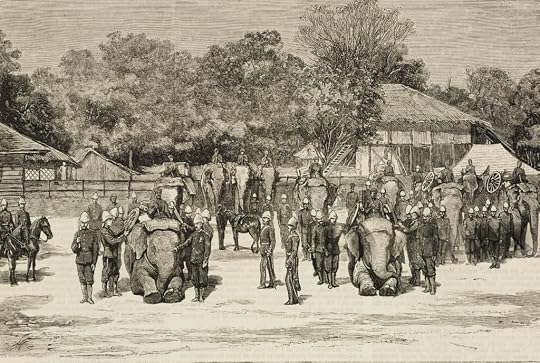
As there was no work in Beyriah, in the afternoon Douglas marched to Ballia and arrived there on the morning of the 16th. Here he found that McMullin’s messages for reinforcements had been received in Buxar and the commander had wasted no time in sending off as many men as he could spare. The rebels had been more than discomfited by this turn of events and had once again retreated. Douglas decided that this time he was going to have it out with them, come what may. In pursuit, he now sent Major Rolleston with 24 men of the 84th Regiment (on elephants), 72 sowars of the Madras Cavalry and the 3rd Sikh Cavalry (under Lieutenant Baker) along with another 392 of the Police Battalion (under Captain McMullin). After four hours of hard chase, they came across the rebels who, after exchanging a few shots with the oncoming force, retreated with some haste into countryside, using the cover of the oncoming night to their advantage.
On the morning of the 17th, Douglas, leading the men himself, took 20 men of the 84th, once again on elephants, with 60 sowars of the Sikh Cavalry and 30 men of the Military Train to form a junction with Rolleston. Rolleston, to Douglas’ surprise, had not moved at all, for as luck would have it, he had no idea in which direction the rebels had gone. The villagers had proved singularly unhelpful, and their information proved in every instance wrong. So the force waited. Late in the afternoon, Major Havelock returned – he had found the right track.
Douglas sent him on ahead with the cavalry, and if possible, intercept the rebels until he could come up with the infantry. However, by the time Havelock found them again, it was 6 in the evening. The rebels were “marching in regular order in column of companies”, and there were some 200 of them. Intercepting them was not an option at this point, so he kept on their flank and followed them until he lost them in the dark. Douglas, in the meantime, tried to push his force onwards, but it was hopeless. The elephants were slow, the day was very hot, and his men were tired, and yet, he pushed them on for 40 miles. At 8 in the evening, unable to catch up to Havelock, Douglas called it a day and the force halted at Munuhar on the banks of the Gogra. With no information on which direction the rebels had gone, Douglas now decided to wait for news from Major Havelock.
Havelock restarted the chase early on the morning of the 18th. He picked up the rebels’ track quickly but soon realised they were marching with some speed and were at least ten miles ahead of him. Saddle sore and their horses fatigued, Havelock nevertheless continued in the pursuit. He followed the rebels as far as the village of Phursata on the border of the Azamgarh District before sending a messenger back to Douglas, requesting orders. By now the rebels were making their way through the Azamgarh District towards Oudh, and Havelock was informed that, as Douglas could not catch up to him in any meaningful amount of time, it was best he leave off and return.
August 21, 2026
Brigadier Rowcroft and the Sarun Field Force
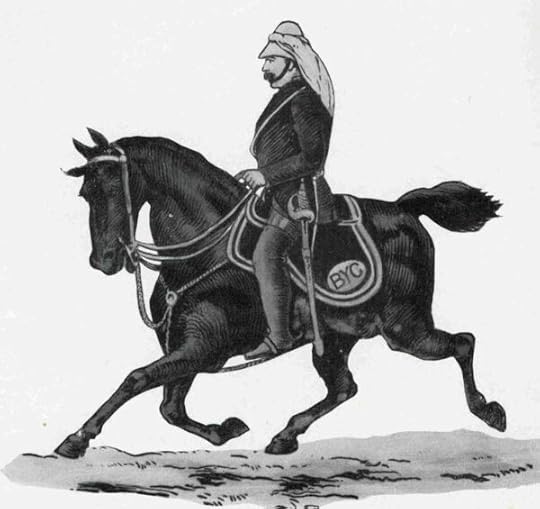
The Sarun Field Force was formed in late 1857 in western Bihar, but their operations would subsequently be concentrated on the Gorakhpur District. Initially the force comprised of 30 men of the Royal Marines, 130 of the Pearl Naval Brigade, 350 Nepal troops and 50 men of the Bengal Police Battalion. For artillery, they had four 12-pounder howitzers, two of which were mountain-train guns. Early in 1858, the Bengal Yeomanry Cavalry joined their ranks. As troops were pushed up from Madras, the Sarun Field Force would be reinforced by both cavalry and infantry, along with detachments of HM’s 13th Regiment. They would however, remain an independent unit for nearly one year, keeping the rebels from extending their influence into the Himalayan Terai, and at the same time, preventing them from regrouping in numbers to launch significant campaigns on the borders of Oudh. The Sarun Field Force November 1858 they would be taken into the winter campaign of Sir Hope Grant in November 1858, after nearly one year of fighting on the fringes of the mutiny. For all their bravery and hardship, their rewards would ultimately be small.
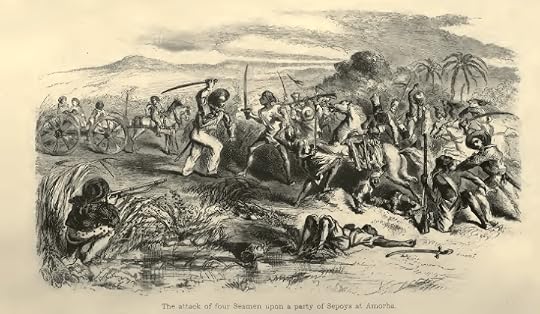 The Sarun Field Force The Sarun Field Force
 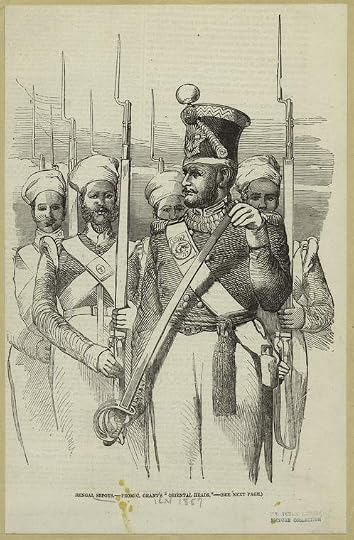 The Sarun Field Force Belwa Fort & Amorha
 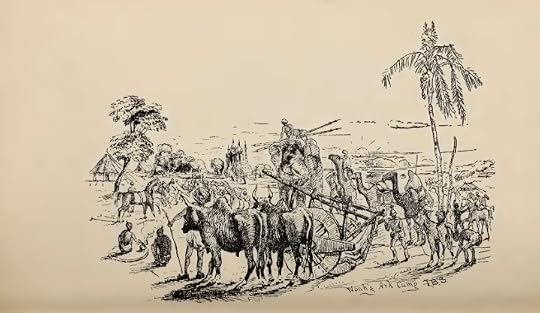 The Sarun Field Force The Sarun Field Force – The Fighting Continues
  The Sarun Field Force At Basti
 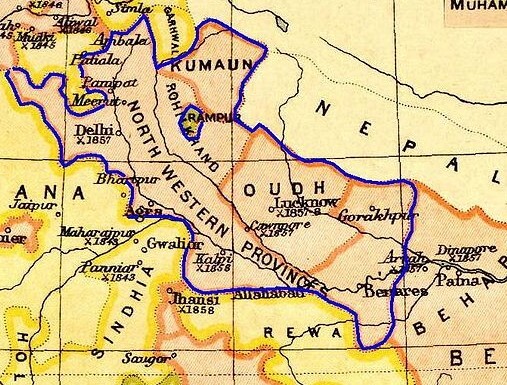 The Sarun Field Force The Sarun Field Force -June and July 1858
  Archive Before the End