Elly Taylor's Blog
April 9, 2016
People say Nothing can Prepare Parents – but I have a secret…

I thought I was really well prepared for parenthood. I did prenatal yoga, read everything I could get my hands on, we did 8 weeks of private birth prep classes and I fell instantly in love with my Irish midwife. Just listening to her voice made me want to have my baby right there on the floor.
And you know what? It all paid off.
We had a fantastic birth experience, one that I still look back on, 21 years later, and cherish. Our midwife showed my husband how to stand behind me with his hands on my hips and do birth circles in early labour. It felt like we were dancing. She demonstrated how to do acupressure when the pain became intense and I was grateful for his touch.
I gave birth with him standing behind me, supporting my weight. Literally, he had my back. I felt safe and relaxed enough that the birth went smoothly and the following day we walked out of those hospital doors proud and grateful parents heading off on our parenthood adventure.
And then we had our first argument in the carpark.
And our second on the way home.
And then things started really unravelling about week three when we were both stretched and stressed and sleep deprived and starting to wonder what the heck we’d gotten ourselves into.
And I wondered: why didn’t someone prepare us for all this?
So of course we went on to have another baby and at the same time I was finding my feet as a newish mama I also finished my training and began working as a Relationship Counsellor. I noticed that pretty much all of my new-parent clients were struggling with the exact same issues my husband and I had.
These couples, like us, had been treading water for weeks, months or even years because they didn’t know who to turn to for help and the lots of normal-but-not-fun new parent challenges were having an increasingly negative impact on their mental and emotional health – and on their new co-parenting relationship. I wondered how we could prepare parents so they could avoid, or at least know how to manage all this.
I was on a mission.
For 15 years I reviewed all the research, read everything I could get my hands on and worked with clients to bring them closer through the transition into parenthood after it had sent them further apart.
And in that time, I discovered some things. Truths about the transition into parenthood that have faded into the shadows with all the focus on pregnancy and on birth.
I found lost research, new studies and ancient wisdom that’s not getting through to the couples that need to be prepared with it. I’ve unearthed some secrets about the transition into parenthood that have the potential to change how we approach it.
If you work with expecting or new parents, I’d like to share these secrets with you.
The post People say Nothing can Prepare Parents – but I have a secret… appeared first on Elly Taylor.


September 11, 2015
Why I Heart New York
 But it was an anniversary of an entirely different nature that left the deepest impression.
For two whole days we have the slate grey skies and streets of Manhattan all to ourselves. Impending Hurricane Irene has cleared the subways and city of cars and commuters. Downtown is populated only by taxis, their bright yellow popping in the gloom as they evacuate residents to safer ground. The only people crazy enough to be out and about are tourists like us, there for the World Police and Fire Games, easily identifiable by accreditations hung proudly around our international necks. This year, the games are being held in NYC to commemorate the ten year anniversary of 9/11. Right now however, this usually vibrant and alive city has the feel of a giant grownup amusement park, abandoned and quiet before the storm, temptingly but frustratingly, closed for the weekend.
At the lush tip of Battery Park, Lady Liberty raises her torch over the Hudson, defiant at the oncoming storm. News crews are poised for action. We are tempted to stay and watch, but the city beckons and we turn northwards. Elegant waterside apartments are humbled by sandbags and chip-boarded windows. Up Wall Street, the narrowest of cobblestone alleys are overwhelmed with dizzy skyscrapers that look as high as the island is wide. Unexpectedly they open up at Federal Square, with classic columns and expansive marble steps of court buildings solemnly contemplating others opposite. Above, the wedding cake spires of the Woolworth Building remind us to keep looking up for other marvels. Chinatown and Little Italy, bustling with colour and crowd in the days following, is blinded by roller-shutters like a deserted side-show alley. Plate glass windows fronting chic Soho boutiques have designer signatures unceremoniously crossed out with packing tape.
Emptied of traffic, my husband and I are able to walk up the middle of Broadway for blocks. Times Square still manages to attract a sprinkling of tourists, the adrenaline ad-fest of neon and plasma further heightened by the anticipation of gathering clouds and rising winds. Those who brave the conditions are rewarded by a camera that captures images of random tourists from the crowd and throws them up enlarged on a giant screen opposite. Faces caught delighted, not just by the city, but the surreal circumstances we are first discovering it in.
To soon for me we leave one island for another, over bridges over sand spits, past pretty pastel clapboard houses to Rockaway Beach in Queens for the final surfing events of the Games. The contestants, mainly American and Australian emergency responders are competing under police protection and the scrutiny of ASP judges there for the Quiksilver Pro. Six black-clad NYPD monitor the boardwalk, in communication with two snipers on the rooftops behind and a massive police launch lolls in the waves out the back.
We think it complete overkill when two Blackhawk helicopters sonourously pass by at low altitude but they are quickly upstaged by the perfect flying formation of WWII bombers afterwards. At our gobsmacked expressions a local laughingly explains: first is the governor of New York surveying storm damage on Long Island and the vintage bombers are a private Wildcat flying club. Of course – this is New York.
As if the day couldn’t hold more amazement, my husband, competing for the first time ever, unexpectedly takes out the gold medal. We are still in shock as he steps onto the dais and dips his head to receive it. There is much back-slapping, hand-clasping and beer drinking as a local firefighter belts out the best Bob Marley covers we have ever heard. A proud surfing community embraces us and firm friendships are made.
Which creates a dilemma. My husband wants to spend more days at the beach but I can’t get enough of the city. We are saved by a fast and firm friendship with another couple. The boys are happy to go surfing some days and leave us girls to do our own thing. We come together at the end of long summer afternoons to share our adventures.
In the city, we discover extreme limits and an abundance of everything in between. Culinary delights at every price and from every corner of the globe: warm salty pretzels and tasty chicken gyros from street carts, tangy Polish borscht, crisp Japanese tempura and of course hotdogs, burgers, pizzas and steaks (for up to $150 I’m told!). Twenty four flavours of rice custard (including Cinnamon Sling, Coconut Coma and Chocolate Chip Flirt!) are a taste-testers delight at from Rice to Riches. Hale and Hearty soup and sandwich stores serve up 14 soups and custom salads daily. Well trained servers watch your face to make sure they stop pouring your chosen dressing at the exact right drop. I taste test Spicy Lentil & Spinach and Shrimp & Roast Corn Chowder and they are both so good I have to go back the next day. Union Square Green Market is foodie heaven with an abundance of colourful and flavorsome produce: Amish cheeses, coloured eggs, fragrant wines and fresh picked fruit and veg (six varieties of carrot!). Pretty pastel cupcakes from Magnolia bakery taste as good as we hope and I am sure I will have withdrawals from the chocolate topped New York baked cheesecake our local restaurant owner kindly organizes for my birthday.
And the shopping! Designer prescription glasses for less than 200 bucks and under an hour on Mott Street. Pop up sample sales beckon with next season’s kid leather brogues for $50 and one-off designer experiments in gorgeous prints and fabrics for $30, railroading my well-intentioned plans to spend the day at the Met. At Anthropologie, sales assistants welcome, coo and reserve change rooms with my name on it. Elaborately styled shop windows delight as much as the merchandise inside. There’s hand painted western gumboots in NoHo, 24 hour chess shops near Washington Square Park, flea-market treasures in Brooklyn and vintage finds all over. We rest in cool shaded parks along the way, sip cold mint tea and are entertained by a busker playing the grand piano and a flash mob of conga-dancers. Before we can decide if we are brave enough to join in, it disappears.
As the days unfold, the preconceived must-see-and-do list we came with is pushed aside. Just being here is more than enough.
In the first week of September our experience of New York shifts downwards. As the city recovers from Irene, with much less damage than anticipated, it prepares for the ten year anniversary of another aberration. News footage switches from floods and fallen trees to planes flying into buildings and paper rain. Locals who discover my husband is a firefighter offer their memories of that day. Minok, from the Korean restaurant in Bleecker Street remembers weeks of cleaning up the dust that “got into everything” in her Greenwich Village apartment. She still grimaces and shakes off the smell ten years later. Mel, a volunteer for the Games, worked for the Port Authority who built the towers. He calls them his ‘babies’. He recounts the day he arrives – blessedly late – for work at his WTC office, coming up from the subway and into the light to experience the agony of people escaping from the buildings and worse, and then, rooted to the spot, the earthquake of their collapse.
On our last day, at Mel’s suggestion, I visit the World Trade Visitors Centre. I am hesitant – it feels somehow voyeuristic. And I’m right. The displays of personal effects and faces of missing loved ones are overwhelming and I rush through in tears. I have spent two weeks with fire fighters and their families and their grief is still raw underneath stoic exteriors. This time of year re-traumatises many of them and it’s the ones who can’t talk about it I worry for the most. While they proudly wear T-shirts emblazoned with “we will never forget”, in reality, it would be a blessing if they could.
Years afterwards I still reflect on our time in the city. It’s easy for me to see past the flash and dazzle and big attitudes. It’s the tension of opposites and sensory overload that makes me feel I will need to go back again and again just to absorb it. The contrasts: the magnificent carved façade of Grand Central Station with its doors locked for the first time ever in that storm – against bewildered homeless men wondering where they are going to sleep that night. Tiny centuries old sandstone churches surrounded by glass and steel monoliths. Massive public spaces and cramped dark tenements. Remnants of the wall in Wall Street. Strangers who make eye contact, ask direct questions and mean what they say. Sirens like cats wailing and the gentle birdsong of Central Park. The smell of rotting garbage, of street spices and fragrant blooms. A teddy bear shrouded in a coat of ash. I feel love for it all.
In many ways New York City has stamped itself on me.
September 9, 2015
And Baby Makes Five
FIVE MAJOR SHIFTS IN THE
TRANSITION INTO PARENTHOOD
We send couples off into parenthood with the equivalent of a Bon Voyage card but a well stocked backpack might be more useful. Studies since the 1950’s have clearly shown that having a first baby has a major impact on a couple’s relationship and yet, decades later, most couples are still unprepared for this fact.
A period of adjustment for both mothers, fathers and same-sex couples, is normal, common and purposeful.
Knowing the major shifts of this transition can equip birth, therapy and parenthood professionals to support
the new families in their care.
1. Parenthood is a Rite of Passage
Traditional societies see parenthood as a rite of passage – a period of transition from one stage of life to the next. It is acknowledged that new parents need time, space and support to find their feet and adjust to the three different phases of the transition:
Letting go of the old way of life (this can often involve a sense of loss).
Facing the confusion and uncertainty of change (which can mean acknowledging fears and managing anxiety).
Emerging with new responsibilities, social standing and a sense of identity.
In the West, couples commonly struggle to get ‘back to normal’ as quickly as possible, and in doing so, often put additional stress on themselves and each other, setting themselves up for a “pressure cooker” lifestyle.
Understanding parenthood as a rite of passage (particularly these days when life before and life after, especially for mothers, can be vastly different) expands a couple’s awareness to the need for different adjustments, respects the significance of the life change, encourages couples to approach the transition as learners rather than experts and appreciate the benefits of social support.
2. Parenthood pushes couples through Relationship Stages
Most people aren’t aware that long-term relationships go through stages. First is the Coming Together phase, where there is high physical attraction, couples spend a lot of time with (or daydreaming about) each other. This stage commonly wears off between six months and two years.
Next stage, Growing Apart, is where couples naturally start to unglue from each other, live their own lives a little more and begin to assert their individual needs and wants, sometimes getting into a power struggle and leading to increased arguments. This stage lasts until the couple learn to negotiate differences or separate.
The third stage, Growing Together, is where couples learn to negotiate their differences in ways that are mutually beneficial. They learn to balance their own needs, desires and goals with their partner. In this stage they realise that the effort they put into their relationship has multiple benefits.
Due to timing, couples usually start having children when they are naturally moving into in the Growing Apart stage – and having a baby introduces more differences into a couple’s relationship. This is a major reason for the increased conflict in baby’s first year that 92% of parents report (Cowan & Cowan). Most couples need to learn to communicate more simply, openly and directly, especially when they are sleep-deprived, dealing with new and unexpected stresses and steep learning curves. Fifteen to 19 percent of parents found (despite increased conflict) that their relationship improved after baby (Gottman & Gottman, Belsky & Kelly). These couples were able to stay connected through friendship – making time for each other, mutual affection, interest and goodwill.
3. Parenthood comes with High Expectations
Probably the first shift the couple actually becomes aware of as they pass over the threshold into parenthood is the difference between what they expected life after baby to look like and the reality of it. Couples tend to expect that having a baby will bring them closer together than ever – and in time, and with work this can happen, but initially 67% of couples report a decline in relationship satisfaction (Gottman & Gottman) and only a tiny 4% (Martyn) say having children lived up to their expectations. The higher the expectations, the more chance of couples experiencing disappointment, blame and conflict afterwards. Australian research found 30% of mothers with Postnatal Depression felt unrealistic expectations contributed (source:Beyondblue).
By preparing parents for the aspects of parenting known to be stressful or challenging and emphasising the need for them to support each other and work together through these issues, we can reduce the potential for individual and relationship distress. In fact just two 40 minute “preparation for parenthood” sessions to adjust parental expectations and increase relationship awareness reduced relationship difficulties and Post-Partum Depression in 2/3 of Gottman’s participants.
4. Parenthood Shifts Relationship Dynamics
Having a baby means a couple become dependent on each other in new ways. In traditional relationships, Dad needs mum to stay home and look after the baby so he can continue working and mum needs dad to continue working so she can stay home with the baby. Alternatively, they both return to work and depend on a volunteer or paid help. And although research shows this is less of an issue for same-sex couples, there are still adjustments for them. Dependence ‘ups the ante’ in a relationship. The stakes become higher: partners are both now responsible for a vulnerable little person who depends on them for survival. Dependence on another brings gratitude when it’s working well, but blame and resentment when it’s not.
More than before, one partner will affect the other. A baby brings a new dynamic into a couple’s relationship, often forcing them to look at issues and work together in ways that may be unfamiliar or uncomfortable. A myriad of new situations need to be discussed and decisions made: birth plans, baby names, religious expectations, circumcision, immunisation, breast vs. bottle, in-law issues, parenting styles.
These need to be joint decisions: where one “wins”, the other “loses” and resentment, on anyone’s part, erodes family foundations. Where couples don’t recognise the need to pull together, issues can pit parents against each other. When an issue becomes bigger than the relationship, the couple is likely to have problems and negatives can escalate. Some parents may need to learn to work together to become interdependent.
5. Parenthood is a time of Emotional Vulnerability
Hormonal shifts of pregnancy and early parenthood make it ripe for mood swings. Exhaustion, broken sleep and stress affect emotional regulation and around 1 in 7 mothers and 1 in 10 fathers experience Postpartum Depression. How a couple communicate and express their feelings to each other can either create tension and conflict – or provide comfort, foster intimacy, promote a deeper understanding of each other and bring them closer together. Both mothers and fathers brains are primed to bond with their baby – which means they’re also primed to bond more closely with each other.
There will be a whole raft of new-baby issues to talk about postpartum so the antenatal period is ripe for opening new lines of communication. The easier practical aspects are discussed, the more likely partners are to be comfortable to drop into more emotional topics.
Emotional intimacy, affection and sexuality are linked. Both the desire and needs for sexual intimacy change after baby and a mismatched sex drive is a major source of conflict for most couples postpartum. Mothers are tired and distracted and want somebody to meet her needs for a change, as well as suffering from an overdose of skin and too many baby body fluids. The last thing she usually wants is sex. What mothers do crave is non-sexual affection (this is also linked to positive self-esteem), some good strong arms around her at the end of a long day, to feel understood by her partner and that she is not alone in this. Feeling isolated and misunderstood is a contributing factor to PPD.
Men tend to want to return to a ‘normal’ sex life as soon as possible. This needs to be normalised and negotiated. It needs to be made clear that a woman’s rejection of sex is not a rejection of HIM (many men can take it this way). If he does, he is likely to withdraw physically and emotionally from her and this can lead to other relationship problems down the track. Couples who feel connected emotionally usually return to a mutually satisfying sex life sooner.
Most couples are unprepared for the transition into parenthood and the effects of this transition on their partnership. However, strong relationships and families are built through knowing how to pull together and support each other – through all the changes.
For more: www.ellytaylor.com.
June 3, 2015
Review: Becoming Us, 8 Steps to Grow a Family that Thrives
Reviewed by: Dawn Bhat, MA, MS, NCC, LMHC appearing in Somatic Psychotherapy Today | Fall 2014 | Volume 4 Number 2
Personal ReflectionWhile I was reading Taylor’s book for this review, my then ten-month-old daughter was climbing all over me and pulling herself up to stand by using my knees for support. I felt Taylor’s words speak to me, as if she were a dear companion on my journey of motherhood from the onset. Taylor knew all about what I experienced during the newborn phase from breastfeeding to a messy house. What shocked me the most was Taylor seemed to know what this meant for my partnership, as we were experiencing the changes both together as one and separately as individuals. It is no wonder that Taylor is an expert and well-seasoned clinician whose work focuses on transforming couple’s experiences during the critical period between pregnancy and parenting. I was lucky that SPT’s editor, Nancy Eichhorn, PhD asked me to review Becoming Us: 8 Steps to Grow a Family that Thrives! I doubt I would have known about it otherwise. I hope you find my review a small representation of how informative and formative Becoming Us: 8 Steps to Grow a Family that Thrives is.
–download a copy of the full review here: Becoming Us in Somatic Psychotherapy Today
 Dawn Bhat, LMHC is in pr ivate pr actice in Hicksville, NY. She holds graduate degrees in General Psychology and Clinical Mental Health Counseling. Dawn is a National Certified Counselor and a Registered Yoga Teacher (RYT-500). Dawn has been researching somatic psychotherapy under the guidance of Jacqueline A. Carleton, Ph.D. of the USABP since 2010 and has presented scholarly papers and professional workshops regionally, nationally and internationally. Feel free to contact her: www.dawnbhat.com
May 28, 2015
Nurture Parenting Magazine features Attachment Partnering
When we have our baby, they necessarily take up all our time and energy. However, not many couples realize the toll this has on the relationship with our partners. Elly Taylor discusses ways in which you can ensure that your family remains attached.


Download and print the PDF of the article.
Read more at Nurture Parenting Magazine.
May 9, 2015
Five Things Mothers Want Their Partner to Know But Don’t Know How to Say It

Our new mother self-esteem can be a fragile thing, our confidence just a veneer.
This is partly because we have been bombarded with perfect (and so now we’re realizing unrealistic) images of motherhood on the screen and in the pages of magazines. This makes our expectations of ourselves, and maybe your expectations of us, impossible to live up to. Motherhood feels like a big gig for many of us and it is a case of ‘fake it till you make it’. But then there is no yardstick for ‘successful parenting’, no measure of performance like salary raises or work bonuses. Nobody gives a bottle of champagne for superior nappy changing. Where we may have looked to bosses, co-workers or friends to feel good about ourselves before the baby came, now, it’s pretty much only you. We want your acknowledgement, appreciation and encouragement. You also might have to let us know that you want the same from us.
We’re learning too.
Some of us bought into the myth that motherhood would be instinctive, and some things may be, but other things are also a steep learning curve – and that can cause us some performance anxiety. Some things we thought would come naturally are taking longer than expected. And sometimes the responsibilities of looking after our little person can be stressful. That’s why we’re snappy some times. Please be patient with us and ask us to be patient with you, join in with our learning and share the responsibility so it’s not just on our shoulders. Ask us how we’re going and prompt us to ask you – the baby absorbs our energy like a sponge and we forget sometimes. Please be curious, wonder what it’s like for us, just listen if you don’t know what to say. This is not a problem to be solved; it’s a journey for us to share. Let’s take the pressure off, experiment, make mistakes, forgive each other and laugh over it together.
Our lack of interest in sex isn’t personal. Really.
We’ve been covered in sticky body fluids all day, we’re ‘touched out’ from an overdose of skin contact and being clutched, pulled and scratched (those little fingernails can hurt!) and after a long day of feeling like we’re giving out, giving out, giving out, sex can feel like more giving out and an unreasonable demand on an exhausted body. What we really, really, need is some “getting” to get some sense of balance back. We need no-strings-attached affection, we need your arms around us so we can relax into your strength, a bath run or some vacuuming done. We need to know you care and love us and still think we’re beautiful even if we’ve got baby spit caked in our hair. Keep gifting us this and we will feel like giving back and eventually when we’re not giving out so much we will remember that sex means getting too. Resentment is a contraceptive, but gratefulness is a great aphrodisiac.
We are worried about being judged.
By you, by our mother, by your mother, by other mothers, and yet – we judge ourselves. Somewhere along the line we have bought into two big untruths: first that we will love every single moment of being a mother – and secondly, that if we don’t, it means we don’t love our baby. But there are times when we feel bored or lonely or frustrated or overwhelmed or disappointed, and then some of us feel guilty about it. Other mothers don’t admit it, although we’re starting to suspect that most of them feel like this too and it would be great if we could all just relax and talk about it. We might make some new friends that way. All this means we sometimes hold a lot of stuff inside, it sits there bubbling and churning like lava in a volcano – and because you’re the one around most, you get it when we burst.
We expected that life would get back to normal, but it’s starting to dawn on us that it never will.
We expected to feel more in control, but we’re working out it’s the baby that’s going to be calling the shots for a while. Some days we feel a bit caged. On these days we can feel envious that your life hasn’t changed as much ours. We know this isn’t your fault, but we don’t know what to do about it. On those days we might be snappy as soon as you walk through the door looking fabulous in your still-clean suit. Please understand that this is not personal, although it must feel like it is. It’s just such a big adjustment for us – life after baby can be very different to life before – and every day and for the next 18 years has now become real. We also need to have regular ‘time out’ too so we feel like ourselves again. We need and appreciate your support so we can do this.
These things can be hard to put into words and they take some getting used to. Nobody told us this was part of the full experience of parenthood so we weren’t prepared that we would grow in different ways along with the baby – with all the joys, the challenges, the adjustments and the changes, big and small, that they bring. But we want to share it – all of it – with you. We want you to walk alongside us, hold our hand, and put your arm around us, as we create the new – and maybe even better – normal for our family.
This post was first published on the Becoming Dad website.
March 11, 2015
More highlights from Marce International, Wales
It’s been almost six months since the International Marce Conference on maternal mental health in sunny Swansea, Wales, and I’m wanting to share with you the information that’s stayed with me from two particular sessions.
Karen Wynter from Monash University presented her research on postpartum anxiety. Whilst there is now, thankfully, more awareness of Postnatal/Postpartum Depression, Postnatal Anxiety is proving to be a much bigger issue with 33% of mothers and 17% of fathers reporting symptoms. In psychological jargon it’s referred to as an ‘adjustment disorder’, a term I personally bristle at.
My view is our culture sets expecting parents up with unrealistic expectations, little awareness of the importance of postpartum recovery and then fails to support them for the reality of life after baby. No wonder we/they have trouble adjusting!!! It’s our culture that has the “adjustment disorder” methinks. If you like, you can read more about the study in this article.
The second session was from Australia’s own Jeanette Milgrom, incoming president of the International Marce Society (and yay, the next two Marce conferences will both be in Australia!) Jeantette’s presentation was on Postnatal Depression and the work we can potentially do to minimize the risk.
Over 10% of women experience experience depression during pregnancy (AND), and it is a contributing factor to PND/PPD.
Other risk factors for PND include:
l
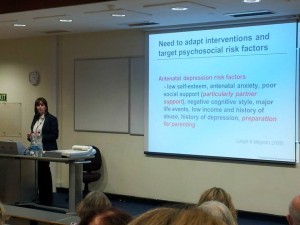 ow self esteem
poor social support (particularly from partner)
negative cognitive style
negative major life events
low income
history of abuse
history of depression
lack of preparation for parenting
Professor Milgrom stressed the benefits, to both mothers and fathers, of more robust antenatal preparation. If you work in this capacity, the above can provide some clues as to how a couple may be likely to fare postpartum. Some of this information might be voiced by the client, some appear on an intake form or even be communicated non-verbally and intuited by you. You may be able to use this information to tailor your approach with clients, any additional needs they may have and the importance of preparing for extra support postnatally. If you’d like something to help facilitate these conversations with your clients, you might like to use the Nest Building Plan on my website.
Professor Milgrom also stressed the need to include partners in any treatment for antenatal depression. Where a woman is depressed, there is a 50% chance that her partner is also depressed. Both mothers and fathers tend to be highly sensitive to their partner’s moods, particularly during times of transition.
I suspect this is also a factor in postnatal anxiety.
One of the things this brings up for me is the importance of clients adopting regular new family-friendly stress relief activities during pregnancy that are sustainable after the baby comes. Exercise, particularly, is a natural anti-anxiety and anti-depressant. A daily walk for example, as well as good nutrition and talking about “outside” stresses in a supportive way so they don’t become “inside” stresses is good preparation for those marathon early months of parenthood.
I write this as I’ve just returned from my first yoga session in waaay too long. Trying to practice what I preach!
March 3, 2015
Review: Becoming Us: 8 Steps to Grow a Family that Thrives
Reviewed by: Dawn Bhat, MA, MS, NCC, LMHC appearing in Somatic Psychotherapy Today | Fall 2014 | Volume 4 Number 2
Personal ReflectionWhile I was reading Taylor’s book for this review, my then ten-month-old daughter was climbing all over me and pulling herself up to stand by using my knees for support. I felt Taylor’s words speak to me, as if she were a dear companion on my journey of motherhood from the onset. Taylor knew all about what I experienced during the newborn phase from breastfeeding to a messy house. What shocked me the most was Taylor seemed to know what this meant for my partnership, as we were experiencing the changes both together as one and separately as individuals. It is no wonder that Taylor is an expert and well-seasoned clinician whose work focuses on transforming couple’s experiences during the critical period between pregnancy and parenting. I was lucky that SPT’s editor, Nancy Eichhorn, PhD asked me to review Becoming Us: 8 Steps to Grow a Family that Thrives! I doubt I would have known about it otherwise. I hope you find my review a small representation of how informative and formative Becoming Us: 8 Steps to Grow a Family that Thrives is.
–download a copy of the full review here: Becoming Us in Somatic Psychotherapy Today
Dawn Bhat, LMHC is in pr ivate pr actice in Hicksville, NY. She holds graduate degrees in General Psychology and Clinical Mental Health Counseling. Dawn is a National Certified Counselor and a Registered Yoga Teacher (RYT-500). Dawn has been researching somatic psychotherapy under the guidance of Jacqueline A. Carleton, Ph.D. of the USABP since 2010 and has presented scholarly papers and professional workshops regionally, nationally and internationally. Feel free to contact her: www.dawnbhat.com
December 17, 2014
Is your Partner Left on the Line?

It’s been a little while since you had your baby and things have finally started to settle down. You’ve managed to get into a sort-of routine, you’re starting to feel almost normal and your little one excelled at their last check-up.
Now it’s time for another important health check: how’s your bond with your partner going?
Relationship Adjustments after Baby are Normal!
This may surprise you, but according to researchers, 92% of couples report increased conflict and disagreement in their baby’s first year. Or maybe you’re relieved, feeling normal and not alone! Either way, if this resonates: you’re losing sight of your partner, you don’t feel as close, you find yourself feeling irritated or resentful towards them or if they’ve started shutting down or shutting you out, don’t panic! It’s common for couples to take some time to adjust to all the changes and find their way through those first months of parenthood – and back to their partner in the midst of all the chaos.
So when you can peer over that mountainous washing pile, you might want to take a good look at them. A bit crusty around the edges? Naturally you’ve been preoccupied with nurturing your baby, but your partner might just be missing you. Dads and partners can be excluded and sometimes feel distanced through pregnancy, birth and early parenting. Chances are, when you have time to think about it, you may have been missing them too.
You Can Bond as a Whole Family
So turn it around and bond with your partner again at the same time you bond with your baby. One way is through eye contact. When was the last time you held your lover’s gaze? Another way of bonding is becoming familiar with baby’s signs for attention. What was the last signal your partner sent out? Cuddling makes babies feel loved. How long has it been since you really held hubby? And how did it feel to have your partner’s arms around you?
To make that first step back to them, at a quiet time initiate an open conversation. Acknowledge how things have been for you, and ask how they’re doing. From there, make it a daily priority to spend time just relaxing and catching up. You’re both going through changes and adjustments, most of them occurring on the inside. Let your partner in and let them know you care. The rewards will pay off for years to come.
It’s The Little Things that Count
Easy to forget in the blur of sleep deprivation and day to day distractions but remembering to say “please” and “thankyou” encourages team work. Apologising to each other if you say something hurtful mends harm. Greeting each other warmly morning and night lovingly bookends each day. Text or email fond thoughts in between. Share a laugh or take a walk together – they are great antidotes for stress and depression!
Use endearments like “honey” or “darling” and share affection when you can to celebrate your relationship. After all, that’s what lead to you having your gorgeous baby in the first place!
Four things to keep in mind:
New disagreements are a natural part of parenthood; they are not your partner’s fault or the sign of a failing relationship.
You took this journey together so include your partner every step of the way!
You were friends and lovers before you became parents. Be these still.
The very best gift you can give your baby is a warm and loving family.
For communication skills help click here.
November 30, 2014
BOLD
Hi there, friends,
The following is from Karen Brody and her Bold Movement: