The Seven Wisdoms of: 'I don't know'
 Photo by Tomas Hudolin on Unsplash
This week has offered fresh reminders of how divided our world has become. From political shutdown in Washington, to brinkmanship in Gaza, to heated debates over migration in Britain - and a synagogue attack - the air is thick with opposing voices - each convinced that their position alone is the only right way.
Conflicts like these may seem binary when reduced to slogans. In reality, there is little black and white about them. Personally, I often see kernels of truth on both sides. Perhaps you do too?
Intolerance and the demonisation of otherness has always been with us. Still, in recent times the tone of public debate has undeniably become more coarse, combative, and corrosive.
What to do?
The wise have always pointed us towards humility. Socrates put it simply: “I know that I am intelligent, because I know that I know nothing.” The great Greek philosopher wasn’t being coy. He was pointing to the truth that false certainty leads us astray. The only reliable starting point is: “I don’t know.”
In the West, “I don’t know” is the foundation of science and progress. We question, test, and build on the basis of it.
In the East, ‘I don’t know’ is seen as the highest wisdom—not for the purposes of going outside, but venturing within. Like two hemispheres of the brain, West and East have always had these different imperatives, one focusing outwards, the other inwards.
In this post I’d like to explore seven wisdoms that are empowered when we hold true to the principle of ‘I don’t know’ from a Tibetan Buddhist perspective.
1. Reduces mental agitation and anxietyIn Dharma practice, ‘I don’t know’ and a settled mind nourish one another. The more we quieten the mind, the easier it becomes to release the compulsion to have the answser to everything. And the more we rest in ‘I don’t know,’ the less we are drawn into restless currents of thought. We discover for ourselves that much of our mental activity is neither useful nor harmless, but a source of suffering.
Of course, thinking has its role - in planning, creating, and problem-solving. But when our thoughts circle obsessively around what is negative and beyond our control, they only unsettle and disturb.
The more familiar we are with a peaceful mind, and the more we return to that state throughout the day, the less inclined we are to feel the need to voice an opinion. To be right, which I have written about previously here.
2. Encourages open-mindednessBuddha’s teachings — and now the insights of quantum science — overturn many of our most basic assumptions. We imagine that we see reality as it is, yet both the Buddha and modern physics remind us that our senses register only the thinnest slice of what exists. Nor are we passive observers: the mind itself plays an active role in shaping what we experience.
Becoming familiar with these revolutionary, if ancient, ideas gives us a more panoramic view of reality. And from that wider perspective, it becomes much easier to approach opposing views not with hostility, but with curiosity — to wonder what we might glean from them.
3. Supports compassionate action‘I don’t know’ applies not only to the issues being debated but to the people debating them. Others’ worldviews are shaped by karma, often unconsciously. When we see how bound we all are by our own conditioning, compassion becomes the only sane response - including towards those who lash out in anger.
Karma explains how hostility released into the world will have a result: it circles back, and sooner or later those who create it will be compelled to endure it. How sad to be trapped in such a cycle - and how much wiser for us to meet them with understanding instead.
4. Prevents dogmatic beliefs and extremesBuddhism is called the Middle Way because awakening lies between extremes—between indulgence and self-mortification, between nihilism and externalism. “I don’t know” keeps us on that path. It softens dogma, tempers extremes, and reminds us to be humble.
5. Arises from reflective wisdomThrough meditation on shunyata — the emptiness of inherent existence — we begin to see that mind itself is running our personal reality show. What appears to us is shaped by our conditioning, our karma; yet when we look more deeply, we find that whatever arises has no fixed, independent nature. It is like an illusion: vivid, convincing, but impossible to pin down.
How, then, can we claim certainty about something that is illusion-like? From this perspective, ‘I don’t know’ isn’t an admission of igorance, but an expression of wisdom — a candid recognition that reality is far more subtle and fluid than our labels or opinions can contain.
6. Cultivates emotional resilienceTibetan Buddhism is big on lojong (mind training) as a way of reframing difficulties as opportunities. “I don’t know” is a powerful reframe. Outrage may seem the natural response to difficult news, but do we truly know how events will unfold?
Tibetan monks fleeing in 1959 saw their world destroyed, yet their exile brought Buddhism to a much wider world—and millions more people. Would I be sitting here now, writing these words, and would you be reading them, if it weren’t for what happened?
7. Encourages skillful engagement rather than blameThe Dalai Lama never speaks with bitterness about China, though he could easily do so. Instead, he embodies “I don’t know,” refusing to demonise and instead seeking dialogue with patience and wisdom. By loosening our certainties, we open space for more creative, skillful action.
ConclusionIn a world addicted to certainty, “I don’t know” is a radical act. It lowers anxiety, opens minds, nurtures compassion, prevents extremism, reveals wisdom, strengthens resilience, and inspires more skillful engagement.
We empower our own freedom when we dare to release ourselves from the illusion of knowing.
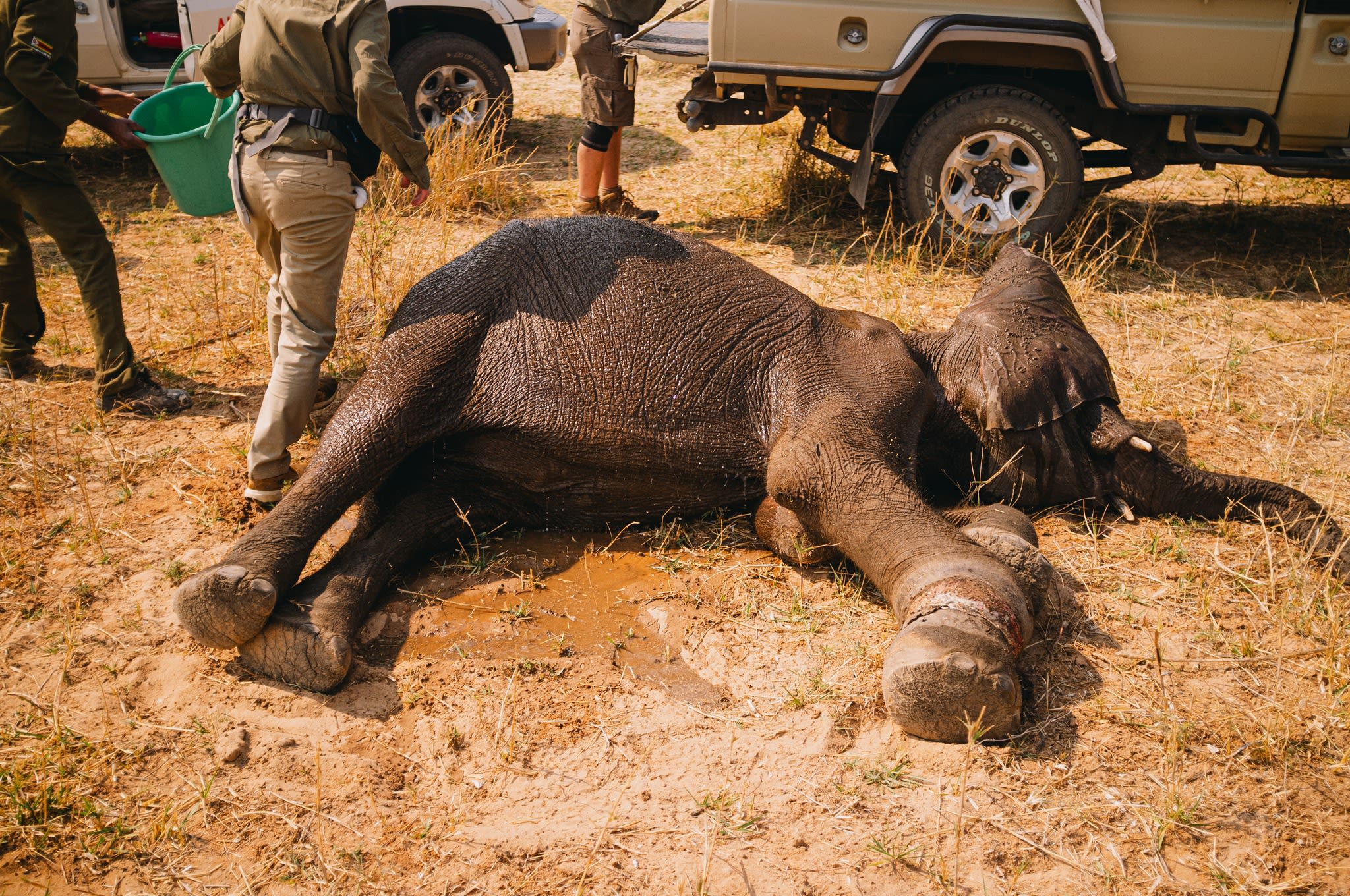
Photo: the sedated calf. The deeply embedded snare was on his front left leg
Sengwa calf rescue - contains graphic snare image
This week’s non-profit update comes from Wild is Life/Zimbabwe Elephant Nursery, one of the three non-profits supported by paying subscribers.
Over to Roxy from Wild is Life:
This week we received a call out from the Regional Manager, Zimparks, (Sebungwe) to attend to an older elephant calf, on its own, with a bad snare wound. From examination of the photograph, we could see that the leg was very badly damaged and the calf was very thin. It was in an open area and no other elephants were in the immediate proximity.
ZimParks asked us to rescue the calf, as they felt it was clearly too young and badly damaged to survive on its own.
After contacting the nearby Akashinga - Nature Protected by Women team for ground support and further information, we mobilised our Vet Team, a plane and proceeded to the location. On arrival, the team ascertained that the calf was much older than we anticipated, as well as much bigger! We would not be able to be load him into the plane. The calf was around 3/4 years old. An immediate decision was made to immobilise and treat the calf, but that he would need to be left in situ.
The vet team compromised of Dr Lombard (Wild is Life/IFAW), Dr Chaitezvi (ZimParks) and Catherine Jennings (Wild is Life). The Akashinga team was lead by Dean Steven and Ranga Huruba.
Dr Lombard immobilised the calf using a powerful opioid drug and the calf went down quickly. On examination of the leg, it was discovered that there was a thick steel cable deeply embedded in the leg. Infection had set in and clearly the animal had been in tremendous pain. The team got to work, in very hot conditions, to try and remove the snare. Normal wire cutting tools are useless for these steel cable snares, but luckily we had a special tool that had been donated to us previously, for such eventuality.
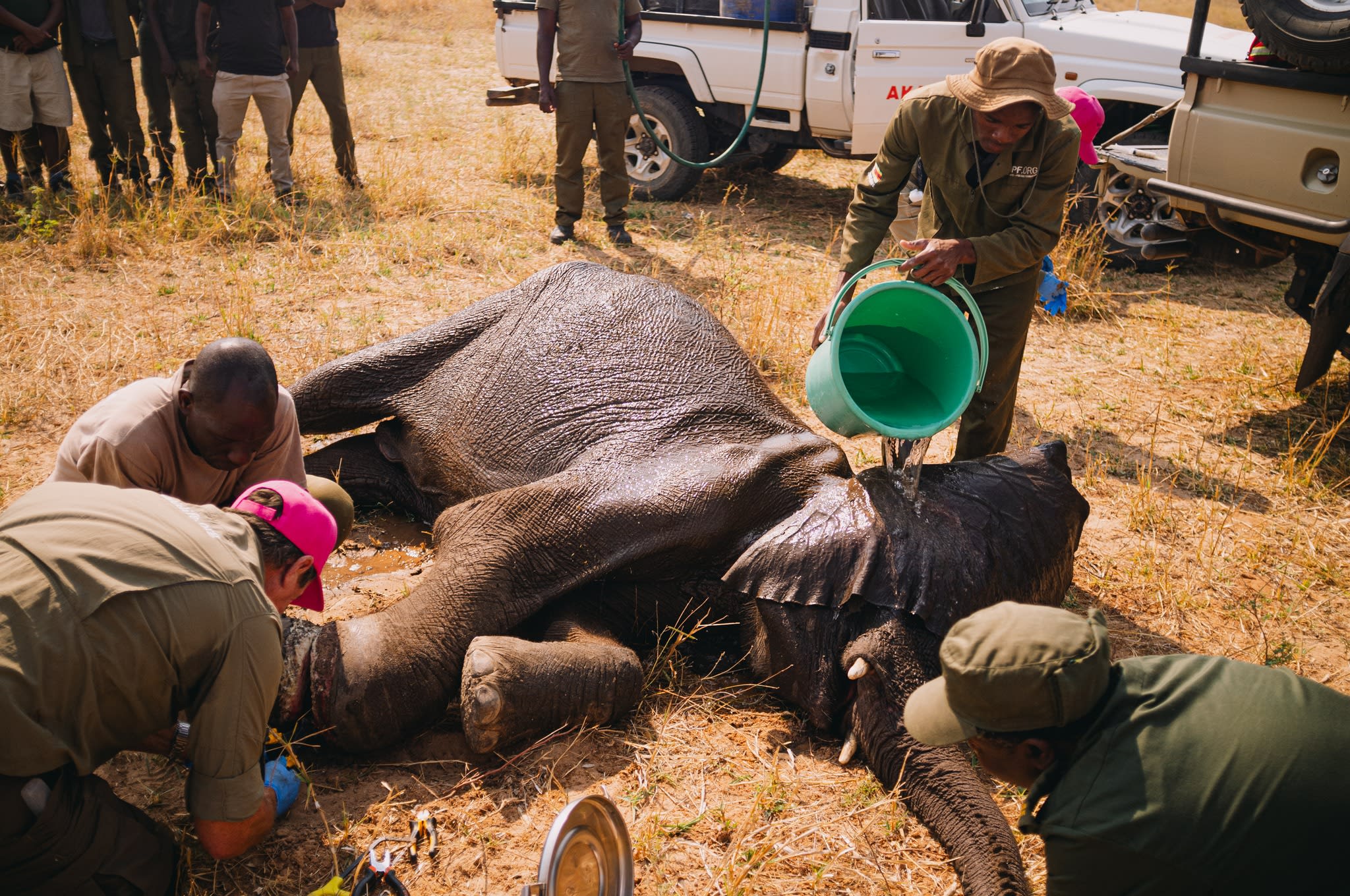
Photo: elie being kept cool as the vets work on his leg. Capillaries on the back of an elephant’s ears are their cooling mechanism.
It took a long time getting the snare out, with each thread of the cable having to be cut and pulled out singularly. Once completely removed, the wound was examined and luckily the bone had not been penetrated. However, the wound was severe and needed considerable debridement.
These cable snares, in my opinion, are the most cruel form of poaching. They are impossible to dislodge naturally and the animal dies a slow and agonising death.
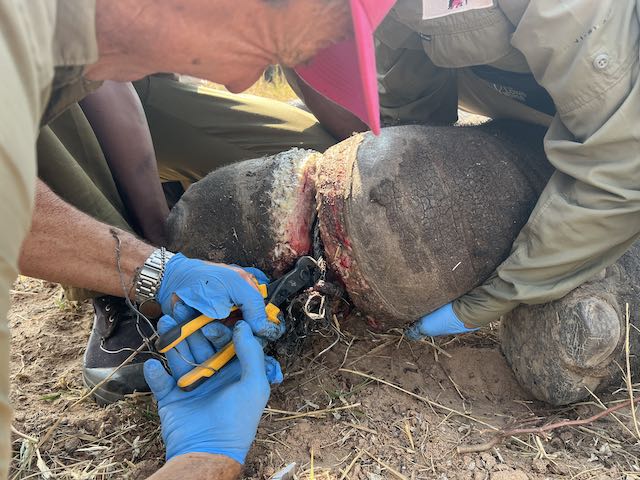
Photo - removing the snare
While the vets were working on the calf, the rest of the team were monitoring the calf’s respiration and signs of distress. He was also kept cool with the hosing of water, fortuitously provided by Akashinga. Armed Rangers stood guard around the the team as they worked.
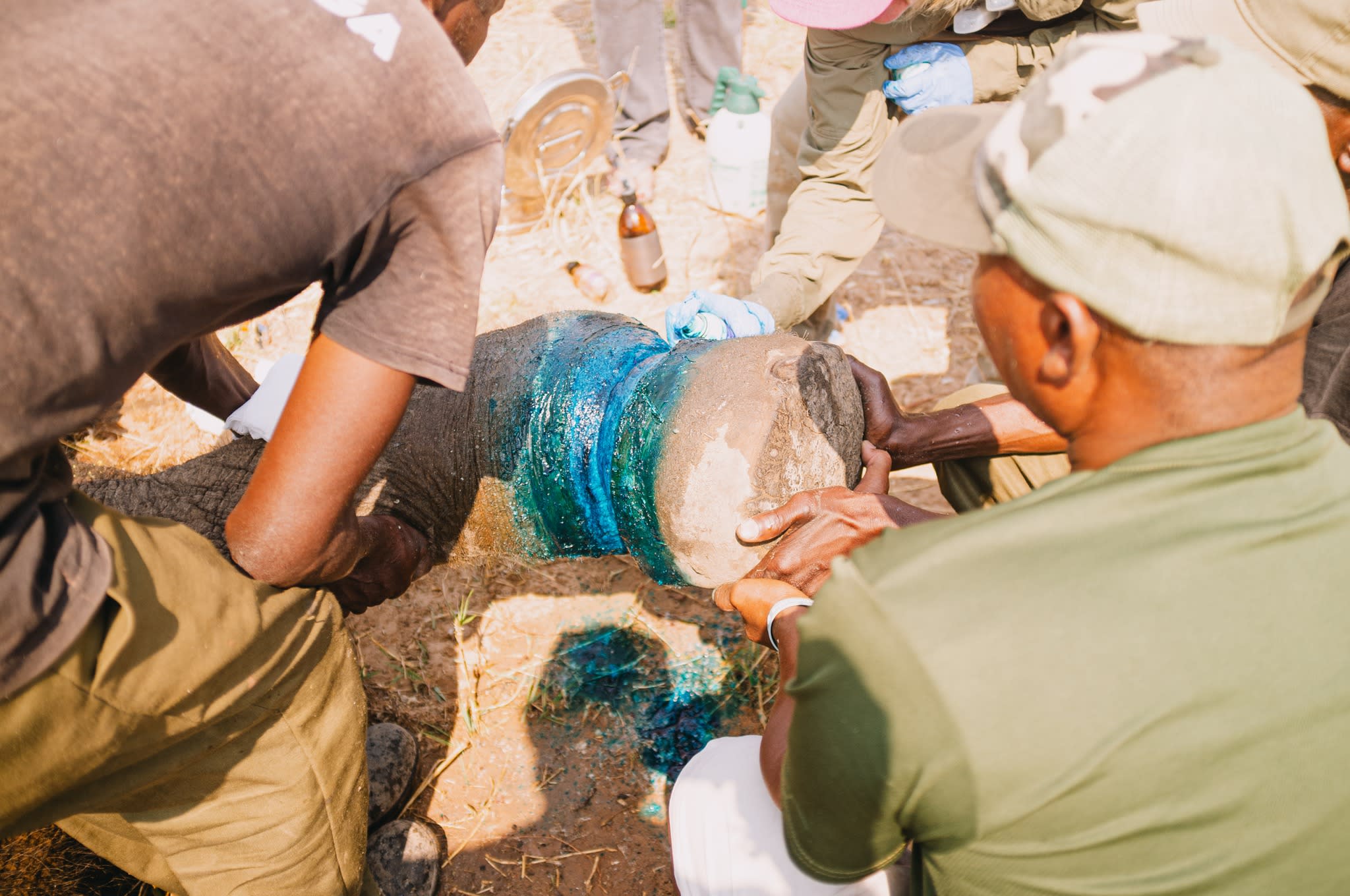
Photo: snare removed and wound treated
Once everyone was happy and treatment was complete, the calf was reversed and stood up on his own. He walked off, with a slightly better gait than before, able to put more weight onto the leg.
If that snare had not been removed, the calf would never have survived.
It is our hope that the calf will gain strength to walk further to browse and eventually join up with the resident herd of 60 elephant. We believe he has a very good chance of survival now, particularly as lions are rarely seen in the area. Akashinga will continue to monitor him.
Ultimately, it was a decision that I made happily, despite not being able to bring the calf home for further treatment. I believe that, as he is not of an age to be milk dependent, he will be able to gain some weight, with his improved mobility. In addition, the resilience of wild animals can never be underestimated.”
It’s David here again:
I donate 50% of your subscription money to three non-profits including Wild is Life. You can help me help them by becoming a paying subscriber.
Be the change you wish to see in the world.
Feel free to share this post with anyone you feel may benefit from it.