The Good Karma Refuge for Elephants
Dear Readers,
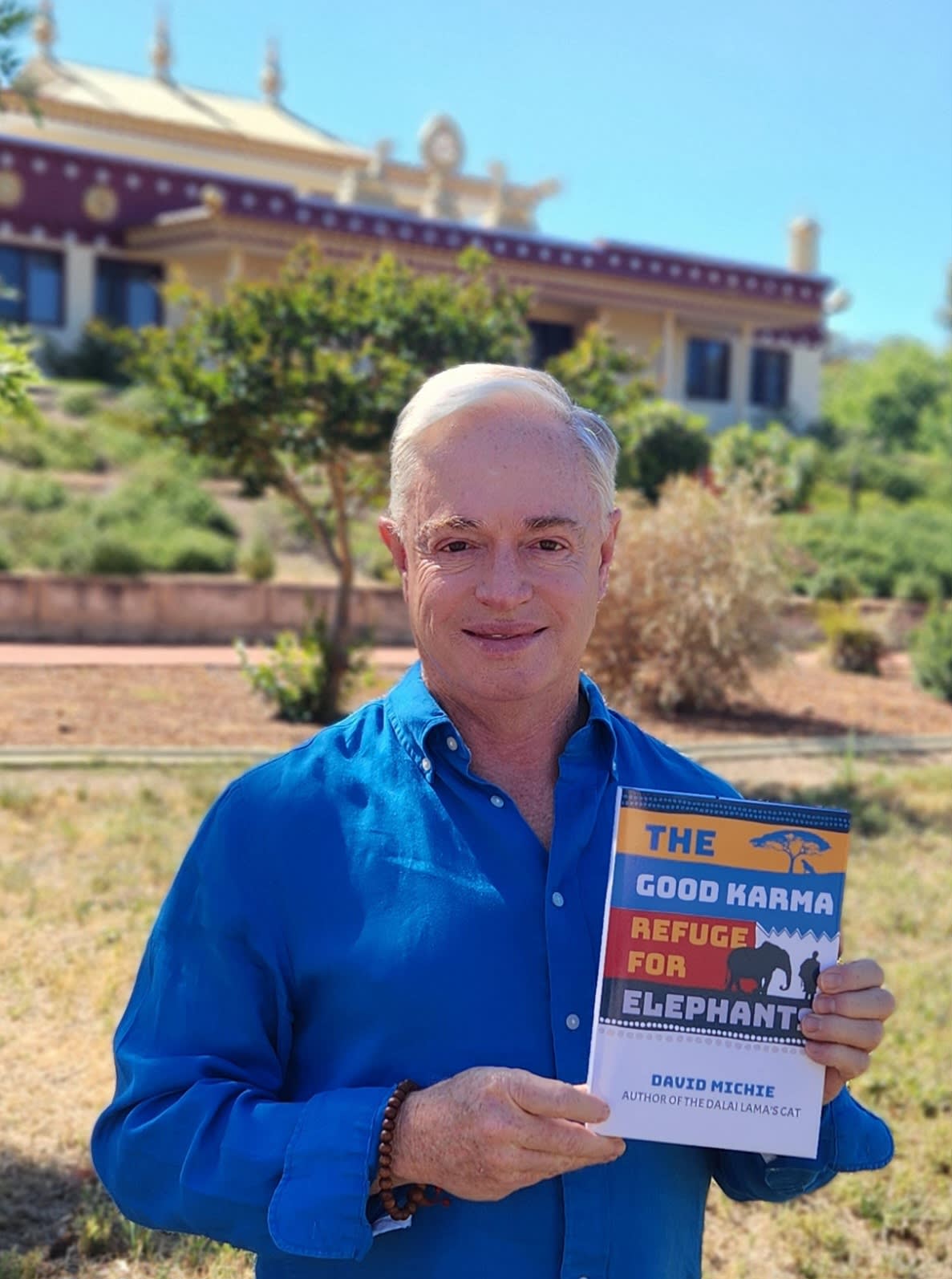
I am delighted to let you know that my new novel, The Good Karma Refuge for Elephants is now published.
Hurrah!
You can get your copy from the usual online retailers as well as bricks and mortar stores which have Ingram accounts.
You’ll find links to where you can order/download the novel at the bottom of this post.
To celebrate with a taster, I am sharing the Prologue and part of Chapter One below.
So find yourself a comfy spot, make yourself a drink, and join me on a visit to my kumusha, my homeland, in Africa …
Prologue
London, UK
NICK BERKELEY chose to make the offer in the timeless elegance of his London club. At an immaculately set table in a discreet corner of the dining room, my mentor and good friend invited me to set up my own fund management business within the investment firm he chaired. I would be independent but would have a constant inflow of money to manage. I could set my own strategies yet be part of a global blue-chip brand. At the age of fifty-six, the opportunity promised to be the most lucrative of my career.
As our meal ended, we agreed that a few details needed to be resolved. Of these, my non-compete period seemed so unimportant that we hardly discussed it.
‘Landers will put me on “gardening leave”,’ I said, referring to the firm where I’d made my name over the past decade. It was standard practice for investment directors who left for competitors to be placed on a period of paid leave during which all contact with clients was barred. Gardening leave was a hiatus during which you were forced to disappear.
‘Six months?’ he confirmed.
I nodded.
‘Devon?’ Nick and his wife had stayed at my country home in the past.
‘Who knows?’ I remembered the email I’d received from Aunt Carrie. ‘Maybe a chance for that long-delayed visit to Zimbabwe.’
‘Ah. Robbie Forbes goes back to his roots.’ He regarded me with a perceptive gaze before prodding me in the chest with his forefinger. ‘Maybe Africa is what makes you different.’
We exchanged a smile. It was a recurring theme of his — how I wasn’t like so many of my fund manager contemporaries. How I was attuned to the longer game.
When the deal went official, several friends whom I told of my unfolding plans were sceptical.
‘Isn’t violent crime really awful there?’ asked some.
‘That’s Jo’burg,’ I answered. ‘Not Zim.’
‘No water or electricity?’ Others looked dubious.
‘Aunt Carrie lives off-grid. She has a borehole and solar panels. Zimbabweans “make a plan”.’ I quoted the unofficial national motto.
I was so settled in my London life and so busy preparing for my time away that the real threat posed by Africa never occurred to me. Even if it had, I would have dismissed it. Perhaps a form of protective amnesia made me oblivious to it. Having been abruptly removed from my childhood world at the end of school, I was heedless about what I would feel when I returned — the forceful, heartfelt jolt of homecoming.
It’s an experience that affects many people, even those with no previous link to Africa. Anthropologists offer a plausible explanation. This place, they tell us, is the cradle of humanity. It’s where our earliest ancestors lived. We emerged into the world from the womb of Africa. She is our mother and her blood courses through our veins. It was she who first held us in her arms, whose soft breath blew on our faces. We may have long forgotten the warmth of her sun on our skin, the caress of her satin dust on the soles of our feet. But when we return, we feel the belonging and we know that we have come home. Whatever we may be used to calling ourselves — British, American, European — much to our own surprise, we discover an earlier identity, for we are all children of Africa too.
In my own case, this revelation was accompanied by one of an even greater order. I could have met my guru Rinpoche anywhere in the world, but it so happened that I encountered him in Zimbabwe. Had I needed to arrive at a particular moment in life for the wisdom he imparted?
When the student is ready, the great inner traditions tell us, the teacher will appear. This process is less mystical than it may seem, suggesting only that whatever wisdom may exist in our lives, until our mind is open to its transformative power we are blind to it.
Before going on gardening leave, I had been a regular meditator for years, encouraged by my godmother Kay to spend twenty minutes each morning focusing on the breath. I benefited in ways hard to describe, but I wouldn’t make any great claims about my practice. However, some subtle but important shift must have occurred, because it seems I was at a place that I was ready for what Rinpoche had to show me.
If I have learned anything from him it is that, far from living in an objective world, how we see, hear, and experience things arises, first and foremost, in our minds. This reversal of assumptions has the most extraordinary significance. Not least that if we wish to experience reality in its most exquisite form, we don’t need to change the world around us or wait to go to heaven. By cultivating the mental causes, transcendent states are available to us here and now.
Africa nudges us towards a different way of being. She re-awakens us to a long-forgotten past when we lived with the immediacy of children, the innocence of young lovers, an openness we may believe was irretrievably lost.
When we can find simple joy in the dawn fragrance of African violets or the babble of bulbuls in the shrubs, in sweet wisps of mopane wood smoke from a village fire or in soulful gospel choruses rising from beneath a distant winter thorn tree, when no matter what streams through our senses we are filled with an unaccountable wonder, we know how it may be possible to leave our jaded selves behind. To let go of whatever notions we cling to and live with the same easy spontaneity as Rinpoche himself — a way of being where the heart is more benevolent and outward focused.
All of which brought me to a dilemma: Having tasted this exalted reality, at what point was I ready to return to my London life of long hours, relentless pressure, and untold riches? When should I tear myself away from Africa to apply what I had learned from my guru to the ‘real’ world?
It is a dilemma faced by each of us who has the immense good fortune to sit in the presence of a realised being and to feel the awe of connection ripple through eternity.
 Chapter One
Ruwa, Zimbabwe
‘THEY’RE HERE!’
On Ruwa Rock, three villagers exuberantly waved their arms. From the top of the kopje, the huge, eggplant-shaped granite boulder that balanced dramatically at the bottom of the garden — they could see the whole district below: a sun-baked sprawl of brown scrub and brittle trees. On this clear November morning, any vehicle turning off the main road would send up a trail of dust at the moment it turned onto the dirt track.
Down at the car park, the band struck up. Organising today’s events with her usual joyful exuberance, Diva Derembwe had persuaded two marimba players and three drummers to accompany the welcoming committee who burst into Shona chorus. The sudden outbreak sent a troop of vervet monkeys scrambling through the msasa trees. The monkeys, in turn, set off Sonny and Cher, peacock and peahen, occupying their usual perches at either end of the thatched roof above us. As they brayed loudly, Mampara the wildebeest glanced up from the lush-green lawn before shaking his horned head with a dismissive snort.
Along with others lining the hallway of the former homestead, I took the white scarf out of my pocket, preparing for our visitor. Yogi Tarchin was the very first Tibetan teacher to visit the Ruwa Buddhist Society, and one of only a handful of lamas ever to visit Africa. Standing beside the large, snowy-haired Harris Gould, who along with Diva comprised the Ruwa Buddhist Society, I felt I was here under false pretences. Not only was my understanding of Buddhism shaky to say the least, I wasn’t even a local. Not really.
I caught a glimpse of my reflection in a clouded, gilt-framed mirror and brushed a grey lock off my forehead before straightening my jacket. As I caught the tang of creosote from the tarred poles above merging with the equally long-held memory of Cobra Floor Polish, I thought how unlikely all this was. True, I was a willing participant in today’s cheerful if quirky event, but it didn’t seem to have much to do with me.
The singing and clapping rose to a crescendo as a battered Land Rover pulled up under the msasas. All of us in the hall turned to peer into the distance as the passenger door of the vehicle opened and a slight figure in a yellow shirt and ochre pants emerged. Diva greeted him with a deep bow and a proffered white scarf. Accepting the scarf, he raised it in his hands and, in the traditional Tibetan custom, placed it around her neck in blessing. Several more such offerings were being made by other greeters. As Himalayan etiquette was observed with impeccable formality, yards away the band whooped and jived with unrestrained vigour.
Diva ushered the lama towards the house. But Yogi Tarchin had other ideas. There was a lightness about him apparent even from here. An irrepressible spontaneity. Turning to the musicians, he smiled broadly, clapping in rhythm. They responded with an appreciative lurch in volume. Several greeters needed no further encouragement and were soon dancing next to their VIP visitor. Village children materialised from nowhere, stamping their feet joyfully in the dust. The rising music level sparked a renewed frenzy among the vervet monkeys, who swooped dangerously low through the canopy, barking with excitement. For a moment it seemed that Yogi Tarchin’s welcome might go chaotically off-course.
But then he turned to Diva, who was waiting in a fawn-coloured dress and high heels, perfectly tailored, as for every occasion. Dark hair falling in elaborately coiled braids, woven through for today’s visitor with threads of red and gold, she guided the lama through the trees onto the emerald-green lawn that formed a luxuriant runner up to the house.
~
Forty-something Diva was a force of nature, compelling your attention with a combination of girlish frivolity and commanding power. Large, emotion-filled eyes decorated with startlingly brilliant eyeshadow would turn from deeply imploring to ecstatically grateful in an instant. Within moments of meeting, you’d feel connected to her seemingly boundless warmth. It was only because of Diva that I was here.
When Diva was a young woman two decades ago, experimenting with organic skin care products in the kitchen of her Chisipite home, Aunt Carrie had been her business mentor. Since then, Diva’s Treasure Trees Apothecary business had grown from a cottage industry to a national brand, Diva becoming a local business celebrity. Fervent about the power of Zimbabwe’s indigenous trees as a source of healing and beauty, Diva was on a mission to popularise her unique range of baobab, kigelia, and other products.
When I’d travelled from London six weeks ago to help Aunt Carrie through cancer treatment, I’d soon met Diva, who was a regular visitor. When Carrie’s health, instead of responding positively to treatment, took a grave turn for the worse, it had been Diva who’d arranged hospital admission at short notice. Diva who knew exactly how to access the best medical specialists. Diva who had helped Carrie and me as we found ourselves approaching the precipitous end.
Instead of supporting my mother’s sister, the last of her generation in my family, through what was nothing more than a bothersome bump in her return to full health, I had ended up moving her from hospital to hospice and, days later, holding her hand as she passed away.
Carrie had made me the executor and a beneficiary of her will. She didn’t own much — the house, a car, a modest amount in savings. There were a few items she wanted given to friends. It was a simple estate to dispose of. But what to do about her gardener with the dazzlingly optimistic name of Marvellous? He had worked here for well over a decade, and in a country where nine out of ten people were unemployed, his chances of finding a new job were non-existent.
What of Thor and Tiki, Carrie’s wolfhound and Jack Russell respectively, who had only ever known life in this Ruwa house and who, in Carrie’s absence, were increasingly bonding to me? What of the birds in the garden that Aunt Carrie fed every morning — a practice I continued? The village man who visited to sell her vegetables every Thursday morning? Mr Buba, a not-so-regular but no less important visitor, who made sure her inverter and generator worked smoothly when there was no electricity available — which was most days. A vulnerable ecosystem was coming to an abrupt end.
For the time being I stayed in the guest bedroom as I began wrapping up things. It wasn’t how I envisaged spending my gardening leave, but having applied for probate, it would be at least two weeks until I could finalise the estate and depart.
~
I was emptying cupboards early one afternoon when I heard a car coming up the dust driveway. Thor and Tiki launched into a frenzy of barking. They settled when they recognised the car. It was Diva’s Land Cruiser, the vehicle of choice for navigating Harare’s dangerously potholed streets.
‘It’s not a social visit,’ she explained, emerging from the cab wearing a bright floral top and white pants. Her eyes searched mine, and mine hers, with the intimacy that comes from shared grief.
‘We have a Tibetan lama coming to the Ruwa Buddhist Society on Saturday. You’ll be his neighbour, so I thought you might like to come as well,’ she said, placing the emphasis, in that curious way of some Zimbabweans, on the “as”.
‘John Elliott’s place, right?’ I pointed across the garden.
She nodded. ‘He left us the property.’
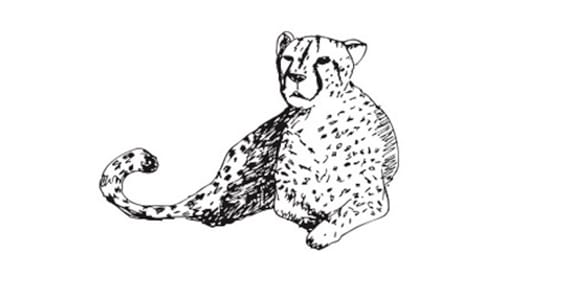
I remembered Carrie telling me how her neighbour of over thirty years had set up a charity to make sure that his cheetah was looked after when he died. He had stumbled across Bodhi in the bush as an abandoned cub just weeks old. Unable to find her mother, and with the cub’s life in danger, he had reluctantly taken her home to raise, with the mothering of his domestic tabby cat, Football. Bodhi had grown quickly from mewing cub to lithe and muscular big cat. All efforts to rewild her ended in failure. No matter how suitable a release site they took her to, she always returned to John, Football, and the place she regarded as home.
John came to accept her as his constant if unlikely companion. When people went to visit him, they’d find Bodhi sprawled on a sofa beside him or lying in a patch of sunshine nearby. John became known locally as “the cheetah guy”, the two of them even finding fame in a small way. There had been a few magazine articles and an appearance on a National Geographic documentary.
What neither John nor anyone else predicted was how Bodhi would react when John’s time came to pass. He had died in his sleep one night at home, three years ago. By the following afternoon the cheetah had vanished, never to be seen again. The irony escaped no one: The whole reason John had set up the Ruwa Buddhist Society walked out the door the day he passed.
‘Will the lama stay long?’ I asked Diva.
‘A few days,’ she shrugged. ‘Week or two at the most. It’s up to him. When we heard about this Rinpoche visiting his brother up at Hwange, we got in touch and asked if he’d be willing to offer us a teaching.’
‘On Saturday?’ I confirmed.
‘I know you meditate,’ she responded to my hesitancy.
‘Just basic breathing stuff.’
‘Come along!’ she beamed, her dangly bead earrings glinting in the light as she hooked me with her most persuasive appeal. ‘Carrie would.’
It was true. Carrie’s sense of community would take her next door, and she would probably also have been curious to meet a Tibetan lama. Although she wasn’t religious in any formal way, in her last days at the hospice we had spoken freely of her imminent death and I’d been struck by how accepting, even positive she was about it — which made it easier for me to be accepting also. A near-death experience over a decade before had changed the way she felt about transitioning, as she called it. Her equanimity had been authentic. ‘Don’t waste any tears over me, Robbie,’ she’d smiled on her pillow. ‘I’m looking forward to what comes next.’
Diva and Yogi Tarchin were halfway up the lawn. John’s former homestead comprised three large rondavels linked by broad passages in a sprawling crescent-shaped structure, all beneath a magnificent sweep of silver-grey thatch. Under the eaves, a string of vividly coloured Tibetan prayer flags fluttered in the breeze.
I wondered what the lama made of this oasis in the veldt. Shielding his eyes from the sun, he took in the immensity of Ruwa Rock, and somewhat closer, the long necks of Debbie and Kim, John Elliott’s giraffes, who stood motionless in the distance observing the ruckus at the house. The lama chuckled on catching sight of a family of warthogs, affronted by the continuing din in the car park, sprinting across the lawn, tails aloft like radio aerials — Mum, Dad, and three piglets. An elegant pair of crowned cranes paused hesitantly in the shade of a gigantic flamboyant tree, observing the arrivals with their fine golden plumes raised on full alert.
Suddenly Rinpoche and Diva were out of the blazing sunshine and inside with us. In the flurry, dust motes shimmered in a mid-morning glow. One by one, we indoor greeters offered the lama our white scarves.
Other than bringing a scarf, I had not prepared for this encounter, nor did I expect anything in particular. But now that it was happening, I felt the strangest sensation. Not on account of Yogi Tarchin’s appearance, although his warm brown eyes, ageless face, grey moustache, and goatee gave him the look of an archetypal eastern sage. Rather, it was a radiant sense of lightness, of joy, that seemed to emanate from him. The ineffable sensation that even though you could see and touch him, his presence was somehow more energetic than physical. As if his body were hardly there at all.
As I bent in offering, our eyes met. In that instant, it was as if Rinpoche gazed through the person I usually took myself to be and saw something more panoramic. Not a 56-year-old businessman who had returned to the country of his birth to take care of an ailing aunt and now found himself in limbo. Instead, a boundless reality beyond that, one from which I had been for so long disconnected that, incredibly, I had forgotten it was even there. So benevolent was Rinpoche’s expression, however, so wholehearted his acceptance, that I felt a surge of the most powerful emotion. In his gaze was all the reassurance I could hope for, that however things appeared to be, beneath the surface, all was well.
This entire experience happened in an instant — then he was moving on. I could tell it was the same for the others who encountered him. The briefest pause. The meeting of eyes and hearts. The upwelling of emotion. Next to me, Harris Gould brushed at his cheek.
Early reviews posted online in the past 24 hours …
Pamela Barit Nolan *****
Each one of David Michie’s books seems to touch my heart more deeply. I read this latest book in a day, devouring each chapter and reflecting on my own journey through life. The characters are beautifully developed and the descriptions of the natural world exquisite. The interconnected relationships between humans, animals and nature remind me to be fully present in order to drink in the present moment and not to miss any amazing detail of the world that we live in. I encourage all readers to dive into this story with hearts open. Pay attention as David leads us through this story – ask yourself how each chapter might relate to you and the choices you are making in life. I hope we all find the profound sense of peace and purpose that the main character of this story is able to embrace.
AR *****
Combining lush descriptions of the African veldt, an animal sanctuary, and a beautiful experience of Buddhism, Michie’s character has returned to the place of his birth for an unexpected series of new adventures. Even those who are not as interested in the Buddhist perspective will delight in Kadiki, the tiny orphan elephant who lights up the story, and the mysterious cheetah, Bodhi. I recommend this book as an escape - a refuge - from the terrors of the world right now.
Kimberly L Novak *****
David Michie’s The Good Karma Refuge for Elephants is a charming, uplifting read that beautifully blends the spirit of Zimbabwe with touches of Tibetan philosophy. Michie has long been gifted at weaving Buddhist ideas into engaging stories, and this book is no exception.
The novel is told through the eyes of Rob, whose transformation begins when he meets his guru. The cast of human and animal characters are written with such personality you feel like you know them. For readers who savor quiet, comforting stories, who delight in African cultures, who are drawn to Buddhist wisdom, and who cherish animals, this novel shines as a little gem waiting to be discovered.
Karen LeCocq *****
Another excellent book by David Michie! I have been a fan of his books for many years now, both the fiction and non fiction. I did not think he could top his Dalai Lama’s Cat series, however, this book immediately caught my attention. (Perhaps because there is a very strong cat presence in the story, illusive and almost mythical.) I really admire the teaching quality in all of David’s books, even in his fiction. I always learn from them while also being immerse in a powerfully moving storyline. He has a real talent for entertaining his readers and enlightening them at the same time. This book is no exception.
Donna J Parkinson *****
Another lovely inspirational story by David Michie. You can easily visualize all the beautiful animals, flora and fauna of Africa encountered by the characters. The story is illustrative of David’s own journey from marketing to Buddhism and following one’s spiritual path. But I forget not to read his books on a plane. My seat mates always notice me wiping the tears that squeeze out while I’m reading the touching story. Definitely a good uplifting read!
Becca *****
A most engaging account of one man’s unexpected journey from the corporate rat race to the tranquility of purpose found. Michie seamlessly melds Zimbabwean traditions and culture with Tibetan Buddhist wisdom and practices into a fascinating story of awareness and belonging. This deceptively easy read evokes a sense of enchantment, providing deep insights along with enigmatic and lovable animals, exotic flora and charming human characters. Highly recommend!
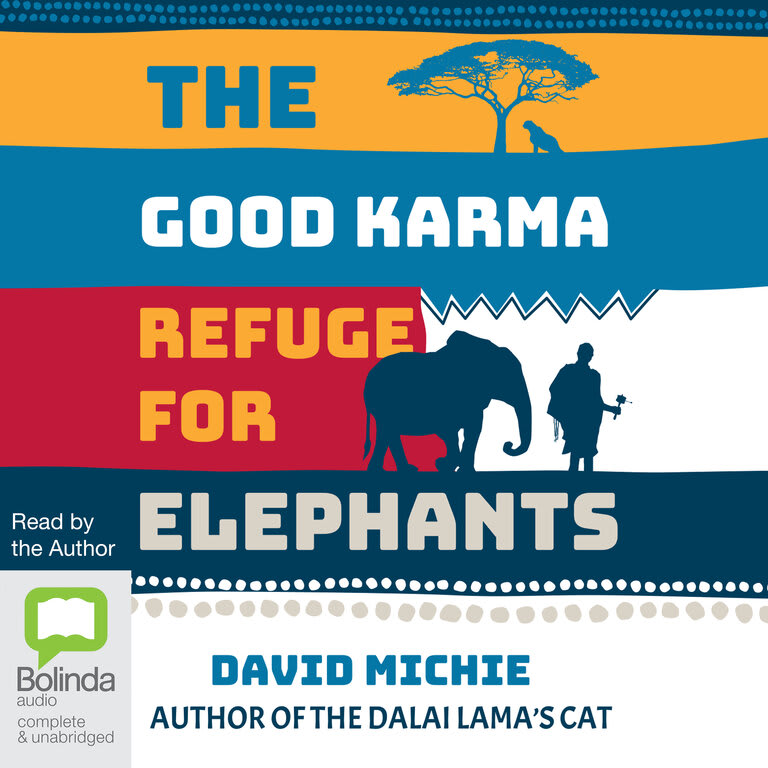
To continue reading, get your copy of The Good Karma Refuge for Elephants in paperback, hardback, e-book or audio formats by clicking the links below:
USA: Barnes & Noble Bookshop.org Amazon (paperback) Kobo Kindle
UK: Waterstones Kindle Amazon (paperback) Kobo
Australia: Dymocks Kindle Amazon (paperback) Kobo
Germany: Thalia.de Kindle Amazon (paperback)
South Africa: Exclusive Books
Zimbabwe: The Booklist at the Hub, 14 Hindhead Avenue, Chisipite, Harare
FOR THOSE OF YOU WHO PREFER TO LISTEN:
AUDIBLE: USA UK Australia and New Zealand Germany
Google Apple Spotify Kobo Libro FM
Please share the news of my new novel with anyone you feel may be interested.