This will prevent Matthew from sending you messages, friend request or from viewing your profile. They will not be notified. Comments on discussion boards from them will be hidden by default.
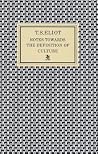
The first important assertion is that no culture has appeared or developed except together with a religion: according to the point of view of the observer, the culture will appear to be the product of the religion, or the religion theThe first important assertion is that no culture has appeared or developed except together with a religion: according to the point of view of the observer, the culture will appear to be the product of the religion, or the religion the product of the culture....more
“People can be persuaded to desire almost anything, for a time, if they are constantly told that it is something to which they are entitled and which is unjustly withheld from them.”
―
T.S. Eliot,
Notes Towards the Definition of Culture
“In religion, Liberalism may be characterised as a progressive discarding of elements in historical Christianity which appear superfluous or obsolete, confounded with practices and abuses which are legitimate objects of attack. But as its movement is controlled rather by its origin than by any goal, it loses force after a series of rejections, and with nothing to destroy is left with nothing to uphold and with nowhere to go.”
―
T.S. Eliot
“These people always say (as Hitler says in Mein Kampf) that they started out with no anti-Jewish prejudice but were driven into their present position by mere observation of the facts. Yet one of the marks of antisemitism is an ability to believe stories that could not possibly be true.”
―
George Orwell,
Notes on Nationalism
“Individualism and statism advance together, always mutually supportive, and always at the expense of lived and vital relations that stand in contrast to both the starkness of the autonomous individual and the abstraction of our membership in the state.”
―
Patrick J. Deneen,
Why Liberalism Failed
“One of the main goals of the expansion of commerce is the liberation of embedded individuals from their traditional ties and relationships. The liberal state serves not only the reactive function of umpire and protector of individual liberty; it also takes on an active role 'liberating' individuals who, in the view of the state, are prevented from making wholly free choices as liberal agents.”
―
Patrick J. Deneen,
Why Liberalism Failed
Goodreads Librarians Group
— 344540 members
— last activity 13 minutes ago
Goodreads Librarians are volunteers who help ensure the accuracy of information about books and authors in the Goodreads' catalog. The Goodreads LibraGoodreads Librarians are volunteers who help ensure the accuracy of information about books and authors in the Goodreads' catalog. The Goodreads Librarians Group is the official group for requesting additions or updates to the catalog, including:
* Adding new books or editions
* Editing book information (including covers)
* Combining and merging book editions
* Edits to page counts, quotes or awards
* Correcting author profiles for authors not in the Goodreads Author Program
If you're a Goodreads member with a new request, click Join Group. Once you're added to the group, you can post your question following this link.
Simple requests (e.g. page count updates) typically take around 48 hours depending on the volume of requests, while more complex requests could take up to a couple of weeks (e.g. adding a new book).
Authors, if you are a member of the Goodreads Author Program, you can edit information about your own books. Find out how in this guide.
Keep in mind that Librarians don't:
* Grant or give insights into Librarian applications / Librarian status
* Move ISBNs or ASINs between editions
* Help with non-catalog Support questions (e.g. How do I reset my password?)
For help with these queries or to submit general questions, comments or feature requests, try Goodreads Help or use the Contact Us form.
If you're a Librarian and want to process requests, please refer to our Librarian Manual to ensure edits are performed in line with Goodreads policies....more












 Goodreads Librarians Group
— 344540 members
— last activity 13 minutes ago
Goodreads Librarians Group
— 344540 members
— last activity 13 minutes ago



