
Cindy Vallar's Blog - Posts Tagged "asian"
Review of Anne Rooney's Pirates
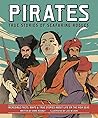 Pirates: True Stories of Seafaring Rogues: Incredible Facts, Maps True Stories About Life on the High Seas by Anne Rooney
My rating: 5 of 5 stars
An alternate subtitle of this book is “Incredible facts, maps & true stories about life on the high seas,” and in this claim the volume, geared toward older children who can read and comprehend this complicated subject, ably succeeds. It is stuffed full of pirate facts and lore; it even includes a glossary and index. Readers understand from the opening pages that this is not just another dull recitation of facts. It begins with a unique table of contents – one that is predominantly colorful pictures with some text to clarify what each chapter is about.
The first topic explored is “Who Would Want to be a Pirate?” After this short introductory question, there follows a question-answer format with a boxed highlight. This arrangement is followed throughout subsequent pages, which cover each topic in two-page spreads of color illustrations, blank spaces, and succinct paragraphs pertaining to the explored subject.
Maps introduce each region were piracy blossomed. The highlights denote such things as treasure, attacks, battles, haunts, ghost towns, and shipwrecks. The first map focuses on the Mediterranean, since this is the region where pirates first began their attacks. Within the topic readers learn about Barbary corsairs, life as a galley slave, and the switch from privateering to piracy. Subsequent regions explore the Caribbean, the Indian Ocean, and Asian waters. Each includes a special focus page on a specific pirate: the Barbarossa brothers, Blackbeard, Mary Read and Anne Bonny, Bartholomew Roberts, and Zheng Shi. The subject matter for each region essentially covers who, what, when, where, and how. Also discussed are universal topics such as ships, punishments, and life at sea and stopovers on land.
American readers might not understand one of the subheadings under “Who Would Want to be a Pirate?” “Pirate Porkies” is British slang for fat lies (or myths) about pirates, such as walking the plank. The only drawbacks in an otherwise entertaining, but realistic, romp through history are the small font size and dark colored words on dark pictures. This will be a problem for children fascinated by pirates, but who have sight challenges. More than once I resorted to using a magnifying glass with a light to read the text, and I have good eyesight. There are a few questionable statements, but only a true pirate aficionado would recognize these missteps and they do not detract from the overall introductory nature to pirate history.
Reminiscent of a scavenger hunt, Pirates is a fun-filled exploration of pirates throughout history in sixty-four pages. Yet neither the author nor the illustrator portrays pirates as romantic heroes. Perhaps one of this book’s strengths is that it introduces pirates often excluded from or glossed over in children books. One example is the Wokou. Readers young and old will find interesting tidbits that cover the whole of piracy from the Mediterranean to the Far East.
One additional note: This is the paperback edition of Pirates: Dead Men’s Tales (2018), so those who have read that book won’t find anything new in this volume.
View all my reviews


A Novel of Chinese Pirates
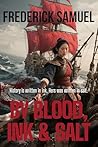 By Blood, Ink & Salt by Frederick Samuel
My rating: 5 of 5 stars
This is not a biography. It is the hush between waves – and what rises when you listen.
Thus begins Samuel’s story of Shek Ying (also known as Zheng Yi Sao). This is not a normal rendering of historical fiction. It is lyrical. With well-chosen words and phrases, Samuel instills in readers a sense of place – of China, of sea, of Asian piracy instead of Western. He captures the essence of the woman and the formidable confederation she devises. At its core is the Code.
Shek Ying does not begin life as a pirate. She pleasures men, one of whom is a successful captain of sea bandits. Zheng Yi wants her join him. She agrees because she will longer walk in someone’s shadow. She will be his equal.
Each band has its own leader, but they sometimes work in consort. Zheng Yi commands the Red Fleet. Shek Ying sees potential, and devises principles that, if followed, will bring them success far greater than they have alone. It will also protect them from those who would destroy them. Although all the captains sign, they do not pledge loyalty to her or the Code. They merely watch and wait.
High-ranking and low-ranking sea bandits test her. She offers those on land a way to live rather than subsist or starve. In return, she receives loyalty that is shown by the vital information they share. Through blood, ink, and salt (a form of currency), Shek Ying “becomes the tide they follow.”
The more powerful they become, the more others feel threatened. The British, the Dutch, and the Triads seek illicit trade alliances involving guns and opium. Such partnerships will absorb the sea bandits until they disappear. Shek Ying understands this and acts to preserve the confederation and her fellow sea bandits. When gifts do not bring forth the desired alliances, their enemies find alternatives to gain objectives. Spies, saboteurs, forgers, and traitors work from within, and Zheng Yi vanishes during a storm. His loss is grievous, but Shek Ying is determined to cut out the rot that threatens to destroy them.
On occasion, I do not explicitly understand what transpires, but the significance is always clear. Chapter 55 seems to be a fitting end to the story, but subsequent chapters are a mix of past and present, and cover a wide span of years. In response to my question about this, Samuel responds:
Once the fleet surrenders, the book moves away from a purely chronological progression and becomes something more reflective – a way of exploring meaning, memory, and legacy rather than simply recounting events in order.
I chose this structure because it echoes the way memory actually works: not as a straight line, but as a series of the most resonant memories. By placing scenes out of order – for example, showing the surrender before the betrayals that led to it – the story highlights the hidden personal struggles behind the official history. And through these time jumps, we get to see Shek Ying in her fullness: not just as a leader at a single point in time, but as a woman defined by her choices, her sacrifices, and ultimately the legend she becomes.
In essence, the narrative shifts from a straightforward historical account into a more poetic reflection on what remains after everything is over – how we remember, and what truly endures.
As a result, readers become immersed in a story in which fact and fiction are interwoven with a weaver’s expertise. Although predominately from Shek Ying’s perspective, the story occasionally unfolds from other points of view – a Qing governor, a pirate captain, a pirate archivist, a foster son, and a silent watcher -- to provide a broader picture of the confederation’s birth, rise, downfall, and legacy. Key components that flesh out the story are endurance, greed, and power. What Samuel deftly shows is that no matter how often the authorities attempt to erase Shek Ying from history, she remains as powerful a figure as she was in the early 19th century. He writes in present tense and the imagery he wields is vivid. Some action is subtle; some is not. This is a pirate tale, just not the one readers expect. Instead, this passage sums up the reading experience: “No sirens. No panic. Only the steady rise of the Pearl River, slipping under doorways, over thresholds, until streets carry water like veins carry blood.”
This review originally appeared at Pirates and Privateers: http://www.cindyvallar.com/FSamuel.html
View all my reviews


