
Cindy Vallar's Blog - Posts Tagged "red-fleet"
Ching Shih: review of graphic biography
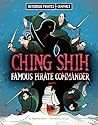 Ching Shih, Famous Pirate Commander by Stephanie Peters
My rating: 3 of 5 stars
To survive, young Ching Shih serves men who visit her place of work. She overhears men talking, and she offers the information to a pirate for a price. They marry and she becomes his partner. Their success garners them many riches and much power. When her husband dies, she finds a way to continue to lead the Red Fleet and to instill fear in the heart of the Chinese emperor in Ching Shih.
Rather than farm the land, John Roberts joins the British Navy and seeks adventure. Later, he joins the crew of a merchant ship, which encounters pirates. He is forced to join their ranks, but soon discovers that the perks of plundering other ships will make his life richer. When his captain is ambushed and slain, the crew elects Roberts to be their commander. He chooses a new name and wreaks havoc everywhere he sails in Black Bart.
Daughter of a chieftain and pirate, Grace O’Malley chops off her hair and hides aboard her father’s ship until they are so far out at sea that he can’t tell her to go home. The day eventually comes when her mother puts her foot down and Grace must follow the traditional role of a woman in 16th-century Ireland. Later, she returns to the sea to become a pirate leader and dares to meet face-to-face with the English queen to save her son in Grace O’Malley.
When England is at war with France, a youth named Edward Teach joins a crew of privateers, but when peace comes, he signs aboard a pirate ship captained by the infamous Benjamin Hornigold, who teaches Edward how to be a pirate. Before long, he becomes famous in his own right and earns a moniker that instills fear in anyone who crosses his path: Blackbeard.
Notorious Pirates is a series of four graphic novels geared toward pirate apprentices. Each pirate’s life unfolds from earliest days to the end of his or her piratical career. Fact is entwined with legend, sometimes to fill in gaps, sometimes to further entice readers. Each book is divided into five chapters and includes additional facts about the pirate, a glossary, and several internet sites where additional information can be found. The text combines dialogue and narrative to provide a cohesive tale from start to finish. The artwork grabs the reader’s attention and the artists incorporate a variety of techniques to instill emotion into the scenes. Those found in Blackbeard are particularly good at portraying victims’ terror and Blackbeard’s fearsomeness. I particularly like how the artists of this book depict the final battle between Blackbeard and Lieutenant Maynard; it’s visually stunning without being bloody and gory. Equally compelling is how the artists depict a duel between a pirate and a sailor in Black Bart.
There are some issues with the books that may or may not bother readers. Unfortunately, the inclusion of websites is problematic. It’s great to provide additional information, but not all of the URLs are current. For example, the last one listed in Grace O’Malley – Twinkl: Who Was Grace O’Malley? – is no longer viable. I did a search to see whether the URL had changed, but the information that answers the question is no longer there. Instead “Grace O’Malley” turned up a variety of visuals and activities for use in the classroom.
While most of the artwork vividly depicts scenes and action, the graphics do have some shortcomings. The clothing in Grace O’Malley is that of a later period than the one in which she lives. Vessels of the 1500s do not have staircases – nor do those of Blackbeard’s days – and the types of cannons used on the ships differ from those of later centuries. The vessels Ching Shih and her pirates sail are junks, yet those pictured show them as being predominately Western-style ships. This detracts from the setting and misleads the reader.
There are also a few historical inaccuracies. One graphic perpetuates the myth of walking the plank. The golden age of piracy does not begin in 1701; it occurs after the War of the Spanish Succession ends in the next decade. This is supposedly why Blackbeard turns to piracy. While the depiction of how he meets Stede Bonnet is humorous, in actuality, Bonnet is gravely injured and on the mend at the time Blackbeard commandeers Bonnet’s ship.
Since this series is geared toward younger pirates in training (Reading Level: grades 2-3, Interest Level: 4-6), these books will be popular with this age group and the reinforced library bindings of the hardback editions guarantee they will stand up to frequent usage. They serve as good introductions to the pirates, and the inclusion of two females and two males ensures that the books will interest girls and boys equally. The stories do gloss over some of the seamier aspects of these pirates’ lives, so parents and teachers need not worry about this. I recommend that further investigations into these pirates be paired with these books so readers receive a fuller and more accurate picture of who Grace O’Malley, Blackbeard, Black Bart, and Ching Shih really were.
(This review originally appeared at Pirates and Privateers: http://www.cindyvallar.com/YA-biograp...)
View all my reviews


A Novel of Chinese Pirates
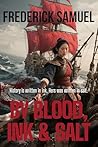 By Blood, Ink & Salt by Frederick Samuel
My rating: 5 of 5 stars
This is not a biography. It is the hush between waves – and what rises when you listen.
Thus begins Samuel’s story of Shek Ying (also known as Zheng Yi Sao). This is not a normal rendering of historical fiction. It is lyrical. With well-chosen words and phrases, Samuel instills in readers a sense of place – of China, of sea, of Asian piracy instead of Western. He captures the essence of the woman and the formidable confederation she devises. At its core is the Code.
Shek Ying does not begin life as a pirate. She pleasures men, one of whom is a successful captain of sea bandits. Zheng Yi wants her join him. She agrees because she will longer walk in someone’s shadow. She will be his equal.
Each band has its own leader, but they sometimes work in consort. Zheng Yi commands the Red Fleet. Shek Ying sees potential, and devises principles that, if followed, will bring them success far greater than they have alone. It will also protect them from those who would destroy them. Although all the captains sign, they do not pledge loyalty to her or the Code. They merely watch and wait.
High-ranking and low-ranking sea bandits test her. She offers those on land a way to live rather than subsist or starve. In return, she receives loyalty that is shown by the vital information they share. Through blood, ink, and salt (a form of currency), Shek Ying “becomes the tide they follow.”
The more powerful they become, the more others feel threatened. The British, the Dutch, and the Triads seek illicit trade alliances involving guns and opium. Such partnerships will absorb the sea bandits until they disappear. Shek Ying understands this and acts to preserve the confederation and her fellow sea bandits. When gifts do not bring forth the desired alliances, their enemies find alternatives to gain objectives. Spies, saboteurs, forgers, and traitors work from within, and Zheng Yi vanishes during a storm. His loss is grievous, but Shek Ying is determined to cut out the rot that threatens to destroy them.
On occasion, I do not explicitly understand what transpires, but the significance is always clear. Chapter 55 seems to be a fitting end to the story, but subsequent chapters are a mix of past and present, and cover a wide span of years. In response to my question about this, Samuel responds:
Once the fleet surrenders, the book moves away from a purely chronological progression and becomes something more reflective – a way of exploring meaning, memory, and legacy rather than simply recounting events in order.
I chose this structure because it echoes the way memory actually works: not as a straight line, but as a series of the most resonant memories. By placing scenes out of order – for example, showing the surrender before the betrayals that led to it – the story highlights the hidden personal struggles behind the official history. And through these time jumps, we get to see Shek Ying in her fullness: not just as a leader at a single point in time, but as a woman defined by her choices, her sacrifices, and ultimately the legend she becomes.
In essence, the narrative shifts from a straightforward historical account into a more poetic reflection on what remains after everything is over – how we remember, and what truly endures.
As a result, readers become immersed in a story in which fact and fiction are interwoven with a weaver’s expertise. Although predominately from Shek Ying’s perspective, the story occasionally unfolds from other points of view – a Qing governor, a pirate captain, a pirate archivist, a foster son, and a silent watcher -- to provide a broader picture of the confederation’s birth, rise, downfall, and legacy. Key components that flesh out the story are endurance, greed, and power. What Samuel deftly shows is that no matter how often the authorities attempt to erase Shek Ying from history, she remains as powerful a figure as she was in the early 19th century. He writes in present tense and the imagery he wields is vivid. Some action is subtle; some is not. This is a pirate tale, just not the one readers expect. Instead, this passage sums up the reading experience: “No sirens. No panic. Only the steady rise of the Pearl River, slipping under doorways, over thresholds, until streets carry water like veins carry blood.”
This review originally appeared at Pirates and Privateers: http://www.cindyvallar.com/FSamuel.html
View all my reviews


