
Cindy Vallar's Blog - Posts Tagged "opium"
William C. Hammond's A Return to Duty
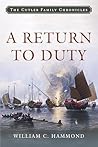 A Return to Duty by William C. Hammond
My rating: 5 of 5 stars
Separated when their ship wrecks, followed by desperate struggles to survive, Richard and Anne Cutler reunite in New South Wales in the fall of 1845. The reasons that originally brought them to this part of the world have been successfully concluded without them. The British Royal Navy will work with the United States Navy to suppress piracy in Asian waters with Imperial China’s approval. Now, the Cutlers return home to family and friends, and to decide what course their lives will take after their ordeals.
Richard secures leave from the Navy, while he and Anne work on a joint writing venture that will share their story with American readers. He also steps into the role of director of Cutler & Sons, after his predecessor was lost at sea while in the Far East. In his new role, he agrees with the older members of the family that under no circumstances will Cutler ships import opium into the United States. Some younger family members don’t agree with this since the importation is legal.
Before he decides whether to resign his commission and take full control of the family business, Richard needs to return to the Far East and confer with their agents there. He will also work with the American and Royal Navies in their attempt to stop the pirates from seizing merchant ships and to rescue their captives, many of whom are American sailors. His journey reunites him with two of his men from the shipwreck, both of whom played crucial roles in their survival after the disaster. One is Lieutenant Jonathan “Jonty” Montgomery, who now serves aboard Columbia. He’s become smitten with Daisy Cutler, whose father is the director of the Asian segment of the company. An encounter with pirates leads to a severe injury, but Jonty is determined not to let it end his naval career. He’s just as certain that he and Daisy will marry one day.
The other survivor is Jack Brengle, Richard’s former executive officer and now a captain in his own right. He commands the steamship that will take Richard to the Far East. First, though, the pair must track down Richard’s niece, Lucy Seymour, who has mysteriously disappeared. It’s possible that her disappearance is connected to Harlan Sturgis, who was romancing Richard’s mother until she realized all he wanted was information about the company to use to his advantage.
A Return to Duty is the eighth offering in the Cutler Family Chronicles. It centers around the lucrative trade of the highly addictive opium that resulted in war between China and Great Britain, and the brutal and persistent marauding of Chinese pirates on foreign shipping. The characters are expertly drawn and they pull you into the story with a full gamut of emotions. Hammond deftly weaves his research into his tale without ever allowing you to notice that he’s done so. Instead, he breathes life into a world that no longer exists and yet seems real enough to touch. He masterfully crafts unsettling action involving sharks, fire ships, bomb vessels, and boarders in a gut-wrenching climax that is tempered with love and reunion.
(Review originally appeared at Pirates and Privateers: http://www.cindyvallar.com/WHammond.h...)
View all my reviews


A Novel of Chinese Pirates
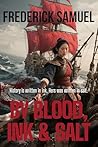 By Blood, Ink & Salt by Frederick Samuel
My rating: 5 of 5 stars
This is not a biography. It is the hush between waves – and what rises when you listen.
Thus begins Samuel’s story of Shek Ying (also known as Zheng Yi Sao). This is not a normal rendering of historical fiction. It is lyrical. With well-chosen words and phrases, Samuel instills in readers a sense of place – of China, of sea, of Asian piracy instead of Western. He captures the essence of the woman and the formidable confederation she devises. At its core is the Code.
Shek Ying does not begin life as a pirate. She pleasures men, one of whom is a successful captain of sea bandits. Zheng Yi wants her join him. She agrees because she will longer walk in someone’s shadow. She will be his equal.
Each band has its own leader, but they sometimes work in consort. Zheng Yi commands the Red Fleet. Shek Ying sees potential, and devises principles that, if followed, will bring them success far greater than they have alone. It will also protect them from those who would destroy them. Although all the captains sign, they do not pledge loyalty to her or the Code. They merely watch and wait.
High-ranking and low-ranking sea bandits test her. She offers those on land a way to live rather than subsist or starve. In return, she receives loyalty that is shown by the vital information they share. Through blood, ink, and salt (a form of currency), Shek Ying “becomes the tide they follow.”
The more powerful they become, the more others feel threatened. The British, the Dutch, and the Triads seek illicit trade alliances involving guns and opium. Such partnerships will absorb the sea bandits until they disappear. Shek Ying understands this and acts to preserve the confederation and her fellow sea bandits. When gifts do not bring forth the desired alliances, their enemies find alternatives to gain objectives. Spies, saboteurs, forgers, and traitors work from within, and Zheng Yi vanishes during a storm. His loss is grievous, but Shek Ying is determined to cut out the rot that threatens to destroy them.
On occasion, I do not explicitly understand what transpires, but the significance is always clear. Chapter 55 seems to be a fitting end to the story, but subsequent chapters are a mix of past and present, and cover a wide span of years. In response to my question about this, Samuel responds:
Once the fleet surrenders, the book moves away from a purely chronological progression and becomes something more reflective – a way of exploring meaning, memory, and legacy rather than simply recounting events in order.
I chose this structure because it echoes the way memory actually works: not as a straight line, but as a series of the most resonant memories. By placing scenes out of order – for example, showing the surrender before the betrayals that led to it – the story highlights the hidden personal struggles behind the official history. And through these time jumps, we get to see Shek Ying in her fullness: not just as a leader at a single point in time, but as a woman defined by her choices, her sacrifices, and ultimately the legend she becomes.
In essence, the narrative shifts from a straightforward historical account into a more poetic reflection on what remains after everything is over – how we remember, and what truly endures.
As a result, readers become immersed in a story in which fact and fiction are interwoven with a weaver’s expertise. Although predominately from Shek Ying’s perspective, the story occasionally unfolds from other points of view – a Qing governor, a pirate captain, a pirate archivist, a foster son, and a silent watcher -- to provide a broader picture of the confederation’s birth, rise, downfall, and legacy. Key components that flesh out the story are endurance, greed, and power. What Samuel deftly shows is that no matter how often the authorities attempt to erase Shek Ying from history, she remains as powerful a figure as she was in the early 19th century. He writes in present tense and the imagery he wields is vivid. Some action is subtle; some is not. This is a pirate tale, just not the one readers expect. Instead, this passage sums up the reading experience: “No sirens. No panic. Only the steady rise of the Pearl River, slipping under doorways, over thresholds, until streets carry water like veins carry blood.”
This review originally appeared at Pirates and Privateers: http://www.cindyvallar.com/FSamuel.html
View all my reviews


