
Cindy Vallar's Blog - Posts Tagged "greed"
Review of James Boschert's The Dragon's Breath
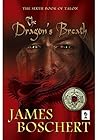 The Dragon's Breath by James Boschert
My rating: 5 of 5 stars
Still hunted by his beloved’s brother, Master of the Assassini, and a sultan thwarted from marrying Rav’an, Talon takes her and his newly-met son, Rostam, to Oman. There lives a man Talon once saved from an executioner’s sword, one who may be able to help the fugitives resettle in a new land. Accompanying them on this journey is Reza, Talon’s brother-in-arms and fellow fugitive from the Assassini, as well as another woman rescued from the sultan’s harem.
The day Talon arrives in Oman, Allam al Mardini celebrates his victory against an arch rival. His camel, Jasmine, has won the most prestigious race of the year. He welcomes Talon into his home, even though five months have passed since they were imprisoned together. He knows well that although Talon claims to be a merchant, his friend is far more than that. Talon soon discovers that he and Allam’s family have similar interests – merchant ships and a good game of Chogan. Talon is invited to play, but one of their opponents is the man bested in the camel race. After a failed attempt to inflict a fatal injury and a second loss to Allam’s family, Nejem al Khulood vows vengeance – a pledge that necessitates Talon’s and Reza’s intervention after Jasmine disappears.
Knowing of Talon’s interest in his family’s ships and journeys, Allam intercedes with his brothers and father and they provide their new friend with guidance in purchasing a new vessel and in journeying to Africa, Al Hind, and China. But such voyages are rarely without perils, as Talon, Reza, and their families soon discover. A sick woman in their first port of call soon leads to mobs trying to flee rumors of plague. When illness sweeps through the brothers’ ships, Talon must continue onward into unknown waters. The sighting of three sails announces the arrival of pirates too numerous to defeat in hand-to-hand combat; surprise is Talon’s only option, yet it offers a slim chance of survival.
In the midst of a vicious storm a foundering ship, showing signs of a fire and no crew, demands a daring rescue to save the four people still aboard. The gamble pays off in unexpected ways, since one of those saved is Lord Meng Hsü who was returning home from a mission to India on behalf of Guangzhou’s governor. Talon is intrigued by his guest and his country, but as tantalizing as a visit to China might seem, it must wait for another day . . . until a cruel and dictatorial ruler on an island off the Malay peninsula attempts to maneuver Talon into selling his cargo at a loss. But China is a land of strange customs and political maneuverings, where death is but a whisper away.
The Dragon’s Breath is the sixth entry in the Book of Talon series, and it is rife with roller-coaster adventure, exotic locales, and breathtaking jeopardy. Boschert spins a compelling tale with subplots intricately interwoven to create the finest silken tapestry. His knowledge and research of the various cultures transport readers back to the twelfth century, where the intoxicating allure and inevitable reality place readers in the midst of ambition, intrigue, jealousy, espionage, greed, betrayal, and survival. Talon and Reza come close to meeting their match when they tangle with eastern pirates, as well as a new and formidable group of assassins, the Ninja. There is even a quest to find a dragon, which matches the serpentine curves of that legendary creature and inserts a bit of levity into a story where it’s difficult to determine just who can be trusted. Whether new to Talon and his journeys or a longtime fan, readers will find The Dragon’s Breath rewarding, spellbinding, and an excursion not to be missed.
View all my reviews


Review of Wayne Savage's Eldorado
 Eldorado: The Pyrate Chronicles by Wayne Savage
My rating: 3 of 5 stars
In this second book of The Pyrate Chronicles, journalist Nathaniel Bagshaw returns to prison to learn more from the condemned pirate William Benton. His fantastical tale begins when supplies are low and a strange mist envelops the ships of Captain Björn "Ironside" Gunnarsson and Captain Wolfenden, who sail in consort. Their emergence from the murky cloak reveals a stone fort flying a Spanish flag. Not knowing how much time has passed since they entered the fog or whether their countries are at war or peace, they devise a plan. Gunnarsson and a small contingent approach the fort directly. Wolfenden and his men sail farther down the coast and sneak ashore.
The pirates are astounded to be greeted by 200 soldiers who look like the conquistadores of the past, and many enslaved natives. This domination doesn’t set well with the pirates, especially ship's surgeon Faustus Quiddington, but being outnumbered and the tenuousness of their plight forces Gunnarson, his wife Cassandra, and the rest of the shore party to keep their true feelings hidden.
Governor Hidalgo’s welcome raises some questions, which he answers. A treasure ship departed the viceroyalty in 1543. Ever since, they’ve been waiting for another galleon to return. In the intervening 175 years, an uprising resulted in the loss of some information and a blending of two cultures, such as the Holy Catholic bible of our Lord Jesus Christ-Quetzalcoatl. The other tidbit that gains the pirates’ attention is the fact that the governor has been stockpiling the annual collections of gold and silver while they wait for the treasure galleon to return.
The pirate who is particularly intrigued is Will Benton. Obeying orders isn’t his strong suit, and being a true pirate, he only heeds the captain’s commands in battle. Since gold is to be had, he has every intention of claiming his portion. Swiping one piece of gold proves relatively easy. No one notices because gold and silver adorn everything in the governor’s home. Purloining may lead people to believe that Will has no scruples, but he draws the line at human sacrifice. His disruption of such an act gains him a sentence of death. It takes all of Gunnarsson’s negotiating skills to gain Will’s freedom, but Governor Hildalgo’s price may prove too high.
This historical fantasy takes place in the early 18th century. Think of it as “a book in which Black Sails meets Gulliver’s travels [sic] with a dash of the authentic humour of that loveable pirate band Ye Banished Privateers.” (5) Savage’s depiction of piracy and the brutal realities of life in this time period show the depth of his research. There are occasions where too much data is conveyed in characters’ conversations; the dialogue is a device to show the passage of time and these details are interesting, but they aren’t always relevant to what’s happening in the unfolding scene. There are also some errors that a copyeditor would have caught.
Aside from the greed and allure that gold tends to spark, not everyone gets away with treasure. Rifts arise and this time around, they prove unmendable. The encounter with Hildalgo, however, is only one of the piratical adventures in this book. The second one involves sirens, sea serpents, and mermaids. It also shines a light on some minor characters, especially the women in the crew, in unique ways. It will be interesting to see what comes next for this band of pirates, especially since Gunnarsson’s captaincy may be in jeopardy.
(This review originally appeared at Pirates and Privateers: http://www.cindyvallar.com/adult-fant...)
View all my reviews
A Novel of Chinese Pirates
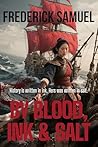 By Blood, Ink & Salt by Frederick Samuel
My rating: 5 of 5 stars
This is not a biography. It is the hush between waves – and what rises when you listen.
Thus begins Samuel’s story of Shek Ying (also known as Zheng Yi Sao). This is not a normal rendering of historical fiction. It is lyrical. With well-chosen words and phrases, Samuel instills in readers a sense of place – of China, of sea, of Asian piracy instead of Western. He captures the essence of the woman and the formidable confederation she devises. At its core is the Code.
Shek Ying does not begin life as a pirate. She pleasures men, one of whom is a successful captain of sea bandits. Zheng Yi wants her join him. She agrees because she will longer walk in someone’s shadow. She will be his equal.
Each band has its own leader, but they sometimes work in consort. Zheng Yi commands the Red Fleet. Shek Ying sees potential, and devises principles that, if followed, will bring them success far greater than they have alone. It will also protect them from those who would destroy them. Although all the captains sign, they do not pledge loyalty to her or the Code. They merely watch and wait.
High-ranking and low-ranking sea bandits test her. She offers those on land a way to live rather than subsist or starve. In return, she receives loyalty that is shown by the vital information they share. Through blood, ink, and salt (a form of currency), Shek Ying “becomes the tide they follow.”
The more powerful they become, the more others feel threatened. The British, the Dutch, and the Triads seek illicit trade alliances involving guns and opium. Such partnerships will absorb the sea bandits until they disappear. Shek Ying understands this and acts to preserve the confederation and her fellow sea bandits. When gifts do not bring forth the desired alliances, their enemies find alternatives to gain objectives. Spies, saboteurs, forgers, and traitors work from within, and Zheng Yi vanishes during a storm. His loss is grievous, but Shek Ying is determined to cut out the rot that threatens to destroy them.
On occasion, I do not explicitly understand what transpires, but the significance is always clear. Chapter 55 seems to be a fitting end to the story, but subsequent chapters are a mix of past and present, and cover a wide span of years. In response to my question about this, Samuel responds:
Once the fleet surrenders, the book moves away from a purely chronological progression and becomes something more reflective – a way of exploring meaning, memory, and legacy rather than simply recounting events in order.
I chose this structure because it echoes the way memory actually works: not as a straight line, but as a series of the most resonant memories. By placing scenes out of order – for example, showing the surrender before the betrayals that led to it – the story highlights the hidden personal struggles behind the official history. And through these time jumps, we get to see Shek Ying in her fullness: not just as a leader at a single point in time, but as a woman defined by her choices, her sacrifices, and ultimately the legend she becomes.
In essence, the narrative shifts from a straightforward historical account into a more poetic reflection on what remains after everything is over – how we remember, and what truly endures.
As a result, readers become immersed in a story in which fact and fiction are interwoven with a weaver’s expertise. Although predominately from Shek Ying’s perspective, the story occasionally unfolds from other points of view – a Qing governor, a pirate captain, a pirate archivist, a foster son, and a silent watcher -- to provide a broader picture of the confederation’s birth, rise, downfall, and legacy. Key components that flesh out the story are endurance, greed, and power. What Samuel deftly shows is that no matter how often the authorities attempt to erase Shek Ying from history, she remains as powerful a figure as she was in the early 19th century. He writes in present tense and the imagery he wields is vivid. Some action is subtle; some is not. This is a pirate tale, just not the one readers expect. Instead, this passage sums up the reading experience: “No sirens. No panic. Only the steady rise of the Pearl River, slipping under doorways, over thresholds, until streets carry water like veins carry blood.”
This review originally appeared at Pirates and Privateers: http://www.cindyvallar.com/FSamuel.html
View all my reviews


