Lance Tyson's Blog - Posts Tagged "sales-success"
3 KEYS TO ACHIEVING SALES SUCCESS

SALES WISDOM I’VE DISCOVERED IN MY CAREER
Throughout my time in sales, I’ve researched numerous complex theories, process descriptions, tactics, and strategies. In addition to these, I have also come across a number of quips from sales gurus who try to encapsulate sales success in a simple phrase that can be easily understood, even by a 5th grader.
For example, Zig Ziglar was famous for saying, “Either you’re green and growing or you’re ripe and rotten.”
Not only is this a nice example of an analogy, but it’s a message to all salespeople, young and old, that you need to be learning new stuff all the time. Otherwise, you’ve reached the end of your useful life.
Throughout my training sessions, speaking engagements, and lectures, I’ve peppered my talks with my own version of these sales success tips based on my own experiences. In my book, Selling is an Away Game, they are referred to as “Lance-isms.” Here are a few you can use to put you on the path to your own sales success.
SALES SUCCESS KEY: BE YOUR OWN ARCHITECT. THE WORLD IS YOUR OYSTER.
This is one I actually heard from my father. I still use it in my sessions to impart upon salespeople that they have the freedom, power, and responsibility to visualize and create their own outcomes. They simply must do the work necessary to reach those outcomes. But as we teach in our sales leadership programs, people will work willingly in a world they help create. And they will work tirelessly to reach a goal they set. So, we coach and encourage salespeople to set meaningful and relevant goals that support the world they envision. In doing so, they find the motivation to propel themselves forward as opposed to having the sales manager hold their hands, constantly micromanage their activities, and sometimes even give them a push.
So, to sales leaders I say coach your people to be independent. Give them the responsibility to act.
And to salespeople striving for sales success, I say be your own architect. The world is your oyster.
SALES SUCCESS KEY: DON’T CONFUSE ACTIVITY WITH RESULTS
Back when I ran several training franchises in Ohio, I had a new sales rep who spent a lot of time developing a territory about 70 miles north of our office location. He cultivated some good leads, made some good contacts and we held a few training events in the area. But the trip there and back cost him over two hours every day. That was over two hours every day that he wasn’t in front of a prospect. That was over two hours every day that he wasn’t selling. That activity may have been necessary to get him up to the area, but it wasn’t getting him the results that he wanted, more sales.
I see this all the time. Sales reps getting caught up in performing busy maintenance work, like updating the CRM – important functions to be sure. But these aren’t selling activities. These are maintenance activities. Remember, don’t confuse activity with results. Use activity to build habits and skills. Then use those habits and skills to get the results you want. If you aren’t getting results, build up some different habits and skills. But focus on getting the results you want. If you do that, you’ll have an easier time of identifying and performing the necessary activities.
SALES SUCCESS KEY: STOP SPRAYING AND PRAYING
I was once in the presence of a gifted sales rep who was producing mediocre results. The guy was able to read people quickly and easily. The challenge was in his selling method. He would sit across from the prospect, rifle through a list of features, and watch the prospect for a reaction. When he got a reaction, he would focus on the feature that got him the reaction.
The problem here is that you aren’t interacting with your prospect. You aren’t performing any type of diagnostic conversation. You aren’t helping them to identify and acknowledge their challenges. You’re simply poking them with a variety of sticks, looking for that one, magic stick that will make them jump.
And then you’ll keep poking them with that magic stick hoping for a sale.
Add to the fact that not every sales rep has the skill or temperament to read people that well. They are simply praying that something they sprayed will stick.
Look, to produce consistent results and achieve sales success, you must be like a scientist or an engineer and adhere to a reproducible and repeatable process. Showing up at a prospect’s door, spraying out a bunch of product features, and praying that something will stick is not a recipe for reproducible results. Be investigative in your approach. Diagnose your prospect’s challenges. Design solutions that solve their challenges or create opportunities for them. And above all else, stick to your sales process.
Remember, If you have to pray for a result, your activity isn’t producing it.
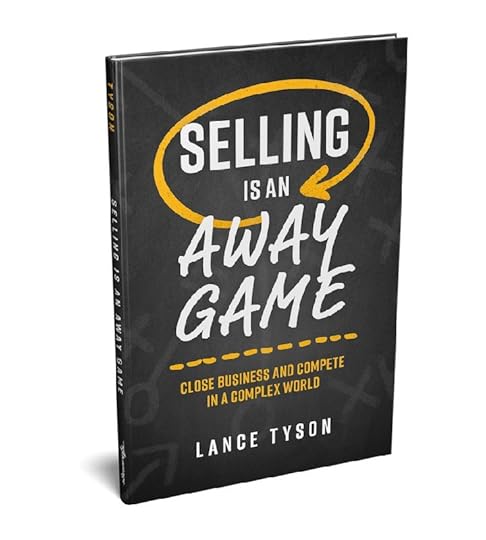
For additional Lance-isms and ideas on achieving sales success, pick up a copy of Selling is an Away Game, available online at Amazon, fine bookstores and many Hudson News locations.


Need to Motivate Your Sales Team? Try These 5 Tips

A question I often get in my consultation sessions is, “Bob’s not motivated. What’s the best way to motivate Bob to get out there and sell more?”
Well, I don’t know if there’s a best way to motivate sales people because I actually don’t believe motivation is an outward force. It’s not something you do to someone. Motivation comes from within the individual.
Now, there are some things you can do as a leader. In fact, there are some things you need to do as a leader to get your people off and running on all cylinders. But there is no special lightning-in-a-bottle that you can juice your whole team with to get them moving with gusto. In fact, there are probably some people in prison that are motivated by the same values as the sales reps on your team! Ultimately, we define motivation as coming from within the individual, not from something external to the person.
Now, from a sales leadership standpoint, I don’t believe your job is to motivate your people. I believe your job is to understand motivation to the point where you can help your people motivate themselves.
With that, here are 5 secrets of motivation to help you get your people performing at the next level.
MOTIVATION IS DIFFERENT FOR EVERYONE
Now, if I go back to what we just said, your job as a sales leader is to understand motivation and realize that it’s not a one size fits most. That would be like one of those hats you buy down in Disney World, where all the hats fit the same head. I think motivation is really personal. To understand that, you need to really consider the following example.
Two sales people have worked with me for multiple years and each motivates themselves in a different way. They are just completely opposite. One person on staff loves the public accolades, loves to win contests. That’s the way she rolls. But the other salesperson feels stuff like that is not as important to her. She competes against herself.
Now if I try to apply the same, cookbook, motivation techniques to each person the same way, that’s an example of one size fits most. And it doesn’t work.
That leads us to…
KNOWING THE DIFFERENCE BETWEEN MOTIVATION AND MANIPULATION
I don’t think most sales leaders understand the difference between motivation and manipulation In fact, most people think manipulation is a bad thing. Well, you have to know that there are several meanings to the word manipulation. If you look up the definition on Google or the Merriam Webster’s website, the first meaning will tell you that manipulation is to act in a skillful manner.
I think the number one thing you have to understand as a sales leader is that you are trying to manipulate a situation to achieve a result. You’re trying to, for instance, use a contest to extract the best from some of your people. Or maybe you give someone additional responsibility to make a member feel challenged. Or maybe you ultimately give members the clients that match their temperament.
Since motivation comes from within, it’s not something you can just turn on or off in an individual. But you can manipulate the environment to help your people perform their best. Don’t like the word manipulate? Try create. Or engineer. But know that you need to set up the environment where your people can flourish, grow, and feel compelled to succeed.
Now, if you’ve created the best environment for your people, there’s another piece you need to be aware of. And that is…
WHAT YOU SAY MATTERS
The other thing you have to understand is that great pep talks aren’t going to get the job done. Sure you can use stories, anecdotes, and offer encouragement to move your team members. But none of these have a lasting effect. And they don’t work the same on all people.
Some people operate more like how Dr. Seuss describes them in his book, Oh, the Places You’ll Go. Dr. Seuss said, “You’ll succeed yes you will indeed, 98 and 3⁄4 percent guaranteed. Kid, you’ll move mountains be your name Buxbaum or Bixby or Bray. or Mordecai Ali Van Allen O’Shea, you’re off to Great Places! You’re off and away. Your mountain is waiting so get on your way.” So your people will understand they can do it.
But then there’s another section in the same book where Dr. Seuss says “You’ll play lonely games too. Games you can’t win because they’ll be against you.”
Words matter. But they won’t necessarily move all of the people all of the time. Some people need that occasional, verbal pat-on-the-back to keep them on track. Others see the actual accomplishment as the ultimate motivation and they “play those lonely games.”
If you’re going to be an effective sales leader, you gotta really understand that some people play those lonely, inner games. You have to have a clear understanding of what makes both types of people work and who is which type in your team.
That brings us to…
FAIR IS NOT EQUAL
I think the next thing sales leaders have to realize is that a lot of people come into sales jobs and think everyone should be treated equally. I think people need to be treated fairly, not necessarily equally. You have to remember, everyone has their own unique talents, styles, and experiences. So treating everyone equally will not have the effect you want.
For example, let’s say I’m talking about inbound leads. If I’m gonna give out a lead, I’m not necessarily going to spread the wealth around to everybody. Leads or company referrals that come in are probably going to be given to my best people – the ones who are going to address the lead timely and have the best chance to close it.
It’s kinda like ice hockey. You give the ice time to the first liners, you expect more goals. You need to understand that.
Finally…
TO MOTIVATE YOUR PEOPLE, KNOW YOUR PEOPLE
In your role as a leader, if you want to understand motivation, the key here is not to think that motivation is merely an external tactic you can quickly apply to your team. You need to get to know your people.
Everybody is motivated by different things. For example, some people reading this blog post might be very motivated by getting to the next level in their profession. So, maybe their motivation extends into actualization, the top level of Maslow’s Hierarchy of Needs. On the other hand, some of your people may be at the bottom of Maslow’s Hierarchy, living in survival mode. They need the job to survive.
Your role, as a sales leader, is to invest some time getting to understand the different narratives of the members on your team and assess their skills and talents. Only then can you strategically set the environment and your interactions accordingly to get the best out of them.
Back when we performed general leadership training, one of the pillars we reviewed constantly was an idea pulled from Jim Collins’ book, Good to Great. In that book, Collins stated that leaders of great companies were good at getting the right people on the bus, the wrong people off the bus, and the right people in the right seats. That’s the crux of motivating your team. Know your people’s temperament, skills, and abilities so that you can get them in the right position where they can be successful and motivate themselves.
You don’t want to be in a position where you are constantly pumping up your team. Instead, take time to know your people so you can set up the environment that will compel them to motivate themselves to be the best they can be.
Be sure to check out Lance Tyson’s book, Selling Is An Away Game: Close Business and Compete in a Complex World available on Amazon. Get your copy today!
WANT MORE IDEAS ON ASSESSING YOUR SALES REPS AND TO MOTIVATE YOUR TEAM?
Contact Tyson Group here to learn more about how away-game selling can give you a competitive edge,
5 Winning Tips To Close More Sales

When we conduct our sales training, a fast rule we follow is that there are no special skills in closing. In a different article, the Myth of the Perfect Closing Script, I relayed as much. Those closing scripts and closing techniques are a part of a different era, a different environment, and different customer culture.
Today, the reason we say there is no special skill in closing is because we believe that closing has more to do with the sales reps confidence, not his or her ability to follow a script.
In all the assessments that we have done prior to conducting our training sessions, I’ve seen that the ability to close is related to how an individual deals with scarcity and abundance. For instance, if the salesperson is operating out of a scarcity mentality, and they don’t have much in their sales pipeline, they’ll be more likely to accept a “maybe” from the prospect. They may be opposed to challenging the prospect, vetting out objections, clarifying objections, and using any language that may put the relationship at risk. They can’t afford to lose any opportunities.
On the other hand, when we find sales reps with a more abundant mentality, their pipeline is might be three or five times their goal, and they are more apt to give a prospect a push, try some new techniques, and challenge their objections. They don’t lose sight of their people skills, but they are a little more assertive when dealing with buyers.
SALES AS A SERIES OF YESES
In looking for sales closing tips, we realize that closing in today’s complex selling environment is not something that is tacked on at the end of the sales process as an afterthought. It happens throughout the sales process. Selling is a series of yeses:
“Yes. I’ll meet with you.”
“Yes, you can ask me questions.”
“Yes, you can present something to me or prescribe something to me.”
“Yes, you addressed and resolved my objections.”
“Yes, I’ll buy from you.”
You’ve got about 5 necessary yeses when shepherding your prospect through your sales process.
When you look at the sales process this way, we see there are 5 critical junctions where you must overcome some type of resistance, or “objections”. Understanding where you are in the sales process and understanding the type of resistance, or objections, you are facing will help you close better.
CLOSING TIP 1: KNOW WHAT A BUYING SIGNAL IS
Our first sales closing tip is being able to identify a buying signal. Looking back at the collected sales wisdom of the past, we have ample descriptions of buying signals from the experts. Your prospect is sitting across from you: they are leaning forward, they look attentive, maybe they are rubbing their chin, perhaps they are asking clarifying questions…all are buying signals.
However, an alternate narrative might be they are confused, and they are trying to understand what you are saying. Perhaps they have an itchy chin, or they need a shave.
The truth is you don’t know which explanation adequately explains what you are seeing.
So, what’s a buying signal? A buying signal is anything a buyer says or does that indicates some level of interest.
CLOSING TIP 2: KNOW WHAT A WARNING SIGNAL IS
Now, let’s flip the coin over and look at the other side. What’s a warning signal?
Again, going back to all those sales books and psychology books that made attempts at codifying body language, we can look at past descriptions. Your prospect is sitting across from you with their arms crossed. They aren’t paying attention. Perhaps even looking at their phone. Alternately, they could be cold and trying to keep warm. Maybe they’ve got another meeting scheduled and your session is bumping into that time. Or maybe they just got a call from home.
Again, we don’t know which description explains your observations. And again, we are left with trying to define a warning signal.
A warning signal is anything the buyer says or does that indicates disinterest at some level.
The question becomes, for both buying and warning signals: if you can see what they buyer does and you can hear what the buyer says, how do you know if they are interested or disinterested? The answer is: you test them by asking a trial close question. It might be something like, “how does this sound so far?”
This is like sticking a toothpick in a cupcake to determine if it’s done. If the toothpick comes out clean, then you are ready to move to the next phase. But if the toothpick comes out with stuff attached, then you have some more cooking to do.
CLOSING TIP 3: IDENTIFYING AN OBJECTION
A third closing tip is to recognize an objection.
We have different categories of objections. In my best-selling book, Selling is an Away Game, we talk more about your financial marketplace-driven objections. There are objections that are wrapped in cost, value, price, or budget.
An objection, one that we typically think of as a sales objection, comes after you’ve proposed or prescribed your solution to your prospect. And objections, by their nature, reflect a certain level of interest in your solution.
An objection is anything the buyer says or does that indicates hesitation to move the sale forward.
CLOSING TIP 4: DISTINGUISH YOUR INHERENT OBJECTIONS
In a previous article, I mentioned an inherent objection. These are objections that occur because you didn’t do something well in the sales process.
I was recently with a group, the Baltimore Ravens, and we were discussing objections. Someone in the session said, “What if your prospect just doesn’t want to meet with you? Is that an objection?”
Well, this is what we call a put-off because the “objection” is more about you and your process and not about any solution you’ve offered.
Inherent objections mostly occur early in the sales process and often relate to your prospect being preoccupied, busy, distracted, or not wanting to meet with you. You find a level of disinterest or disengagement with your prospect. These all occur without you offering any type of solution to their problem.
You need to be able to distinguish these inherent objections (the ones in which you have not yet gained the prospect’s trust) from your standard sales objections (the ones in which your prospect is interested in your offering and might move forward if you can resolve the issue at hand).
CLOSING TIP 5: ASKING FOR THE BUSINESS
The fifth sales closing tip is to close once you’ve pitched a real solution. Following the sales process will get you most of the way to the close. However, you still must ask for the business.
As we’ve stated before, the close is not something that is forced at the end. When you walk your prospect through your sales process, the close flows naturally. But it won’t happen on its own. You still must ask the question. And so many sales reps miss this. They either try to force the close or they become shy as the end approaches, as if they’re afraid that they’ll scare off the prospect by asking for the business.
Most of the time, the simplest close is the best. I’ve seen sales reps try to overcomplicate the close by cloaking it in some “mystical language” that only sales people can understand. Don’t get fancy. Just ask if they are ready to proceed.
I can’t emphasize this enough. If you have followed your process and addressed their concerns, then the close is merely the doorway to the next phase in the customer lifecycle. Simply ask them if they are ready to move forward. If the buyer says yes, then move forward. And if the buyer says no, then treat the response as an objection and find a way to overcome it. Either way, you’re moving forward. So stop hedging and start moving!
WANT MORE IDEAS ON ASSESSING YOUR SALES REPS AND TO MOTIVATE YOUR TEAM?
To learn more about how away-game selling can give you a competitive edge, contact Tyson Group here.
Also, be sure to check out my book, Selling Is An Away Game, available on Amazon, for additional methods and sales strategy. Get your copy today!