Lance Tyson's Blog - Posts Tagged "sales-close"
Closing in a Complex World: Landing the Deal

For sales professionals, there is perhaps no single word more enshrouded in mystery than “closing.” If you check out the descriptions for sales jobs, you’ll find that companies are always looking to hire closers. There’s a kind of mythology built around closing that implies a rarefied skill possessed by only a few elite salespeople.
But, in reality, closers are like pixies or leprechauns – they don’t exist. That’s because there’s no special skill required to close business.
TO CLOSE MORE SALES, PREPARE TO LOSE SALES
A few weeks ago, I was conducting sales training for a major NBA team. At the break, one of the sales reps approached me and asked for some advice on how to become a better closer. I asked him to clarify what he meant by that, and he said, “I want to close more sales.”
My response back to him was: “Are you also ready to lose more sales?” He gave me a look of pure confusion. So, we walked over to the door of the training room, which was standing wide open. I said, “See this door?” He nodded. I slammed the door shut as hard as I could. “Now it’s closed.”
My point was not to act like a jerk or make the sales rep feel small – I was simply trying to illustrate that the act of closing business means bringing the deal to its final conclusion. As long as that door stands open, the deal is still a possibility.
As human beings, we tend to accept maybes because they allow us to keep the door open indefinitely. But clinging to “maybe” actually prevents us from closing the deal.
THE TOUGHEST QUESTION IN SELLING
If you want to close a deal, you have to be willing to ask the toughest question in sales – “Are you in or out?” And, before you do that, you have to accept the fact that you might not like the answer. Because sometimes this question serves as a catalyst to help us close business. In other cases, it means walking away so we can find another, more suitable prospect.
That’s why I believe there’s no specialized skill to closing. You simply have to decide whether you are ready and willing to shut the door.
Is the timing right to close? To find out, ask yourself these four questions. Have you:
- successfully established a rapport with the buyer?
- done your homework in evaluating and diagnosing the problem?
- offered a carefully considered prescription?
- had a frank dialogue about objections?
If your answers to these questions are “yes,” then the timing is probably right to close.
Successful sales reps need to be confident – or at least act confident. Don’t be willing to live in a world of perpetual maybes. It’s okay to let the cake sit on the table and cool down a bit, but at least be ready and willing to ask buyers if they want a slice.
A FEW STRATEGIES TO CLOSE BUSINESS
I travel about 50 times per year, and I still marvel at the fact that a 60-ton piece of steel tubing can thrust itself through the air at a speed of hundreds of miles per hour and manage to stay up. By contrast, landing makes sense to me. After all, we have gravity in our favor – inevitably, the plane will come down.
Closing business is like landing a plane – at its core, it’s simply the act of bringing the deal to its natural conclusion.
That said, there are a few strategies for closing, and it helps (before you hit the runway) to choose which one you want to work with:
THE DIRECT CLOSE
I always prefer this approach, which can be summed up in the words of Nike: “Just do it.” In this variant, you just ask the question directly, “What are your thoughts on this – do you want to do it?” At the very worst, the answer may mean walking away from the deal. But, if you’ve taken the other previous steps in the sales process, chances are that it will move you more quickly toward a positive resolution and closure.
THE ALTERNATE CHOICE CLOSE
In cases where the direct close seems too presumptuous or risky, you might opt for the Alternate Choice Close, where you offer a couple of options, e.g., “Do you want to go with the three-year contract or the seven-year contract?”
THE MINOR POINT CLOSE
If you encounter a situation where the buyer’s position is opaque and they claim to still be thinking about it, you could try the Minor Point Close. Ask how the buyer feels about a particular section of the contract (or some other minor point) to gauge interest and move the dialogue forward.
THE NEXT STEP CLOSE
When we are setting up a sales training at a hotel, often the sales rep will actually show us a room and ask us, “What are your thoughts on this?” They are literally helping us see beyond the close to the next step, which can be quite effective.
THE OPPORTUNITY CLOSE
Often, organizations will pressure buyers by giving them a limited time frame – telling them that, if they act now, they will get a discount. Infomercials and timeshares are notorious for this type of close. Be careful with this one, however, because it’s the most manipulative kind of close, and it can backfire. But sometimes it works like a charm.
THE BALANCING CLOSE
In this approach, the sales rep helps buyers weigh the pros and cons in order to make an informed decision. There’s something to be said for taking the higher ground and helping someone go back through their consideration process to make sure they will be happy with the outcome. It helps build trust and can produce great results.
Remember: Closing is based on the momentum you have already established during the course of the flight. How quickly and smoothly you bring the deal in for a landing is just a matter of how well you direct it toward the runway.
PUT YOUR TEAM ON THE FAST TRACK OF HOW TO CLOSE BUSINESS IN A COMPLEX WORLD
To learn more about how away-game selling can give you a competitive edge, contact Tyson Group here.
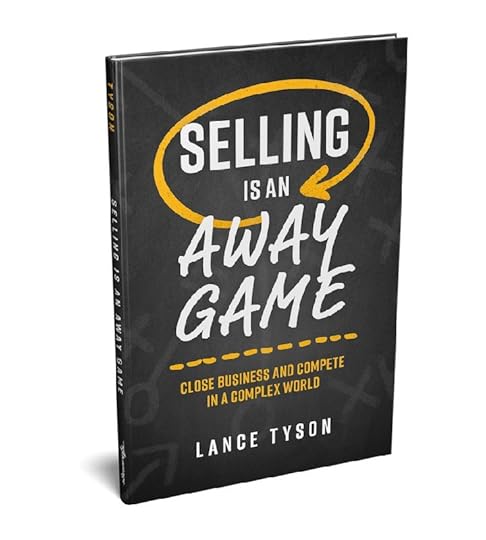
Purchase a copy of Lance's best-selling book, Selling is an Away Game, here.
Tyson Group received honorable mention in SellingPower’s prestigious list of Top 20 Sales Training Companies in 2018 and 2019 for excellence in sales training. Lance Tyson is a regular SellingPower blog contributor.


Master to Win: Away-Game Selling Strategies

I’m addicted to my Fitbit. It keeps my diet on track, helps me work out longer and more frequently, and basically keeps me on my game regardless of whether I’m at home or on the road.
But the thing I love the most about my Fitbit is that it’s mine and mine alone. Even though the basic hardware is off the shelf, it feels like it’s been tailored just for me because it uses my unique data.
Devices like Fitbit have inspired a wave of interest in products and solutions that feel tailored. In this era of 24/7 connectivity, the sales process needs to be tailored in a similar fashion.
Buyers are armed with more information than they would have been in the past, which gives them an advantage. When buying a product online, 92 percent of consumers spend time reading online reviews ahead of time – and 40 percent of those consumers form an opinion by reading just 1-3 reviews. They read those reviews, insert their own confirmation biases, and make quick decisions based on how well they believe that product or solution will be customized for their own pre-determined needs before they even speak with a salesperson.
The ready availability of information is fundamentally changing how they buy, across the board. The biggest challenge for salespeople today is having to make constant decisions on the fly as they adapt to the needs of the buyer.
These are just a few of the factors that have turned selling into an “away game.” Just like a sports team must overcome a disadvantage when playing on the opponent’s field, salespeople need to be prepared to play on a dynamically changing field, adapting to what the buyer already knows or wants.
THE FOUR ELEMENTS OF AWAY-GAME SELLING
In away-game selling, successful salespeople need to be more like the Waze App than a printed map. They need to constantly adjust in real time, based on the feedback they receive from the buyer and from other drivers, and continually update with relevant, customized information depending on where the buyer wants to go. That said, it’s essential for the salesperson to have a predictable process with repeatable steps.
There are four interrelated elements to the away-game sales process, shifting dynamically to accommodate one another in real time. Here are tips on how to succeed:
UNDERSTAND THE BUYER’S MINDSET
The buyer’s mindset is like a prism through which to view the decision-making process. To align with what is in the buyer’s mind, you need to mirror every action that person would normally take when buying something: get the attention of prospects, qualify them to see if they fit the business parameters, engage them in some kind of request for their time, ask them a series of questions, and create a scenario in which you can present ideas and start to create an opportunity.
DEVELOP A STRATEGY
To adapt to the buyer’s mindset, you need a sales strategy that is flexible enough to be tailored to individual clients, yet sturdy enough to be scalable and repeatable. Find a way to engage buyers in conversation and convince them you are a person worth listening to.
EMPLOY BATTLE-TESTED TACTICS
Your sales strategy needs to be supported by a set of tried-and-true tactics: “If this, then that.” For example, if you get someone’s voicemail, what will you say? How will you start the sales conversation? If you encounter an objection about price, how will you respond? It’s important to have a deep repertoire of tactics for every step of the sales process, but it’s equally important to stay in the moment and continue looking for opportunities to adapt to the buyer’s mindset.
HONE YOUR SKILLS
You need a skill set that is versatile enough to support your process. The basic toolkit should include a range of skills, including verbal brevity, selling time and awareness, communicating value, resolving objections, facilitating, and selling over the phone vs. selling in person.
To win this game, you’ve got to be like the Waze app – find out where your buyer wants to go and identify and eliminate potential roadblocks or other issues that might get in the way. Learn more about the landscape continuously so you can adjust your strategy accordingly. Then, use your acquired tactics and skills to help buyers reach their destination.
Want more? Purchase a copy of my best-selling book, Selling is an Away Game, here.
To learn more about how away-game selling can give you a competitive edge, contact Tyson Group here.
-----------------------------------------------------
This article was originally posted on March 25, 2019 by Lance Tyson in SellingPower
5 Winning Tips To Close More Sales

When we conduct our sales training, a fast rule we follow is that there are no special skills in closing. In a different article, the Myth of the Perfect Closing Script, I relayed as much. Those closing scripts and closing techniques are a part of a different era, a different environment, and different customer culture.
Today, the reason we say there is no special skill in closing is because we believe that closing has more to do with the sales reps confidence, not his or her ability to follow a script.
In all the assessments that we have done prior to conducting our training sessions, I’ve seen that the ability to close is related to how an individual deals with scarcity and abundance. For instance, if the salesperson is operating out of a scarcity mentality, and they don’t have much in their sales pipeline, they’ll be more likely to accept a “maybe” from the prospect. They may be opposed to challenging the prospect, vetting out objections, clarifying objections, and using any language that may put the relationship at risk. They can’t afford to lose any opportunities.
On the other hand, when we find sales reps with a more abundant mentality, their pipeline is might be three or five times their goal, and they are more apt to give a prospect a push, try some new techniques, and challenge their objections. They don’t lose sight of their people skills, but they are a little more assertive when dealing with buyers.
SALES AS A SERIES OF YESES
In looking for sales closing tips, we realize that closing in today’s complex selling environment is not something that is tacked on at the end of the sales process as an afterthought. It happens throughout the sales process. Selling is a series of yeses:
“Yes. I’ll meet with you.”
“Yes, you can ask me questions.”
“Yes, you can present something to me or prescribe something to me.”
“Yes, you addressed and resolved my objections.”
“Yes, I’ll buy from you.”
You’ve got about 5 necessary yeses when shepherding your prospect through your sales process.
When you look at the sales process this way, we see there are 5 critical junctions where you must overcome some type of resistance, or “objections”. Understanding where you are in the sales process and understanding the type of resistance, or objections, you are facing will help you close better.
CLOSING TIP 1: KNOW WHAT A BUYING SIGNAL IS
Our first sales closing tip is being able to identify a buying signal. Looking back at the collected sales wisdom of the past, we have ample descriptions of buying signals from the experts. Your prospect is sitting across from you: they are leaning forward, they look attentive, maybe they are rubbing their chin, perhaps they are asking clarifying questions…all are buying signals.
However, an alternate narrative might be they are confused, and they are trying to understand what you are saying. Perhaps they have an itchy chin, or they need a shave.
The truth is you don’t know which explanation adequately explains what you are seeing.
So, what’s a buying signal? A buying signal is anything a buyer says or does that indicates some level of interest.
CLOSING TIP 2: KNOW WHAT A WARNING SIGNAL IS
Now, let’s flip the coin over and look at the other side. What’s a warning signal?
Again, going back to all those sales books and psychology books that made attempts at codifying body language, we can look at past descriptions. Your prospect is sitting across from you with their arms crossed. They aren’t paying attention. Perhaps even looking at their phone. Alternately, they could be cold and trying to keep warm. Maybe they’ve got another meeting scheduled and your session is bumping into that time. Or maybe they just got a call from home.
Again, we don’t know which description explains your observations. And again, we are left with trying to define a warning signal.
A warning signal is anything the buyer says or does that indicates disinterest at some level.
The question becomes, for both buying and warning signals: if you can see what they buyer does and you can hear what the buyer says, how do you know if they are interested or disinterested? The answer is: you test them by asking a trial close question. It might be something like, “how does this sound so far?”
This is like sticking a toothpick in a cupcake to determine if it’s done. If the toothpick comes out clean, then you are ready to move to the next phase. But if the toothpick comes out with stuff attached, then you have some more cooking to do.
CLOSING TIP 3: IDENTIFYING AN OBJECTION
A third closing tip is to recognize an objection.
We have different categories of objections. In my best-selling book, Selling is an Away Game, we talk more about your financial marketplace-driven objections. There are objections that are wrapped in cost, value, price, or budget.
An objection, one that we typically think of as a sales objection, comes after you’ve proposed or prescribed your solution to your prospect. And objections, by their nature, reflect a certain level of interest in your solution.
An objection is anything the buyer says or does that indicates hesitation to move the sale forward.
CLOSING TIP 4: DISTINGUISH YOUR INHERENT OBJECTIONS
In a previous article, I mentioned an inherent objection. These are objections that occur because you didn’t do something well in the sales process.
I was recently with a group, the Baltimore Ravens, and we were discussing objections. Someone in the session said, “What if your prospect just doesn’t want to meet with you? Is that an objection?”
Well, this is what we call a put-off because the “objection” is more about you and your process and not about any solution you’ve offered.
Inherent objections mostly occur early in the sales process and often relate to your prospect being preoccupied, busy, distracted, or not wanting to meet with you. You find a level of disinterest or disengagement with your prospect. These all occur without you offering any type of solution to their problem.
You need to be able to distinguish these inherent objections (the ones in which you have not yet gained the prospect’s trust) from your standard sales objections (the ones in which your prospect is interested in your offering and might move forward if you can resolve the issue at hand).
CLOSING TIP 5: ASKING FOR THE BUSINESS
The fifth sales closing tip is to close once you’ve pitched a real solution. Following the sales process will get you most of the way to the close. However, you still must ask for the business.
As we’ve stated before, the close is not something that is forced at the end. When you walk your prospect through your sales process, the close flows naturally. But it won’t happen on its own. You still must ask the question. And so many sales reps miss this. They either try to force the close or they become shy as the end approaches, as if they’re afraid that they’ll scare off the prospect by asking for the business.
Most of the time, the simplest close is the best. I’ve seen sales reps try to overcomplicate the close by cloaking it in some “mystical language” that only sales people can understand. Don’t get fancy. Just ask if they are ready to proceed.
I can’t emphasize this enough. If you have followed your process and addressed their concerns, then the close is merely the doorway to the next phase in the customer lifecycle. Simply ask them if they are ready to move forward. If the buyer says yes, then move forward. And if the buyer says no, then treat the response as an objection and find a way to overcome it. Either way, you’re moving forward. So stop hedging and start moving!
WANT MORE IDEAS ON ASSESSING YOUR SALES REPS AND TO MOTIVATE YOUR TEAM?
To learn more about how away-game selling can give you a competitive edge, contact Tyson Group here.
Also, be sure to check out my book, Selling Is An Away Game, available on Amazon, for additional methods and sales strategy. Get your copy today!