
Find & Share Quotes with Friends
Dissociative Disorder Quotes
Quotes tagged as "dissociative-disorder"
Showing 1-30 of 107

“Perfectionism is the unparalleled defense for emotionally abandoned children. The existential unattainability of perfection saves the child from giving up, unless or until, scant success forces him to retreat into the depression of a dissociative disorder, or launches him hyperactively into an incipient conduct disorder. Perfectionism also provides a sense of meaning and direction for the powerless and unsupported child. In the guise of self-control, striving to be perfect offers a simulacrum of a sense of control. Self-control is also safer to pursue because abandoning parents typically reserve their severest punishment for children who are vocal about their negligence.”
―
―

“Punishments include such things as flashbacks, flooding of unbearable emotions, painful body memories, flooding of memories in which the survivor perpetrated against others, self-harm, and suicide attempts.”
― Healing the Unimaginable: Treating Ritual Abuse and Mind Control
― Healing the Unimaginable: Treating Ritual Abuse and Mind Control
“Fear and anxiety affect decision making in the direction of more caution and risk aversion... Traumatized individuals pay more attention to cues of threat than other experiences, and they interpret ambiguous stimuli and situations as threatening (Eyesenck, 1992), leading to more fear-driven decisions. In people with a dissociative disorder, certain parts are compelled to focus on the perception of danger. Living in trauma-time, these dissociative parts immediately perceive the present as being "just like" the past and "emergency" emotions such as fear, rage, or terror are immediately evoked, which compel impulsive decisions to engage in defensive behaviors (freeze, flight, fight, or collapse). When parts of you are triggered, more rational and grounded parts may be overwhelmed and unable to make effective decisions.”
― Coping with Trauma-Related Dissociation: Skills Training for Patients and Therapists
― Coping with Trauma-Related Dissociation: Skills Training for Patients and Therapists
“And if we do speak out, we risk rejection and ridicule. I had a best friend once, the kind that you go shopping with and watch films with, the kind you go on holiday with and rescue when her car breaks down on the A1. Shortly after my diagnosis, I told her I had DID. I haven't seen her since. The stench and rankness of a socially unacceptable mental health disorder seems to have driven her away.”
― Living with the Reality of Dissociative Identity Disorder: Campaigning Voices
― Living with the Reality of Dissociative Identity Disorder: Campaigning Voices
“More than one personality was created in the hope of being the daughter Nancy could consistently love. More than one new personality was created in response to Mother's unexpected fury.”
― The Flock: The Autobiography of a Multiple Personality
― The Flock: The Autobiography of a Multiple Personality
“Depersonalization—Detachment from one's self, e.g., a sense of looking at one's self as if one is an outsider.”
― Handbook for the Assessment of Dissociation: A Clinical Guide
― Handbook for the Assessment of Dissociation: A Clinical Guide
“DID survivors are failed twice: once at the initial point of their abuse/trauma and again when the system fails to acknowledge their needs, even doubting their diagnosis if they have been fortunate enough to obtain one. This cannot be right in the twenty-first century.”
―
―
“Finally, those who do not meet the SCID-D-R standard for "distinct identities or personality states," but who do meet the SCID-D-R's other four standards (for DSM-IV's Criterion A and Criterion B) for DID, receive a SCID-D-R diagnosis of DDNOS-1a.”
― Dissociation and the Dissociative Disorders: DSM-V and Beyond
― Dissociation and the Dissociative Disorders: DSM-V and Beyond
“Lots of people with dissociative disorders are so used to losing time that they don’t even notice it anymore. Switching and the coming and going are so normal for them, and the covering for a “bad memory” are just natural parts of the day. In fact, it can be so natural, that many people with DID/MPD are firmly convinced that they don’t lose any time at all. However, a close examination of that belief can usually prove otherwise, but that is not an uncommon initial assumption.”
―
―
“Dissociation — complete dissociation — is an emotional protection strategy that totally and completely removes painful realities from the mind and body of the survivor.”
―
―
“Given that recent research has demonstrated the complex psychopathology of DID, equating the disorder with one specific but broadly denned behavior (multiple identity enactment) is clearly unwarranted. The latter should be conceptualized as one observable behavior that may or may not be related to a feature of the disorder (identity alteration). As an analogy, equating major depressive disorder with "acting sad" would be similarly unwarranted because the former is a complex depressive disorder characterized by a clear group of depressive symptoms, whereas the latter is one specific behavior that may or may not be related to one of the symptoms of the disorder (sad affect). One could also easily generate a list of factors that affect whether one acts sad that would have little relevance to the complex psychopathology of depressive disorders.”
―
―

“My mind instinctively developed new parts to specialize in skills I needed to make it through law school. They learned to focus on the important information: the outlines, the nutshells, and what each case meant.”
― The Sum of My Parts: A Survivor's Story of Dissociative Identity Disorder
― The Sum of My Parts: A Survivor's Story of Dissociative Identity Disorder
“Skeptics of DID have generally not seen a real multiple, probably because alters, having been created by abuse, do not readily reveal themselves to practioners who are unwilling to accept their reality.”
―
―
“DID is understood as a developmental failure by a traumatized child - younger than age 5-6 to establish a unified sense of self across states and contexts. Repeated severe traumatic experiences, primarily at the hands of caregivers, disrupt unification of self through the creation of extreme states.”
―
―
“I have come to believe with fervent passion that the focus on multiple personalities is missing the point. dissociative identity disorder is not rare; it is not unique; it is not special. It is just a logical set of symptoms to some terrible trauma. It is a normal way to react to very abnormal childhood treatment. In fact, I only have it because I am normal. If I had not reacted normally to chronic trauma and disrupted attachment, I would not have developed it.”
―
―
“The term 'multiple personality disorder' has historical precedent but it perpetuates the mistaken idea that the proliferation of personality is its key feature. The problem is actually not more but less than one personality: a difficulty in integrating fragments.”
―
―
“Identity alteration is a more general term for the objective behaviors that are manifestations of the assumption of different identities (Steinberg, 1993). It includes not only behaving like a different person but also disremembered behaviors, finding possessions for which one cannot account, hearing voices and carrying on internal or written dialogues between dissociated ego states, spontaneous age regressions to traumatic events, and referring to oneself as "we." Overtly behaving as if one were a different person does not appear to be typical of the clinical presentation of DID...”
―
―
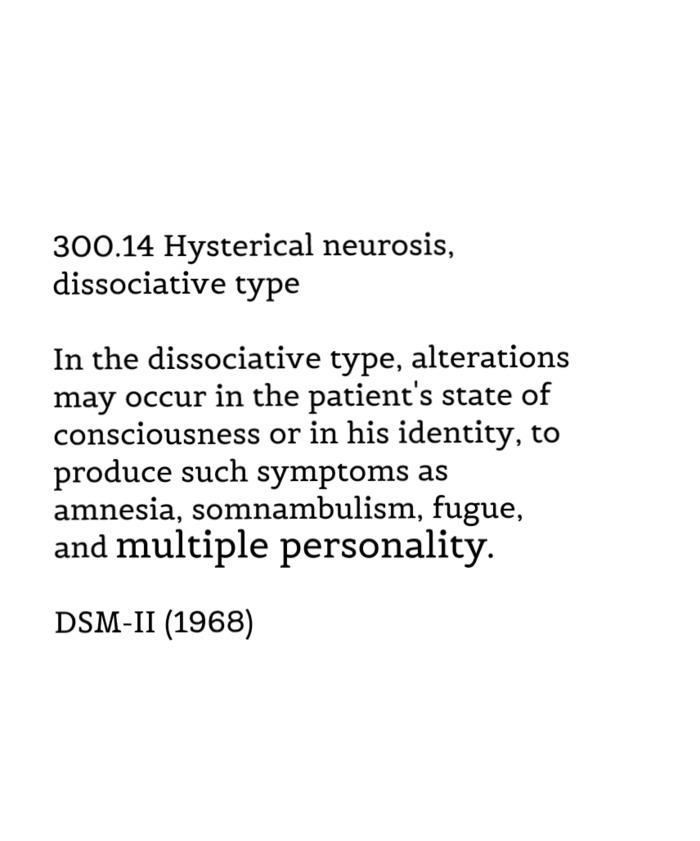
“300.14* Hysterical neurosis, dissociative type*
In the dissociative type, alterations may occur in the patient's state of consciousness or in his identity, to produce such symptoms as amnesia, somnambulism, fugue, and multiple personality.”
― Diagnostic and Statistical Manual of Mental Disorders DSM-II
In the dissociative type, alterations may occur in the patient's state of consciousness or in his identity, to produce such symptoms as amnesia, somnambulism, fugue, and multiple personality.”
― Diagnostic and Statistical Manual of Mental Disorders DSM-II
“I'm here as a person who coped in a way that allowed me to be here today but made me vulnerable to abuse when I was a teenager and young adult...”
― The Sum of My Parts: A Survivor's Story of Dissociative Identity Disorder
― The Sum of My Parts: A Survivor's Story of Dissociative Identity Disorder

“Polyfragmented Dissociative Identity Disorder
A form of DID that often involves over one hundred DID personality states and is likely to be the result of cult abuse or some other form of extreme sadistic abuse that extends over a long period and often involves multiple perpetrators.”
― The Dissociative Identity Disorder Sourcebook
A form of DID that often involves over one hundred DID personality states and is likely to be the result of cult abuse or some other form of extreme sadistic abuse that extends over a long period and often involves multiple perpetrators.”
― The Dissociative Identity Disorder Sourcebook
“Identity Alteration—Objective behavior indicating the assumption of different identities, much more distinct than different roles.”
―
―
“To achieve a diagnostic assessment, it is important to remember that diagnosis does not hinge on the subjects answer to any single question on the SCID-D. A positive response regarding one dissociative symptom often has several possible ramifications, which must be explored through persistence with related questions. Isolated dissociative symptoms may occur in a number of different psychiatric syndromes, both dissociative and nondissociative. An isolated dissociative symptom, such as use of an alternate name or an amnestic episode, is insufficient grounds for diagnosis. To provide evidence sufficient for an accurate diagnosis, the symptom must exist in combination with other symptoms that, as a group, conform to the characteristic pattern of one of the five disorders oudined in the Diagnostic Work Sheets in Appendix 2.”
― Interviewer's Guide to the Structured Clinical Interview for Dsm-IV Dissociative Disorders
― Interviewer's Guide to the Structured Clinical Interview for Dsm-IV Dissociative Disorders
“Severity and the ritual nature of abuse has a significant causative relationship with polyfragmentation in A.D.D. and/or in M.P.D. Ritual, satanic abuse is usually administered by parents and other family cult members, and incest is of necessity involved. Incestuous abuse is not necessarily related to the most severe, polyfragmented forms of MPD; however, ritual abuse, with or without incest, is the most common underlying cause of polyfragmentation for MPD or dissociative disorders NOS.”
― Incest-Related Syndromes of Adult Psychopathology
― Incest-Related Syndromes of Adult Psychopathology

“Incestuous abuse is not necessarily related to the most severe, polyfragmented forms of MPD; however, ritual abuse, with or without incest, is the most common underlying cause of polyfragmentation for MPD [DID] or dissociative disorders NOS.”
― Incest-Related Syndromes of Adult Psychopathology
― Incest-Related Syndromes of Adult Psychopathology

“Experience indicates that the more severe and/or ritualistic the abuse suffered as a child, the more fragmented is the adult patient's personality and thinking. Victims of satanic abuse are likely to exhibit polyfragmented atypical dissociative disorder (ADD) (dissociative disorder NOS) or polyfragmented MPD. Some victims of incest may not exhibit any exaggerated or special dissociative psychopathology.”
― Incest-Related Syndromes of Adult Psychopathology
― Incest-Related Syndromes of Adult Psychopathology
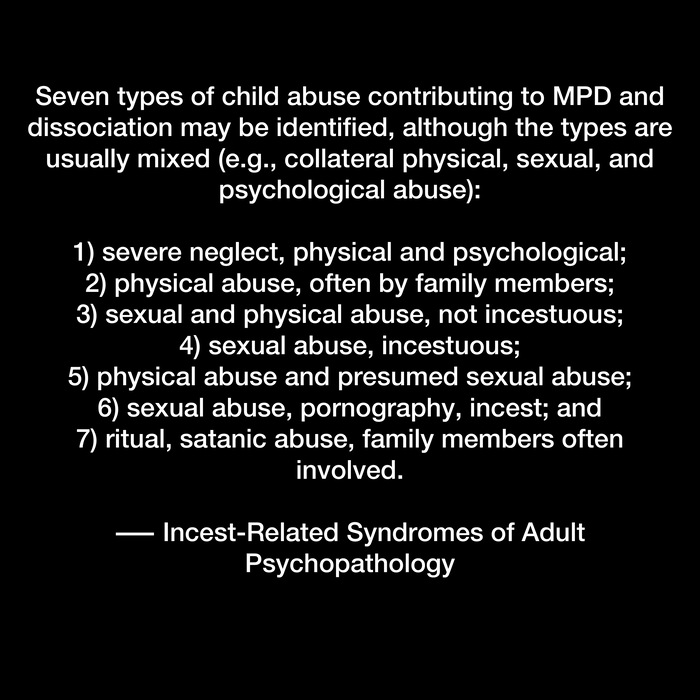
“Seven types of child abuse contributing to MPD and dissociation may be identified, although the types are usually mixed (e.g., collateral physical, sexual, and psychological abuse):
1) severe neglect, physical and psychological;
2) physical abuse, often by family members;
3) sexual and physical abuse, not incestuous;
4) sexual abuse, incestuous;
5) physical abuse and presumed sexual abuse;
6) sexual abuse, pornography, incest; and
7) ritual, satanic abuse, family members often involved.”
― Incest-Related Syndromes of Adult Psychopathology
1) severe neglect, physical and psychological;
2) physical abuse, often by family members;
3) sexual and physical abuse, not incestuous;
4) sexual abuse, incestuous;
5) physical abuse and presumed sexual abuse;
6) sexual abuse, pornography, incest; and
7) ritual, satanic abuse, family members often involved.”
― Incest-Related Syndromes of Adult Psychopathology
“Comparing the hippocampal volume of mentally healthy subjects and patients with PTSD, DDNOS, and DID, thus patients with increasing levels of dissociation, an increasingly smaller volume is observed: PTSD (primary structural dissociation), approximately -10%; DDNOS (secondary structural dissociation), approximately -15%; and DID (tertiary structural dissociation), approximately -20%. These findings are characterized by a remarkable relationship: the more severe the structural dissociation of the personality, the smaller the hippocampal volume. Furthermore, Ehling et al. (2008) found high correlations between the volume of these brain structures and psychoform and somatoform symptoms, as well as with the severity of the reported potentially traumatizing events. Correlations between the volume of these brain structures and the degree of general psychopathology and fantasy-proneness were lower or statistically nonsignificant.”
―
―
“Working within the NHS, we are, as therapists, part of the system that has its own logic and values that can be experienced by the DID patient as not consistent with their own needs, and can be experienced as cold, detached and abusive.”
― Attachment, Trauma and Multiplicity: Working with Dissociative Identity Disorder
― Attachment, Trauma and Multiplicity: Working with Dissociative Identity Disorder
“Severe [dissociative] symptoms are found mainly in people who have a dissociative disorder, but even at its most extreme this illness is not the catastrophic
affliction that it's often made out to be.”
―
affliction that it's often made out to be.”
―

“The individual with DID may refer to himself as ‘we’ and experience internal dialogues with different aspects of himself, each aspect having unique characteristics such as specific age, personality and appearance. These internal dialogues are often described as conversations, arguments, disagreements and discussions ‘going on in my head’.”
― Counselling Adult Survivors of Child Sexual Abuse
― Counselling Adult Survivors of Child Sexual Abuse
All Quotes
|
My Quotes
|
Add A Quote
Browse By Tag
- Love Quotes 102.5k
- Life Quotes 81k
- Inspirational Quotes 77.5k
- Humor Quotes 45.5k
- Philosophy Quotes 32k
- Inspirational Quotes Quotes 29k
- God Quotes 27k
- Wisdom Quotes 25.5k
- Romance Quotes 25k
- Truth Quotes 25k
- Poetry Quotes 24.5k
- Life Lessons Quotes 23k
- Quotes Quotes 21.5k
- Death Quotes 21k
- Happiness Quotes 19k
- Hope Quotes 19k
- Faith Quotes 18.5k
- Inspiration Quotes 18k
- Relationships Quotes 16k
- Spirituality Quotes 16k
- Motivational Quotes 16k
- Religion Quotes 15.5k
- Life Quotes Quotes 15.5k
- Writing Quotes 15k
- Love Quotes Quotes 15k
- Success Quotes 14.5k
- Motivation Quotes 14k
- Time Quotes 13k
- Science Quotes 12.5k
- Motivational Quotes Quotes 12k