Bernie MacKinnon's Blog
September 17, 2017
From Lucifer's Drum: Remembering The Bloodiest Day In U.S. History
In its July 1864 raid into Maryland and eventually against Washington, D.C., Confederate General Jubal A. Early's 14,000-man force paused near Sharpsburg, site of American history's bloodiest one-day battle less than two years earlier. A technical victory for the North, the Battle of Antietam (a.k.a. Sharpsburg) is remembered just as much for Union commander George B. McClellan's squandered opportunities—his failure to exploit the discovery (via the infamous "Lost Order") that Robert E. Lee had split his army in four, and to commit more than a quarter of his available troops in the titanic clash itself. About 4,000 men were killed and nearly 19,000 left wounded, captured or missing. My future wife and I once visited the battlefield. In the late-summer stillness and the brassy luster of late afternoon, it did feel haunted.
On the Union side of my novel Lucifer's Drum, two central characters—federal agents Major Nathaniel Truly and Captain Bartholomew Forbes—remain haunted by Antietam. Truly, an army scout at the time, privately recalls—"Miles to the rear, atop a ridge, he had listened as man-made thunder engulfed the sky. With McClellan’s army smashing into Lee’s, he had imagined a huge black portal on the horizon and soldiers pouring through, rank upon rank. Spilling into the void. At first it had felt like a monotonous dream, nothing more. Then came the sensation—that picking at his spine, something like the dread of battle and yet worse. A dread devoid of hope. Safe behind the lines, he felt not only small but coldly, utterly separate. The guns were God, pummeling him to vapor. They roared extinction."
Forbes is less fortunate, having lost a leg in a skirmish on the great battle's eve. Late in the book, while suffering phantom pains, he recounts it—"The day before, my regiment was with Hooker’s corps on the right. We crossed the creek near Keedysville and blundered into enemy pickets. Their artillery kicked up. The next thing I knew, I’d joined the Brotherhood of the Stump . . . I was taken to a barn set up as a field hospital. That first night, there were just a few other wounded. I was under morphine but the guns still woke me at dawn. By mid-morning the barn was full and they moved me outside. By noon the surrounding acre was covered with wounded and by mid-afternoon they covered the surrounding five. There were pyramids of amputated limbs outside the barn. Twice, the roar of the fighting died down and then erupted farther south. Come evening, it all turned quiet except for the wails and moaning. I was evacuated to Frederick, and that’s where I heard my company had been decimated, my regiment half destroyed.”
On that day—September 17, 1862—the nation crossed and burned a symbolic bridge, ensuring that the war would grind on and yield many more mounds of dead. We can scarcely guess what the reflections of veterans like Early were, finding themselves returned to those former scenes of hell. But in this chapter from my novel, I made the attempt:
HERE, WHERE ARTILLERY had ripped the earth and sky, where barns and haystacks had burned, where battle lines had surged, withered and disintegrated, trailing bodies through the bullet-lashed corn and along the wooden fences—here, where slaughter had reigned, all was peaceful. The day was warm and clear, the corn high and the barns rebuilt. To the west, a Confederate encampment ringed the fair Unionist town of Sharpsburg, its citizens pondering their fate before another invasion. To the east, between steep wooded banks, Antietam Creek looped its way to the Potomac. Early’s musings today were unusual, and he wished that the others had not wandered off so soon. He wanted to ask aloud if human struggle ever amounted to much. Once the smoke cleared and the last cry faded, what really remained except headstones and fever dreams?
He raised his field glasses. Across the undulating green of the landscape, by the Hagerstown Pike, he spied the tiny white church with no steeple. The church had marked the battle’s axis. From behind it, through those same trees, Early had led his brigade to “relieve” Hood’s division, though the latter was mincemeat by then. He recalled the gun roar, drowning the Rebel yell and the Yankee war-whoop; men charging, heads bowed to the tempest, falling like locusts in a fire. September 17th, 1862—nothing before or since had matched it. Not Gettysburg, not the Wilderness or Spotsylvania.

Famous image by Alexander Gardner, showing dead Confederate artillerymen by Dunker Church, near Robert E. Lee's center at Antietam. (Courtesy: Library of Congress)
On a stone bridge over the creek, two boys sat with fishing poles, feet dangling. Scanning along the Boonsboro Pike, Early picked out the solitary figure of Gordon, dismounted now, lost in thoughts of his own. Early lowered the binoculars. Against all his usual feelings toward Gordon, a sense of brotherly connection took hold. On that endless roaring day, the Georgian had defended a stretch of sunken road known thereafter as Bloody Lane. Through one Northern assault after another, the position held fast until Gordon was carried from the field, five times wounded. His men fought on, only to die in rows and mounds amid a final onslaught. Yet their stand had exhausted the enemy and unsettled McClellan, who then failed to exploit the breach.
Early dismounted to stretch his legs. Doing so, he saw Kyd Douglas riding slowly toward him up the gentle slope.
Halting by Early’s horse, the major gave an absent smile and hopped down. “I was just remembering, Genr’l—late that day I found Jackson eating a peach, sitting there with his dead all ‘round him. You know what he said?”
“‘God has been good to us,’” Early quoted. “I heard it from someone.”
“Well, I was thinking too—for all that, God was good to us. Wasn’t He?”

This 1887 print shows the Union assault around Dunker Church. (Courtesy: Library of Congress)
Shy of this Almighty reference, Early looked away. He ran a hand through his beard. “Suppose so, if it was Him working on McClellan. I didn’t truly see it till it was all over, but McClellan could have finished us here. If he’d thrown his reserves in . . . ”
“Or even if he’d renewed the attack next morning,” said Douglas. “But no, he just sat there and let us limp back across the river.”
“Yes, well . . . There’s no substitute for nerve.”
God was as good an explanation as any. It had been good enough for Jackson.
Rubbing his sore hips, Early assumed a hearty air. “Your father was right hospitable. In your next letter to him, pass along my respects.”
Douglas gave an appreciative nod. Though brief, their visit to the nearby home of his widowed father had been pleasant. “He was honored to have you. Since the day I joined up for the South, he’s taken a heap of abuse from Yankee neighbors.”
“It must be an extra trial, coming from a border state,” said Early.
The major’s eyes turned distant. “I was speaking of that with General Breckinridge. It’s worse for him. Seems he’s related to half of Kentucky, folks on both sides of the war. Including Mary Lincoln, did you know? ‘Cousin Mary,’ he calls her.”
Early grunted. “Do tell! Well, we might be calling on Cousin Mary pretty soon. And her husband.”
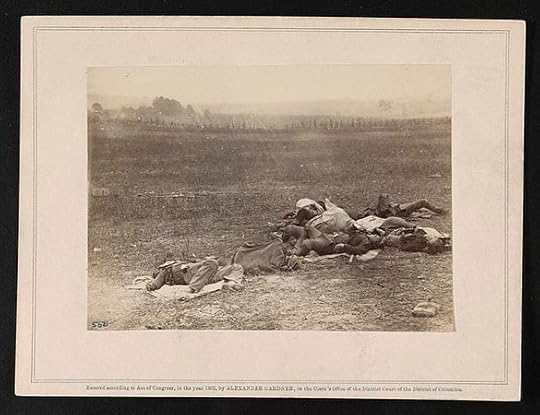
Another Alexander Gardner image, showing dead of the federal Irish Brigade. Taking
60 per cent casualties, the brigade had assaulted the sunken road known as "Bloody
Lane," in the Confederate center. (Courtesy: Library of Congress)
Douglas removed his hat and wiped his brow, then pointed. “There he is now.”
In the distance, Early picked out the mounted, majestic figure of Breckinridge in his dark blue coat, trotting along the road toward Gordon. Gordon remounted as Breckinridge drew up, and the two began speaking. Early sighed wearily. Logistical matters had begun to crowd his head once more. First, though, there was an issue that he could postpone no longer. “I need a word with him, Douglas. You’d best be getting back to Ramseur’s camp.”
The major departed. Early mounted up and descended into the rolling terrain, losing sight of the two generals. When the pike reappeared, there was only Breckinridge riding toward town. Early veered to intercept him. Seeing him, the Kentuckian reined up.
“Gordon was asking about the shoes again,” said Breckinridge.
Early drew alongside. “They should arrive tomorrow.”
“Good. Back at the ford, it was hell for the barefoot ones–all those sharp rocks.”
Early was tired of the shoe predicament. “They’re going without a lot of things. Forage and supplies are scarce, but we’re doing our best. It’s more vital than ever to maintain order.” From Breckinridge’s pained look, it was clear he had guessed where this was leading. Early continued briskly. “It hardly needs saying: we can’t permit a repeat of Martinsburg.”
Breckinridge gave a stoic nod. “No. We cannot.”
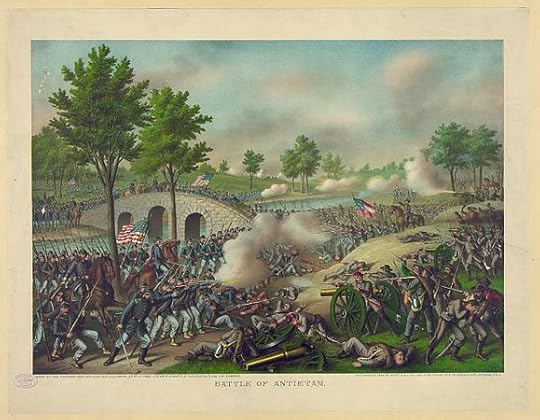
Print from 1887 shows Union troops storming the stone bridge—"Burnside's Bridge"
—on the Confederate right. (Courtesy: Library of Congress)
“Your men’s gladness was understandable. Marching up to the depot and seeing all those Fourth-of-July victuals the enemy left–it must have seemed like paradise.”
“After days of eating parched corn, yes. Still . . . ”
The enemy retreat had been too swift. From Martinsburg, from Harper’s Ferry, across the river to the safety of Maryland Heights—all before a major attack could be pressed. Yankee skittishness had foiled rather than aided Early’s trap. Yet it had proven a boon for Breckinridge’s corps at Martinsburg, where rail cars and warehouses groaned with abandoned delicacies. The resultant orgy of eating, drinking and plunder did not bode well for discipline.
“I’m issuing a general order,” Early said. “Any more marauding and such will be summarily punished.”
“I’ll see that it’s enforced,” said Breckinridge.
The discomfort passed. Once more Early was glad to have Breckinridge at his side. Whatever the glittering titles of his past, he could still listen manfully to criticism.
Early pulled the stopper from his canteen. “That’s not to say we can’t exact retribution. I’ve sent McCausland up to Hagerstown . . . ” He took a swig and offered the canteen to Breckinridge, who took it. “It’s a fair-sized place. He has orders to return with two-hundred thousand dollars, cash or gold or both. If the citizens don’t raise it, the town burns.” As Breckinridge gave back the canteen, Early checked for signs of chivalric disapproval. There was a slight aversion of the eyes, nothing more. “Our primary goal remains one of diversion,” Early said. “Washington has sent no fresh troops our way, so we can conclude that they underestimate our size. But now we want to frighten the bejesus out of them. Our cavalry’s ranging as wide as possible, along with the partisans of Mosby and Gilmoor, striking in small groups wherever they can. In Yankee minds, we’ll go from a minor raiding party to twice our actual strength.”
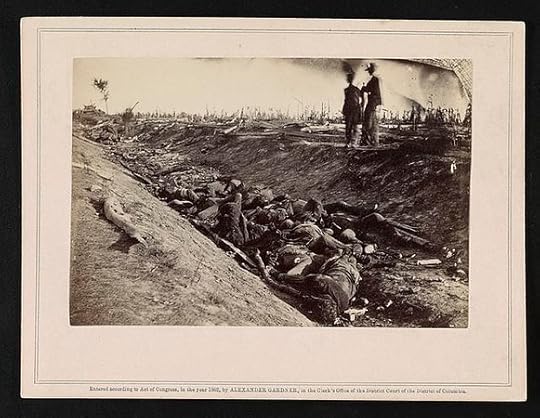
A ditch full of Confederate dead after the Battle of Antietam. (Courtesy: Library of
Congress)
Breckinridge smirked. “Not that we don’t pose a real threat as we are.”
“Yep–quite a raiding party. And at this moment, we represent the northernmost reach of the Confederacy.” He squinted down the pike, then across a wheat field to the creek. Through its curtain of trees, the creek sparkled. “I tell you, we had the devil’s own day here.”
“So I’m told,” said Breckinridge.
Early fiddled with the reins. Against the sky, a long chain of crows straggled eastward. “The way the ground is, you couldn’t see it all from a given spot. You could damn well hear it, though. At dusk we were collecting our casualties and I looked out on the field—up there around the church. It was squirming. I knew it was wounded men out there, dying men, but the whole field was like some crawling, moaning thing. Just acres of . . . "He glanced at Breckinridge. Previously assigned to the western theater, Breckinridge had not been here two years ago but had, no doubt, seen his share of crawling fields. These somber reflections should end now, Early decided. “Is Gordon set to make his demonstration against the Heights?”
“He’s moving within the hour,” said Breckinridge.
Against all of Early’s fighting instincts, he would order no assault against the dug-in foe. Time and speed were paramount. “While Gordon executes his feint, the cavalry will probe the mountain passes north of here. Then we’ll push the whole force through, toward Frederick. We’ll be gone before they know it.”
“Frederick . . . ,” Breckinridge murmured. “Pretty close to Washington.”
“Forty miles or so,” said Early. Further instructions from Lee would soon arrive, as would further word about the traitorous Yankee officer. In a high-flown mood, Early lifted his gaze to the blue distance. The crows were bobbing black flecks. “Not far at all,” he said.
On the Union side of my novel Lucifer's Drum, two central characters—federal agents Major Nathaniel Truly and Captain Bartholomew Forbes—remain haunted by Antietam. Truly, an army scout at the time, privately recalls—"Miles to the rear, atop a ridge, he had listened as man-made thunder engulfed the sky. With McClellan’s army smashing into Lee’s, he had imagined a huge black portal on the horizon and soldiers pouring through, rank upon rank. Spilling into the void. At first it had felt like a monotonous dream, nothing more. Then came the sensation—that picking at his spine, something like the dread of battle and yet worse. A dread devoid of hope. Safe behind the lines, he felt not only small but coldly, utterly separate. The guns were God, pummeling him to vapor. They roared extinction."
Forbes is less fortunate, having lost a leg in a skirmish on the great battle's eve. Late in the book, while suffering phantom pains, he recounts it—"The day before, my regiment was with Hooker’s corps on the right. We crossed the creek near Keedysville and blundered into enemy pickets. Their artillery kicked up. The next thing I knew, I’d joined the Brotherhood of the Stump . . . I was taken to a barn set up as a field hospital. That first night, there were just a few other wounded. I was under morphine but the guns still woke me at dawn. By mid-morning the barn was full and they moved me outside. By noon the surrounding acre was covered with wounded and by mid-afternoon they covered the surrounding five. There were pyramids of amputated limbs outside the barn. Twice, the roar of the fighting died down and then erupted farther south. Come evening, it all turned quiet except for the wails and moaning. I was evacuated to Frederick, and that’s where I heard my company had been decimated, my regiment half destroyed.”
On that day—September 17, 1862—the nation crossed and burned a symbolic bridge, ensuring that the war would grind on and yield many more mounds of dead. We can scarcely guess what the reflections of veterans like Early were, finding themselves returned to those former scenes of hell. But in this chapter from my novel, I made the attempt:
HERE, WHERE ARTILLERY had ripped the earth and sky, where barns and haystacks had burned, where battle lines had surged, withered and disintegrated, trailing bodies through the bullet-lashed corn and along the wooden fences—here, where slaughter had reigned, all was peaceful. The day was warm and clear, the corn high and the barns rebuilt. To the west, a Confederate encampment ringed the fair Unionist town of Sharpsburg, its citizens pondering their fate before another invasion. To the east, between steep wooded banks, Antietam Creek looped its way to the Potomac. Early’s musings today were unusual, and he wished that the others had not wandered off so soon. He wanted to ask aloud if human struggle ever amounted to much. Once the smoke cleared and the last cry faded, what really remained except headstones and fever dreams?
He raised his field glasses. Across the undulating green of the landscape, by the Hagerstown Pike, he spied the tiny white church with no steeple. The church had marked the battle’s axis. From behind it, through those same trees, Early had led his brigade to “relieve” Hood’s division, though the latter was mincemeat by then. He recalled the gun roar, drowning the Rebel yell and the Yankee war-whoop; men charging, heads bowed to the tempest, falling like locusts in a fire. September 17th, 1862—nothing before or since had matched it. Not Gettysburg, not the Wilderness or Spotsylvania.
Famous image by Alexander Gardner, showing dead Confederate artillerymen by Dunker Church, near Robert E. Lee's center at Antietam. (Courtesy: Library of Congress)
On a stone bridge over the creek, two boys sat with fishing poles, feet dangling. Scanning along the Boonsboro Pike, Early picked out the solitary figure of Gordon, dismounted now, lost in thoughts of his own. Early lowered the binoculars. Against all his usual feelings toward Gordon, a sense of brotherly connection took hold. On that endless roaring day, the Georgian had defended a stretch of sunken road known thereafter as Bloody Lane. Through one Northern assault after another, the position held fast until Gordon was carried from the field, five times wounded. His men fought on, only to die in rows and mounds amid a final onslaught. Yet their stand had exhausted the enemy and unsettled McClellan, who then failed to exploit the breach.
Early dismounted to stretch his legs. Doing so, he saw Kyd Douglas riding slowly toward him up the gentle slope.
Halting by Early’s horse, the major gave an absent smile and hopped down. “I was just remembering, Genr’l—late that day I found Jackson eating a peach, sitting there with his dead all ‘round him. You know what he said?”
“‘God has been good to us,’” Early quoted. “I heard it from someone.”
“Well, I was thinking too—for all that, God was good to us. Wasn’t He?”
This 1887 print shows the Union assault around Dunker Church. (Courtesy: Library of Congress)
Shy of this Almighty reference, Early looked away. He ran a hand through his beard. “Suppose so, if it was Him working on McClellan. I didn’t truly see it till it was all over, but McClellan could have finished us here. If he’d thrown his reserves in . . . ”
“Or even if he’d renewed the attack next morning,” said Douglas. “But no, he just sat there and let us limp back across the river.”
“Yes, well . . . There’s no substitute for nerve.”
God was as good an explanation as any. It had been good enough for Jackson.
Rubbing his sore hips, Early assumed a hearty air. “Your father was right hospitable. In your next letter to him, pass along my respects.”
Douglas gave an appreciative nod. Though brief, their visit to the nearby home of his widowed father had been pleasant. “He was honored to have you. Since the day I joined up for the South, he’s taken a heap of abuse from Yankee neighbors.”
“It must be an extra trial, coming from a border state,” said Early.
The major’s eyes turned distant. “I was speaking of that with General Breckinridge. It’s worse for him. Seems he’s related to half of Kentucky, folks on both sides of the war. Including Mary Lincoln, did you know? ‘Cousin Mary,’ he calls her.”
Early grunted. “Do tell! Well, we might be calling on Cousin Mary pretty soon. And her husband.”
Another Alexander Gardner image, showing dead of the federal Irish Brigade. Taking
60 per cent casualties, the brigade had assaulted the sunken road known as "Bloody
Lane," in the Confederate center. (Courtesy: Library of Congress)
Douglas removed his hat and wiped his brow, then pointed. “There he is now.”
In the distance, Early picked out the mounted, majestic figure of Breckinridge in his dark blue coat, trotting along the road toward Gordon. Gordon remounted as Breckinridge drew up, and the two began speaking. Early sighed wearily. Logistical matters had begun to crowd his head once more. First, though, there was an issue that he could postpone no longer. “I need a word with him, Douglas. You’d best be getting back to Ramseur’s camp.”
The major departed. Early mounted up and descended into the rolling terrain, losing sight of the two generals. When the pike reappeared, there was only Breckinridge riding toward town. Early veered to intercept him. Seeing him, the Kentuckian reined up.
“Gordon was asking about the shoes again,” said Breckinridge.
Early drew alongside. “They should arrive tomorrow.”
“Good. Back at the ford, it was hell for the barefoot ones–all those sharp rocks.”
Early was tired of the shoe predicament. “They’re going without a lot of things. Forage and supplies are scarce, but we’re doing our best. It’s more vital than ever to maintain order.” From Breckinridge’s pained look, it was clear he had guessed where this was leading. Early continued briskly. “It hardly needs saying: we can’t permit a repeat of Martinsburg.”
Breckinridge gave a stoic nod. “No. We cannot.”
Print from 1887 shows Union troops storming the stone bridge—"Burnside's Bridge"
—on the Confederate right. (Courtesy: Library of Congress)
“Your men’s gladness was understandable. Marching up to the depot and seeing all those Fourth-of-July victuals the enemy left–it must have seemed like paradise.”
“After days of eating parched corn, yes. Still . . . ”
The enemy retreat had been too swift. From Martinsburg, from Harper’s Ferry, across the river to the safety of Maryland Heights—all before a major attack could be pressed. Yankee skittishness had foiled rather than aided Early’s trap. Yet it had proven a boon for Breckinridge’s corps at Martinsburg, where rail cars and warehouses groaned with abandoned delicacies. The resultant orgy of eating, drinking and plunder did not bode well for discipline.
“I’m issuing a general order,” Early said. “Any more marauding and such will be summarily punished.”
“I’ll see that it’s enforced,” said Breckinridge.
The discomfort passed. Once more Early was glad to have Breckinridge at his side. Whatever the glittering titles of his past, he could still listen manfully to criticism.
Early pulled the stopper from his canteen. “That’s not to say we can’t exact retribution. I’ve sent McCausland up to Hagerstown . . . ” He took a swig and offered the canteen to Breckinridge, who took it. “It’s a fair-sized place. He has orders to return with two-hundred thousand dollars, cash or gold or both. If the citizens don’t raise it, the town burns.” As Breckinridge gave back the canteen, Early checked for signs of chivalric disapproval. There was a slight aversion of the eyes, nothing more. “Our primary goal remains one of diversion,” Early said. “Washington has sent no fresh troops our way, so we can conclude that they underestimate our size. But now we want to frighten the bejesus out of them. Our cavalry’s ranging as wide as possible, along with the partisans of Mosby and Gilmoor, striking in small groups wherever they can. In Yankee minds, we’ll go from a minor raiding party to twice our actual strength.”
A ditch full of Confederate dead after the Battle of Antietam. (Courtesy: Library of
Congress)
Breckinridge smirked. “Not that we don’t pose a real threat as we are.”
“Yep–quite a raiding party. And at this moment, we represent the northernmost reach of the Confederacy.” He squinted down the pike, then across a wheat field to the creek. Through its curtain of trees, the creek sparkled. “I tell you, we had the devil’s own day here.”
“So I’m told,” said Breckinridge.
Early fiddled with the reins. Against the sky, a long chain of crows straggled eastward. “The way the ground is, you couldn’t see it all from a given spot. You could damn well hear it, though. At dusk we were collecting our casualties and I looked out on the field—up there around the church. It was squirming. I knew it was wounded men out there, dying men, but the whole field was like some crawling, moaning thing. Just acres of . . . "He glanced at Breckinridge. Previously assigned to the western theater, Breckinridge had not been here two years ago but had, no doubt, seen his share of crawling fields. These somber reflections should end now, Early decided. “Is Gordon set to make his demonstration against the Heights?”
“He’s moving within the hour,” said Breckinridge.
Against all of Early’s fighting instincts, he would order no assault against the dug-in foe. Time and speed were paramount. “While Gordon executes his feint, the cavalry will probe the mountain passes north of here. Then we’ll push the whole force through, toward Frederick. We’ll be gone before they know it.”
“Frederick . . . ,” Breckinridge murmured. “Pretty close to Washington.”
“Forty miles or so,” said Early. Further instructions from Lee would soon arrive, as would further word about the traitorous Yankee officer. In a high-flown mood, Early lifted his gaze to the blue distance. The crows were bobbing black flecks. “Not far at all,” he said.


July 9, 2017
From Lucifer's Drum: The Battle Of Monocacy
On this day in 1864, at the Monocacy River near Frederick, MD, a Union force under Major General Lewis "Lew" Wallace faced a considerably larger Confederate force under Lieutenant General Jubal Early. Though defeated, the federals succeeded in delaying Early's drive toward Washington, D.C.—the historical centerpiece of my novel Lucifer's Drum—for a precious twenty-four hours.
The Indiana-born Wallace led a busy and distinguished life. From small-town lawyer and Republican operative, he rose to major general in the Civil War—the Union's youngest, at the time—after which he served as governor of New Mexico Territory and then as U.S. minister to the Ottoman Empire. A writer of historical fiction, he gained lasting fame with the 1880 publication of Ben Hur, which surpassed even Uncle Tom's Cabin in sales and became the best-selling American novel of the 19th Century.
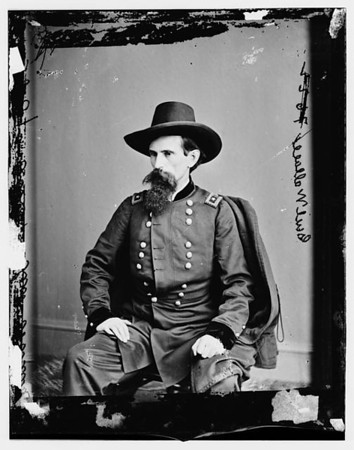
Major General Lew Wallace, USA (1827-1905). (Courtesy:
Library Of Congress)
His role in the war was more checkered, however. After Ulysses S. Grant's close call at the Battle of Shiloh, he charged Wallace with tardiness in moving his reserves forward. (Many years later, writing his memoirs and near death from cancer, Grant would be presented with new evidence from the battle and publicly retract his complaint.) Over the next two years, Wallace found himself exiled to a series of quiet sectors far behind the front lines. Though restored to active duty in March 1864, he was again given a relatively sedate appointment, commanding the VIII Corps at Baltimore. But it was in this capacity that he performed his greatest service to the nation, when Early's invasion of Maryland yanked him out of the doldrums.
Wallace never lacked for initiative. Not waiting for orders from the unaccountably listless War Department, he sped to meet Early's 14,000 rebels at the riverside rail hub of Monocacy Junction. With most of his corps sent to the epic bloodbath in eastern Virginia, he commanded a force less than 6,000 strong, comprised of green "hundred-day" volunteers but also—crucially—two brigades from the battle-hardened VI Corps, under Brigadier General James Ricketts. (Grant had sent them, spurred by the news of Harper's Ferry and Martinsburg being captured.) There was also a small Illinois cavalry detachment under Lieutenant Colonel David Clendenin.
In this gaping hour, these were the only defenders between Early and Washington City. Wallace apprised Army Chief of Staff General Henry Halleck of Early's apparent intentions, and Halleck wired Grant to rush reinforcements to the weakly garrisoned capital. For these to arrive in time, Wallace and his men would have to put up the fight of their lives—which they did on that hot Saturday, for nine blistering hours. Ricketts' left wing bore most of the fighting and eventually collapsed beneath the Confederate onslaught. In the Union center and on the right, having fiercely defended two vital bridgeheads, less experienced units at last had to race back across the river as the attackers bore down. In nearby Frederick, meanwhile, Early secured a $200,000 "levy"—a ransom from civic leaders, against the town being torched.
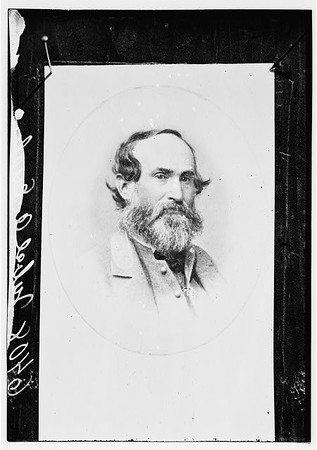
Lieutenant General Jubal Early, CSA (1816-1894).
(Courtesy: Library of Congress)
Wallace's troops began a limping retreat toward Baltimore, leaving hundreds of dead across the rolling farmland. But they had cost Early a full day's march. On July 11, Early's straggling, sun-beaten raiders reached the capital's fortified perimeter and started probing it. He did not launch his main assault until the next day, at Fort Stevens—and ran up against the rest of Major General Horatio Wright's VI Corps, which had in fact arrived just in time. Early withdrew his force the day after, headed back to the Shenandoah Valley. Union elements pursued but did not catch him.
Margaret Leech wrote in her classic Reveille In Washington, "It was only in contemplation of what might have been that Wallace's stand on the Monocacy assumed the proportions of a deliverance . . . Washington shuddered at a narrow escape." Upon hearing of Wallace's defeat, Grant replaced him as corps commander but soon reinstated him, when his role in saving the capital became clear. In his memoirs, Grant would write, "If Early had been but one day earlier, he might have entered the capital before the arrival of the reinforcements I had sent . . . General Wallace contributed on this occasion by the defeat of the troops under him, a greater benefit to the cause than often falls to the lot of a commander of an equal force to render by means of a victory."
Lucifer's Drum depicts Lew Wallace as a friendly acquaintance of my central character, federal agent Nathaniel Truly, with whom he shares a passion for literature. But it depicts the Monocacy battle from the perspective of Jubal Early. Here it is:
MONOCACY RIVER, MARYLAND, JULY 9
From the town of Frederick, Early’s party rode southeastward along the Washington Pike. Ahead of them, the artillery duel grew louder, resounding over the lush summer farmland. One river bend and then another appeared, intermittently brilliant beneath the high sun, while drifting white smoke marked the battle front. Early turned off the macadam surface, entered a pasture and slowed to a halt, digging for his field glasses. The others reined up around him.
“That’s a mighty strong position,” Sandie Pendleton observed.
At first, Early did not entirely grasp it as he peered at the enemy center. Ramseur’s men had swept through Frederick a few hours ago and were now pushing across wheatfields along the railroad spur. Before them, offering desultory fire, Yankee skirmishers fell back toward the sluggish Monocacy. On the river’s near bank, a tight bluecoat formation guarded a railroad bridge where the spur and the main B & O line merged, continuing eastward. A stone’s throw to the right, a similar formation shielded a covered bridge that served the pike. A fortified blockhouse stood between the bridges, anchoring the whole position like a spike-head while, on the far bank, other Yankee elements waited to frustrate any crossing.
From the north, a clatter of small arms told him that Rodes had deployed, pressing the enemy right wing astride the Baltimore Pike. But the main assault would have to be against the left, to secure the route to Washington. Scanning that way, Early saw that the Union commander had anticipated well, placing the bulk of his infantry along hilly ground east of the river.
Early handed Pendleton the glasses. “Your eyes are younger. Tell me if you see any sign of reserves back there.”
The adjutant gazed for half a minute. “None, Genr’l. Not in large numbers. I’d estimate their total strength at seven, maybe eight thousand.”
“That sounds right to me.” Taking the glasses back, Early gestured south. “If we can get a division or more across, then extend our right and mount a strong attack, they’ll have to change fronts in order to face it. At which point we can exploit any confusion and roll ‘em up.”
Two other staff officers had dismounted and gotten out the map, each holding a side of it. One traced the Monocacy with his finger. “Don’t see any fords or bridges that way, sir. None that’s close enough, according to this.”
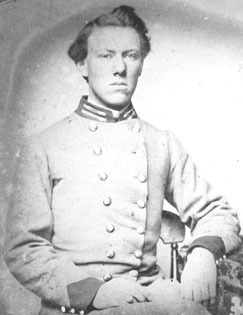
Lieutenant Colonel Alexander "Sandie"
Pendleton, CSA, (1840-1864), aide to
Early, said to have been the finest staff
officer on either side. (Courtesy: Library
of Congress)
“There must be one, damn it! We need scouts. Anyone know if McCausland’s back yet?”
“Barring any real troubles, he ought to be,” said Pendleton.
Early scowled. Too often, with McCausland, “ought to be” fell shy of “is.” The cavalryman’s assignment had been simple enough: cut telegraph wires, rip up more of the B & O and then return as fast as possible. “We’ll have to do our own scouting, then. Let’s get at it.”
The party rode on, turning down a divergent road. The road and tracks ran parallel to the river until, separately, they bridged a curling creek. On the creek’s near side, Breckinridge’s corps lay in wait. Early signaled a halt. From a grassy rise across the river, a Yankee battery let loose and frightened the horses. Early nearly dropped the glasses as he steadied his mount, wondering if they were out of range.
“Genr’l–look yonder!” Pendleton pointed.
From the west, along the creek’s far side, Early saw a cloud of dust and then flapping guidons, followed by a large body of horsemen: McCausland’s battalion. They crossed the road and then the tracks, headed straight for the Monocacy. Through the glasses, Early watched as three lead riders—tawny men in buckskin, probably Cherokee—reached the creek’s point of confluence and dismounted, then waded into the mud-brown river. The water came up only to their waists. Holding their carbines high, two of the scouts kept on while the remaining one motioned for the rest to follow. Rider after rider dismounted, plunged in and started wading toward the opposite bank.
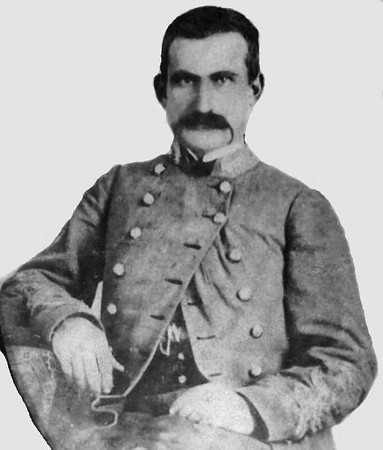
Brigadier General "Tiger" John McCausland, CSA (1836-1927).
An object of Early's repeated scorn, he performed magnificently
at Monocacy. (Courtesy: Library of Congress)
“God-a-mighty!” cried Early. “He’s gone and done something right!” Checking the Yankee gun, he saw its crew manhandling it to a new position while some infantry moved up, lying on their stomachs or crouching. Again Early peered downriver. McCausland was holding back about a third of his brigade to tend the riderless horses. The rest of his men continued to pour across, vanishing into foliage along the Monocacy’s east bank. Not far beyond it, they began to reappear in a gently sloping cornfield. With sabers, carbines and pistols drawn, the wet troopers were forming a battle line. Near their right, an enemy shell sent up a spout of earth.
“Foot charge,” Early muttered.
Another shell struck in front of McCausland’s line, but with no sign of faltering it started through the corn. Onward it pushed, quick and then double-quick, headed for the battery atop the grassy rise. An enemy fusillade crackled. Several gray-clad bodies fell but the rest surged on, their order commendable as a shell sailed over their heads and exploded uselessly. Thinking of McCausland, Early granted himself some credit. Since Lynchburg he had made his disapproval of the cavalry chief well known, thereby holding him to a stern standard. Surely it had helped drive McCausland to this startling deed of valor, rash though it was. And at least a suitable ford had been located. Early passed the glasses to Pendleton. From his saddlebag he took a pencil, a book and a piece of writing paper. The book was a signed gift from Jackson, a collection of religious essays which Early had never even glanced at; its cover provided a writing surface.
“Pendleton—Gordon’s division is closest down there, correct?”
“Yes, Genr’l . . . My God, they’re going to take the battery!”
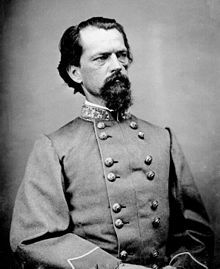
Major General John Brown Gordon,
CSA (1832-1904). One of the war's
greatest field commanders, he
survived five wounds at Antietam.
(Courtesy: National Archives and
Records Administration)
Early looked up. Even without the glasses, he could see that the Yankee gun crew had fled. The supporting infantry began to waver, their volleys degenerating to random pops as McCausland’s men broke out of the cornfield, closing the last fifty yards. The bluecoats retreated. The gray troopers swarmed over the rise, a few stopping to turn the gun on the enemy.
“Bully for them!” cried one officer.
Pendleton shook his head. “They can’t hold it. Without support, they’ll be driven back.”
Even as the adjutant said this, a solid line of blue materialized along a ridge farther on. The retreating Yankees halted, rallying as the new line swept down from the ridge. Before the counterattack, the Confederates finally stalled, spitting fire as they lurched back toward the captured gun. The gun’s would-be crew gave up trying to fire it and rejoined the fight.
“McCausland will get his support,” Early declared. He finished writing his dispatch and handed it to a lieutenant. “To Gordon—fast. And ask Breckinridge to join us, if he’s ready.”
The lieutenant galloped down the road.
Early jotted a second note, this one ordering up a couple of General Long’s batteries. A second junior staffer took it and rode off. Now there was little to do but wait and watch. Dismounting, Early unbuttoned his tunic, and most of the others followed suit. Pendleton stayed mounted, gazing across the river as McCausland’s men fought on, disputing every blade of grass. With its flanks threatened and men dropping, the battalion fell back to the rise in fair order.
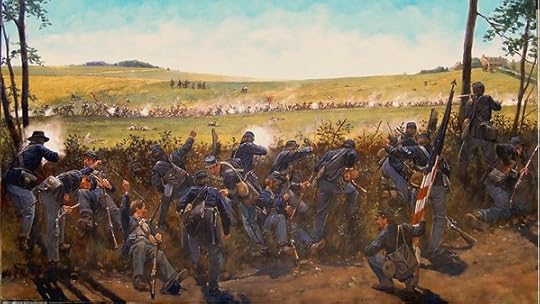
In this painting by Keith Rocco, Ricketts' troops try to stop Gordon's advance at the
Battle of Monocacy. (Courtesy: National Park Service)
Down by the creek, dust stirred as Gordon’s division lumbered forth, leaving gear strewn and tents unstruck. Within minutes, platoons and whole companies were splashing across the ford, rifles held aloft, men wading waist-deep to the east bank and pawing their way up.
“Gordon always gets ‘em moving,” said Pendleton.
Early gave his adjutant a glance. On the noble, long-chinned face, a smile had surfaced—an admiring smile for Gordon. Everyone seemed to admire the fierce son of Georgia. Raising the glasses, Early grunted—"That’s only what’s expected of him.” Down by the ford, the red-shirted Gordon was easy to spot atop his black charger, urging his men across. He did look fine.
Tending the horses on the west bank, McCausland’s remaining men could only watch while, on the east side, their hard-pressed comrades fought to buffer Gordon’s movement. Nevertheless the infantry too drew fire as it fanned out and deployed in echelon. By the railroad, one of Long’s Napoleons unlimbered and commenced shelling, while another was rolled with some difficulty across the ford.
Swift and efficient though the crossing had been, time slowed as Gordon’s still-forming division began sidling to the right. The sun grew hotter. Early paced, stroking his beard and chewing his tobacco. Looking at his pocket watch—one o’clock already—he wondered how things were progressing back in Frederick. There, under the eyes of a Confederate officers’ delegation, town fathers were scrambling to raise two hundred-thousand dollars from the citizenry. Early hoped the effort would succeed. Torching the town would cause more delay, given that so many of its homes were of brick. And a wagon full of Yankee gold would please Richmond.
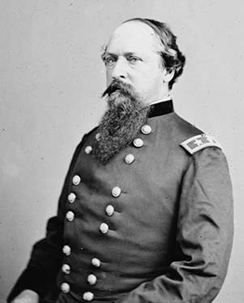
Brigadier General James Ricketts, USA
(1817-1887), whose two brigades bore
the brunt of the Confederate attack at
Monocacy. (Courtesy: Library of Congress)
At the rail junction upriver, the cannonade and rifle clash had intensified. Scanning that way, Pendleton rose in his stirrups. “Genr’l, they’ve fired the bridge. The blockhouse too.”
Early seized the glasses and observed twin columns of black smoke rolling skyward, flames leaping from the blockhouse and the covered bridge. Under steady fire, Ramseur’s men moved in. The federal center had withdrawn across the Monocacy, though it still held the iron railroad bridge. “Fine,” said Early. “Billy Yank is good and nervous.”
He swung his gaze back to Gordon’s division, still maneuvering slowly to the south, its extreme right having vanished beyond some woods. The Union line had moved forward in that sector, thinning as it strained to meet the threat. Mounted officers cantered back and forth, gesticulating. Sweeping the higher ground, Early realized the full difficulty of the command he had given. A network of wooden rail fences traversed the sloping fields; studding the fields were stacks of harvested grain, like orderly brown hillocks. When the Yankees inevitably pulled back, these would obstruct attack while supplying good defensive cover.
The two couriers returned, soon followed by Breckinridge and his staff. The Kentuckian announced that his other divisional chief, John Echols, was preparing to lend any needed support. He had no sooner said this when an eruption of shell and musketry heralded Gordon’s assault. Mounting for a better view, Early saw a thin curtain of skirmishers appear from the trees. Massed infantry followed—so dense, for an instant, that it looked like a surge of gray lava. Fire flashed from the Union line. The oncoming brigades slowed but did not pause, pouring out and expanding in a great wave—rifles bristling, blades gleaming, flags like ship-masts in the smoke. The roar of guns stoked the general thunder, a pummeling monotony that devoured the minutes.
Two hours later, with the entire Union left collapsing, Early rode with Breckinridge and the others toward the rail junction. They had drawn alongside the tracks when Early dug his spurs in and broke ahead. In the smoke and flash from across the river, he caught jarred glimpses of the enemy in reeling retreat. His back felt nothing. Like a dream of youth, his whole body sang and he heard himself cackle. “Go it!” he yelled. “Go it, Gordon!” The breeze having shifted, black smoke traveled down from the blockhouse and the covered bridge and began to obscure his vision. The din of war enveloped him: the cataract of rifles, the whistle of minie-balls, the yells and screams, the shell shriek and cannon thunder. And through and above it all, floating, that Rebel cry—shrill as falcons, ice to the spine, the sound of one nightmare engulfing another. Tossing his head back, Early crowed.
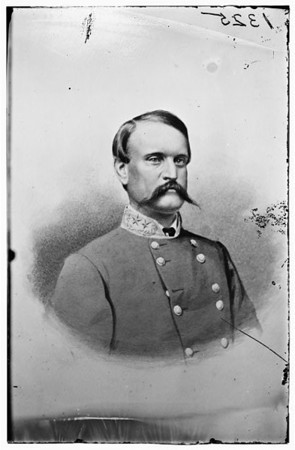
Major General John Cabell Breckinridge, CSA
(1821-1875). Early's second-in-command on
the drive toward Washington, D.C., he had
served as U.S. congressman, senator and
vice-president. (Courtesy: Library of Congress)
He emerged coughing from the smoke. Slowing his horse, he saw federals flying back across the eastward rail line, Confederates scrambling over the last fences in pursuit. Up at the junction, Yankee artillery had gone silent. Early stopped and got out his binoculars. He watched Ramseur’s men pour across the river shallows and the iron bridge, the enemy center crumbling. Early’s staff clustered around him, all nods and smiles. At the head of Ramseur’s skirmish line he spied a familiar tan horse, its rider waving his hat in celebration. Kyd Douglas had evidently joined the final assault, spurning his duties as Frederick’s provost marshal. Three thoughts struck Early at once: he could court-martial Douglas; he would not court-martial him; he would have liked having a son like him—brave, capable, insufficiently solemn.
“Lord above, Gordon’s a wonderment!” someone exclaimed.
Pulled from his reverie, Early cleared his throat and turned to Pendleton. “Head back to Frederick. Find out about the levy. If they’re still stalling, prepare to fire the town.”
“I don’t think they’ll need convincing now,” said Pendleton, heading off.
Soon afterward, Early was riding among Gordon’s sweaty, powder-blackened infantry as they gathered prisoners. Some stopped to jeer Echols’ men as they streamed tardily past. To the north, stuttering rifle fire persisted. Corpses littered the fields and hillsides and dangled from fences, with carrion birds circling above. Along the riverbank, commandeered boats ferried wounded to the Frederick side, where they were loaded into ambulance wagons.
(Below: a trailer link for the 2006 docu-drama "No Retreat From Destiny: The Battle That Rescued Washington," from Lionheart Filmworks.) https://www.youtube.com/watch?v=zWRpT...
Early’s staff had dispersed for the moment. In the middle distance, Gordon sat atop his charger, looking more grim than triumphant. Breckinridge rode up to him, hand extended in congratulation. Closer by, Early recognized one of Gordon’s aides, a gangly major who was supervising the collection of dead. At Early’s approach, the major gave a dazed salute.
“What can you tell me about your losses?” Early demanded.
The major looked side to side. “I’d reckon about a third of the division, sir.”
Early gazed down the row of outstretched bodies, some already bloating in the heat—limbs stiff and clothes disheveled, some with eyes wide to the afternoon sun, mouths open as if they had died in conversation. Even the bearded ones looked no older than twenty.
“Make sure to collect weapons and cartridges,” said Early. “Shoes, too.”
Squinting up, the major seemed to sway a bit. “Yessir, Genr’l.”
Early watched a cartload of captured flags and rifles roll by. Hanging over the side, a white-and-blue guidon caught his eye. “Hold up there!” he called. The teamster yanked the reins. Leaning down from his horse, Early grabbed the little flag by its swallowtail and examined it. It displayed the Greek Cross. Waving the teamster on, he watched a line of guarded prisoners stumble by, some of them daring an upward glance at their conqueror. He eyed the badges on their caps—again, the Greek Cross. A set of hoofbeats distracted him, and he turned to see Breckinridge cantering up.
(Below: a link for a video on the Battles of Monocacy and Fort Stevens, with historian Marc Leepson.)https://www.youtube.com/watch?v=OFQVp...
“Where’s Gordon?” Early asked.
“Gone back to town,” said Breckinridge. “To personally check on medical supplies. His brother’s badly wounded and so’s his senior brigadier.”
“I see.” Early pointed to the prisoners filing past. “Look at those insignias.”
Breckinridge looked, narrowing his eyes. “The Sixth Corps!”
“Part of it, anyhow,” said Early. “Last seen at Petersburg.”
The Kentuckian smiled. “Then Grant’s pulling troops from the main front.”
Yes, Early thought—and that was good for Lee. Yet it conflicted with what had become Early’s most fearsome hope, his blazing vision of what lay ahead. “If Grant sees the full threat we pose, he’ll be sending the rest of the Sixth. More, possibly. I’d wager they’ll be in Washington mighty soon, if not already. And we can’t afford a bloody repulse.”
Breckinridge mulled it over. “Once we’re there, we can determine enemy strength. If it’s too much, we can withdraw—but we won’t know till then. We’ve just over thirty miles left to go. This fight cost us a day’s march, but the race may still be won.”
However quiet and cryptic Breckinridge had been on the subject of Washington, he seemed game about it now. Boldness was catching. “Very good, then,” said Early, heartened. “And lest we forget, a hidden advantage awaits us.” In his side-vision, soldiers dragged more battered corpses into line. He turned his gaze to the pike, following it till it vanished in the low distant hills. “At dawn, your troops will lead the column out. Drive them hard, Breck. By tomorrow night, we need to be on Washington’s doorstep.”
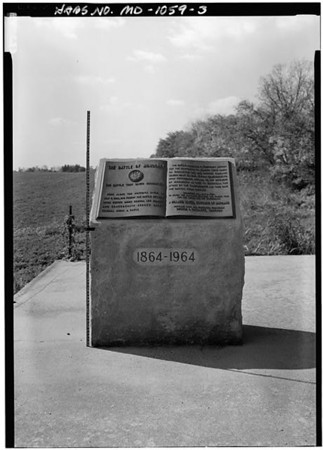
Monument to the Battle of Monocacy, dedicated
on its 1964 centennial. (Courtesy: Library of Congress)
“Then we shall be,” said Breckinridge.
They spent a minute discussing Bradley Johnson’s expedition. Johnson’s eight hundred horsemen had left at sunup, aiming for the Baltimore vicinity and thence down the cape to Point Lookout, where thousands of Southern captives needed liberating. On their way, the troopers would spread more panic and destruction.
Pendleton arrived at a gallop, announcing that Frederick would not have to burn; its leading citizens had agreed to scrounge up the two hundred-thousand in bank loans. Apart from that, the town’s supply depot abounded with clothes, blankets, foodstuffs, medicine and horse livery. Best of all, someone’s cellar had yielded a cache of that rarest delicacy, ice cream, packed in ice and woodchips. “If we head back now, we can get ourselves a heap of it!” cried Pendleton.
Breckinridge chuckled. “A good day for the South, all-round.”
Early grunted agreement. Riding off, he cast another glance toward Washington. The way was open. Everything now depended upon speed—speed and, quite possibly, a single Yankee traitor.
The Indiana-born Wallace led a busy and distinguished life. From small-town lawyer and Republican operative, he rose to major general in the Civil War—the Union's youngest, at the time—after which he served as governor of New Mexico Territory and then as U.S. minister to the Ottoman Empire. A writer of historical fiction, he gained lasting fame with the 1880 publication of Ben Hur, which surpassed even Uncle Tom's Cabin in sales and became the best-selling American novel of the 19th Century.
Major General Lew Wallace, USA (1827-1905). (Courtesy:
Library Of Congress)
His role in the war was more checkered, however. After Ulysses S. Grant's close call at the Battle of Shiloh, he charged Wallace with tardiness in moving his reserves forward. (Many years later, writing his memoirs and near death from cancer, Grant would be presented with new evidence from the battle and publicly retract his complaint.) Over the next two years, Wallace found himself exiled to a series of quiet sectors far behind the front lines. Though restored to active duty in March 1864, he was again given a relatively sedate appointment, commanding the VIII Corps at Baltimore. But it was in this capacity that he performed his greatest service to the nation, when Early's invasion of Maryland yanked him out of the doldrums.
Wallace never lacked for initiative. Not waiting for orders from the unaccountably listless War Department, he sped to meet Early's 14,000 rebels at the riverside rail hub of Monocacy Junction. With most of his corps sent to the epic bloodbath in eastern Virginia, he commanded a force less than 6,000 strong, comprised of green "hundred-day" volunteers but also—crucially—two brigades from the battle-hardened VI Corps, under Brigadier General James Ricketts. (Grant had sent them, spurred by the news of Harper's Ferry and Martinsburg being captured.) There was also a small Illinois cavalry detachment under Lieutenant Colonel David Clendenin.
In this gaping hour, these were the only defenders between Early and Washington City. Wallace apprised Army Chief of Staff General Henry Halleck of Early's apparent intentions, and Halleck wired Grant to rush reinforcements to the weakly garrisoned capital. For these to arrive in time, Wallace and his men would have to put up the fight of their lives—which they did on that hot Saturday, for nine blistering hours. Ricketts' left wing bore most of the fighting and eventually collapsed beneath the Confederate onslaught. In the Union center and on the right, having fiercely defended two vital bridgeheads, less experienced units at last had to race back across the river as the attackers bore down. In nearby Frederick, meanwhile, Early secured a $200,000 "levy"—a ransom from civic leaders, against the town being torched.
Lieutenant General Jubal Early, CSA (1816-1894).
(Courtesy: Library of Congress)
Wallace's troops began a limping retreat toward Baltimore, leaving hundreds of dead across the rolling farmland. But they had cost Early a full day's march. On July 11, Early's straggling, sun-beaten raiders reached the capital's fortified perimeter and started probing it. He did not launch his main assault until the next day, at Fort Stevens—and ran up against the rest of Major General Horatio Wright's VI Corps, which had in fact arrived just in time. Early withdrew his force the day after, headed back to the Shenandoah Valley. Union elements pursued but did not catch him.
Margaret Leech wrote in her classic Reveille In Washington, "It was only in contemplation of what might have been that Wallace's stand on the Monocacy assumed the proportions of a deliverance . . . Washington shuddered at a narrow escape." Upon hearing of Wallace's defeat, Grant replaced him as corps commander but soon reinstated him, when his role in saving the capital became clear. In his memoirs, Grant would write, "If Early had been but one day earlier, he might have entered the capital before the arrival of the reinforcements I had sent . . . General Wallace contributed on this occasion by the defeat of the troops under him, a greater benefit to the cause than often falls to the lot of a commander of an equal force to render by means of a victory."
Lucifer's Drum depicts Lew Wallace as a friendly acquaintance of my central character, federal agent Nathaniel Truly, with whom he shares a passion for literature. But it depicts the Monocacy battle from the perspective of Jubal Early. Here it is:
MONOCACY RIVER, MARYLAND, JULY 9
From the town of Frederick, Early’s party rode southeastward along the Washington Pike. Ahead of them, the artillery duel grew louder, resounding over the lush summer farmland. One river bend and then another appeared, intermittently brilliant beneath the high sun, while drifting white smoke marked the battle front. Early turned off the macadam surface, entered a pasture and slowed to a halt, digging for his field glasses. The others reined up around him.
“That’s a mighty strong position,” Sandie Pendleton observed.
At first, Early did not entirely grasp it as he peered at the enemy center. Ramseur’s men had swept through Frederick a few hours ago and were now pushing across wheatfields along the railroad spur. Before them, offering desultory fire, Yankee skirmishers fell back toward the sluggish Monocacy. On the river’s near bank, a tight bluecoat formation guarded a railroad bridge where the spur and the main B & O line merged, continuing eastward. A stone’s throw to the right, a similar formation shielded a covered bridge that served the pike. A fortified blockhouse stood between the bridges, anchoring the whole position like a spike-head while, on the far bank, other Yankee elements waited to frustrate any crossing.
From the north, a clatter of small arms told him that Rodes had deployed, pressing the enemy right wing astride the Baltimore Pike. But the main assault would have to be against the left, to secure the route to Washington. Scanning that way, Early saw that the Union commander had anticipated well, placing the bulk of his infantry along hilly ground east of the river.
Early handed Pendleton the glasses. “Your eyes are younger. Tell me if you see any sign of reserves back there.”
The adjutant gazed for half a minute. “None, Genr’l. Not in large numbers. I’d estimate their total strength at seven, maybe eight thousand.”
“That sounds right to me.” Taking the glasses back, Early gestured south. “If we can get a division or more across, then extend our right and mount a strong attack, they’ll have to change fronts in order to face it. At which point we can exploit any confusion and roll ‘em up.”
Two other staff officers had dismounted and gotten out the map, each holding a side of it. One traced the Monocacy with his finger. “Don’t see any fords or bridges that way, sir. None that’s close enough, according to this.”
Lieutenant Colonel Alexander "Sandie"
Pendleton, CSA, (1840-1864), aide to
Early, said to have been the finest staff
officer on either side. (Courtesy: Library
of Congress)
“There must be one, damn it! We need scouts. Anyone know if McCausland’s back yet?”
“Barring any real troubles, he ought to be,” said Pendleton.
Early scowled. Too often, with McCausland, “ought to be” fell shy of “is.” The cavalryman’s assignment had been simple enough: cut telegraph wires, rip up more of the B & O and then return as fast as possible. “We’ll have to do our own scouting, then. Let’s get at it.”
The party rode on, turning down a divergent road. The road and tracks ran parallel to the river until, separately, they bridged a curling creek. On the creek’s near side, Breckinridge’s corps lay in wait. Early signaled a halt. From a grassy rise across the river, a Yankee battery let loose and frightened the horses. Early nearly dropped the glasses as he steadied his mount, wondering if they were out of range.
“Genr’l–look yonder!” Pendleton pointed.
From the west, along the creek’s far side, Early saw a cloud of dust and then flapping guidons, followed by a large body of horsemen: McCausland’s battalion. They crossed the road and then the tracks, headed straight for the Monocacy. Through the glasses, Early watched as three lead riders—tawny men in buckskin, probably Cherokee—reached the creek’s point of confluence and dismounted, then waded into the mud-brown river. The water came up only to their waists. Holding their carbines high, two of the scouts kept on while the remaining one motioned for the rest to follow. Rider after rider dismounted, plunged in and started wading toward the opposite bank.
Brigadier General "Tiger" John McCausland, CSA (1836-1927).
An object of Early's repeated scorn, he performed magnificently
at Monocacy. (Courtesy: Library of Congress)
“God-a-mighty!” cried Early. “He’s gone and done something right!” Checking the Yankee gun, he saw its crew manhandling it to a new position while some infantry moved up, lying on their stomachs or crouching. Again Early peered downriver. McCausland was holding back about a third of his brigade to tend the riderless horses. The rest of his men continued to pour across, vanishing into foliage along the Monocacy’s east bank. Not far beyond it, they began to reappear in a gently sloping cornfield. With sabers, carbines and pistols drawn, the wet troopers were forming a battle line. Near their right, an enemy shell sent up a spout of earth.
“Foot charge,” Early muttered.
Another shell struck in front of McCausland’s line, but with no sign of faltering it started through the corn. Onward it pushed, quick and then double-quick, headed for the battery atop the grassy rise. An enemy fusillade crackled. Several gray-clad bodies fell but the rest surged on, their order commendable as a shell sailed over their heads and exploded uselessly. Thinking of McCausland, Early granted himself some credit. Since Lynchburg he had made his disapproval of the cavalry chief well known, thereby holding him to a stern standard. Surely it had helped drive McCausland to this startling deed of valor, rash though it was. And at least a suitable ford had been located. Early passed the glasses to Pendleton. From his saddlebag he took a pencil, a book and a piece of writing paper. The book was a signed gift from Jackson, a collection of religious essays which Early had never even glanced at; its cover provided a writing surface.
“Pendleton—Gordon’s division is closest down there, correct?”
“Yes, Genr’l . . . My God, they’re going to take the battery!”
Major General John Brown Gordon,
CSA (1832-1904). One of the war's
greatest field commanders, he
survived five wounds at Antietam.
(Courtesy: National Archives and
Records Administration)
Early looked up. Even without the glasses, he could see that the Yankee gun crew had fled. The supporting infantry began to waver, their volleys degenerating to random pops as McCausland’s men broke out of the cornfield, closing the last fifty yards. The bluecoats retreated. The gray troopers swarmed over the rise, a few stopping to turn the gun on the enemy.
“Bully for them!” cried one officer.
Pendleton shook his head. “They can’t hold it. Without support, they’ll be driven back.”
Even as the adjutant said this, a solid line of blue materialized along a ridge farther on. The retreating Yankees halted, rallying as the new line swept down from the ridge. Before the counterattack, the Confederates finally stalled, spitting fire as they lurched back toward the captured gun. The gun’s would-be crew gave up trying to fire it and rejoined the fight.
“McCausland will get his support,” Early declared. He finished writing his dispatch and handed it to a lieutenant. “To Gordon—fast. And ask Breckinridge to join us, if he’s ready.”
The lieutenant galloped down the road.
Early jotted a second note, this one ordering up a couple of General Long’s batteries. A second junior staffer took it and rode off. Now there was little to do but wait and watch. Dismounting, Early unbuttoned his tunic, and most of the others followed suit. Pendleton stayed mounted, gazing across the river as McCausland’s men fought on, disputing every blade of grass. With its flanks threatened and men dropping, the battalion fell back to the rise in fair order.
In this painting by Keith Rocco, Ricketts' troops try to stop Gordon's advance at the
Battle of Monocacy. (Courtesy: National Park Service)
Down by the creek, dust stirred as Gordon’s division lumbered forth, leaving gear strewn and tents unstruck. Within minutes, platoons and whole companies were splashing across the ford, rifles held aloft, men wading waist-deep to the east bank and pawing their way up.
“Gordon always gets ‘em moving,” said Pendleton.
Early gave his adjutant a glance. On the noble, long-chinned face, a smile had surfaced—an admiring smile for Gordon. Everyone seemed to admire the fierce son of Georgia. Raising the glasses, Early grunted—"That’s only what’s expected of him.” Down by the ford, the red-shirted Gordon was easy to spot atop his black charger, urging his men across. He did look fine.
Tending the horses on the west bank, McCausland’s remaining men could only watch while, on the east side, their hard-pressed comrades fought to buffer Gordon’s movement. Nevertheless the infantry too drew fire as it fanned out and deployed in echelon. By the railroad, one of Long’s Napoleons unlimbered and commenced shelling, while another was rolled with some difficulty across the ford.
Swift and efficient though the crossing had been, time slowed as Gordon’s still-forming division began sidling to the right. The sun grew hotter. Early paced, stroking his beard and chewing his tobacco. Looking at his pocket watch—one o’clock already—he wondered how things were progressing back in Frederick. There, under the eyes of a Confederate officers’ delegation, town fathers were scrambling to raise two hundred-thousand dollars from the citizenry. Early hoped the effort would succeed. Torching the town would cause more delay, given that so many of its homes were of brick. And a wagon full of Yankee gold would please Richmond.
Brigadier General James Ricketts, USA
(1817-1887), whose two brigades bore
the brunt of the Confederate attack at
Monocacy. (Courtesy: Library of Congress)
At the rail junction upriver, the cannonade and rifle clash had intensified. Scanning that way, Pendleton rose in his stirrups. “Genr’l, they’ve fired the bridge. The blockhouse too.”
Early seized the glasses and observed twin columns of black smoke rolling skyward, flames leaping from the blockhouse and the covered bridge. Under steady fire, Ramseur’s men moved in. The federal center had withdrawn across the Monocacy, though it still held the iron railroad bridge. “Fine,” said Early. “Billy Yank is good and nervous.”
He swung his gaze back to Gordon’s division, still maneuvering slowly to the south, its extreme right having vanished beyond some woods. The Union line had moved forward in that sector, thinning as it strained to meet the threat. Mounted officers cantered back and forth, gesticulating. Sweeping the higher ground, Early realized the full difficulty of the command he had given. A network of wooden rail fences traversed the sloping fields; studding the fields were stacks of harvested grain, like orderly brown hillocks. When the Yankees inevitably pulled back, these would obstruct attack while supplying good defensive cover.
The two couriers returned, soon followed by Breckinridge and his staff. The Kentuckian announced that his other divisional chief, John Echols, was preparing to lend any needed support. He had no sooner said this when an eruption of shell and musketry heralded Gordon’s assault. Mounting for a better view, Early saw a thin curtain of skirmishers appear from the trees. Massed infantry followed—so dense, for an instant, that it looked like a surge of gray lava. Fire flashed from the Union line. The oncoming brigades slowed but did not pause, pouring out and expanding in a great wave—rifles bristling, blades gleaming, flags like ship-masts in the smoke. The roar of guns stoked the general thunder, a pummeling monotony that devoured the minutes.
Two hours later, with the entire Union left collapsing, Early rode with Breckinridge and the others toward the rail junction. They had drawn alongside the tracks when Early dug his spurs in and broke ahead. In the smoke and flash from across the river, he caught jarred glimpses of the enemy in reeling retreat. His back felt nothing. Like a dream of youth, his whole body sang and he heard himself cackle. “Go it!” he yelled. “Go it, Gordon!” The breeze having shifted, black smoke traveled down from the blockhouse and the covered bridge and began to obscure his vision. The din of war enveloped him: the cataract of rifles, the whistle of minie-balls, the yells and screams, the shell shriek and cannon thunder. And through and above it all, floating, that Rebel cry—shrill as falcons, ice to the spine, the sound of one nightmare engulfing another. Tossing his head back, Early crowed.
Major General John Cabell Breckinridge, CSA
(1821-1875). Early's second-in-command on
the drive toward Washington, D.C., he had
served as U.S. congressman, senator and
vice-president. (Courtesy: Library of Congress)
He emerged coughing from the smoke. Slowing his horse, he saw federals flying back across the eastward rail line, Confederates scrambling over the last fences in pursuit. Up at the junction, Yankee artillery had gone silent. Early stopped and got out his binoculars. He watched Ramseur’s men pour across the river shallows and the iron bridge, the enemy center crumbling. Early’s staff clustered around him, all nods and smiles. At the head of Ramseur’s skirmish line he spied a familiar tan horse, its rider waving his hat in celebration. Kyd Douglas had evidently joined the final assault, spurning his duties as Frederick’s provost marshal. Three thoughts struck Early at once: he could court-martial Douglas; he would not court-martial him; he would have liked having a son like him—brave, capable, insufficiently solemn.
“Lord above, Gordon’s a wonderment!” someone exclaimed.
Pulled from his reverie, Early cleared his throat and turned to Pendleton. “Head back to Frederick. Find out about the levy. If they’re still stalling, prepare to fire the town.”
“I don’t think they’ll need convincing now,” said Pendleton, heading off.
Soon afterward, Early was riding among Gordon’s sweaty, powder-blackened infantry as they gathered prisoners. Some stopped to jeer Echols’ men as they streamed tardily past. To the north, stuttering rifle fire persisted. Corpses littered the fields and hillsides and dangled from fences, with carrion birds circling above. Along the riverbank, commandeered boats ferried wounded to the Frederick side, where they were loaded into ambulance wagons.
(Below: a trailer link for the 2006 docu-drama "No Retreat From Destiny: The Battle That Rescued Washington," from Lionheart Filmworks.) https://www.youtube.com/watch?v=zWRpT...
Early’s staff had dispersed for the moment. In the middle distance, Gordon sat atop his charger, looking more grim than triumphant. Breckinridge rode up to him, hand extended in congratulation. Closer by, Early recognized one of Gordon’s aides, a gangly major who was supervising the collection of dead. At Early’s approach, the major gave a dazed salute.
“What can you tell me about your losses?” Early demanded.
The major looked side to side. “I’d reckon about a third of the division, sir.”
Early gazed down the row of outstretched bodies, some already bloating in the heat—limbs stiff and clothes disheveled, some with eyes wide to the afternoon sun, mouths open as if they had died in conversation. Even the bearded ones looked no older than twenty.
“Make sure to collect weapons and cartridges,” said Early. “Shoes, too.”
Squinting up, the major seemed to sway a bit. “Yessir, Genr’l.”
Early watched a cartload of captured flags and rifles roll by. Hanging over the side, a white-and-blue guidon caught his eye. “Hold up there!” he called. The teamster yanked the reins. Leaning down from his horse, Early grabbed the little flag by its swallowtail and examined it. It displayed the Greek Cross. Waving the teamster on, he watched a line of guarded prisoners stumble by, some of them daring an upward glance at their conqueror. He eyed the badges on their caps—again, the Greek Cross. A set of hoofbeats distracted him, and he turned to see Breckinridge cantering up.
(Below: a link for a video on the Battles of Monocacy and Fort Stevens, with historian Marc Leepson.)https://www.youtube.com/watch?v=OFQVp...
“Where’s Gordon?” Early asked.
“Gone back to town,” said Breckinridge. “To personally check on medical supplies. His brother’s badly wounded and so’s his senior brigadier.”
“I see.” Early pointed to the prisoners filing past. “Look at those insignias.”
Breckinridge looked, narrowing his eyes. “The Sixth Corps!”
“Part of it, anyhow,” said Early. “Last seen at Petersburg.”
The Kentuckian smiled. “Then Grant’s pulling troops from the main front.”
Yes, Early thought—and that was good for Lee. Yet it conflicted with what had become Early’s most fearsome hope, his blazing vision of what lay ahead. “If Grant sees the full threat we pose, he’ll be sending the rest of the Sixth. More, possibly. I’d wager they’ll be in Washington mighty soon, if not already. And we can’t afford a bloody repulse.”
Breckinridge mulled it over. “Once we’re there, we can determine enemy strength. If it’s too much, we can withdraw—but we won’t know till then. We’ve just over thirty miles left to go. This fight cost us a day’s march, but the race may still be won.”
However quiet and cryptic Breckinridge had been on the subject of Washington, he seemed game about it now. Boldness was catching. “Very good, then,” said Early, heartened. “And lest we forget, a hidden advantage awaits us.” In his side-vision, soldiers dragged more battered corpses into line. He turned his gaze to the pike, following it till it vanished in the low distant hills. “At dawn, your troops will lead the column out. Drive them hard, Breck. By tomorrow night, we need to be on Washington’s doorstep.”
Monument to the Battle of Monocacy, dedicated
on its 1964 centennial. (Courtesy: Library of Congress)
“Then we shall be,” said Breckinridge.
They spent a minute discussing Bradley Johnson’s expedition. Johnson’s eight hundred horsemen had left at sunup, aiming for the Baltimore vicinity and thence down the cape to Point Lookout, where thousands of Southern captives needed liberating. On their way, the troopers would spread more panic and destruction.
Pendleton arrived at a gallop, announcing that Frederick would not have to burn; its leading citizens had agreed to scrounge up the two hundred-thousand in bank loans. Apart from that, the town’s supply depot abounded with clothes, blankets, foodstuffs, medicine and horse livery. Best of all, someone’s cellar had yielded a cache of that rarest delicacy, ice cream, packed in ice and woodchips. “If we head back now, we can get ourselves a heap of it!” cried Pendleton.
Breckinridge chuckled. “A good day for the South, all-round.”
Early grunted agreement. Riding off, he cast another glance toward Washington. The way was open. Everything now depended upon speed—speed and, quite possibly, a single Yankee traitor.
May 5, 2017
Spy Chiefs For The Union
STEEL NERVES, IRON FIST
In his dank gas-lit chamber he had come to haunt the public imagination, fashioning himself as a burrowed beast of prey. Infamy and prestige were one and the same for Lafayette Baker—and from his basement lair, that prestigious infamy resonated like a tiger’s snarl.—from Lucifer's Drum
In Lucifer's Drum, my main character Major Nathaniel Truly works for the secret service of the U.S. War Department. His boss and occasional bane-of-existence is Colonel (later Brigadier-General) Lafayette C. Baker, one of those figures who could only have sprung from real life—especially from the Civil War, whose turmoil swept many natural-born scoundrels into positions of power. The grandson of a Revolutionary War hero, Baker was born in western New York in 1826. As a young itinerant mechanic, he landed in California around the time of the Gold Rush and joined San Francisco's ruthless Vigilance Committee, pledged to impose order and quash crime. Baker—gray-eyed, reddish-haired and a sharp dresser—stood out among the vigilantes, who recalled him as a crack pistol shot and paragon of physical stamina. These assets plus a disdain for legal niceties (and for liquor—rare in that time and place) would serve him well later on.
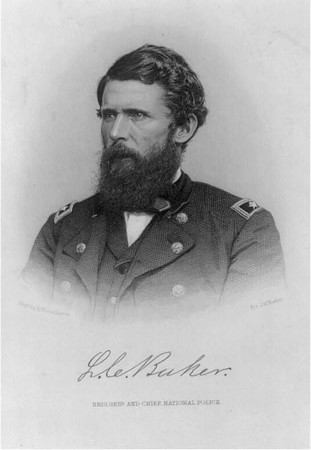
Lafayette C. Baker (1826-1868), chief detective
of the U.S. War Department and my main character's
problematic superior. (Courtesy: Library of Congress)
Baker returned East in time for the Civil War's onset—an hour that gaped with nation-wide menace but also with opportunity, for men of certain skills. In July 1861, as the First Battle of Manassas loomed, he wangled an audience with General-in-Chief Winfield Scott. Baker proposed that he prove his worth with a daring, free-of-charge solo mission into northern Virginia, where he would learn the disposition of Confederate forces. Struck by his self-confidence, the elderly general agreed, giving him ten twenty-dollar pieces to finance the mission—which, even if you discount a detail or two of Baker's narrative, unfolded as an espionage drama and comedy in equal parts, requiring more nerve, luck and tenacity than a dozen ordinary spies could have shown.
His first effort to cross the Potomac was thwarted when federal troops arrested him and sent him to General Scott, who chuckled and told him to try again. He did so and was once more arrested by Union soldiers, though this time he talked his way out of it. The third try proved a charm, when he paid a farmer to row him to the Virginia side. Now on Rebel soil, he tramped westward through the summer heat but was nabbed by a pair of Confederate pickets. Before they could march him to their commander, he persuaded them to stop at a tavern where he got them drunk and gave them the slip. He kept on toward the main Southern encampment at Manassas but was caught yet again by a cavalry patrol.
Following a stern interview with General P.G.T. Beauregaud, he found himself in a stockade but then bribed an officer into letting him out for a spell, under guard. He got his guard drunk at a hotel bar and then took a leisurely stroll with him around the Confederate encampment, noting various units and learning the strength of each—including the Black Horse Cavalry, a special interest of General Scott's. When his tipsy, talkative guard wandered off, Baker wisely attempted no escape and returned on his own to the stockade. Confined again, he deflected his jailers' tricks to reveal him as a spy, as when a teenaged girl appeared with a whispered offer to smuggle out a note for him. (The girl was purportedly Belle Boyd, soon to be famous as "La Belle Rebelle" and the "Cleopatra of the Secession." Whether or not it really was her, the two would eventually cross paths—in reverse circumstances.)
Baker declared himself an innocent Knoxville, Tennessee native who had returned South to settle legal claims for a California minister—he had a partially forged letter to this effect. Still under suspicion, however, he was sent to Richmond by train and imprisoned there, wondering whether he would be hanged or just left to moulder. But after a few days, he found himself at the Spottswood Hotel, being interrogated by the President of the Confederate States himself, Jefferson Davis. Baker's nimble performance under pressure won him a parole within Richmond city limits, though he assumed that he was being watched. In an unlikely chance encounter, an old acquaintance called out his name in the street—then needed a ton of convincing that he had made a mistake. Alarmed, Baker decided it was time to cut bait. He managed to obtain a temporary pass to Fredericksburg.
His escape from Dixie was no less harrowing than his infiltration of it. Detained by Rebel cavalrymen north of the Rappahannock, he faked a limp to put them off guard, then stole a horse and a revolver as they slept. The next day, he evaded a Confederate search party by hiding in a haystack—into which an officer thrust his sword, coming inches from running the spy through. At last—starved, exhausted and with Rebel troops firing after him—he crossed the Potomac to safety in a stolen skiff.
This exploit earned Baker a job as confidential agent, first to the Secretary of State and later to the Secretary of War. His suspicious nature helped make him effective as he shifted from intelligence to counterintelligence, ferreting out Confederate spies, smugglers and sympathizers. Military authorities and the District of Columbia police took a dim view of his brusqueness as well as his contempt for due process. Still, Edwin Stanton's War Department raised him to "Special Provost Marshal" and commissioned him a colonel, lending greater scope to his zeal. He was therefore perfectly positioned when, in November 1862, President Lincoln sacked General George McClellan as commander of the Army of the Potomac, and McClellan's loyal hireling Allan J. Pinkerton left the scene as well, ending his role as the Union's chief spymaster.
THE RELENTLESS SCOTSMAN
. . . the war’s onset had found him restless and uncertain, vulnerable when Pinkerton’s telegraphed plea arrived from Washington: MOMENTOUS TIMES–GOOD MEN NEEDED–AMPLE PAY–PLEASE COME EAST. What if he had declined? Would the war tides have left him relatively untouched, sitting on his stoop outside Chicago? With Rachel still at his side?
"Fate," Truly murmured, "thy name is Allan Pinkerton.”—from Lucifer's Drum
Born in Scotland in 1819, Allan Pinkerton immigrated to Illinois at age 23, working as a cooper until he helped foil a group of counterfeiters who were operating near his settlement. That episode led to his becoming Chicago's first police detective and in 1850, with an attorney partner, founding the private detective agency that came to bear his name. With cutting-edge business acumen, the firm advertised itself with the logo of a single unblinking eye (from which the term "private eye" would hatch) and the slogan, "We Never Sleep." Pinkerton was a constant reader and autodidact, as well as a lifelong atheist. He hired the first-ever female detective, the intrepid Kate Warne, and other women after her. He also hired the Union's first African American agent, John Scobell. And in the 1870's, he began compiling the world's first criminal database—a "rogue's gallery," with clippings, rap sheets and mug shots.
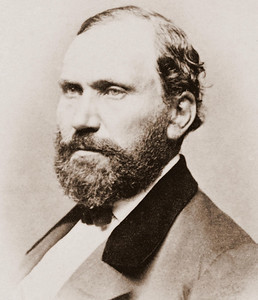
Union detective Allan J. Pinkerton (1819-
1884)—effective on the home front,
out of his depth at the battlefront.
(Courtesy: Library of Congress)
Pinkerton's eventual close linkage with McClellan held one apparent contradiction: the former was a committed Abolitionist—his homestead was a stop on the Underground Railroad and he and his wife gave material support to John Brown—while the latter never hid his disdain for Abolitionism. Nevertheless, the relationship commenced after McClellan became chief engineer and vice-president of the Illinois Central Railroad, for which Pinkerton's agency solved a series of train robbery cases. The detective also became acquainted with the Railroad's top lawyer, Abraham Lincoln.
Thus, with the eruption of the Civil War, did Pinkerton land at history's red-hot center. In February 1861, charged with ensuring President-Elect Lincoln's safe arrival in Washington, Pinkerton obtained intelligence concerning an assassination plot in Baltimore, where Lincoln's train would have to stop. He personally shepherded Lincoln onto a secret train that made Baltimore by night, then onto another train that left before secessionist mobs could get wind of it. That summer, when his patron McClellan took command of the Army of the Potomac, Pinkerton became head of the Union Intelligence Service. He threw himself into plugging intelligence leaks—both the government and the army high command were spouting like sieves—and arresting Confederate spies in and around the capital. He and his agents did a highly creditable job, breaking up the Rose Greenhow Ring and sending that celebrated femme fatale to the Old Capitol Prison.

The Old Capitol Prison, First & A Street, Washington, D.C., present-day site of the
Supreme Court. (Courtesy: Library of Congress)
But battlefield intelligence-gathering was another matter entirely—and when McClellan's lumbering Peninsular Campaign got under way in April 1862, Pinkerton's inexperience in that area bore bitter fruit. His methodology reflected McClellan's already delusional fears about the forces opposing him, greatly magnifying their numbers and reinforcing the general's innate caution—and turning the campaign into a bloody failure. (See "Until A Dictator: Lincoln vs. The RISODS," https://www.goodreads.com/author_blog.... In Lucifer's Drum, Truly recalls his frustration over this sorry performance and the final break it causes between him and Pinkerton.) For months, even through the sanguinary saga of Antietam, Lincoln found reason to tolerate McClellan's unchanging conduct, until he no longer could. And when the President at last fired Little Mac, handing Ambrose Burnside command of the Army of the Potomac, Pinkerton decided to pack it up. He spent the rest of the war investigating fraud among army supply vendors and other such cases.
BATTLEFRONT BRILLIANCE, HOME FRONT THUGGERY
In his brief, disastrous tenure as commanding general, Burnside appears to have done nothing innovative in the area of intelligence. But when Joseph Hooker succeeded him in late January 1863, that general charged Colonel George H. Sharpe of the 120th New York Regiment with building a new organization within the army itself. So was born the Bureau of Military Information. Multi-lingual and classically educated—and in Lucifer's Drum, the immediate superior of Truly's associate Captain Bartholomew Forbes—Sharpe was an attorney and also a low-level diplomat who had served in Rome and Vienna. Under his capable authority and with invaluable help from two subordinates—Captain John McEntee and the civilian scout "Captain" John Babcock—the Bureau gathered an effective stable of scouts and agents and began cross-checking intelligence from numerous sources. Its greatest triumph was in the immediate days before Gettysburg, when its web of informants and diligent sifting of reports yielded the size, composition and direction of Robert E. Lee's army.
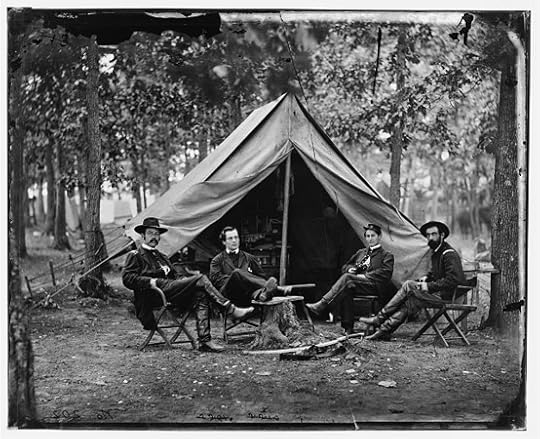
The capable Colonel George H. Sharpe (left, 1828-1900) of the Bureau of Military
Information, with subordinates at Brandy Station, Virginia, early 1864. (Courtesy:
U.S. Army)
Sticking with military intelligence, Colonel Sharpe's superb outfit filled half of the post-Pinkerton vacuum. To fill the other half—civilian espionage on the home front—Lafayette Baker was named head of the War Department's new detective section, which he grandly dubbed the National Detective Police (a name that my character Nate Truly derides.) It never boasted more than forty regular employees, though its tentacles reached some 2,000 informants throughout the North. Granted wide latitude, Baker consequently ran a rather nebulous operation. Counterintelligence and Confederate spies were of course a major focus, along with smuggling—and it took only a vague suspicion for Baker to arrest someone and consign him or her to the grimy, crowded confines of the Old Capitol Prison.
Appalled observers pronounced it a Reign of Terror, comparing Baker to Napoleon's cold-blooded police director Joseph Fouche. Supposedly modeling his methods on those of another Frenchman—the legendary criminal-turned-detective Eugene-Francois Vidocq—Baker wore a silver badge engraved with the words "Death To Traitors" (a detail that, damn it, I wish I'd stumbled upon while researching my novel—it would have been a nice touch). Still, his activities were all over the map. Much energy went to tracking down fraudsters, deserters, bounty-jumpers and, increasingly, counterfeiters. Baker even raided saloons, bordellos and gambling "hells" around the District and tried to suppress the nascent pornography industry. It all sounds grimly dutiful—but persistent scuttlebutt had him extorting cuts from illegal money schemes that he uncovered, as well as pocketing funds from arrestees.
Working hand-in-glove with Baker was the wily superintendent of the Old Capitol, William P. Wood, a figure worth a book of his own. A model-maker by trade, the Alexandria, Virginia native had testified as an expert defense witness in the 1854 McCormick Reaping Machine trial, in which future Secretary of War Edwin Stanton beat back charges of patent infringement against his client. The Civil War revealed an enduring tie between Wood and Stanton, who became the former's patron and protector—often to a startling degree. (Of Wood's mysterious hold over the volatile Secretary, it was said, "Stanton is head of the War Department, and Wood is the head of Stanton.") Before his appointment as the Union's preeminent jailer, Wood was Commissioner of Public Buildings as well as a War Department operative. As bodyguard to Mary Todd Lincoln, he accompanied her on at least one of her notorious shopping binges (to Philadelphia, during which she bought the famous "Lincoln Bed.")
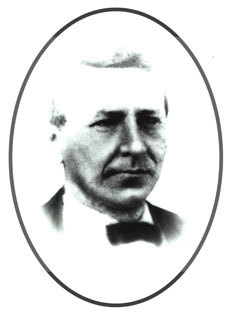
William P. Wood (1820-1903),
wily and sardonic, superintendent
of the Old Capitol Prison, later
head of the first formally named
United States Secret Service.
Physically small but powerful, Wood had served as a cavalryman in the Mexican-American War, though his rumored heroic exploits in that conflict remain just rumors. More certain is that while posted to New Mexico Territory, his commanding officer—future Union Brigadier-General and D.C. Provost Marshal Andrew Porter—sometimes ordered him strung up by the thumbs for one infraction or another. Later, presiding at the Old Capitol—and like Baker, holding a colonel's commission—he took obvious delight in bucking military orders (Porter's especially) and outraging the brass, whose efforts to retaliate were nevertheless quashed by Stanton.
Wood liked to receive incoming prisoners personally, his manner mixing graciousness with amused sarcasm. To an Englishman caught trying to pass through federal lines, he said, "I'm always glad to see your countrymen here!" Mockery was of course the least of an inmate's worries. In the dingy cells of the Old Capitol (present-day site of the Supreme Court), Wood and Baker employed time-honored and decidedly lowdown interrogation tactics. After days or weeks of isolation, a prisoner would be urged to sign a confession and, if he refused, be confronted with fake testimony. This would prompt him to speak in protest and perhaps elaborate on his case, after which the transcript would be read back to him with bogus passages inserted, leaving him confused, despairing and ripe for confession.
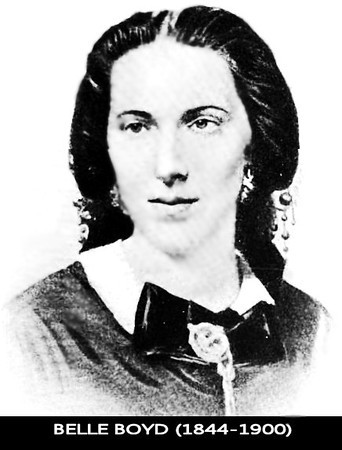
Confederate spy Belle Boyd, "the Cleopatra of the Secession."
(Courtesy: Getty Images)
Belle Boyd, age 18 at the time, described her own encounter with the Lafe & Willy Show during her stay in the summer of 1862, with Baker playing the menacing bad cop and Wood the unctuous good one. Boyd got off with relative ease, though, considering her refusal to confess or to take the oath of allegiance. When Baker's verbal bullying provoked a haughty retort from the girl spy, Wood took his colleague by the arm and said, "We'd better go—the lady is tired."
In her incomparable Pulitzer-winning book Reveille In Washington: 1860-1865, Margaret Leech said of Wood, "He was crafty and hypocritical, but his kindness was genuine." This quality showed in a grand gesture he made upon Belle Boyd's release, as part of a prisoner exchange. Having become engaged to a young Confederate officer and fellow inmate, Boyd had earlier been denied a day pass to shop for her wedding trousseau, so that joyous ritual remained unfulfilled. Sadness no doubt clouded her trip southward to Richmond, since freedom meant separation from her fiancee. But one happy surprise awaited her behind Confederate lines, when she received the trousseau that Wood himself had bought and sent after her under a flag of truce. Wood was especially solicitous with females, though he did have his limits. After a demanding note from the imperious Rose Greenhow, the superintendent wrote back, requesting that she "be kind enough to dispense with the God and Liberty style in your next pronunciamento."
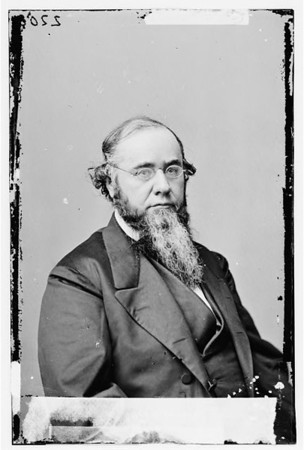
Edwin M. Stanton (1814-1869), Lincoln's
volatile yet gifted Secretary of War.
(Courtesy: Library of Congress)
Part of historical fiction's challenge is doing justice to any real historical figures an author might use, figures he would have had a hard time inventing. And in Lucifer's Drum, I tried to do justice to William Wood, depicting him as someone who Nate Truly values but can't entirely trust:
At the Old Capitol, government supplies had a habit of disappearing. Wood’s nephew ran the prison commissary, and it was whispered that the two of them were robbing it blind. Though an unswerving Republican and Abolitionist, Wood seemed on good terms with the smugglers and blockade runners who he kept under lock. Even with some of the Rebel troops he appeared friendly, provided they weren’t rabid in politics or aristocratic in bearing. With the occasional lady prisoner he was indulgent unto silliness, and most new arrivals were in fact received kindly. To a prisoner brought in on dubious charges, his rights blown away like dandelion seeds, Wood pledged every effort for his comfort and eventual release, then arranged for a detective to pose as the fellow’s cellmate. A lapsed Catholic, he reveled openly in non-belief while encouraging Sunday services at the prison. Dubbing him “The Crown Prince of Duplicity” or—invoking the two-faced Roman god—“Janus the Jailer,” Truly was nonetheless grateful for Wood’s presence on Earth, with its reminder of life’s twisted sorcery.
HARD FATES AND TANGLED WEBS
Most likely with job security in mind, Baker tried to dig up dirt on his boss Stanton by tapping one of his telegraph lines. But he was found out. Despite Stanton's fury, he did not sack Baker but exiled him to New York City, placing him under the thumb of an Assistant Secretary. Immediately upon President Lincoln's assassination, however, Stanton summoned his wayward operative back to Washington. Baker's aggressive reputation recommended him to the task of tracking down John Wilkes Booth and his fellow conspirators—which in a matter of days, he accomplished. Hound-like, he and his men scoured the District and countryside and made key arrests. On April 26, 1865, thanks in large part to Baker's efforts, Booth and his associate David Herold were trapped in a barn near Port Royal, Virginia and the actor/assassin was fatally shot. Baker collected $3,750 in reward money and President Andrew Johnson commissioned him a brigadier-general. From that point, however, Baker's fortunes took a steep dive.
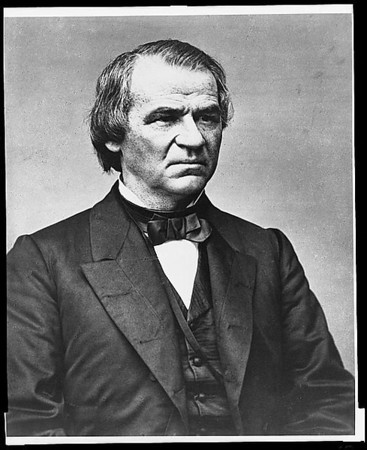
President Andrew Johnson (1808-1875), combative
impeachment survivor, consistently rated among
the worst Presidents. (Courtesy: Library of Congress)
Amid the rancor between Johnson and Congress, Baker's promotion was never confirmed. And in February 1866, having discovered that Baker was spying on him, Johnson ordered him sacked. Newspaper condemnation of the uber-snoop's wartime excesses had meanwhile been mounting. (Baker's story makes me reflect on historical figures like him and the nations that hire them—in particular, nations that openly aspire to humane and democratic values. Faced with an existential threat, they will call upon brutal men to act out their natures and do whatever the country's survival seemingly demands. With eyes averted, they will advance and encourage these men—but once the threat subsides, will distance themselves from the tools of their dirty work. It's as if democracy, at least in extremis, requires a certain amount of hypocrisy.)
A year later, Baker published his colorfully unreliable memoir, History Of The United States Secret Service, in which he stated that Stanton had ordered him to spy on Johnson—a plausible enough claim, given the two men's mutual enmity. No doubt resentful over Stanton's throwing him to the wolves, Baker also charged that his erstwhile chief had suppressed John Wilkes Booth's diary. When a Congressional investigating committee forced Stanton to turn over the diary, Baker testified that eighteen pages had been cut out. Stanton denied maiming the volume, though speculation persists to this day about its allegedly missing content. When the power struggle between Johnson and Stanton culminated in the former's impeachment trial, Baker testified against the President. Johnson famously survived the attempt to remove him from office, prompting Stanton to at last resign as War Secretary.
The Pinkerton National Detective Agency's iconic logo,
origin of the term "private eye."
As for Allan Pinkerton—the years enhanced his reputation as a crime fighter, despite setbacks and personal compromise. His agency's largely successful pursuit of the train-robbing Reno Gang was eclipsed by its failure to track down Jesse James. In 1872, despite his Abolitionist convictions, the Spanish government hired him to help defeat a Cuban revolutionary movement that opposed slavery. The Pinkertons played an increasingly anti-labor union role, breaking up the violent Molly Mcguires in Pennsylvania's coal region. Upon Pinkerton's 1884 death in Chicago—variously ascribed to a stroke, to malaria, or to gangrene after he slipped on the pavement and bit his tongue—his sons Robert and William took over the agency. Under them and later under his grandson Allan II, it gained long-term notoriety in the Homestead Strike (1892), the Pullman Strike (1894), the Ludlow Massacre (1914) and the Battle of Blair Mountain (1921)—a tragic irony, given its founder's youthful pro-labor sentiments. The agency exists today as a guard/detective subsidiary of Securitas AB, a Stockholm-based security group.
As head of the Bureau of Military Information, George Sharpe contributed mightily to the Union cause. But Army of the Potomac Commander George Meade nearly ruined the Bureau, absorbing it into his command structure and interfering with its methodology. In part because of this, Confederate General Jubal Early's July 1864 raid on Washington, D.C. went undetected until it was almost too late. The near-calamity prompted Ulysses S. Grant, the supreme commander, to reorganize the Bureau and restore its full effectiveness. Sharpe was promoted to brigadier-general in February, 1865. At Appomattox, he had the job of issuing paroles to every Confederate soldier, including Lee himself.

Federal civilian scout "Captain" John Babcock and his horse Gimlet, 1862. Babcock
served under Pinkerton and later under Sharpe. He went on to become a prominent
Chicago architect. (Courtesy: Getty Images)
In 1867, having resumed his happy life in Kingston, New York, Sharpe was dispatched by Secretary of State William Seward to Europe, where he vainly pursued the alleged Lincoln assassination conspirator John Surratt. Grant, having become President, appointed him federal marshal for the Southern District of New York in 1869. Against great resistance, he conducted an accurate census and thereby revealed election fraud, helping to break the power of the Tweed Ring. He then served as New York’s surveyor of customs until 1878, after which he remained active in the law and in state politics. He died in 1900.
In the aftermath of Lincoln's murder, the relationship between William Wood and his benefactor Stanton came apart. Wood took up the cause of accused conspirator Mary Surratt (John's mother), whose innocence he proclaimed, and sought an audience with President Johnson. In this Stanton allegedly thwarted him, breaking a promise that Mrs. Surratt would be spared the gallows. She hanged along with three male conspirators. Wood cut his ties with the War Department but, in July 1865, was named head of the first formally named United States Secret Service, a division of the Treasury Department, with the central task of fighting counterfeiting. He hired former forgers and counterfeiters to help in the endeavor, making more than two hundred arrests before angrily resigning in 1869, over a reward money dispute.
Late that same year, Stanton died, just days after President Grant nominated him for the Supreme Court. In an 1883 series of articles, Wood stated that Stanton had committed suicide, haunted to the last by the ghost of Mary Surratt. This claim was widely believed, though never proven. (Amid the aftershocks of the assassination, instances of personal disaster and despair make that period seem truly cursed. Senators James Lane of Kansas and Preston King of New York, for two examples, committed suicide within months of each other. The pair had blocked the White House stairs when Surratt’s daughter Anna came to beg a presidential pardon.)

Hanging of Lincoln conspirators, July 7, 1865. (Courtesy: Library of Congress)
Wood made another startling claim, this one dating from the outset of his and Stanton’s acquaintance. He said that as Stanton's expert witness in the McCormick Reaping Machine trial, he had perjured himself, altering an early model of the reaper in order to win the case. He did not say whether Stanton knew of the deception—but to many, the story explained how Wood had come to secure the powerful man’s sponsorship. (Another member of the defense team was Abraham Lincoln, toward whom Stanton was rudely dismissive; Lincoln nevertheless appointed him as War Secretary eight years later—a tribute to the President’s pragmatic ego, as well as his eye for talent.) Wood died in 1903 at the age of 83, a more durable rogue than his friend Lafayette Baker.
Because Lafe Baker was long dead. In his sensational memoir as well as his testimony before Congress, he had come off as less than credible. But in 1868, settled in Philadelphia and expressing growing fears for his safety, he was said to be working on another book—one that would expose Stanton as the orchestrator of Lincoln's assassination. This roundly refutable conspiracy theory has proven more stubborn than most. Regardless, he died suddenly on July 3, age 41. Meningitis was deemed the cause, though Baker's wife had her suspicions. In the 1960's, Professor Ray A. Neff of Indiana State University used an atomic absorption spectrophotometer to analyze strands of Baker’s hair. It revealed arsenic poisoning as the cause of death. Citing Mrs. Baker's diary, Neff noted that the toxin's sequential elevations corresponded to deliveries of imported beer from Baker's brother-in-law, Walter "Wally" Pollock—Baker having evidently overcome his distaste for alcohol. Lafeyette Baker was as shady a character as ever wielded power in the Republic—but his demise, like Lincoln's, will keep theorists talking till Kingdom Come. Especially with this last detail: Wally Pollack was an employee of the War Department.
In his dank gas-lit chamber he had come to haunt the public imagination, fashioning himself as a burrowed beast of prey. Infamy and prestige were one and the same for Lafayette Baker—and from his basement lair, that prestigious infamy resonated like a tiger’s snarl.—from Lucifer's Drum
In Lucifer's Drum, my main character Major Nathaniel Truly works for the secret service of the U.S. War Department. His boss and occasional bane-of-existence is Colonel (later Brigadier-General) Lafayette C. Baker, one of those figures who could only have sprung from real life—especially from the Civil War, whose turmoil swept many natural-born scoundrels into positions of power. The grandson of a Revolutionary War hero, Baker was born in western New York in 1826. As a young itinerant mechanic, he landed in California around the time of the Gold Rush and joined San Francisco's ruthless Vigilance Committee, pledged to impose order and quash crime. Baker—gray-eyed, reddish-haired and a sharp dresser—stood out among the vigilantes, who recalled him as a crack pistol shot and paragon of physical stamina. These assets plus a disdain for legal niceties (and for liquor—rare in that time and place) would serve him well later on.
Lafayette C. Baker (1826-1868), chief detective
of the U.S. War Department and my main character's
problematic superior. (Courtesy: Library of Congress)
Baker returned East in time for the Civil War's onset—an hour that gaped with nation-wide menace but also with opportunity, for men of certain skills. In July 1861, as the First Battle of Manassas loomed, he wangled an audience with General-in-Chief Winfield Scott. Baker proposed that he prove his worth with a daring, free-of-charge solo mission into northern Virginia, where he would learn the disposition of Confederate forces. Struck by his self-confidence, the elderly general agreed, giving him ten twenty-dollar pieces to finance the mission—which, even if you discount a detail or two of Baker's narrative, unfolded as an espionage drama and comedy in equal parts, requiring more nerve, luck and tenacity than a dozen ordinary spies could have shown.
His first effort to cross the Potomac was thwarted when federal troops arrested him and sent him to General Scott, who chuckled and told him to try again. He did so and was once more arrested by Union soldiers, though this time he talked his way out of it. The third try proved a charm, when he paid a farmer to row him to the Virginia side. Now on Rebel soil, he tramped westward through the summer heat but was nabbed by a pair of Confederate pickets. Before they could march him to their commander, he persuaded them to stop at a tavern where he got them drunk and gave them the slip. He kept on toward the main Southern encampment at Manassas but was caught yet again by a cavalry patrol.
Following a stern interview with General P.G.T. Beauregaud, he found himself in a stockade but then bribed an officer into letting him out for a spell, under guard. He got his guard drunk at a hotel bar and then took a leisurely stroll with him around the Confederate encampment, noting various units and learning the strength of each—including the Black Horse Cavalry, a special interest of General Scott's. When his tipsy, talkative guard wandered off, Baker wisely attempted no escape and returned on his own to the stockade. Confined again, he deflected his jailers' tricks to reveal him as a spy, as when a teenaged girl appeared with a whispered offer to smuggle out a note for him. (The girl was purportedly Belle Boyd, soon to be famous as "La Belle Rebelle" and the "Cleopatra of the Secession." Whether or not it really was her, the two would eventually cross paths—in reverse circumstances.)
Baker declared himself an innocent Knoxville, Tennessee native who had returned South to settle legal claims for a California minister—he had a partially forged letter to this effect. Still under suspicion, however, he was sent to Richmond by train and imprisoned there, wondering whether he would be hanged or just left to moulder. But after a few days, he found himself at the Spottswood Hotel, being interrogated by the President of the Confederate States himself, Jefferson Davis. Baker's nimble performance under pressure won him a parole within Richmond city limits, though he assumed that he was being watched. In an unlikely chance encounter, an old acquaintance called out his name in the street—then needed a ton of convincing that he had made a mistake. Alarmed, Baker decided it was time to cut bait. He managed to obtain a temporary pass to Fredericksburg.
His escape from Dixie was no less harrowing than his infiltration of it. Detained by Rebel cavalrymen north of the Rappahannock, he faked a limp to put them off guard, then stole a horse and a revolver as they slept. The next day, he evaded a Confederate search party by hiding in a haystack—into which an officer thrust his sword, coming inches from running the spy through. At last—starved, exhausted and with Rebel troops firing after him—he crossed the Potomac to safety in a stolen skiff.
This exploit earned Baker a job as confidential agent, first to the Secretary of State and later to the Secretary of War. His suspicious nature helped make him effective as he shifted from intelligence to counterintelligence, ferreting out Confederate spies, smugglers and sympathizers. Military authorities and the District of Columbia police took a dim view of his brusqueness as well as his contempt for due process. Still, Edwin Stanton's War Department raised him to "Special Provost Marshal" and commissioned him a colonel, lending greater scope to his zeal. He was therefore perfectly positioned when, in November 1862, President Lincoln sacked General George McClellan as commander of the Army of the Potomac, and McClellan's loyal hireling Allan J. Pinkerton left the scene as well, ending his role as the Union's chief spymaster.
THE RELENTLESS SCOTSMAN
. . . the war’s onset had found him restless and uncertain, vulnerable when Pinkerton’s telegraphed plea arrived from Washington: MOMENTOUS TIMES–GOOD MEN NEEDED–AMPLE PAY–PLEASE COME EAST. What if he had declined? Would the war tides have left him relatively untouched, sitting on his stoop outside Chicago? With Rachel still at his side?
"Fate," Truly murmured, "thy name is Allan Pinkerton.”—from Lucifer's Drum
Born in Scotland in 1819, Allan Pinkerton immigrated to Illinois at age 23, working as a cooper until he helped foil a group of counterfeiters who were operating near his settlement. That episode led to his becoming Chicago's first police detective and in 1850, with an attorney partner, founding the private detective agency that came to bear his name. With cutting-edge business acumen, the firm advertised itself with the logo of a single unblinking eye (from which the term "private eye" would hatch) and the slogan, "We Never Sleep." Pinkerton was a constant reader and autodidact, as well as a lifelong atheist. He hired the first-ever female detective, the intrepid Kate Warne, and other women after her. He also hired the Union's first African American agent, John Scobell. And in the 1870's, he began compiling the world's first criminal database—a "rogue's gallery," with clippings, rap sheets and mug shots.
Union detective Allan J. Pinkerton (1819-
1884)—effective on the home front,
out of his depth at the battlefront.
(Courtesy: Library of Congress)
Pinkerton's eventual close linkage with McClellan held one apparent contradiction: the former was a committed Abolitionist—his homestead was a stop on the Underground Railroad and he and his wife gave material support to John Brown—while the latter never hid his disdain for Abolitionism. Nevertheless, the relationship commenced after McClellan became chief engineer and vice-president of the Illinois Central Railroad, for which Pinkerton's agency solved a series of train robbery cases. The detective also became acquainted with the Railroad's top lawyer, Abraham Lincoln.
Thus, with the eruption of the Civil War, did Pinkerton land at history's red-hot center. In February 1861, charged with ensuring President-Elect Lincoln's safe arrival in Washington, Pinkerton obtained intelligence concerning an assassination plot in Baltimore, where Lincoln's train would have to stop. He personally shepherded Lincoln onto a secret train that made Baltimore by night, then onto another train that left before secessionist mobs could get wind of it. That summer, when his patron McClellan took command of the Army of the Potomac, Pinkerton became head of the Union Intelligence Service. He threw himself into plugging intelligence leaks—both the government and the army high command were spouting like sieves—and arresting Confederate spies in and around the capital. He and his agents did a highly creditable job, breaking up the Rose Greenhow Ring and sending that celebrated femme fatale to the Old Capitol Prison.
The Old Capitol Prison, First & A Street, Washington, D.C., present-day site of the
Supreme Court. (Courtesy: Library of Congress)
But battlefield intelligence-gathering was another matter entirely—and when McClellan's lumbering Peninsular Campaign got under way in April 1862, Pinkerton's inexperience in that area bore bitter fruit. His methodology reflected McClellan's already delusional fears about the forces opposing him, greatly magnifying their numbers and reinforcing the general's innate caution—and turning the campaign into a bloody failure. (See "Until A Dictator: Lincoln vs. The RISODS," https://www.goodreads.com/author_blog.... In Lucifer's Drum, Truly recalls his frustration over this sorry performance and the final break it causes between him and Pinkerton.) For months, even through the sanguinary saga of Antietam, Lincoln found reason to tolerate McClellan's unchanging conduct, until he no longer could. And when the President at last fired Little Mac, handing Ambrose Burnside command of the Army of the Potomac, Pinkerton decided to pack it up. He spent the rest of the war investigating fraud among army supply vendors and other such cases.
BATTLEFRONT BRILLIANCE, HOME FRONT THUGGERY
In his brief, disastrous tenure as commanding general, Burnside appears to have done nothing innovative in the area of intelligence. But when Joseph Hooker succeeded him in late January 1863, that general charged Colonel George H. Sharpe of the 120th New York Regiment with building a new organization within the army itself. So was born the Bureau of Military Information. Multi-lingual and classically educated—and in Lucifer's Drum, the immediate superior of Truly's associate Captain Bartholomew Forbes—Sharpe was an attorney and also a low-level diplomat who had served in Rome and Vienna. Under his capable authority and with invaluable help from two subordinates—Captain John McEntee and the civilian scout "Captain" John Babcock—the Bureau gathered an effective stable of scouts and agents and began cross-checking intelligence from numerous sources. Its greatest triumph was in the immediate days before Gettysburg, when its web of informants and diligent sifting of reports yielded the size, composition and direction of Robert E. Lee's army.
The capable Colonel George H. Sharpe (left, 1828-1900) of the Bureau of Military
Information, with subordinates at Brandy Station, Virginia, early 1864. (Courtesy:
U.S. Army)
Sticking with military intelligence, Colonel Sharpe's superb outfit filled half of the post-Pinkerton vacuum. To fill the other half—civilian espionage on the home front—Lafayette Baker was named head of the War Department's new detective section, which he grandly dubbed the National Detective Police (a name that my character Nate Truly derides.) It never boasted more than forty regular employees, though its tentacles reached some 2,000 informants throughout the North. Granted wide latitude, Baker consequently ran a rather nebulous operation. Counterintelligence and Confederate spies were of course a major focus, along with smuggling—and it took only a vague suspicion for Baker to arrest someone and consign him or her to the grimy, crowded confines of the Old Capitol Prison.
Appalled observers pronounced it a Reign of Terror, comparing Baker to Napoleon's cold-blooded police director Joseph Fouche. Supposedly modeling his methods on those of another Frenchman—the legendary criminal-turned-detective Eugene-Francois Vidocq—Baker wore a silver badge engraved with the words "Death To Traitors" (a detail that, damn it, I wish I'd stumbled upon while researching my novel—it would have been a nice touch). Still, his activities were all over the map. Much energy went to tracking down fraudsters, deserters, bounty-jumpers and, increasingly, counterfeiters. Baker even raided saloons, bordellos and gambling "hells" around the District and tried to suppress the nascent pornography industry. It all sounds grimly dutiful—but persistent scuttlebutt had him extorting cuts from illegal money schemes that he uncovered, as well as pocketing funds from arrestees.
Working hand-in-glove with Baker was the wily superintendent of the Old Capitol, William P. Wood, a figure worth a book of his own. A model-maker by trade, the Alexandria, Virginia native had testified as an expert defense witness in the 1854 McCormick Reaping Machine trial, in which future Secretary of War Edwin Stanton beat back charges of patent infringement against his client. The Civil War revealed an enduring tie between Wood and Stanton, who became the former's patron and protector—often to a startling degree. (Of Wood's mysterious hold over the volatile Secretary, it was said, "Stanton is head of the War Department, and Wood is the head of Stanton.") Before his appointment as the Union's preeminent jailer, Wood was Commissioner of Public Buildings as well as a War Department operative. As bodyguard to Mary Todd Lincoln, he accompanied her on at least one of her notorious shopping binges (to Philadelphia, during which she bought the famous "Lincoln Bed.")
William P. Wood (1820-1903),
wily and sardonic, superintendent
of the Old Capitol Prison, later
head of the first formally named
United States Secret Service.
Physically small but powerful, Wood had served as a cavalryman in the Mexican-American War, though his rumored heroic exploits in that conflict remain just rumors. More certain is that while posted to New Mexico Territory, his commanding officer—future Union Brigadier-General and D.C. Provost Marshal Andrew Porter—sometimes ordered him strung up by the thumbs for one infraction or another. Later, presiding at the Old Capitol—and like Baker, holding a colonel's commission—he took obvious delight in bucking military orders (Porter's especially) and outraging the brass, whose efforts to retaliate were nevertheless quashed by Stanton.
Wood liked to receive incoming prisoners personally, his manner mixing graciousness with amused sarcasm. To an Englishman caught trying to pass through federal lines, he said, "I'm always glad to see your countrymen here!" Mockery was of course the least of an inmate's worries. In the dingy cells of the Old Capitol (present-day site of the Supreme Court), Wood and Baker employed time-honored and decidedly lowdown interrogation tactics. After days or weeks of isolation, a prisoner would be urged to sign a confession and, if he refused, be confronted with fake testimony. This would prompt him to speak in protest and perhaps elaborate on his case, after which the transcript would be read back to him with bogus passages inserted, leaving him confused, despairing and ripe for confession.
Confederate spy Belle Boyd, "the Cleopatra of the Secession."
(Courtesy: Getty Images)
Belle Boyd, age 18 at the time, described her own encounter with the Lafe & Willy Show during her stay in the summer of 1862, with Baker playing the menacing bad cop and Wood the unctuous good one. Boyd got off with relative ease, though, considering her refusal to confess or to take the oath of allegiance. When Baker's verbal bullying provoked a haughty retort from the girl spy, Wood took his colleague by the arm and said, "We'd better go—the lady is tired."
In her incomparable Pulitzer-winning book Reveille In Washington: 1860-1865, Margaret Leech said of Wood, "He was crafty and hypocritical, but his kindness was genuine." This quality showed in a grand gesture he made upon Belle Boyd's release, as part of a prisoner exchange. Having become engaged to a young Confederate officer and fellow inmate, Boyd had earlier been denied a day pass to shop for her wedding trousseau, so that joyous ritual remained unfulfilled. Sadness no doubt clouded her trip southward to Richmond, since freedom meant separation from her fiancee. But one happy surprise awaited her behind Confederate lines, when she received the trousseau that Wood himself had bought and sent after her under a flag of truce. Wood was especially solicitous with females, though he did have his limits. After a demanding note from the imperious Rose Greenhow, the superintendent wrote back, requesting that she "be kind enough to dispense with the God and Liberty style in your next pronunciamento."
Edwin M. Stanton (1814-1869), Lincoln's
volatile yet gifted Secretary of War.
(Courtesy: Library of Congress)
Part of historical fiction's challenge is doing justice to any real historical figures an author might use, figures he would have had a hard time inventing. And in Lucifer's Drum, I tried to do justice to William Wood, depicting him as someone who Nate Truly values but can't entirely trust:
At the Old Capitol, government supplies had a habit of disappearing. Wood’s nephew ran the prison commissary, and it was whispered that the two of them were robbing it blind. Though an unswerving Republican and Abolitionist, Wood seemed on good terms with the smugglers and blockade runners who he kept under lock. Even with some of the Rebel troops he appeared friendly, provided they weren’t rabid in politics or aristocratic in bearing. With the occasional lady prisoner he was indulgent unto silliness, and most new arrivals were in fact received kindly. To a prisoner brought in on dubious charges, his rights blown away like dandelion seeds, Wood pledged every effort for his comfort and eventual release, then arranged for a detective to pose as the fellow’s cellmate. A lapsed Catholic, he reveled openly in non-belief while encouraging Sunday services at the prison. Dubbing him “The Crown Prince of Duplicity” or—invoking the two-faced Roman god—“Janus the Jailer,” Truly was nonetheless grateful for Wood’s presence on Earth, with its reminder of life’s twisted sorcery.
HARD FATES AND TANGLED WEBS
Most likely with job security in mind, Baker tried to dig up dirt on his boss Stanton by tapping one of his telegraph lines. But he was found out. Despite Stanton's fury, he did not sack Baker but exiled him to New York City, placing him under the thumb of an Assistant Secretary. Immediately upon President Lincoln's assassination, however, Stanton summoned his wayward operative back to Washington. Baker's aggressive reputation recommended him to the task of tracking down John Wilkes Booth and his fellow conspirators—which in a matter of days, he accomplished. Hound-like, he and his men scoured the District and countryside and made key arrests. On April 26, 1865, thanks in large part to Baker's efforts, Booth and his associate David Herold were trapped in a barn near Port Royal, Virginia and the actor/assassin was fatally shot. Baker collected $3,750 in reward money and President Andrew Johnson commissioned him a brigadier-general. From that point, however, Baker's fortunes took a steep dive.
President Andrew Johnson (1808-1875), combative
impeachment survivor, consistently rated among
the worst Presidents. (Courtesy: Library of Congress)
Amid the rancor between Johnson and Congress, Baker's promotion was never confirmed. And in February 1866, having discovered that Baker was spying on him, Johnson ordered him sacked. Newspaper condemnation of the uber-snoop's wartime excesses had meanwhile been mounting. (Baker's story makes me reflect on historical figures like him and the nations that hire them—in particular, nations that openly aspire to humane and democratic values. Faced with an existential threat, they will call upon brutal men to act out their natures and do whatever the country's survival seemingly demands. With eyes averted, they will advance and encourage these men—but once the threat subsides, will distance themselves from the tools of their dirty work. It's as if democracy, at least in extremis, requires a certain amount of hypocrisy.)
A year later, Baker published his colorfully unreliable memoir, History Of The United States Secret Service, in which he stated that Stanton had ordered him to spy on Johnson—a plausible enough claim, given the two men's mutual enmity. No doubt resentful over Stanton's throwing him to the wolves, Baker also charged that his erstwhile chief had suppressed John Wilkes Booth's diary. When a Congressional investigating committee forced Stanton to turn over the diary, Baker testified that eighteen pages had been cut out. Stanton denied maiming the volume, though speculation persists to this day about its allegedly missing content. When the power struggle between Johnson and Stanton culminated in the former's impeachment trial, Baker testified against the President. Johnson famously survived the attempt to remove him from office, prompting Stanton to at last resign as War Secretary.
The Pinkerton National Detective Agency's iconic logo,
origin of the term "private eye."
As for Allan Pinkerton—the years enhanced his reputation as a crime fighter, despite setbacks and personal compromise. His agency's largely successful pursuit of the train-robbing Reno Gang was eclipsed by its failure to track down Jesse James. In 1872, despite his Abolitionist convictions, the Spanish government hired him to help defeat a Cuban revolutionary movement that opposed slavery. The Pinkertons played an increasingly anti-labor union role, breaking up the violent Molly Mcguires in Pennsylvania's coal region. Upon Pinkerton's 1884 death in Chicago—variously ascribed to a stroke, to malaria, or to gangrene after he slipped on the pavement and bit his tongue—his sons Robert and William took over the agency. Under them and later under his grandson Allan II, it gained long-term notoriety in the Homestead Strike (1892), the Pullman Strike (1894), the Ludlow Massacre (1914) and the Battle of Blair Mountain (1921)—a tragic irony, given its founder's youthful pro-labor sentiments. The agency exists today as a guard/detective subsidiary of Securitas AB, a Stockholm-based security group.
As head of the Bureau of Military Information, George Sharpe contributed mightily to the Union cause. But Army of the Potomac Commander George Meade nearly ruined the Bureau, absorbing it into his command structure and interfering with its methodology. In part because of this, Confederate General Jubal Early's July 1864 raid on Washington, D.C. went undetected until it was almost too late. The near-calamity prompted Ulysses S. Grant, the supreme commander, to reorganize the Bureau and restore its full effectiveness. Sharpe was promoted to brigadier-general in February, 1865. At Appomattox, he had the job of issuing paroles to every Confederate soldier, including Lee himself.
Federal civilian scout "Captain" John Babcock and his horse Gimlet, 1862. Babcock
served under Pinkerton and later under Sharpe. He went on to become a prominent
Chicago architect. (Courtesy: Getty Images)
In 1867, having resumed his happy life in Kingston, New York, Sharpe was dispatched by Secretary of State William Seward to Europe, where he vainly pursued the alleged Lincoln assassination conspirator John Surratt. Grant, having become President, appointed him federal marshal for the Southern District of New York in 1869. Against great resistance, he conducted an accurate census and thereby revealed election fraud, helping to break the power of the Tweed Ring. He then served as New York’s surveyor of customs until 1878, after which he remained active in the law and in state politics. He died in 1900.
In the aftermath of Lincoln's murder, the relationship between William Wood and his benefactor Stanton came apart. Wood took up the cause of accused conspirator Mary Surratt (John's mother), whose innocence he proclaimed, and sought an audience with President Johnson. In this Stanton allegedly thwarted him, breaking a promise that Mrs. Surratt would be spared the gallows. She hanged along with three male conspirators. Wood cut his ties with the War Department but, in July 1865, was named head of the first formally named United States Secret Service, a division of the Treasury Department, with the central task of fighting counterfeiting. He hired former forgers and counterfeiters to help in the endeavor, making more than two hundred arrests before angrily resigning in 1869, over a reward money dispute.
Late that same year, Stanton died, just days after President Grant nominated him for the Supreme Court. In an 1883 series of articles, Wood stated that Stanton had committed suicide, haunted to the last by the ghost of Mary Surratt. This claim was widely believed, though never proven. (Amid the aftershocks of the assassination, instances of personal disaster and despair make that period seem truly cursed. Senators James Lane of Kansas and Preston King of New York, for two examples, committed suicide within months of each other. The pair had blocked the White House stairs when Surratt’s daughter Anna came to beg a presidential pardon.)
Hanging of Lincoln conspirators, July 7, 1865. (Courtesy: Library of Congress)
Wood made another startling claim, this one dating from the outset of his and Stanton’s acquaintance. He said that as Stanton's expert witness in the McCormick Reaping Machine trial, he had perjured himself, altering an early model of the reaper in order to win the case. He did not say whether Stanton knew of the deception—but to many, the story explained how Wood had come to secure the powerful man’s sponsorship. (Another member of the defense team was Abraham Lincoln, toward whom Stanton was rudely dismissive; Lincoln nevertheless appointed him as War Secretary eight years later—a tribute to the President’s pragmatic ego, as well as his eye for talent.) Wood died in 1903 at the age of 83, a more durable rogue than his friend Lafayette Baker.
Because Lafe Baker was long dead. In his sensational memoir as well as his testimony before Congress, he had come off as less than credible. But in 1868, settled in Philadelphia and expressing growing fears for his safety, he was said to be working on another book—one that would expose Stanton as the orchestrator of Lincoln's assassination. This roundly refutable conspiracy theory has proven more stubborn than most. Regardless, he died suddenly on July 3, age 41. Meningitis was deemed the cause, though Baker's wife had her suspicions. In the 1960's, Professor Ray A. Neff of Indiana State University used an atomic absorption spectrophotometer to analyze strands of Baker’s hair. It revealed arsenic poisoning as the cause of death. Citing Mrs. Baker's diary, Neff noted that the toxin's sequential elevations corresponded to deliveries of imported beer from Baker's brother-in-law, Walter "Wally" Pollock—Baker having evidently overcome his distaste for alcohol. Lafeyette Baker was as shady a character as ever wielded power in the Republic—but his demise, like Lincoln's, will keep theorists talking till Kingdom Come. Especially with this last detail: Wally Pollack was an employee of the War Department.
July 19, 2016
Until A Dictator: Lincoln vs. The RISODs
"ONLY A DWARF IN MIND!"
"In looking over the orders I find nothing of moment, save one in which the President commutes the death punishment of all deserters to imprisonment during the war. Poor, weak, well meaning Lincoln!"
—from the diary of Colonel Charles S. Wainwright, Chief of Artillery, Fifth Corps, Army of the Potomac, June 30, 1864
In his dim view of Abraham Lincoln's nerve and competence, Colonel Wainwright was hardly alone among Union officers, men chronically frustrated over the war's prosecution. William Tecumseh Sherman, a colonel in March of 1861, came away exasperated from his first meeting with the new President, judging him naive about what Southern secession meant and the national trauma it would bring. Sherman's take on Lincoln improved over the war's tumultuous course. Still, on the eve of the 1864 Presidential election and ultimate Northern victory, Sherman's core ambivalence remained. "I am almost in despair of popular Government," the general wrote to his brother, Ohio Senator John Sherman, "but if we must be so inflicted I suppose Lincoln is the best choice, but I am not a voter."
On the political side, harsher assessments issued from the Republican left. When Lincoln did not declare immediate Emancipation in the days after Fort Sumter, Abolitionist firebrand William Lloyd Garrison accused him of "unwittingly helping to prolong the war, and to render the result more and more doubtful! If he is 6 feet 4 inches high, he is only a dwarf in mind!" And when Lincoln's year-end message to Congress pledged (vainly, God knows) to prevent the war from becoming "a violent, remorseless revolutionary struggle," Garrison's rancor surged again: "What a wishy-washy message from the President! He has evidently not a drop of anti-slavery blood in his veins."
Frederick Douglass, who would come to admire Lincoln and in the end declare him "emphatically the black man's president," spent much of the war's first half spitting rhetorical nails in his direction. So did that Radical titan Congressman Thaddeus Stevens of Pennsylvania, of whom historian Allan Nevins wrote, "In brooding over what he regarded as Lincoln's delays and excessive generosity, Stevens sometimes exhibited a frenzy of anger." Michigan Senator Zachariah Chandler, a pillar of Abolitionism, declared, "The President is a weak man, too weak for the occasion." And Maine Senator William Pitt Fessenden huffed, "If the President had his wife's will and would use it rightly, our affairs would look much better."

Last portrait of Abraham Lincoln, April 10, 1865, four
days before his assassination. (Courtesy: Library of Congress)
Meanwhile, of course, the political right strafed Lincoln without letup. Despite a soldierly scorn for politics, Colonel Wainwright expressed what many War Democrats thought when he described the President as "completely in the hands of the radicals of his party." Democratic Governor Horatio Seymour of New York, who opposed Lincoln on Emancipation as well as the Draft, accused his administration of "military despotism." Above all there was the virulent Copperhead or Peace Democrat movement, drawing from the North's "doughface" (pro-Southern) element (see https://www.goodreads.com/author_blog...). Reacting to Emancipation, the Draft and the sporadic suspension of habeas corpus, Copperhead spokesmen often made today's Talk Radio hosts sound like the soul of forbearance. Wisconsin editor Marcus "Brick" Pomeroy of the LaCrosse Democrat called Lincoln "fungus from the corrupt womb of bigotry and fanaticism . . . a worse tyrant and more inhuman butcher than has existed since the days of Nero," before going on to urge the President's assassination. (It's unknown if Pomeroy noted that these statements did not land him in jail—in time of war, no less.) An Ohio editor stated that the Abolition and conscription agenda of "the despot Lincoln" would bring him "the fate he deserves: hung, shot or burned." And the pre-eminent Copperhead champion, Ohio Congressman Clement L. Vallandigham, excoriated the President as "King Lincoln."
When you are the low-born leader of a country neck-deep in crisis—in its bloodiest war, say, and a Civil one besides—and trying your best to shepherd it through, maneuvering among the varied factions, marshaling governmental powers to meet the challenge, willing to take emergency measures yet mindful of legal precedent, facing fierce enemies both at home and on the battlefield, you will be subject to a whole range of insult. When the war is not going well, as it often won't be, military men will call you meddling and incompetent. Thundering egotists among them—Major General George B. McClellan, for instance—will even refer to you as "an idiot," "a well meaning baboon" and "the original gorilla."
But the most merciless criticism will come from the political sphere, where men of greater wealth and education—men who imagine how much better they would have done in your place—regard you as a rube and see your struggles as their judgment's confirmation. Idealogical allies, impatient with your administration's progress toward cherished goals, will call you soft, spineless, feckless, weak-kneed, a poor leader. And idealogical foes will deliver the opposite charge, calling you a tyrannical monster. A remarkable few might even manage to call you weak and diabolically effective, depending on which feels best at the moment.

Union Major General Joseph "Fighting Joe" Hooker, partial to dictatorship. (Courtesy:
Library of Congress)
In Lincoln's case, a lot of this bile came from an understandable horror and frustration over the war. Some of it came from that deep-seated American addiction to moral outrage, or at least the ennobling sound of it, combined with an uncomplicated idea of how much power a President actually has. Some of it came from a shallow commitment to democracy, with its creaky workings, endless debate and the chance that things won't always go your way. Some it came from pure wackjob hysteria, with racial animus as its tinder. And some of it, once in a while, was fair. An activist like Frederick Douglass, for example, could hardly be faulted for chafing over the delays in African American recruitment—which, when it did come about, proved indispensable to victory. Nor could Negro leaders be fairly criticized for rejecting Lincoln's August 1862 proposal of black colonization in Central America. (The eminent historian Eric Foner has, nevertheless, observed that Lincoln's doubts concerning black assimilation arose from his view of white racism as its chief impediment—something that placed him ahead of most whites on that subject.) And Lincoln's military critics were not always off base. During T.J. "Stonewall" Jackson's spring 1862 rampage in the Shenandoah Valley, Lincoln's flurry of orders played into the wily Jackson's ploy to divert Union forces, three of which separately pursued but did not catch him. And given the President's sensitivity to public opinion, he was capable of giving the kind of contradictory order that he gave Ulysses S. Grant at Petersburg, directing him to make a strong attack but keep casualties minimal.
Yet nothing summed up political and military discontent with Lincoln like Major General Joseph "Fighting Joe" Hooker's whiskey-fueled comment in late January, 1863.
"I WILL RISK THE DICTATORSHIP"
Along with the entire Army of the Potomac, corps commander Hooker had just endured that army's latest morale-stomping failure: the Mud March, when General-in-Chief Ambrose E. Burnside tried to cross the Rappahannock and outflank Robert E. Lee, but was thwarted by a three-day rainstorm. Bad luck is unforgivable in a commander—but in mid-December, at the Battle of Fredericksburg, Burnside had shown bad judgment too. Ignoring Hooker's protests, he had thrown wave after wave of Union boys against Lee's defenses on Mayre's Heights and suffered a crushing defeat. Now Hooker, disgusted once more with his superior, castigated him to any who would listen. He also criticized the Union's state of affairs more broadly, and a New York Times reporter relayed the gist of it: "Nothing would go right until we had a dictator, and the sooner the better."
With the Mud March and with discord among his subordinates, Burnside's fortunes were played out and Lincoln named "Fighting Joe" to replace him. It was an obvious and popular choice. Since the Second Seminole and Mexican-American Wars, Hooker had earned his nickname many times over. And since McClellan's Peninsular Campaign the previous spring, he had proven himself a brave and aggressive field commander who cared deeply about his men. At Antietam, his corps hammered the Confederate left and took tremendous casualties, with Hooker himself wounded in the foot. (In my novel Lucifer's Drum, Bartholomew Forbes loses his leg at Antietam while under Hooker's command.) He was also known for hard drinking and prostitutes. Though the general and the term "hooker" have no connection, he certainly made one seem plausible—his headquarters at Falmouth, VA was described as part saloon and part brothel. And a red-light section of Washington, D.C. was called "Hooker's Division" in his honor. He was known too for denigrating fellow generals—chiefly McClellan, whose irrational fears and risk-aversion doomed the Peninsular Campaign and kept him from destroying Lee at Antietam, and Burnside for the Fredericksburg disaster. Hooker was indiscreet—but in those two cases, he was also right.
Having appointed Hooker, Lincoln sent him a letter admonishing him for his efforts to undermine Burnside, "a brother officer" who the President regarded as a good man simply over his head. He also said, more cooly: "I have heard, in such way as to believe it, of your recently saying that both the Army and the Government needed a Dictator. Of course it was not for this, but in spite of it, that I have given you the command. Only those generals who gain success can set up dictators. What I now ask of you is military success, and I will risk the dictatorship."
Over the next three months, however, Hooker revealed himself as a gifted and energetic administrator. His improvements in training, food, sanitation, medical care and the furlough system brought army morale back from the depths and desertions down to a trickle. His creation of the Bureau of Military Information under the capable Colonel George Sharpe (Bart Forbes' superior in Lucifer's Drum) would eventually bear marvelous fruit. His introduction of corps badges promoted pride and made units more identifiable to one another when on the march. Last but not least, his reorganization of the cavalry as a single corps made it more effective against Southern horsemen, who had been so plainly superior thus far. And with the coming of spring, Hooker was able to crow: "I have the finest army on the planet. I have the finest army the sun ever shone on . . . If the enemy does not run, God help them. May God have mercy on General Lee, for I will have none."
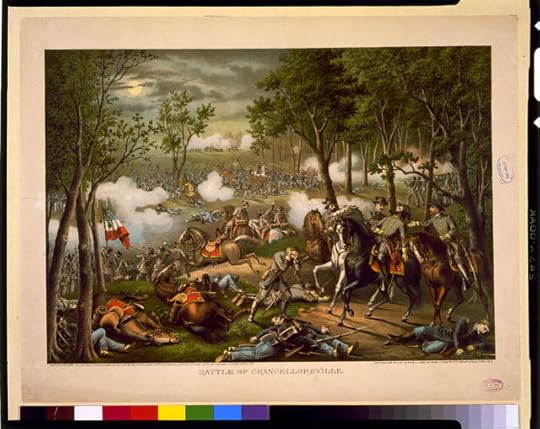
Print from the Battle of Chancellorsville, May 2, 1863. In right foreground, Confederate General Stonewall Jackson's fatal wounding by his own men. (Courtesy: Library of Congress)
CHANCELLORSVILLE: A BOAST DROWNED IN BLOOD
For a present-day American whose sympathies tilt Union, reading about Hooker's dazzling plan to smash Lee—and its dazzling execution, at first—can bring a pang. In late April, screened by cavalry, three of his corps swiftly forded the Rappahannock and the Rapidan, then swung southeast to envelop Lee (whose army totaled less than half of Hooker's 134,000-man behemoth) in the rear and left flank. Two more corps under Major General John Sedjwick remained in front of Fredericksburg to focus Rebel concern; another corps and a division were poised upriver, ready to reinforce either Sedjwick or Hooker's main body. On the evening of April 30, that main body was camped around a crossroads mansion called Chancellorsville, amid a thick second-growth forest called The Wilderness. To his troops, Hooker declared that the enemy "must either ingloriously fly, or come out from behind his defenses and give us battle on our own ground, where certain destruction awaits him." His cockiness peaked the next day, even as his advancing force hit a solid line of Confederate infantry and artillery. "The rebel army is the legitimate property of the Army of the Potomac," he proclaimed.
But the Confederates' scrappy first response caused something strange to happen, deep inside Hooker. Wondering if enemy strength was greater than had been thought, he hesitated, then withdrew back to Chancellorsville to think things out. In this fateful hour—with the plan working and glory in his grasp—he caught a case of existential vertigo. That same evening, Lee and Stonewall Jackson—two men alien to such vertigo—sat side by side on a cracker box and worked out a spectacular counter-stroke, one that defied all military convention. Jackson with 25,000 men would march wide to the southwest around Hooker's right flank, while Lee with 20,000 continued to fight him in front. The army's remainder would be left on Mayre's Heights to face Sedjwick.
Jackson's march through the tangled growth took most of May 2. When Yankee advance units reported the movement, Hooker decided it was just part of Lee's army in retreat and sent two divisions after it. And that evening, when Jackson launched his Rebel-yell attack on Hooker's oblivious right, there was hell to pay (as depicted through Ben Truly's memory of it in Lucifer's Drum). An entire Union corps was overrun and scattered through the woods. In the savage night's confusion, troops of both sides blindly fired upon their own—and presently, this claimed Jackson himself. Mistaking his party for Yankee cavalry, a North Carolina unit raked it with fire and wounded the great general. His left arm amputated, Jackson survived a week before dying of pneumonia, to the lasting sorrow of Lee and the non-enslaved South.
One more gaping fact eluded Hooker and his staff on the morning of May 3: in the face of superior numbers, Lee had daringly split his main force in two. A more engaged commander would have grasped this and ordered an attack from the Union-held high ground at Hazel Grove, driving between the two halves and destroying them in turn. But in his mental paralysis, Hooker gave no such order. Instead he let Lee capture Hazel Grove and reunite his forces, which converged on Chancellorsville as the lumbering Union retreat began. Lee arrived on the scene to the wild cheers of his victorious, powder-blackened troops. Back at Fredericksburg, meanwhile, Sedjwick crossed the Rappahannock and successfully stormed Mayre's Heights, accomplishing what Burnside had so sadly failed to do in December. But he then dallied as General Jubal A. Early (a major character in Lucifer's Drum) conducted a stiff fighting retreat, preventing Sedjwick from coming to Hooker's aid. So ended the second bloodiest day in U.S. history (21,357 casualties), next to Antietam. And so ended Joe Hooker's dream of being the Union's savior.
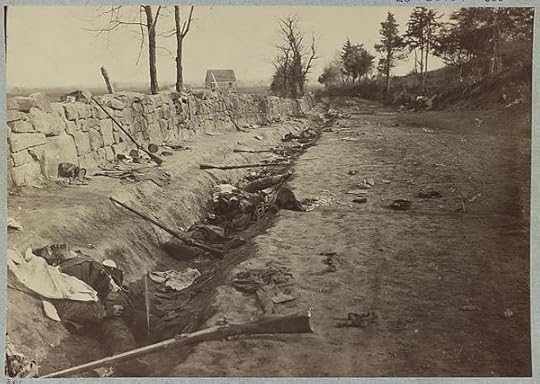
Confederate dead at Mayre's Heights, Fredericksburg, VA, May 3, 1863. This photo was
taken some fifteen minutes after Union troops successfully stormed the infamous stone wall. (Courtesy: Library of Congress)
In the next few days, the battered Army of the Potomac withdrew north of the Rappahannock and Lee retook Fredericksburg. Absorbing yet another calamity, Lincoln lamented: "My God, my God, what will the country say?" His close friend, reporter Noah Brooks, said, "Never, as long as I knew him, did he seem to be so broken up, so dispirited, and so ghostlike." Chancellorsville was called Lee's "perfect battle"—a description made plausible only when considering what would have happened to his army, had his gamble not paid off. The South could ill afford the high casualties he sustained, and no one could fill Stonewall Jackson's boots. (The first thing I ever read on Chancellorsville was a book aptly subtitled "Defeat In Victory.")
In mid-June, Lee marched his Army of Northern Virginia over the Blue Ridge and down the Shenandoah, beginning the invasion that would culminate in the three-day epic of Gettysburg. Hooker, still in command, wanted to use the chance to seize Richmond; Lincoln, who knew that destroying Lee and not capturing any city would bring victory, nixed the idea. It was a telling moment. Since Chancellorsville, Hooker's position had been shaky—his second-in-command, Major General Darius N. Couch, had even refused to continue serving under him. Shadowing the enemy while trying to shield Washington and Baltimore, Hooker fell into a relatively minor dispute with Army Headquarters and offered his resignation. Lincoln immediately accepted it, replacing him with the waspish but competent Major General George G. Meade on June 28.
"THE PRESIDENT SEEMED TO THINK HIM A LITTLE CRAZY"
So what the devil happened to Hooker at Chancellorsville? Reportedly he had given up whiskey for the campaign; some have suggested that from a psychological standpoint, it was exactly the wrong time to abandon the routine of liquid courage. Others have pointed to the crucial morning of May 3 at Hooker's headquarters, when a Rebel cannonball struck the pillar that he was leaning against, knocking him out for an hour. Suffering a concussion, he nonetheless refused to pass command to General Couch. But I think Hooker's basic problem was one he shared with all men who run primarily on bluster—a propellent that takes them only so far, past which a fundamental insecurity begins to surface and cripple their brains.
Apart from all that, though, we have to wonder: When Hooker asserted the country's need for a dictator, did he envision himself in that role? The authoritarian, the strongman, the "man on horseback?" Rising out of the turmoil to talk straight and point the way? To slash through all the red tape, legal niceties and prissy caveats? To kick ass and take names? To save the country? It's a sort of figure we've come to know on a global scale. Republican government was still relatively new in the American Civil War era—and to many, a dubious proposition. Cold aristocratic eyes gazed from Europe, willing the United States to tear itself apart and disprove its own precepts.
Generally defined, authoritarianism was history's ancient norm, by way of kings, queens and warlords. But a more modern and specific definition was dawning. Napoleon Bonaparte, revered by Northern and Southern military men alike, had already set the template. He was the daring upstart, the bold usurper, the national unifier, the martial genius—France's emperor not by lineage but by his own ambition, as well as the French people's acclaim. He premiered the characteristic central figure of authoritarianism, the Rugged Individualist Superman Of Destiny—or RISOD, as I'll refer to it from here on. To an extent, Fighting Joe fit the self-styled RISOD bill. He had the swagger, the grandiosity, the braggadocio. He was a clever man of action, blazingly free in his belittlement of others.
Napoleon Bonaparte (1769-1821), Emperor of France, template
for the Rugged Individualist Superman Of Destiny, or RISOD.
(Courtesy: Library of Congress)
But if there was one contemporary who met RISOD specs even more, it was another man whom Hooker had served under and come to despise: George Brinton McClellan, once hailed by Northern newspapers as the "Young Napoleon Of The West." On the heels of the embarrassing Union defeat at First Bull Run, 34-year-old Major General McClellan had arrived in Washington in late July, 1861, having scored two minor victories in western Virginia. Born of a wealthy and prominent Philadelphia family, he had graduated second in his class at West Point and served with distinction, even representing the U.S. as an observer in the Crimean War. He then had a creditable run in civilian life, as an official with the Illinois Central and the Ohio & Mississippi Railroads. Except for the malaria he contracted in the Mexican-American War, this was someone who had led a charmed life, without one major personal or professional setback.
The term "narcissist" had not yet been coined, but we may safely view Little Mac through that lens. A high proportion of talented narcissists achieve prominence in public life—and while all of us fall somewhere on the pathology spectrum, this sort of person is essentially different. Still, just an elite few qualify for full-on RISOD status. To call them "arrogant" falls breathtakingly short and is somehow beside the point, like dwelling on how cold it is at the South Pole. Confronted with their stratospheric self-regard, a regular sane person can only smile, maintain eye contact and slowly back out of the room. It is no wonder that presidential secretary John Hay said of Lincoln (a man who'd had plenty of setbacks in life), "The President seemed to think him {McClellan} a little crazy." And who's to say it wasn't a kind of crazy? Often enough, it sure looked that way.
QUAKER GUNS AND CIRCULAR MARCHING
To read McClellan's series of humblebrags to his worshipful wife (and what other kind of wife would a guy like this have?) is to face a choice: do you laugh or puke? But let's get it over with: "God has placed a great work in my hands . . . The people call upon me to save the country—I must save it & cannot respect anything that is in the way . . . I find myself in a new and strange position here—Presdt, Cabinet, Genl Scott & all deferring to me—by some strange operation of magic I seem to have become the power of the land . . . I almost think that were I to win some small success now I could become Dictator or anything else that might please me—but nothing of that kind would please me—therefore I won't be Dictator. Admirable self-denial!" Jesus Christ make him stop.
{For a magnificent cry-from-the-heart concerning the Young Napoleon, I recommend Mallory Ortberg's "Yellin' About McClellan" commentary in The Toast (http://the-toast.net/2014/03/24/i-hat...). And there's Bob Simpson's glorious installment in Crazytown, "McClellan Was An Asshole" (http://www.crazytownblog.com/crazytow...). Both pieces were inspired by their authors' reading Doris Kearns Goodwin's monumental Team Of Rivals: The Political Genius Of Abraham Lincoln.}
Of Little Mac's dispiriting tenure with the Army of the Potomac, here is a thumbnail version: There were his superb organizational skills that worked wonders on the army, whose men generally idolized him—but also, starting early, his wildly inflated estimates of enemy troop strength, while his own army's numbers were in fact much greater. And there was his public disdain for black people and Abolitionists (After the war, he would write, "I confess a prejudice in favor of my own race, & can't learn to like the odor of either Billy goats or niggers"); his friction with the aging general-in-chief, Lieutenant General Winfield Scott—a truly great soldier, whose ouster and title McClellan soon secured; his endless dithering, which let Confederate General Joseph Johnston's army slip away from Manassas and leave behind its "Quaker guns"—logs painted black, fake cannon used to dupe Yankee eyes; his loathing of Lincoln and other federal officials, even as they strove to meet his bottomless demands for men and materiel, and whose entreaties for action sent him on rants ("If General McClellan does not want to use the army, I would like to borrow it for a time," said the frustrated Lincoln.)
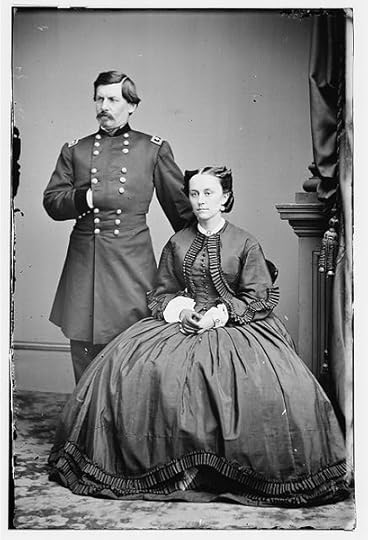
Major General George B. McClellan—superb organizer,
supreme egotist, poor fighter—with his wife Mary
Ellen Marcy McClellan. (Courtesy: Library of Congress)
And there was his spring 1862 offensive up the Peninsula, devolving into a massive snail's creep toward Richmond—while in McClellan's mind, the detective Allan Pinkerton's sloppy intelligence-gathering further magnified the enemy's size, as did some clever Confederate fakery (In Lucifer's Drum, Nathaniel Truly recounts how the Rebs marched in circles to make their Yorktown garrison seem much bigger than it was—and how his boss Pinkerton rejected this report, prompting Truly's cussing resignation); within shouting distance of the Confederate capital—his much faster withdrawal, his nerves unravelling in the Seven Days' Battles; his refusal to reinforce Major General John Pope, one factor in the latter's rout at Second Bull Run; at last, the tragedy of the Maryland Campaign, when he failed to exploit the discovery that Lee's forces were split in four (as revealed in the infamous "Lost Order")—and in the blood-soaked clash at Antietam (September 17, 1862), when he refused to commit his reserves and finish off the outnumbered Lee. On November 5, Lincoln finally sacked him and put in Burnside. In the Presidential race two years later, God called McClellan to "save the country" yet again by running against Lincoln—but Lincoln and the country whomped him, in ungodly fashion.
McCLELLAN'S BODY GUARD
"Self-esteem: an erroneous opinion of oneself."—Ambrose Bierce, The Devil's Dictionary
In the Rugged Individualist Superman Of Destiny, along with the knightly poses and planet-sized self-esteem, with all the God talk and/or Destiny talk, with the flag-draped appeals to "greatness" and "toughness" and "nerve" and "will" (see Triumph Of The), there is a deep well of contempt for others. It is part of what drives him, intensifying as he encounters disagreement and other human obstacles—which, like the authoritarianism he embodies, the RISOD is just not built to tolerate. For him it guarantees chronic rage: how can other people be so stupid, so unpatriotic, such losers? But when things go really bad for him, there is an even deeper well that he draws upon, of self-pity. Self-pity is what Mao Tse Tung reflexively fell into when other Communist Party officials curtailed his power in the early 1960's, after his Great Leap Forward had triggered famine and claimed millions of Chinese lives. (He would later wreak grand-scale RISOD revenge on those officials, when he and his wife launched the ruinous Cultural Revolution.) And self-pity was as much Hitler's refuge as his Berlin bunker in 1945, when he issued the "Nero Decree"—a scorched-earth order to destroy all remaining German industry, transport and supplies—the German people having proven themselves unworthy of him. Reichsminister Albert Speer fortunately disobeyed the order.
But the most central RISOD characteristic, the one that feeds all the others like a vast noxious reservoir, is his relationship with reality. When it comes to truth-telling, the RISOD cuts himself all kinds of slack—because if he is divinely favored, if his cause is by definition just and holy, isn't he right to do or say whatever it takes? Yet at a certain point, it becomes moot whether he is consciously lying or propounding an actual belief, since he sees just what his self-flattering conclusions require him to see. He maintains what amounts to an alternate universe. When it comes to convincing others, the RISOD has the advantage of utterly believing his own propaganda, even if he knows he's fudging the specifics a bit. It's how he's able to conceive himself as a popular hero, conflating his own will with that of The People.
And this talent isn't just an abstract thing. Like a hallucinatory drug, it can edit real-life experience into whatever the RISOD wants. In a letter to his wife, McClellan oozed pity as he recounted the departure of his erstwhile superior and antagonist Winfield Scott: "It was a feeble old man scarce able to walk—hardly any one there to see him off but his successor." But according to the newspapers, a large crowd had gathered at the rail depot to wish Scott a fond farewell, along with both generals' staff members, a cavalry escort and two cabinet secretaries—in a pre-dawn downpour, no less. "Memory is a gentleman," they say—but to McClellan's vanity, it was a slave.
Armed with this pliant view of reality, the RISOD may indulge another of his important traits: blame deflection. (In this area, Napoleon actually seems a cut above the wannabes he spawned, if it's true that he said, "I have been mistaken so often, I no longer blush for it.") McClellan was typical of the breed. Like any general's, his orders implicitly urged personal responsibility on the part of subordinates and government functionaries, who he was quick to blame for whatever went wrong. But God forbid that anyone dare call him to account. When his troops under Brigadier General Charles P. Stone were shattered at Ball's Bluff, the worst decisions of that day (Oct. 21, 1861) were not McClellan's—but he was guilty of poor communication. Still he let the U.S. Congress Joint Committee on the Conduct of the War scapegoat Stone, who was arrested and imprisoned.
To his wife, McClellan wrote, "The whole thing took place some 40 miles from here without my orders or knowledge. It was entirely unauthorized by me & I am in no manner responsible for it." Had that even been true, an overall commander is supposed to take responsibility for any major action that happens on his watch—but this was the opposite of a stand-up guy. On the Peninsula months later, withdrawing before an enemy half the size that he imagined, McClellan telegraphed Secretary of War Stanton thus: "I have lost this battle because my force was too small. I again repeat that I am not responsible for this . . . If I save this army now, I tell you plainly I owe no thanks to you or any other persons in Washington. You have done your best to sacrifice this army." I find it hard not to see this capacity for denial as essential cowardice.
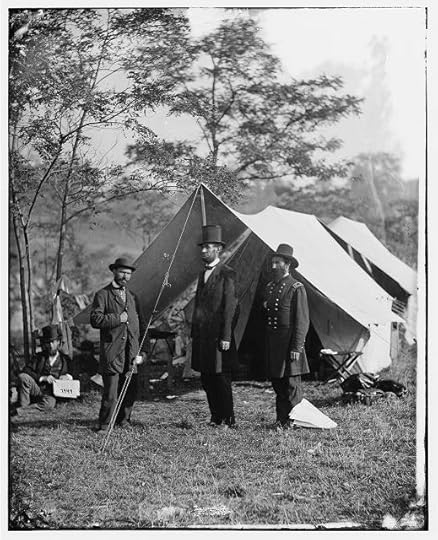
Lincoln visiting the Army of the Potomac at Antietam, October 3,
1862, posed with Major General John A. McClernand (right) and
chief detective Allan Pinkerton (left). (Courtesy: Library of Congress)
"Cowardice" is an awfully easy word to throw around, especially for a 21st-Century noncombatant and non-politician. Still, when you look at the RISOD's self-image and public image and then at the recorded facts, the ironies just won't quit. For instance: so much of his sales pitch is about decisiveness—the bracing clarity it brings, the banishment of doubt. It can play well for a time, if enough people are convinced to indulge their black-and-white thinking—some who have reservations might even say, "Well, at least he's decisive. A Leader." But what looks/sounds like decisiveness can end up being mere dismissiveness in disguise—a lazy reflex, and one that bears a striking resemblance to stupidity. It always brings trouble. And as trouble mounts and pressure grows, beneath all the iron certainty, a worm of doubt starts eating away. Doubt, all the more ravenous for its long suppression.
Failure doesn't necessarily follow—the public-image juggernaut can take its owner quite a distance, on sheer momentum. No less a RISOD paragon than Hitler was called (behind his back) a Teppichfresser, a "carpet-eater," owing to his paroxysms of rage when major decisions weighed on him and he could make no call. Journalist and historian William L. Shirer glimpsed Hitler in the midst of the 1938 Munich Crisis and wrote, "he seemed to be on the edge of a nervous breakdown," with physical tics and a look of insomnia. Munich resulted in a great expansionist coup for the Feuhrer, with France and England backing down before his threats. Yet in the war that commenced a year later, at such crucial points as the Normandy Invasion, his high-strung indecisiveness would doom the Nazi cause.
The RISOD cult also has much to do with physical bravery. Its poster boys may in fact show flashes of this in their youth—but as they rise in the world, as the loss of their wondrous selves becomes a harder and harder thought to bear, an obsession with personal safety overtakes them. Threats surely do exist—these are controversial men, after all, who stir up hatred and become targets thereby. If you are someone on the scale of Hitler or Stalin, an enflamed paranoia will even prove sensible—because they definitely are out to get you. But in most cases, the fear is disproportionate—enough to hurt the RISOD's strutting sense of Destiny, as well as his job performance. In his 1922 power-grabbing March On Rome, Benito Mussolini had photos taken of himself marching alongside black-shirted fellow fascists, then high-tailed it back to Milan to see how the confrontation unfolded, far from its danger. Twenty or so years later, when he visited Axis forces in North Africa, German soldiers disdainfully noted his unwillingness to go anywhere near the action.
And McClellan, who shared Il Duce's sense of self-worth? He kept his headquarters far behind the battlefront—on the Peninsula and also at Antietam, so far that it hampered his awareness of events. During the Battle of Malvern Hill (July 1, 1862), McClellan stayed safely aboard a gunboat on the James River while his rear guard repelled the pursuing Rebels. "I must not unnecessarily risk my life," he wrote to his wife, "—for the fate of my army depends on me & they all know it." (For the love of God, Mrs. M., didn't you ever get tired of this??) In his gripping and masterful Landscape Turned Red: The Battle of Antietam, historian Stephen W. Sears writes of how McClellan hated to lose a single soldier. Compassion—something I'm sure the general was capable of feeling—can be inferred. But as a dominant factor, something else deserves consideration.
It's the nature of the narcissist, the megalomaniac, the RISOD, to see other people as just an extension of himself. Friends, spouses, children—armies. In the Army of the Potomac—that magnificent machine that he had built—how could McClellan not see such a giant self-extension? And how could he not react with horror at its maiming, real or potential? President Lincoln was on to something when, during his visit to the army two weeks after Antietam (and one month before McClellan's dismissal), he gestured toward the legion tents and asked his companion, Illinois Secretary of State Ozias M. Hatch, "Hatch, what is all this?" Hatch replied, "Why, Mr. Lincoln, this is the Army of the Potomac." And Lincoln responded: "No, Hatch, no. This is General McClellan's body-guard."
"LET US BE VIGILANT, BUT KEEP COOL"
In the end, of course, it was neither McClellan nor any other RISOD who vanquished the Confederacy. That achievement, more than any two figures, belonged to Lincoln and Ulysses S. Grant—men of modest bearing, grounded and confident but without bravado. Each absorbed the pain of disaster with an unclouded mind. Each seemed uncannily suited to the trial—Lincoln in particular, as has often been said. Under enormous pressure, he had the judgment to resist the tidal pull of authoritarianism, to push the Constitutional envelope without tearing it. With a priceless combination of skill and principle, he was able to launch Emancipation (at some political cost) and then the Thirteenth Amendment, chattel slavery's tombstone. He had the steady temperament for crises. When Jubal Early's Raid (the pivotal historic event for Lucifer's Drum) threatened D.C. and Baltimore, he kept his public words calm and simple: "Let us be vigilant, but keep cool." His multiple strengths made him an ideal vessel for the nation's suffering. In his last photographic portrait, four days before his murder, we behold the majestic ruin of a man—sandblasted by sorrow and strain, yet with his soul entirely there.
In 1888-89, France saw the sudden rise of general and politician Georges Ernest Boulanger. The nation was in turmoil, though nothing that approached what the United States had faced some 25 years earlier, or what France itself had faced after its defeat by Germany in the Franco-Prussian War (1870-71). Boulanger was a populist hero, a bellicose patriot with strong support among monarchists and traditional Catholics, as well as the working class. In his time as War Minister, his advocacy of revenge against Germany earned him the name General Revanche (Revenge) and—no surprise—the backing of Bonapartists. A literal "man on horseback" (his horse was black and picturesque), he cut a dashing figure despite his poor oratory and vague ideas. The song "Boulanger Is The One We Need" whipped up excitement for him and the movement he led—Boulangisme, a patchwork of political elements that reviled the republican government, tilting conservative and authoritarian overall.
The government fought but could not stop his election to the Chamber of Deputies, representing Paris. Immediately after this (January 27, 1889), partisans urged him to lead a coup d'etat and become military dictator. It seemed imminent. But seized by indecision, Boulanger took shelter at the house of his mistress and could not be found. His magic moment having passed, the government brought charges of conspiracy and treason against him—and to the shock of his followers, he fled the country. In September 1891, at a Brussels cemetery, Boulanger stood over the grave of his recently deceased mistress and shot himself in the head.
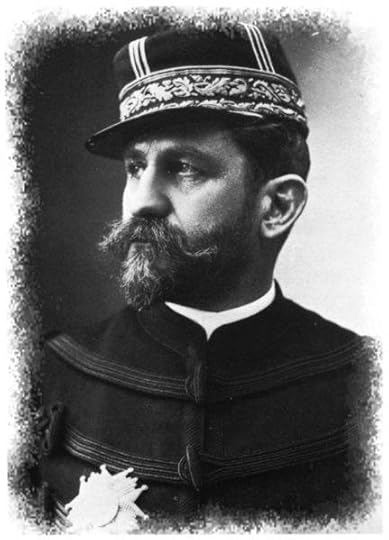
General Georges Ernest Boulanger (1837-91), would-be
political savior of France. (Courtesy: Library of Congress)
I offer Boulanger as a chance to marvel—that in its worst four years, despite everything, the United States experienced no similar close call. I offer him too as an example of boilerplate RISOD. Like McClellan, Boulanger was far from the worst of his kind, in part because he failed. For the worst of them, for the truly successful Rugged Individualist Supermen Of Destiny, we look to the 20th Century: the more focused isms, the more artful disinformation, the midnight purges and secret police, the gulags and extermination camps and wars of conquest. But in history's rearview mirror, viewed simply as men, they all look less like messiahs and more like preening blowhards—loud but small, clownish, strangely weak.
Americans should avoid self-congratulation on never having had such a figure in highest office—because there have been some pretty ruthless occupants, regardless. Besides, it could just be more of our relative good fortune—that the right events haven't yet collided within the right state of decay. Because whenever people pour into ideological cul de sacs, when they care less about facts than about how they feel, when demagoguery goes mainstream, and when what Joan Didion called "the thin whine of hysteria" is constant, the RISOD peril looms large. Yuge, in fact.
"In looking over the orders I find nothing of moment, save one in which the President commutes the death punishment of all deserters to imprisonment during the war. Poor, weak, well meaning Lincoln!"
—from the diary of Colonel Charles S. Wainwright, Chief of Artillery, Fifth Corps, Army of the Potomac, June 30, 1864
In his dim view of Abraham Lincoln's nerve and competence, Colonel Wainwright was hardly alone among Union officers, men chronically frustrated over the war's prosecution. William Tecumseh Sherman, a colonel in March of 1861, came away exasperated from his first meeting with the new President, judging him naive about what Southern secession meant and the national trauma it would bring. Sherman's take on Lincoln improved over the war's tumultuous course. Still, on the eve of the 1864 Presidential election and ultimate Northern victory, Sherman's core ambivalence remained. "I am almost in despair of popular Government," the general wrote to his brother, Ohio Senator John Sherman, "but if we must be so inflicted I suppose Lincoln is the best choice, but I am not a voter."
On the political side, harsher assessments issued from the Republican left. When Lincoln did not declare immediate Emancipation in the days after Fort Sumter, Abolitionist firebrand William Lloyd Garrison accused him of "unwittingly helping to prolong the war, and to render the result more and more doubtful! If he is 6 feet 4 inches high, he is only a dwarf in mind!" And when Lincoln's year-end message to Congress pledged (vainly, God knows) to prevent the war from becoming "a violent, remorseless revolutionary struggle," Garrison's rancor surged again: "What a wishy-washy message from the President! He has evidently not a drop of anti-slavery blood in his veins."
Frederick Douglass, who would come to admire Lincoln and in the end declare him "emphatically the black man's president," spent much of the war's first half spitting rhetorical nails in his direction. So did that Radical titan Congressman Thaddeus Stevens of Pennsylvania, of whom historian Allan Nevins wrote, "In brooding over what he regarded as Lincoln's delays and excessive generosity, Stevens sometimes exhibited a frenzy of anger." Michigan Senator Zachariah Chandler, a pillar of Abolitionism, declared, "The President is a weak man, too weak for the occasion." And Maine Senator William Pitt Fessenden huffed, "If the President had his wife's will and would use it rightly, our affairs would look much better."
Last portrait of Abraham Lincoln, April 10, 1865, four
days before his assassination. (Courtesy: Library of Congress)
Meanwhile, of course, the political right strafed Lincoln without letup. Despite a soldierly scorn for politics, Colonel Wainwright expressed what many War Democrats thought when he described the President as "completely in the hands of the radicals of his party." Democratic Governor Horatio Seymour of New York, who opposed Lincoln on Emancipation as well as the Draft, accused his administration of "military despotism." Above all there was the virulent Copperhead or Peace Democrat movement, drawing from the North's "doughface" (pro-Southern) element (see https://www.goodreads.com/author_blog...). Reacting to Emancipation, the Draft and the sporadic suspension of habeas corpus, Copperhead spokesmen often made today's Talk Radio hosts sound like the soul of forbearance. Wisconsin editor Marcus "Brick" Pomeroy of the LaCrosse Democrat called Lincoln "fungus from the corrupt womb of bigotry and fanaticism . . . a worse tyrant and more inhuman butcher than has existed since the days of Nero," before going on to urge the President's assassination. (It's unknown if Pomeroy noted that these statements did not land him in jail—in time of war, no less.) An Ohio editor stated that the Abolition and conscription agenda of "the despot Lincoln" would bring him "the fate he deserves: hung, shot or burned." And the pre-eminent Copperhead champion, Ohio Congressman Clement L. Vallandigham, excoriated the President as "King Lincoln."
When you are the low-born leader of a country neck-deep in crisis—in its bloodiest war, say, and a Civil one besides—and trying your best to shepherd it through, maneuvering among the varied factions, marshaling governmental powers to meet the challenge, willing to take emergency measures yet mindful of legal precedent, facing fierce enemies both at home and on the battlefield, you will be subject to a whole range of insult. When the war is not going well, as it often won't be, military men will call you meddling and incompetent. Thundering egotists among them—Major General George B. McClellan, for instance—will even refer to you as "an idiot," "a well meaning baboon" and "the original gorilla."
But the most merciless criticism will come from the political sphere, where men of greater wealth and education—men who imagine how much better they would have done in your place—regard you as a rube and see your struggles as their judgment's confirmation. Idealogical allies, impatient with your administration's progress toward cherished goals, will call you soft, spineless, feckless, weak-kneed, a poor leader. And idealogical foes will deliver the opposite charge, calling you a tyrannical monster. A remarkable few might even manage to call you weak and diabolically effective, depending on which feels best at the moment.
Union Major General Joseph "Fighting Joe" Hooker, partial to dictatorship. (Courtesy:
Library of Congress)
In Lincoln's case, a lot of this bile came from an understandable horror and frustration over the war. Some of it came from that deep-seated American addiction to moral outrage, or at least the ennobling sound of it, combined with an uncomplicated idea of how much power a President actually has. Some of it came from a shallow commitment to democracy, with its creaky workings, endless debate and the chance that things won't always go your way. Some it came from pure wackjob hysteria, with racial animus as its tinder. And some of it, once in a while, was fair. An activist like Frederick Douglass, for example, could hardly be faulted for chafing over the delays in African American recruitment—which, when it did come about, proved indispensable to victory. Nor could Negro leaders be fairly criticized for rejecting Lincoln's August 1862 proposal of black colonization in Central America. (The eminent historian Eric Foner has, nevertheless, observed that Lincoln's doubts concerning black assimilation arose from his view of white racism as its chief impediment—something that placed him ahead of most whites on that subject.) And Lincoln's military critics were not always off base. During T.J. "Stonewall" Jackson's spring 1862 rampage in the Shenandoah Valley, Lincoln's flurry of orders played into the wily Jackson's ploy to divert Union forces, three of which separately pursued but did not catch him. And given the President's sensitivity to public opinion, he was capable of giving the kind of contradictory order that he gave Ulysses S. Grant at Petersburg, directing him to make a strong attack but keep casualties minimal.
Yet nothing summed up political and military discontent with Lincoln like Major General Joseph "Fighting Joe" Hooker's whiskey-fueled comment in late January, 1863.
"I WILL RISK THE DICTATORSHIP"
Along with the entire Army of the Potomac, corps commander Hooker had just endured that army's latest morale-stomping failure: the Mud March, when General-in-Chief Ambrose E. Burnside tried to cross the Rappahannock and outflank Robert E. Lee, but was thwarted by a three-day rainstorm. Bad luck is unforgivable in a commander—but in mid-December, at the Battle of Fredericksburg, Burnside had shown bad judgment too. Ignoring Hooker's protests, he had thrown wave after wave of Union boys against Lee's defenses on Mayre's Heights and suffered a crushing defeat. Now Hooker, disgusted once more with his superior, castigated him to any who would listen. He also criticized the Union's state of affairs more broadly, and a New York Times reporter relayed the gist of it: "Nothing would go right until we had a dictator, and the sooner the better."
With the Mud March and with discord among his subordinates, Burnside's fortunes were played out and Lincoln named "Fighting Joe" to replace him. It was an obvious and popular choice. Since the Second Seminole and Mexican-American Wars, Hooker had earned his nickname many times over. And since McClellan's Peninsular Campaign the previous spring, he had proven himself a brave and aggressive field commander who cared deeply about his men. At Antietam, his corps hammered the Confederate left and took tremendous casualties, with Hooker himself wounded in the foot. (In my novel Lucifer's Drum, Bartholomew Forbes loses his leg at Antietam while under Hooker's command.) He was also known for hard drinking and prostitutes. Though the general and the term "hooker" have no connection, he certainly made one seem plausible—his headquarters at Falmouth, VA was described as part saloon and part brothel. And a red-light section of Washington, D.C. was called "Hooker's Division" in his honor. He was known too for denigrating fellow generals—chiefly McClellan, whose irrational fears and risk-aversion doomed the Peninsular Campaign and kept him from destroying Lee at Antietam, and Burnside for the Fredericksburg disaster. Hooker was indiscreet—but in those two cases, he was also right.
Having appointed Hooker, Lincoln sent him a letter admonishing him for his efforts to undermine Burnside, "a brother officer" who the President regarded as a good man simply over his head. He also said, more cooly: "I have heard, in such way as to believe it, of your recently saying that both the Army and the Government needed a Dictator. Of course it was not for this, but in spite of it, that I have given you the command. Only those generals who gain success can set up dictators. What I now ask of you is military success, and I will risk the dictatorship."
Over the next three months, however, Hooker revealed himself as a gifted and energetic administrator. His improvements in training, food, sanitation, medical care and the furlough system brought army morale back from the depths and desertions down to a trickle. His creation of the Bureau of Military Information under the capable Colonel George Sharpe (Bart Forbes' superior in Lucifer's Drum) would eventually bear marvelous fruit. His introduction of corps badges promoted pride and made units more identifiable to one another when on the march. Last but not least, his reorganization of the cavalry as a single corps made it more effective against Southern horsemen, who had been so plainly superior thus far. And with the coming of spring, Hooker was able to crow: "I have the finest army on the planet. I have the finest army the sun ever shone on . . . If the enemy does not run, God help them. May God have mercy on General Lee, for I will have none."
Print from the Battle of Chancellorsville, May 2, 1863. In right foreground, Confederate General Stonewall Jackson's fatal wounding by his own men. (Courtesy: Library of Congress)
CHANCELLORSVILLE: A BOAST DROWNED IN BLOOD
For a present-day American whose sympathies tilt Union, reading about Hooker's dazzling plan to smash Lee—and its dazzling execution, at first—can bring a pang. In late April, screened by cavalry, three of his corps swiftly forded the Rappahannock and the Rapidan, then swung southeast to envelop Lee (whose army totaled less than half of Hooker's 134,000-man behemoth) in the rear and left flank. Two more corps under Major General John Sedjwick remained in front of Fredericksburg to focus Rebel concern; another corps and a division were poised upriver, ready to reinforce either Sedjwick or Hooker's main body. On the evening of April 30, that main body was camped around a crossroads mansion called Chancellorsville, amid a thick second-growth forest called The Wilderness. To his troops, Hooker declared that the enemy "must either ingloriously fly, or come out from behind his defenses and give us battle on our own ground, where certain destruction awaits him." His cockiness peaked the next day, even as his advancing force hit a solid line of Confederate infantry and artillery. "The rebel army is the legitimate property of the Army of the Potomac," he proclaimed.
But the Confederates' scrappy first response caused something strange to happen, deep inside Hooker. Wondering if enemy strength was greater than had been thought, he hesitated, then withdrew back to Chancellorsville to think things out. In this fateful hour—with the plan working and glory in his grasp—he caught a case of existential vertigo. That same evening, Lee and Stonewall Jackson—two men alien to such vertigo—sat side by side on a cracker box and worked out a spectacular counter-stroke, one that defied all military convention. Jackson with 25,000 men would march wide to the southwest around Hooker's right flank, while Lee with 20,000 continued to fight him in front. The army's remainder would be left on Mayre's Heights to face Sedjwick.
Jackson's march through the tangled growth took most of May 2. When Yankee advance units reported the movement, Hooker decided it was just part of Lee's army in retreat and sent two divisions after it. And that evening, when Jackson launched his Rebel-yell attack on Hooker's oblivious right, there was hell to pay (as depicted through Ben Truly's memory of it in Lucifer's Drum). An entire Union corps was overrun and scattered through the woods. In the savage night's confusion, troops of both sides blindly fired upon their own—and presently, this claimed Jackson himself. Mistaking his party for Yankee cavalry, a North Carolina unit raked it with fire and wounded the great general. His left arm amputated, Jackson survived a week before dying of pneumonia, to the lasting sorrow of Lee and the non-enslaved South.
One more gaping fact eluded Hooker and his staff on the morning of May 3: in the face of superior numbers, Lee had daringly split his main force in two. A more engaged commander would have grasped this and ordered an attack from the Union-held high ground at Hazel Grove, driving between the two halves and destroying them in turn. But in his mental paralysis, Hooker gave no such order. Instead he let Lee capture Hazel Grove and reunite his forces, which converged on Chancellorsville as the lumbering Union retreat began. Lee arrived on the scene to the wild cheers of his victorious, powder-blackened troops. Back at Fredericksburg, meanwhile, Sedjwick crossed the Rappahannock and successfully stormed Mayre's Heights, accomplishing what Burnside had so sadly failed to do in December. But he then dallied as General Jubal A. Early (a major character in Lucifer's Drum) conducted a stiff fighting retreat, preventing Sedjwick from coming to Hooker's aid. So ended the second bloodiest day in U.S. history (21,357 casualties), next to Antietam. And so ended Joe Hooker's dream of being the Union's savior.
Confederate dead at Mayre's Heights, Fredericksburg, VA, May 3, 1863. This photo was
taken some fifteen minutes after Union troops successfully stormed the infamous stone wall. (Courtesy: Library of Congress)
In the next few days, the battered Army of the Potomac withdrew north of the Rappahannock and Lee retook Fredericksburg. Absorbing yet another calamity, Lincoln lamented: "My God, my God, what will the country say?" His close friend, reporter Noah Brooks, said, "Never, as long as I knew him, did he seem to be so broken up, so dispirited, and so ghostlike." Chancellorsville was called Lee's "perfect battle"—a description made plausible only when considering what would have happened to his army, had his gamble not paid off. The South could ill afford the high casualties he sustained, and no one could fill Stonewall Jackson's boots. (The first thing I ever read on Chancellorsville was a book aptly subtitled "Defeat In Victory.")
In mid-June, Lee marched his Army of Northern Virginia over the Blue Ridge and down the Shenandoah, beginning the invasion that would culminate in the three-day epic of Gettysburg. Hooker, still in command, wanted to use the chance to seize Richmond; Lincoln, who knew that destroying Lee and not capturing any city would bring victory, nixed the idea. It was a telling moment. Since Chancellorsville, Hooker's position had been shaky—his second-in-command, Major General Darius N. Couch, had even refused to continue serving under him. Shadowing the enemy while trying to shield Washington and Baltimore, Hooker fell into a relatively minor dispute with Army Headquarters and offered his resignation. Lincoln immediately accepted it, replacing him with the waspish but competent Major General George G. Meade on June 28.
"THE PRESIDENT SEEMED TO THINK HIM A LITTLE CRAZY"
So what the devil happened to Hooker at Chancellorsville? Reportedly he had given up whiskey for the campaign; some have suggested that from a psychological standpoint, it was exactly the wrong time to abandon the routine of liquid courage. Others have pointed to the crucial morning of May 3 at Hooker's headquarters, when a Rebel cannonball struck the pillar that he was leaning against, knocking him out for an hour. Suffering a concussion, he nonetheless refused to pass command to General Couch. But I think Hooker's basic problem was one he shared with all men who run primarily on bluster—a propellent that takes them only so far, past which a fundamental insecurity begins to surface and cripple their brains.
Apart from all that, though, we have to wonder: When Hooker asserted the country's need for a dictator, did he envision himself in that role? The authoritarian, the strongman, the "man on horseback?" Rising out of the turmoil to talk straight and point the way? To slash through all the red tape, legal niceties and prissy caveats? To kick ass and take names? To save the country? It's a sort of figure we've come to know on a global scale. Republican government was still relatively new in the American Civil War era—and to many, a dubious proposition. Cold aristocratic eyes gazed from Europe, willing the United States to tear itself apart and disprove its own precepts.
Generally defined, authoritarianism was history's ancient norm, by way of kings, queens and warlords. But a more modern and specific definition was dawning. Napoleon Bonaparte, revered by Northern and Southern military men alike, had already set the template. He was the daring upstart, the bold usurper, the national unifier, the martial genius—France's emperor not by lineage but by his own ambition, as well as the French people's acclaim. He premiered the characteristic central figure of authoritarianism, the Rugged Individualist Superman Of Destiny—or RISOD, as I'll refer to it from here on. To an extent, Fighting Joe fit the self-styled RISOD bill. He had the swagger, the grandiosity, the braggadocio. He was a clever man of action, blazingly free in his belittlement of others.
Napoleon Bonaparte (1769-1821), Emperor of France, template
for the Rugged Individualist Superman Of Destiny, or RISOD.
(Courtesy: Library of Congress)
But if there was one contemporary who met RISOD specs even more, it was another man whom Hooker had served under and come to despise: George Brinton McClellan, once hailed by Northern newspapers as the "Young Napoleon Of The West." On the heels of the embarrassing Union defeat at First Bull Run, 34-year-old Major General McClellan had arrived in Washington in late July, 1861, having scored two minor victories in western Virginia. Born of a wealthy and prominent Philadelphia family, he had graduated second in his class at West Point and served with distinction, even representing the U.S. as an observer in the Crimean War. He then had a creditable run in civilian life, as an official with the Illinois Central and the Ohio & Mississippi Railroads. Except for the malaria he contracted in the Mexican-American War, this was someone who had led a charmed life, without one major personal or professional setback.
The term "narcissist" had not yet been coined, but we may safely view Little Mac through that lens. A high proportion of talented narcissists achieve prominence in public life—and while all of us fall somewhere on the pathology spectrum, this sort of person is essentially different. Still, just an elite few qualify for full-on RISOD status. To call them "arrogant" falls breathtakingly short and is somehow beside the point, like dwelling on how cold it is at the South Pole. Confronted with their stratospheric self-regard, a regular sane person can only smile, maintain eye contact and slowly back out of the room. It is no wonder that presidential secretary John Hay said of Lincoln (a man who'd had plenty of setbacks in life), "The President seemed to think him {McClellan} a little crazy." And who's to say it wasn't a kind of crazy? Often enough, it sure looked that way.
QUAKER GUNS AND CIRCULAR MARCHING
To read McClellan's series of humblebrags to his worshipful wife (and what other kind of wife would a guy like this have?) is to face a choice: do you laugh or puke? But let's get it over with: "God has placed a great work in my hands . . . The people call upon me to save the country—I must save it & cannot respect anything that is in the way . . . I find myself in a new and strange position here—Presdt, Cabinet, Genl Scott & all deferring to me—by some strange operation of magic I seem to have become the power of the land . . . I almost think that were I to win some small success now I could become Dictator or anything else that might please me—but nothing of that kind would please me—therefore I won't be Dictator. Admirable self-denial!" Jesus Christ make him stop.
{For a magnificent cry-from-the-heart concerning the Young Napoleon, I recommend Mallory Ortberg's "Yellin' About McClellan" commentary in The Toast (http://the-toast.net/2014/03/24/i-hat...). And there's Bob Simpson's glorious installment in Crazytown, "McClellan Was An Asshole" (http://www.crazytownblog.com/crazytow...). Both pieces were inspired by their authors' reading Doris Kearns Goodwin's monumental Team Of Rivals: The Political Genius Of Abraham Lincoln.}
Of Little Mac's dispiriting tenure with the Army of the Potomac, here is a thumbnail version: There were his superb organizational skills that worked wonders on the army, whose men generally idolized him—but also, starting early, his wildly inflated estimates of enemy troop strength, while his own army's numbers were in fact much greater. And there was his public disdain for black people and Abolitionists (After the war, he would write, "I confess a prejudice in favor of my own race, & can't learn to like the odor of either Billy goats or niggers"); his friction with the aging general-in-chief, Lieutenant General Winfield Scott—a truly great soldier, whose ouster and title McClellan soon secured; his endless dithering, which let Confederate General Joseph Johnston's army slip away from Manassas and leave behind its "Quaker guns"—logs painted black, fake cannon used to dupe Yankee eyes; his loathing of Lincoln and other federal officials, even as they strove to meet his bottomless demands for men and materiel, and whose entreaties for action sent him on rants ("If General McClellan does not want to use the army, I would like to borrow it for a time," said the frustrated Lincoln.)
Major General George B. McClellan—superb organizer,
supreme egotist, poor fighter—with his wife Mary
Ellen Marcy McClellan. (Courtesy: Library of Congress)
And there was his spring 1862 offensive up the Peninsula, devolving into a massive snail's creep toward Richmond—while in McClellan's mind, the detective Allan Pinkerton's sloppy intelligence-gathering further magnified the enemy's size, as did some clever Confederate fakery (In Lucifer's Drum, Nathaniel Truly recounts how the Rebs marched in circles to make their Yorktown garrison seem much bigger than it was—and how his boss Pinkerton rejected this report, prompting Truly's cussing resignation); within shouting distance of the Confederate capital—his much faster withdrawal, his nerves unravelling in the Seven Days' Battles; his refusal to reinforce Major General John Pope, one factor in the latter's rout at Second Bull Run; at last, the tragedy of the Maryland Campaign, when he failed to exploit the discovery that Lee's forces were split in four (as revealed in the infamous "Lost Order")—and in the blood-soaked clash at Antietam (September 17, 1862), when he refused to commit his reserves and finish off the outnumbered Lee. On November 5, Lincoln finally sacked him and put in Burnside. In the Presidential race two years later, God called McClellan to "save the country" yet again by running against Lincoln—but Lincoln and the country whomped him, in ungodly fashion.
McCLELLAN'S BODY GUARD
"Self-esteem: an erroneous opinion of oneself."—Ambrose Bierce, The Devil's Dictionary
In the Rugged Individualist Superman Of Destiny, along with the knightly poses and planet-sized self-esteem, with all the God talk and/or Destiny talk, with the flag-draped appeals to "greatness" and "toughness" and "nerve" and "will" (see Triumph Of The), there is a deep well of contempt for others. It is part of what drives him, intensifying as he encounters disagreement and other human obstacles—which, like the authoritarianism he embodies, the RISOD is just not built to tolerate. For him it guarantees chronic rage: how can other people be so stupid, so unpatriotic, such losers? But when things go really bad for him, there is an even deeper well that he draws upon, of self-pity. Self-pity is what Mao Tse Tung reflexively fell into when other Communist Party officials curtailed his power in the early 1960's, after his Great Leap Forward had triggered famine and claimed millions of Chinese lives. (He would later wreak grand-scale RISOD revenge on those officials, when he and his wife launched the ruinous Cultural Revolution.) And self-pity was as much Hitler's refuge as his Berlin bunker in 1945, when he issued the "Nero Decree"—a scorched-earth order to destroy all remaining German industry, transport and supplies—the German people having proven themselves unworthy of him. Reichsminister Albert Speer fortunately disobeyed the order.
But the most central RISOD characteristic, the one that feeds all the others like a vast noxious reservoir, is his relationship with reality. When it comes to truth-telling, the RISOD cuts himself all kinds of slack—because if he is divinely favored, if his cause is by definition just and holy, isn't he right to do or say whatever it takes? Yet at a certain point, it becomes moot whether he is consciously lying or propounding an actual belief, since he sees just what his self-flattering conclusions require him to see. He maintains what amounts to an alternate universe. When it comes to convincing others, the RISOD has the advantage of utterly believing his own propaganda, even if he knows he's fudging the specifics a bit. It's how he's able to conceive himself as a popular hero, conflating his own will with that of The People.
And this talent isn't just an abstract thing. Like a hallucinatory drug, it can edit real-life experience into whatever the RISOD wants. In a letter to his wife, McClellan oozed pity as he recounted the departure of his erstwhile superior and antagonist Winfield Scott: "It was a feeble old man scarce able to walk—hardly any one there to see him off but his successor." But according to the newspapers, a large crowd had gathered at the rail depot to wish Scott a fond farewell, along with both generals' staff members, a cavalry escort and two cabinet secretaries—in a pre-dawn downpour, no less. "Memory is a gentleman," they say—but to McClellan's vanity, it was a slave.
Armed with this pliant view of reality, the RISOD may indulge another of his important traits: blame deflection. (In this area, Napoleon actually seems a cut above the wannabes he spawned, if it's true that he said, "I have been mistaken so often, I no longer blush for it.") McClellan was typical of the breed. Like any general's, his orders implicitly urged personal responsibility on the part of subordinates and government functionaries, who he was quick to blame for whatever went wrong. But God forbid that anyone dare call him to account. When his troops under Brigadier General Charles P. Stone were shattered at Ball's Bluff, the worst decisions of that day (Oct. 21, 1861) were not McClellan's—but he was guilty of poor communication. Still he let the U.S. Congress Joint Committee on the Conduct of the War scapegoat Stone, who was arrested and imprisoned.
To his wife, McClellan wrote, "The whole thing took place some 40 miles from here without my orders or knowledge. It was entirely unauthorized by me & I am in no manner responsible for it." Had that even been true, an overall commander is supposed to take responsibility for any major action that happens on his watch—but this was the opposite of a stand-up guy. On the Peninsula months later, withdrawing before an enemy half the size that he imagined, McClellan telegraphed Secretary of War Stanton thus: "I have lost this battle because my force was too small. I again repeat that I am not responsible for this . . . If I save this army now, I tell you plainly I owe no thanks to you or any other persons in Washington. You have done your best to sacrifice this army." I find it hard not to see this capacity for denial as essential cowardice.
Lincoln visiting the Army of the Potomac at Antietam, October 3,
1862, posed with Major General John A. McClernand (right) and
chief detective Allan Pinkerton (left). (Courtesy: Library of Congress)
"Cowardice" is an awfully easy word to throw around, especially for a 21st-Century noncombatant and non-politician. Still, when you look at the RISOD's self-image and public image and then at the recorded facts, the ironies just won't quit. For instance: so much of his sales pitch is about decisiveness—the bracing clarity it brings, the banishment of doubt. It can play well for a time, if enough people are convinced to indulge their black-and-white thinking—some who have reservations might even say, "Well, at least he's decisive. A Leader." But what looks/sounds like decisiveness can end up being mere dismissiveness in disguise—a lazy reflex, and one that bears a striking resemblance to stupidity. It always brings trouble. And as trouble mounts and pressure grows, beneath all the iron certainty, a worm of doubt starts eating away. Doubt, all the more ravenous for its long suppression.
Failure doesn't necessarily follow—the public-image juggernaut can take its owner quite a distance, on sheer momentum. No less a RISOD paragon than Hitler was called (behind his back) a Teppichfresser, a "carpet-eater," owing to his paroxysms of rage when major decisions weighed on him and he could make no call. Journalist and historian William L. Shirer glimpsed Hitler in the midst of the 1938 Munich Crisis and wrote, "he seemed to be on the edge of a nervous breakdown," with physical tics and a look of insomnia. Munich resulted in a great expansionist coup for the Feuhrer, with France and England backing down before his threats. Yet in the war that commenced a year later, at such crucial points as the Normandy Invasion, his high-strung indecisiveness would doom the Nazi cause.
The RISOD cult also has much to do with physical bravery. Its poster boys may in fact show flashes of this in their youth—but as they rise in the world, as the loss of their wondrous selves becomes a harder and harder thought to bear, an obsession with personal safety overtakes them. Threats surely do exist—these are controversial men, after all, who stir up hatred and become targets thereby. If you are someone on the scale of Hitler or Stalin, an enflamed paranoia will even prove sensible—because they definitely are out to get you. But in most cases, the fear is disproportionate—enough to hurt the RISOD's strutting sense of Destiny, as well as his job performance. In his 1922 power-grabbing March On Rome, Benito Mussolini had photos taken of himself marching alongside black-shirted fellow fascists, then high-tailed it back to Milan to see how the confrontation unfolded, far from its danger. Twenty or so years later, when he visited Axis forces in North Africa, German soldiers disdainfully noted his unwillingness to go anywhere near the action.
And McClellan, who shared Il Duce's sense of self-worth? He kept his headquarters far behind the battlefront—on the Peninsula and also at Antietam, so far that it hampered his awareness of events. During the Battle of Malvern Hill (July 1, 1862), McClellan stayed safely aboard a gunboat on the James River while his rear guard repelled the pursuing Rebels. "I must not unnecessarily risk my life," he wrote to his wife, "—for the fate of my army depends on me & they all know it." (For the love of God, Mrs. M., didn't you ever get tired of this??) In his gripping and masterful Landscape Turned Red: The Battle of Antietam, historian Stephen W. Sears writes of how McClellan hated to lose a single soldier. Compassion—something I'm sure the general was capable of feeling—can be inferred. But as a dominant factor, something else deserves consideration.
It's the nature of the narcissist, the megalomaniac, the RISOD, to see other people as just an extension of himself. Friends, spouses, children—armies. In the Army of the Potomac—that magnificent machine that he had built—how could McClellan not see such a giant self-extension? And how could he not react with horror at its maiming, real or potential? President Lincoln was on to something when, during his visit to the army two weeks after Antietam (and one month before McClellan's dismissal), he gestured toward the legion tents and asked his companion, Illinois Secretary of State Ozias M. Hatch, "Hatch, what is all this?" Hatch replied, "Why, Mr. Lincoln, this is the Army of the Potomac." And Lincoln responded: "No, Hatch, no. This is General McClellan's body-guard."
"LET US BE VIGILANT, BUT KEEP COOL"
In the end, of course, it was neither McClellan nor any other RISOD who vanquished the Confederacy. That achievement, more than any two figures, belonged to Lincoln and Ulysses S. Grant—men of modest bearing, grounded and confident but without bravado. Each absorbed the pain of disaster with an unclouded mind. Each seemed uncannily suited to the trial—Lincoln in particular, as has often been said. Under enormous pressure, he had the judgment to resist the tidal pull of authoritarianism, to push the Constitutional envelope without tearing it. With a priceless combination of skill and principle, he was able to launch Emancipation (at some political cost) and then the Thirteenth Amendment, chattel slavery's tombstone. He had the steady temperament for crises. When Jubal Early's Raid (the pivotal historic event for Lucifer's Drum) threatened D.C. and Baltimore, he kept his public words calm and simple: "Let us be vigilant, but keep cool." His multiple strengths made him an ideal vessel for the nation's suffering. In his last photographic portrait, four days before his murder, we behold the majestic ruin of a man—sandblasted by sorrow and strain, yet with his soul entirely there.
In 1888-89, France saw the sudden rise of general and politician Georges Ernest Boulanger. The nation was in turmoil, though nothing that approached what the United States had faced some 25 years earlier, or what France itself had faced after its defeat by Germany in the Franco-Prussian War (1870-71). Boulanger was a populist hero, a bellicose patriot with strong support among monarchists and traditional Catholics, as well as the working class. In his time as War Minister, his advocacy of revenge against Germany earned him the name General Revanche (Revenge) and—no surprise—the backing of Bonapartists. A literal "man on horseback" (his horse was black and picturesque), he cut a dashing figure despite his poor oratory and vague ideas. The song "Boulanger Is The One We Need" whipped up excitement for him and the movement he led—Boulangisme, a patchwork of political elements that reviled the republican government, tilting conservative and authoritarian overall.
The government fought but could not stop his election to the Chamber of Deputies, representing Paris. Immediately after this (January 27, 1889), partisans urged him to lead a coup d'etat and become military dictator. It seemed imminent. But seized by indecision, Boulanger took shelter at the house of his mistress and could not be found. His magic moment having passed, the government brought charges of conspiracy and treason against him—and to the shock of his followers, he fled the country. In September 1891, at a Brussels cemetery, Boulanger stood over the grave of his recently deceased mistress and shot himself in the head.
General Georges Ernest Boulanger (1837-91), would-be
political savior of France. (Courtesy: Library of Congress)
I offer Boulanger as a chance to marvel—that in its worst four years, despite everything, the United States experienced no similar close call. I offer him too as an example of boilerplate RISOD. Like McClellan, Boulanger was far from the worst of his kind, in part because he failed. For the worst of them, for the truly successful Rugged Individualist Supermen Of Destiny, we look to the 20th Century: the more focused isms, the more artful disinformation, the midnight purges and secret police, the gulags and extermination camps and wars of conquest. But in history's rearview mirror, viewed simply as men, they all look less like messiahs and more like preening blowhards—loud but small, clownish, strangely weak.
Americans should avoid self-congratulation on never having had such a figure in highest office—because there have been some pretty ruthless occupants, regardless. Besides, it could just be more of our relative good fortune—that the right events haven't yet collided within the right state of decay. Because whenever people pour into ideological cul de sacs, when they care less about facts than about how they feel, when demagoguery goes mainstream, and when what Joan Didion called "the thin whine of hysteria" is constant, the RISOD peril looms large. Yuge, in fact.
November 20, 2015
Taps For John Crowder
Public monuments, at their best, call us to certain ideals that have been exemplified in the past and remain vital in the present. The individuals that they commemorate do matter, but matter less than the transcendent purpose for which they stand. There are thousands of monuments from America's Civil War, ranging from the generic to the stirring to the highly problematic, but each one stands for things that Americans value in their heroes and heroines, as well as in themselves.
If I had twenty grand or so lying around, I would commission a statue of John H. Crowder, and lobby for its placement in or near Port Hudson, Louisiana. It would fulfill that transcendent purpose. But I do not have twenty grand lying around, so Crowder will likely remain unheralded, while existing monuments continue to extoll the era's prominent generals and politicians.

Union battery at Port Hudson, Louisiana, 1863. (Courtesy: Library of Congress)
My first exposure to the subject of black troops in the Civil War occurred in the fifth grade, when at the Eleanor B. Kennelly School library (Hartford, CT) I discovered Worth Fighting For: A History Of The Negro In The United States During The Civil War And Reconstruction, by Agnes McCarthy and Lawrence Reddick. (Decades later, in my novel Lucifer's Drum, I gave the name Reddick to an African American platoon sergeant.) Central to the book was the assault on Fort Wagner, South Carolina, on July 18, 1863, by the Massachusetts 54th—an event later immortalized in the 1989 film Glory.
The Fort Wagner battle has been referred to as "obscure" but was actually well reported at the time, especially in newspapers with Abolitionist leanings. It had the dramatic essentials—a doomed yet valiant charge by disciplined black troops and, moreover, a dashing white commander killed in action. Colonel Robert Gould Shaw's last hour was surely his finest—smoking a cigar just before the charge, talking with calm affection to his men, personally leading the regiment as it headed through sheets of cannon fire toward the parapet, his death pretty much certain. If there is such a thing as a good death—and I suspect there is—no one ever died better. But Fort Wagner was not the first major use of black Union troops in battle, nor was the valor displayed there unequalled. Several weeks before, the Battle of Port Hudson—Lieutenant John Crowder's first and last action—had showcased the potential of African American soldiery. The one missing element, in terms of lasting public awareness, was a picturesque white martyr.
In the spring of 1863, only two Confederate strongholds remained on the Mississippi—Vicksburg and Port Hudson. While Grant besieged the former, Major-General Nathaniel P. Banks had the task of taking the latter. The previous December, Banks had replaced Major-General Benjamin F. Butler as head of the Army of the Gulf at New Orleans. Banks was a former governor of Massachusetts and a military mediocrity, having had his clock cleaned by Stonewall Jackson in the Shenandoah Valley. One of his failures there had been inadequate reconnaissance. At Port Hudson, he would repeat this lapse and many Union boys would pay for it.
The byzantine culture of New Orleans—a major center of the slave trade—featured a racial caste system based on skin tone as well as blood percentage. There was a large community of free blacks, some slave holders themselves, and a mixed-race elite. At the war's outset, some 1,100 free African Americans formed the Louisiana Native Guard to help defend New Orleans and demonstrate their worth as citizens. The Louisiana legislature, nervous at the spectacle of armed black men—with black officers, even—passed a law that disbanded the regiment. But then the governor, nervous before the Union military threat, defied the legislature and called the Guard back to duty. None of it mattered—New Orleans fell anyway in late April, 1862, when Union Admiral David Farragut's fleet came thundering in, and the Guard was again disbanded.
Yet in September, Butler organized a black Union regiment and gave it the same name. Some ten per cent of the men who had joined the Guard's Confederate incarnation now signed up for this Yankee one, their pride as Southerners eclipsed by an eagerness to combat white supremacy. Some of them took up their previous ranks as line officers, commanding recruits who were for the most part newly escaped slaves. In these pre-Emancipation days, Union policy discouraged such enlistment; yet it gave way to the press of numbers, great enough so that the 2nd, 3rd and eventually the 4th Louisiana Native Guard had to be formed in addition. (In June of '63, with the siege of Port Hudson in progress, they would be absorbed into a more recently formed black outfit called the the Corps d'Afrique—why does just about anything sound better in French?—which would later be absorbed into the United States Colored Troops, or USCT.)
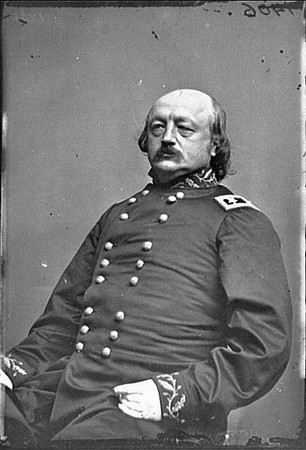
Union Major-General Benjamin F. Butler. Clever
and far-sighted, greedy and unscrupulous.
(Courtesy: Library of Congress)
And please pardon the following tangent.
It was an acerbic God indeed that arranged for Nathaniel Banks to replace Benjamin Butler. Butler, a Democrat and an appeaser of the pro-slavery forces, had narrowly lost to Banks in the race for governor of Massachusetts. In the war, however, he did far more than Banks—an avowed Abolitionist—to help escaped slaves. Commanding at Fortress Monroe, Virginia, in the war's first year, he cleverly declared such people "contrabands" as a legal way to deprive the Confederacy of labor. As military governor of New Orleans, Butler proved strict and effective, providing relief for the poor and taking strong measures to quash the annual yellow fever epidemic. But he became one of the most reviled men in the South following his infamous Order No. 28, which prescribed that any woman who insulted a federal soldier would be treated like a prostitute ("a woman of the town, plying her avocation.") "Beast Butler," they called him, using his likeness to decorate the bottom of chamber pots—"Spoons Butler," too, after he seized silverware from a lady trying to cross Union lines and arrested her as a smuggler. On top of this there were his shady financial dealings in partnership with his brother Andrew. The pair enriched themselves by buying confiscated cotton for cheap at rigged auctions, then selling it at a giant markup.
Thus, amid the rumble of controversy, Butler was recalled from New Orleans. Yet his feisty performance had made him a favorite among Radical Republicans—so President Lincoln found it politic to give him a new appointment in late '63, this time as commander for the Department of Virginia and North Carolina, based at Norfolk. There, his corruption really hit its stride. His deep involvement in the black market trade—across enemy lines, no less—was discovered near the war's end, and would have meant prison and disgrace for a less well-connected man. It was not malfeasance that caused his removal, however, but military ineptitude—he was no better on the battlefield than his rival Banks. In the blood-soaked spring of '64, his half-hearted offensive on the James River ended with his army stymied by a much smaller Confederate force. And in January, 1865, after his failure to capture Fort Fisher near Wilmington, North Carolina—the last major Atlantic port in the South's possession—overall commander General Ulysses S. Grant had him sacked.
"Sic Semper Tyrannis." The 22nd Regiment
USCT, featured in Lucifer's Drum, had a pretty
no-nonsense battle flag. (Courtesy: Library of Congress)
Butler went on to serve five terms as a Republican congressman and one, finally, as governor of Massachusetts (reverting to the Democrats—the man was nothing if not flexible.) Rising to prominence in the House, he skillfully managed the impeachment proceedings against President Andrew Johnson, which famously fell short by one vote. He was an able administrator, a brilliant attorney, a successful industrialist (cartridge manufacturer) and died very rich. He embodied much of what we decry and lampoon in politicians. Still, he was something more than a venal scoundrel and lowdown profiteer, and that's what makes him interesting. In cases that didn't trigger his avarice, he showed nerve and far-sightedness.
Having shed his early role as a slavery accommodationist, and having pioneered black recruitment at New Orleans, he became a sincere believer in African American fighting mettle. He later commanded units of the United States Colored Troops in Virginia, where several (including the 22nd USCT, which has a part in Lucifer's Drum) proved instrumental in the victory at Chaffin's Farm or New Market Heights, Sept. 29-30, 1864, charging through intense fire to turn the Confederate left. Twenty-three USCT troops were awarded the Medal of Honor as a result, and Butler had another medal struck—the so-called Butler Medal—for an additional 200 men. In Congress, he was a key promotor of the Civil Rights Bills of 1871 and 1875, the first one authorizing strong measures against the Ku Klux Klan and the second forbidding racial discrimination in public accommodations (later declared unconstitutional by the Supreme Court and not redeemed until the Civil Rights Act of 1964.) He supported greenback currency, an eight-hour work day and women's suffrage. As Massachusetts governor, he appointed the nation's first African American judge as well as its first Irish Catholic judge. He named the great Clara Barton to head the Massachusetts Reformatory for Women, the state's first-ever instance of a female in an executive position. On the Greenback/Anti-Monopoly ticket, Butler ran for President in 1884 but didn't get a single electoral vote.
Magazine illustration of Native Guardsman on
picket duty. (Courtesy: Library of Congress)
But back to the Native Guard . . . As soon as Nathaniel Banks took command in New Orleans, he set out to purge the Guard regiments of its black line officers and replace them with white ones. Abolitionist or no, he made the typical race-based assumption that these men were sub-standard. But while the 2nd and 3rd Regiments were brought fully under white command, the 1st resisted the order and retained its black officers. These included two who were, each in his own way, extraordinary: Captain Andre Cailloux and 2nd Lieutenant John H. Crowder.
Born a slave of mixed race, Cailloux had petitioned for his freedom at age 21 and been granted it. He founded a successful cigar-making business and married a woman of similar background named Felicie Coulon. They had four children, three of whom lived. On the side, Cailloux was also a feared amateur boxer. Literate in French as well as English, he helped support the Institute Catholique, which had a leading role in educating the city's free and orphaned black children. At the war's outbreak he was 36 and a respected leader in the large African-French (Creole) community. He was among those who first signed up for the Native Guard's Confederate version, proud to defend the city he loved, but put on the blue uniform when his chance came. His Company E was notably well drilled.

Not even a staff this big could save Union Major-General Nathaniel P. Banks (seated
center) from mediocrity. (Courtesy: Library of Congress)
John Crowder had been born to a free black couple in Louisville, Kentucky. He was still an infant when his father left as an army hireling for the Mexican American War and did not return. His mother took John with her to New Orleans, where she had friends and found work as a seamstress. She also married a steamboat steward who proved a worthless drunk and eventually abandoned her and his stepson. From the age of eight, John worked—as a cabin boy, as a steamboat steward, as a jeweler's porter—always forwarding his pay to his mother, Martha Ann. A prominent black minister took an interest in him and saw to his education.
We can only infer how impressive Crowder was by the fact that he became an officer while managing to conceal his age—which was 16. A handful of his letters exist in the special collections library at the University of North Carolina, Chapel Hill, most of them written to his mother. In one he remarked to her, "If Abraham Lincoln knew that a colored Lad of my age could command a company, what would he say?" Crowder's youth brought consternation within the ranks, however, especially since he outshone other officers in leadership qualities. So besides regular insults from white citizenry, he had to contend with them from fellow officers. One in particular, a jealous captain later prosecuted for cowardice, started spreading false rumors about Crowder's personal conduct. When one of this captain's men committed a lewd act in front of an older woman—a friend of Crowder's who had nursed him through a fever—the young lieutenant reported it, his nemesis having failed to do so. "I remember your first lesson," he wrote his mother, "that was to respect all females." After this, the slander campaign against him intensified. But he was resolved not to be driven from the Native Guard—"to stay in the service, as long as there is a straw to hold to."
The Guard had been used only for fatigue duty—chopping wood, digging earthworks, guarding rail lines. Then, in May 1863, the greater part of it was sent to lay bridges around the Confederate bastion at Port Hudson. Having encircled the town, General Banks launched an attack from the east on the morning of the 27th, probing for weak spots in the enemy defenses. When it stalled, the 1st and 3rd Native Guard were sent in from the north, crossing a pontoon bridge over Foster's Creek and heading down Telegraph Road toward Port Hudson. Incredibly, no one from Banks on down had ordered the terrain scouted. Had they done so, they would have found that the enemy had made maximum use of it, placing riflemen atop a bluff on the left, alongside the road. Underbrush, felled trees and a man-made backwater (channeled from the Mississippi) made the position practically impregnable. On the right, the flooded Mississippi formed a large natural backwater full of trees, while down the road stood another bluff holding the main Confederate works.
There were only two Union cannon, and these were quickly disabled by Confederate artillery. The Guard shifted to the left and formed two lines, the 1st Regiment and then the 3rd, moving out of the woods and into a relatively open area. They never had a prayer. Still they charged, taking enfilading fire from the roadside bluff and raked by canister in front. Torn up, the 1st stalled within two hundred yards of the enemy position, whereupon the 3rd barreled past them and were in turn torn up. Twice they fell back and re-formed and twice again they charged. Some troops tried to get at the enemy by wading through the riverside backwater or climbing the roadside bluff, but it was in vain. The Guard withdrew, having lost about 200 out of 1,000. The Confederates recorded not one casualty.
Bottom magazine illustration shows the Native Guard assault at Port Hudson
(May 27, 1863). The dim figure on the far right with sword raised is supposedly Captain
Andre Cailloux. (Courtesy: Library of Congress)
Fatally wounded, John Crowder had been taken to the rear, where he died that afternoon. Andre Cailloux survived nearly to the battle's end, leading his company and bawling orders in both French and English, though a rifle ball had shattered his forearm. Finally a shell killed him. In subsequent days, Rebel sharpshooters prevented the collection of the dead, so Cailloux's noble corpse moldered on the field. When it was at last recovered, he received a hero's funeral attended by thousands in New Orleans. Crowder's mother had to bury her son in a pauper's grave. At Port Hudson, meanwhile, Banks launched a second infantry assault on June 14. It was a costly, ill-coordinated failure, made worse by fog. From there it settled into a siege with frequent bombardments, while Confederate Major-General Franklin Gardner conducted a stubborn and intelligent defense. Disease, desertion, starvation and an ammunition shortage finally led the Southern garrison to surrender on July 9, though only after news came of Vicksburg's fall five days earlier.
The Guard's performance changed a lot of minds concerning black troops. Union Captain Robert F. Wilkinson wrote, " . . . the black troops at P. Hudson fought & acted superbly. The theory of negro inefficiency is . . . at last exploded by the facts." General Banks stated, "The severe test to which they were subjected, and the determined manner in which they encountered the enemy, leaves upon my mind no doubt of their ultimate success." Banks' shortcomings had of course made that test more severe than it need have been. In any case, the protracted misery of Port Hudson left him in a poor light and permanently damaged his larger aspirations. We would never have a President Banks. (Like his adversary Butler and so many other forgotten politicians, he did indulge that fantasy for a spell.)
In faraway New York, the Times editorialized: "Those black soldiers had never before been in any severe engagement. They were comparatively raw troops, and yet were subjected to the most awful ordeal than even veterans ever have to experience—the charging upon fortifications through the crash of belching batteries. The men, white or black, who will not flinch from that will flinch from nothing. It is no longer possible to doubt the bravery and steadiness of the colored race, when rightly led."
"When rightly led." The knife-twisting irony here was, of course, that they acted courageously despite very poor leadership from the top. Even so, African American troops would have to prove themselves over and over—at Milliken's Bend, at Fort Wagner, at Ocean Pond, at Jenkins' Ferry, at Wilson's Wharf, at Brice's Crossroads, at Baylor's Farm and at Chaffin's Farm. Given the majority's tendency toward selective amnesia, they would in fact have to prove themselves in each war thereafter, well into the 20th Century. Race-based ideology has its self-protective reflexes, like any organism. When punched in the face, it takes a fallback position from which it can still resist full equality—a position like "When rightly led." Thus, in every similar instance, this qualifier would come droning up like a persistent wasp, with its own implicit qualifier: "by white officers." Only after President Truman's desegregation of the armed forces in 1948 would that wasp be finally swatted to a paste.
Regimental flag for the 24th USCT: Let soldiers in war,
be citizens in peace. (Courtesy: Library of Congress)
Which brings me once and for all back to John Crowder—his mother's shining hope, dead at 17, buried anonymously. Andre Cailloux got to marry a woman he loved and have children, attain worthy goals and demonstrate character, gain standing in his community and accolades in death. In his last moments—surrounded by friends, I can only wish—John Crowder must have known what millions of dying boys in hundreds of wars have known: that despite all his yearning, he would never have these things. He exhibited just about every quality that makes youth beautiful in our sight—the supple mind, the ardent will, the high hopes, the unbounded bravery, the vivid personality, the generous humor, the aching promise. And the idealism—an idealism that would have been sorely tested, had he lived to a natural old age. Because he would have lived to see the rise of the Klan and the entrenchment of Jim Crow, the Nadir of the 1890's and the plague of lynchings, the use of sharecropping and the penal system to erect a de facto new slavery, the theft or destruction of hard-won property, the denial of education and the trampling of aspirations, the despoiling of those principles that America supposedly holds dear.
Whatever he would have done or said or become in response, we will never know. And I guess that is the precise reason we should treasure him—a youth forever suspended in hope, aching with promise. I swear there are nights when I can feel his ghost moving among us, watching it all. That's why any monument to John Crowder would be to the person he was, the man he would have become and the ideals he signed up for, but also to grief and loss. The worst kind of grief and loss imaginable.
Final tidbits: Future politician, publisher and civil rights pioneer Pinckney Benton Stewart Pinchbeck, a free black man, was a company commander with the 2nd Louisiana Native Guard but resigned his commission after twice being passed over for promotion and repeatedly insulted by white officers. During Reconstruction, he was elected lieutenant-governor of Louisiana and served as governor for 15 days after the sitting governor stepped aside to face impeachment charges. Pinchbeck was later elected to the U.S. Congress and then the Senate, though he was blocked from taking his seat. Each of these attainments was a first for a black politician.
Also: Jamaican-born and of mixed race, Morris W. Morris served in the Confederate version of the Native Guard and briefly in the Union one, as a 19-year-old lieutenant. He was the only black Jewish man to serve on either side. Re-naming himself Lewis Morrison, he went on to become a famous actor. He was the grandfather of Hollywood's Bennett sisters—Constance, Barbara and Joan—and the great-grandfather of TV shock-show host Morton Downey, Jr.
Here is a video link: U.S. Poet Laureate Natasha Trethewey reading her magnificent poem "Elegy For The Native Guards" on Ship Island, MS, where the 2nd Louisiana Native Guard did garrison duty: http://southernspaces.org/2005/elegy-...
{Note: Much of my information here came from Joseph T. Glatthaar's cornerstone work Forged In Battle: The Civil War Alliance Of Black Soldiers And White Officers, which also informed the historical background for Lucifer's Drum.}
If I had twenty grand or so lying around, I would commission a statue of John H. Crowder, and lobby for its placement in or near Port Hudson, Louisiana. It would fulfill that transcendent purpose. But I do not have twenty grand lying around, so Crowder will likely remain unheralded, while existing monuments continue to extoll the era's prominent generals and politicians.
Union battery at Port Hudson, Louisiana, 1863. (Courtesy: Library of Congress)
My first exposure to the subject of black troops in the Civil War occurred in the fifth grade, when at the Eleanor B. Kennelly School library (Hartford, CT) I discovered Worth Fighting For: A History Of The Negro In The United States During The Civil War And Reconstruction, by Agnes McCarthy and Lawrence Reddick. (Decades later, in my novel Lucifer's Drum, I gave the name Reddick to an African American platoon sergeant.) Central to the book was the assault on Fort Wagner, South Carolina, on July 18, 1863, by the Massachusetts 54th—an event later immortalized in the 1989 film Glory.
The Fort Wagner battle has been referred to as "obscure" but was actually well reported at the time, especially in newspapers with Abolitionist leanings. It had the dramatic essentials—a doomed yet valiant charge by disciplined black troops and, moreover, a dashing white commander killed in action. Colonel Robert Gould Shaw's last hour was surely his finest—smoking a cigar just before the charge, talking with calm affection to his men, personally leading the regiment as it headed through sheets of cannon fire toward the parapet, his death pretty much certain. If there is such a thing as a good death—and I suspect there is—no one ever died better. But Fort Wagner was not the first major use of black Union troops in battle, nor was the valor displayed there unequalled. Several weeks before, the Battle of Port Hudson—Lieutenant John Crowder's first and last action—had showcased the potential of African American soldiery. The one missing element, in terms of lasting public awareness, was a picturesque white martyr.
In the spring of 1863, only two Confederate strongholds remained on the Mississippi—Vicksburg and Port Hudson. While Grant besieged the former, Major-General Nathaniel P. Banks had the task of taking the latter. The previous December, Banks had replaced Major-General Benjamin F. Butler as head of the Army of the Gulf at New Orleans. Banks was a former governor of Massachusetts and a military mediocrity, having had his clock cleaned by Stonewall Jackson in the Shenandoah Valley. One of his failures there had been inadequate reconnaissance. At Port Hudson, he would repeat this lapse and many Union boys would pay for it.
The byzantine culture of New Orleans—a major center of the slave trade—featured a racial caste system based on skin tone as well as blood percentage. There was a large community of free blacks, some slave holders themselves, and a mixed-race elite. At the war's outset, some 1,100 free African Americans formed the Louisiana Native Guard to help defend New Orleans and demonstrate their worth as citizens. The Louisiana legislature, nervous at the spectacle of armed black men—with black officers, even—passed a law that disbanded the regiment. But then the governor, nervous before the Union military threat, defied the legislature and called the Guard back to duty. None of it mattered—New Orleans fell anyway in late April, 1862, when Union Admiral David Farragut's fleet came thundering in, and the Guard was again disbanded.
Yet in September, Butler organized a black Union regiment and gave it the same name. Some ten per cent of the men who had joined the Guard's Confederate incarnation now signed up for this Yankee one, their pride as Southerners eclipsed by an eagerness to combat white supremacy. Some of them took up their previous ranks as line officers, commanding recruits who were for the most part newly escaped slaves. In these pre-Emancipation days, Union policy discouraged such enlistment; yet it gave way to the press of numbers, great enough so that the 2nd, 3rd and eventually the 4th Louisiana Native Guard had to be formed in addition. (In June of '63, with the siege of Port Hudson in progress, they would be absorbed into a more recently formed black outfit called the the Corps d'Afrique—why does just about anything sound better in French?—which would later be absorbed into the United States Colored Troops, or USCT.)
Union Major-General Benjamin F. Butler. Clever
and far-sighted, greedy and unscrupulous.
(Courtesy: Library of Congress)
And please pardon the following tangent.
It was an acerbic God indeed that arranged for Nathaniel Banks to replace Benjamin Butler. Butler, a Democrat and an appeaser of the pro-slavery forces, had narrowly lost to Banks in the race for governor of Massachusetts. In the war, however, he did far more than Banks—an avowed Abolitionist—to help escaped slaves. Commanding at Fortress Monroe, Virginia, in the war's first year, he cleverly declared such people "contrabands" as a legal way to deprive the Confederacy of labor. As military governor of New Orleans, Butler proved strict and effective, providing relief for the poor and taking strong measures to quash the annual yellow fever epidemic. But he became one of the most reviled men in the South following his infamous Order No. 28, which prescribed that any woman who insulted a federal soldier would be treated like a prostitute ("a woman of the town, plying her avocation.") "Beast Butler," they called him, using his likeness to decorate the bottom of chamber pots—"Spoons Butler," too, after he seized silverware from a lady trying to cross Union lines and arrested her as a smuggler. On top of this there were his shady financial dealings in partnership with his brother Andrew. The pair enriched themselves by buying confiscated cotton for cheap at rigged auctions, then selling it at a giant markup.
Thus, amid the rumble of controversy, Butler was recalled from New Orleans. Yet his feisty performance had made him a favorite among Radical Republicans—so President Lincoln found it politic to give him a new appointment in late '63, this time as commander for the Department of Virginia and North Carolina, based at Norfolk. There, his corruption really hit its stride. His deep involvement in the black market trade—across enemy lines, no less—was discovered near the war's end, and would have meant prison and disgrace for a less well-connected man. It was not malfeasance that caused his removal, however, but military ineptitude—he was no better on the battlefield than his rival Banks. In the blood-soaked spring of '64, his half-hearted offensive on the James River ended with his army stymied by a much smaller Confederate force. And in January, 1865, after his failure to capture Fort Fisher near Wilmington, North Carolina—the last major Atlantic port in the South's possession—overall commander General Ulysses S. Grant had him sacked.
"Sic Semper Tyrannis." The 22nd Regiment
USCT, featured in Lucifer's Drum, had a pretty
no-nonsense battle flag. (Courtesy: Library of Congress)
Butler went on to serve five terms as a Republican congressman and one, finally, as governor of Massachusetts (reverting to the Democrats—the man was nothing if not flexible.) Rising to prominence in the House, he skillfully managed the impeachment proceedings against President Andrew Johnson, which famously fell short by one vote. He was an able administrator, a brilliant attorney, a successful industrialist (cartridge manufacturer) and died very rich. He embodied much of what we decry and lampoon in politicians. Still, he was something more than a venal scoundrel and lowdown profiteer, and that's what makes him interesting. In cases that didn't trigger his avarice, he showed nerve and far-sightedness.
Having shed his early role as a slavery accommodationist, and having pioneered black recruitment at New Orleans, he became a sincere believer in African American fighting mettle. He later commanded units of the United States Colored Troops in Virginia, where several (including the 22nd USCT, which has a part in Lucifer's Drum) proved instrumental in the victory at Chaffin's Farm or New Market Heights, Sept. 29-30, 1864, charging through intense fire to turn the Confederate left. Twenty-three USCT troops were awarded the Medal of Honor as a result, and Butler had another medal struck—the so-called Butler Medal—for an additional 200 men. In Congress, he was a key promotor of the Civil Rights Bills of 1871 and 1875, the first one authorizing strong measures against the Ku Klux Klan and the second forbidding racial discrimination in public accommodations (later declared unconstitutional by the Supreme Court and not redeemed until the Civil Rights Act of 1964.) He supported greenback currency, an eight-hour work day and women's suffrage. As Massachusetts governor, he appointed the nation's first African American judge as well as its first Irish Catholic judge. He named the great Clara Barton to head the Massachusetts Reformatory for Women, the state's first-ever instance of a female in an executive position. On the Greenback/Anti-Monopoly ticket, Butler ran for President in 1884 but didn't get a single electoral vote.
Magazine illustration of Native Guardsman on
picket duty. (Courtesy: Library of Congress)
But back to the Native Guard . . . As soon as Nathaniel Banks took command in New Orleans, he set out to purge the Guard regiments of its black line officers and replace them with white ones. Abolitionist or no, he made the typical race-based assumption that these men were sub-standard. But while the 2nd and 3rd Regiments were brought fully under white command, the 1st resisted the order and retained its black officers. These included two who were, each in his own way, extraordinary: Captain Andre Cailloux and 2nd Lieutenant John H. Crowder.
Born a slave of mixed race, Cailloux had petitioned for his freedom at age 21 and been granted it. He founded a successful cigar-making business and married a woman of similar background named Felicie Coulon. They had four children, three of whom lived. On the side, Cailloux was also a feared amateur boxer. Literate in French as well as English, he helped support the Institute Catholique, which had a leading role in educating the city's free and orphaned black children. At the war's outbreak he was 36 and a respected leader in the large African-French (Creole) community. He was among those who first signed up for the Native Guard's Confederate version, proud to defend the city he loved, but put on the blue uniform when his chance came. His Company E was notably well drilled.
Not even a staff this big could save Union Major-General Nathaniel P. Banks (seated
center) from mediocrity. (Courtesy: Library of Congress)
John Crowder had been born to a free black couple in Louisville, Kentucky. He was still an infant when his father left as an army hireling for the Mexican American War and did not return. His mother took John with her to New Orleans, where she had friends and found work as a seamstress. She also married a steamboat steward who proved a worthless drunk and eventually abandoned her and his stepson. From the age of eight, John worked—as a cabin boy, as a steamboat steward, as a jeweler's porter—always forwarding his pay to his mother, Martha Ann. A prominent black minister took an interest in him and saw to his education.
We can only infer how impressive Crowder was by the fact that he became an officer while managing to conceal his age—which was 16. A handful of his letters exist in the special collections library at the University of North Carolina, Chapel Hill, most of them written to his mother. In one he remarked to her, "If Abraham Lincoln knew that a colored Lad of my age could command a company, what would he say?" Crowder's youth brought consternation within the ranks, however, especially since he outshone other officers in leadership qualities. So besides regular insults from white citizenry, he had to contend with them from fellow officers. One in particular, a jealous captain later prosecuted for cowardice, started spreading false rumors about Crowder's personal conduct. When one of this captain's men committed a lewd act in front of an older woman—a friend of Crowder's who had nursed him through a fever—the young lieutenant reported it, his nemesis having failed to do so. "I remember your first lesson," he wrote his mother, "that was to respect all females." After this, the slander campaign against him intensified. But he was resolved not to be driven from the Native Guard—"to stay in the service, as long as there is a straw to hold to."
The Guard had been used only for fatigue duty—chopping wood, digging earthworks, guarding rail lines. Then, in May 1863, the greater part of it was sent to lay bridges around the Confederate bastion at Port Hudson. Having encircled the town, General Banks launched an attack from the east on the morning of the 27th, probing for weak spots in the enemy defenses. When it stalled, the 1st and 3rd Native Guard were sent in from the north, crossing a pontoon bridge over Foster's Creek and heading down Telegraph Road toward Port Hudson. Incredibly, no one from Banks on down had ordered the terrain scouted. Had they done so, they would have found that the enemy had made maximum use of it, placing riflemen atop a bluff on the left, alongside the road. Underbrush, felled trees and a man-made backwater (channeled from the Mississippi) made the position practically impregnable. On the right, the flooded Mississippi formed a large natural backwater full of trees, while down the road stood another bluff holding the main Confederate works.
There were only two Union cannon, and these were quickly disabled by Confederate artillery. The Guard shifted to the left and formed two lines, the 1st Regiment and then the 3rd, moving out of the woods and into a relatively open area. They never had a prayer. Still they charged, taking enfilading fire from the roadside bluff and raked by canister in front. Torn up, the 1st stalled within two hundred yards of the enemy position, whereupon the 3rd barreled past them and were in turn torn up. Twice they fell back and re-formed and twice again they charged. Some troops tried to get at the enemy by wading through the riverside backwater or climbing the roadside bluff, but it was in vain. The Guard withdrew, having lost about 200 out of 1,000. The Confederates recorded not one casualty.
Bottom magazine illustration shows the Native Guard assault at Port Hudson
(May 27, 1863). The dim figure on the far right with sword raised is supposedly Captain
Andre Cailloux. (Courtesy: Library of Congress)
Fatally wounded, John Crowder had been taken to the rear, where he died that afternoon. Andre Cailloux survived nearly to the battle's end, leading his company and bawling orders in both French and English, though a rifle ball had shattered his forearm. Finally a shell killed him. In subsequent days, Rebel sharpshooters prevented the collection of the dead, so Cailloux's noble corpse moldered on the field. When it was at last recovered, he received a hero's funeral attended by thousands in New Orleans. Crowder's mother had to bury her son in a pauper's grave. At Port Hudson, meanwhile, Banks launched a second infantry assault on June 14. It was a costly, ill-coordinated failure, made worse by fog. From there it settled into a siege with frequent bombardments, while Confederate Major-General Franklin Gardner conducted a stubborn and intelligent defense. Disease, desertion, starvation and an ammunition shortage finally led the Southern garrison to surrender on July 9, though only after news came of Vicksburg's fall five days earlier.
The Guard's performance changed a lot of minds concerning black troops. Union Captain Robert F. Wilkinson wrote, " . . . the black troops at P. Hudson fought & acted superbly. The theory of negro inefficiency is . . . at last exploded by the facts." General Banks stated, "The severe test to which they were subjected, and the determined manner in which they encountered the enemy, leaves upon my mind no doubt of their ultimate success." Banks' shortcomings had of course made that test more severe than it need have been. In any case, the protracted misery of Port Hudson left him in a poor light and permanently damaged his larger aspirations. We would never have a President Banks. (Like his adversary Butler and so many other forgotten politicians, he did indulge that fantasy for a spell.)
In faraway New York, the Times editorialized: "Those black soldiers had never before been in any severe engagement. They were comparatively raw troops, and yet were subjected to the most awful ordeal than even veterans ever have to experience—the charging upon fortifications through the crash of belching batteries. The men, white or black, who will not flinch from that will flinch from nothing. It is no longer possible to doubt the bravery and steadiness of the colored race, when rightly led."
"When rightly led." The knife-twisting irony here was, of course, that they acted courageously despite very poor leadership from the top. Even so, African American troops would have to prove themselves over and over—at Milliken's Bend, at Fort Wagner, at Ocean Pond, at Jenkins' Ferry, at Wilson's Wharf, at Brice's Crossroads, at Baylor's Farm and at Chaffin's Farm. Given the majority's tendency toward selective amnesia, they would in fact have to prove themselves in each war thereafter, well into the 20th Century. Race-based ideology has its self-protective reflexes, like any organism. When punched in the face, it takes a fallback position from which it can still resist full equality—a position like "When rightly led." Thus, in every similar instance, this qualifier would come droning up like a persistent wasp, with its own implicit qualifier: "by white officers." Only after President Truman's desegregation of the armed forces in 1948 would that wasp be finally swatted to a paste.
Regimental flag for the 24th USCT: Let soldiers in war,
be citizens in peace. (Courtesy: Library of Congress)
Which brings me once and for all back to John Crowder—his mother's shining hope, dead at 17, buried anonymously. Andre Cailloux got to marry a woman he loved and have children, attain worthy goals and demonstrate character, gain standing in his community and accolades in death. In his last moments—surrounded by friends, I can only wish—John Crowder must have known what millions of dying boys in hundreds of wars have known: that despite all his yearning, he would never have these things. He exhibited just about every quality that makes youth beautiful in our sight—the supple mind, the ardent will, the high hopes, the unbounded bravery, the vivid personality, the generous humor, the aching promise. And the idealism—an idealism that would have been sorely tested, had he lived to a natural old age. Because he would have lived to see the rise of the Klan and the entrenchment of Jim Crow, the Nadir of the 1890's and the plague of lynchings, the use of sharecropping and the penal system to erect a de facto new slavery, the theft or destruction of hard-won property, the denial of education and the trampling of aspirations, the despoiling of those principles that America supposedly holds dear.
Whatever he would have done or said or become in response, we will never know. And I guess that is the precise reason we should treasure him—a youth forever suspended in hope, aching with promise. I swear there are nights when I can feel his ghost moving among us, watching it all. That's why any monument to John Crowder would be to the person he was, the man he would have become and the ideals he signed up for, but also to grief and loss. The worst kind of grief and loss imaginable.
Final tidbits: Future politician, publisher and civil rights pioneer Pinckney Benton Stewart Pinchbeck, a free black man, was a company commander with the 2nd Louisiana Native Guard but resigned his commission after twice being passed over for promotion and repeatedly insulted by white officers. During Reconstruction, he was elected lieutenant-governor of Louisiana and served as governor for 15 days after the sitting governor stepped aside to face impeachment charges. Pinchbeck was later elected to the U.S. Congress and then the Senate, though he was blocked from taking his seat. Each of these attainments was a first for a black politician.
Also: Jamaican-born and of mixed race, Morris W. Morris served in the Confederate version of the Native Guard and briefly in the Union one, as a 19-year-old lieutenant. He was the only black Jewish man to serve on either side. Re-naming himself Lewis Morrison, he went on to become a famous actor. He was the grandfather of Hollywood's Bennett sisters—Constance, Barbara and Joan—and the great-grandfather of TV shock-show host Morton Downey, Jr.
Here is a video link: U.S. Poet Laureate Natasha Trethewey reading her magnificent poem "Elegy For The Native Guards" on Ship Island, MS, where the 2nd Louisiana Native Guard did garrison duty: http://southernspaces.org/2005/elegy-...
{Note: Much of my information here came from Joseph T. Glatthaar's cornerstone work Forged In Battle: The Civil War Alliance Of Black Soldiers And White Officers, which also informed the historical background for Lucifer's Drum.}
September 7, 2015
The German Americans
In Manfred Kirschenbaum, my novel's main hero Major Nathan Truly has a hugely valuable asset. Kirschenbaum is a hunchbacked German immigrant, a veteran of the 1848 revolutionary movement that rocked the German states, along with much of Europe. He is working as a hack driver in New York City when he and Truly first meet, in the aftermath of that city's July 1863 Draft Riots (still the most deadly and costly such event in U.S. history.) Kirschenbaum's physical limitation prevents him from joining the Union cause as a soldier—but not as an intelligence operative. In that capacity, under Truly's direction, he shines, displaying wily resourcefulness and an observant eye. Working as coachman for Gideon Van Gilder, a venomous Copperhead newspaper publisher, he gathers information on anti-Union activities in NYC, which was then a hotbed of pro-Southern sentiment. And when Van Gilder mysteriously flees the city in terror, it is Kirschenbaum who drives his horse-drawn coach through the night, toward a fateful rendezvous in the Shenandoah Valley. With that rendezvous, the increasingly dire events of Lucifer's Drum are set in motion.
German Americans remain the largest distinct ethnic group in the U.S.—and in the Civil War, were the largest such group represented in Union military ranks. German-speaking people were settling in British North America from the earliest colonial times, the very first being Dr. Johannes Fleischer at the 1607 founding of Jamestown, Virginia. In the North, they played a conspicuous role in the settling of New York, Pennsylvania, Ohio, Illinois, Wisconsin, Michigan, Iowa and Missouri; in the South, many set roots in Virginia, North Carolina, Georgia, French Louisiana and eventually Texas (where, in a fine example of cultural cross-fertilization, they introduced Mexican residents to the accordion.) They were drawn by the classic immigrant visions—rich land for farmers and a burgeoning economy for shopkeepers and artisans, as well as freedom from religious and political oppression.
Germany would not exist as a coherent nation until the Franco-Prussian War, 1870-71, when Prussian Chancellor Otto von Bismarck engineered a stunning victory over France. Simultaneously, the loosely run German Confederation—founded by the 1815 Congress of Vienna, comprising thirty-nine principalities—was galvanized into the German Empire. But before von Bismarck's triumph, these German states chafed under the autocratic domination of Austria; they were therefore fertile ground for liberal political agitation. In early 1848, an anti-monarchist revolution broke out in Paris and ignited several concurrent uprisings throughout the Confederation, throwing many crowned heads into panic. Working and middle class Germans held massive street demonstrations, demanding better living and working conditions, as well as universal male suffrage, freedom of assembly, freedom of the press and a united Germany. In many instances, royalist troops fired on unarmed demonstrators, who reacted by arming themselves and taking the crisis to a new and bloodier level.
Austrian Emperor Ferdinand I, Prussian King Fredrick William IV and the many German princes made nervous concessions. A National Assembly was called in the free city of Frankfurt am Main—in the novel, Kirschenbaum's home city—and drew up a constitution enshrining the principle of equal rights. Its primary goal was to unite the states as a constitutional monarchy—but as the revolution's working and middle class factions gradually split, and as advocates of Austrian vs. Prussian hegemony failed to agree, royalty and aristocracy realized that the liberal peril was receding. The Assembly at Frankfurt was dissolved in May 1849. Full-fledged war broke out between the revolutionaries and the Kingdom of Prussia, and the revolutionaries lost big.
Street-fighting scene from the Revolutionary Year
of 1848, Adolphe Hervier (1821-1879).
(Courtesy: Library of Congress)
In a dispiriting anticlimax, concessions were cancelled, rights abolished and protests violently suppressed. Arrests, executions and imprisonments followed. One consequence of this was a great wave of German immigration—disappointed exiles known as "The Forty-Eights," seeking the political freedom they had failed to achieve in their homeland. For the United States, this brought an infusion of people who, however hardscrabble their lives, were beneficiaries of the German primary school system—at that time, probably the best and most inclusive in the world. Overall highly literate and well-read, they took a robust interest in current events—and when the Civil War commenced, they overwhelmingly supported Lincoln and then Emancipation.
Several all-German units did fight for the South, though none reached regimental strength. In Texas, the community of Forty-Eighters steadfastly opposed both slavery and secession. Threatened with the draft in August of 1862, one armed group of them attempted an escape to Mexico but were caught and crushed by a Confederate force on the Nueces River. The North, by contrast, raised many all-German regiments—five from Pennsylvania, six from Ohio and eleven from New York, as well as others from Indiana and Wisconsin. More than 200,000 Union soldiers were German-born. In war-riven Missouri, the pro-Union German community was a crucial factor in preventing secession. (It was a largely German unit under Captain Nathaniel Lyon, in May 1861, that kept Confederates from capturing the federal arsenal at St. Louis.)
Prominent among German Americans was Carl Schurz, a Forty-Eighter who threw his legal and journalistic skills behind the early Republican Party, and whose wife Margarethe was a pioneer in the field of early childhood education. Appointed ambassador to Spain by Lincoln, Schurz tactfully influenced that country against supporting the Confederacy. Later, he served as Brigadier-General and earned a reputation for bravery, serving at the Union defeats of Second Bull Run and Chancellorsville and then the victories of Gettysburg and Chattanooga. After the war, he edited newspapers at Detroit and St. Louis. In 1868 he was elected Senator for Missouri, becoming the U.S. Senate's first German American. He later served as Secretary of the Interior under President Rutherford B. Hayes.
Just as prominent was Schurz's friend and fellow Forty-Eighter Major-General Franz Sigel. Sigel's mention in Lucifer's Drum is not complimentary, referring to the whipping he took at the Battle of New Market (May 15, 1864) in the Shenandoah. But Sigel was a man of proven valor, whose reputation helped attract German recruits throughout the war—"I fights mit Sigel!" was their proud declaration. Early on, he was instrumental in keeping the Union's grip on Missouri. And on March 8, 1862, Sigel's counterattack at the Battle of Pea Ridge, Arkansas, sealed an important Union victory.
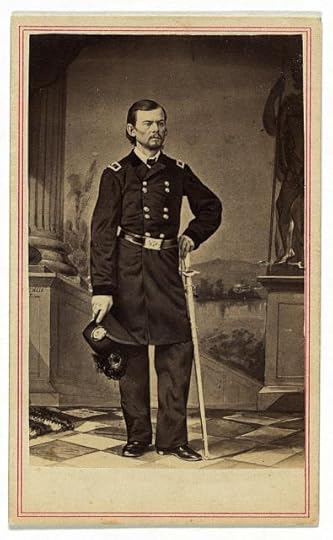
Major-General Franz Sigel, victorious at Pea Ridge
but crushed at New Market; throughout the war, a
powerful symbol of pro-Union German Americans.
(Courtesy: Library of Congress)
Max Weber, who had served under Sigel in the '48 revolutionary forces, raised a German American unit called the Turner Rifles and became a Brigadier-General of Volunteers. At Antietam, assaulting John Brown Gordon's position along the Sunken Road, Weber was grievously wounded. He too gets brief mention in Lucifer's Drum, for his hasty evacuation of Harper's Ferry during Early's Raid. (True to the time and place, Sigel and Weber are referred to in the book as "Dutchmen," a common corruption of "Deutsch.")
Lawyer, revolutionary and politician Friedrich Heckler escaped royalist authorities in Europe and settled in Illinois, where he had a major role in founding the Republican Party and focusing its abolitionist principles. He became a regimental colonel of largely German immigrant troops and was badly wounded at Chancellorsville, though he recovered to participate in the victory of Missionary Ridge and the capture of Knoxville.
Seventeen German immigrants serving under the Union banner received the Medal of Honor.
Rich and poor, male and female, Catholic and Protestant and Jewish, these German Americans represented a vast and obvious benefit for the United States, given their literacy, industriousness and idealism. Poignantly, they were just the sort of German that Germany itself, some seventy years after the U.S. Civil War, could have used to combat Hitler's rise. And when the U.S. army landed in occupied Europe, its ranks again featured German names from top to bottom—from future novelist Private Kurt Vonnegut to Allied Supreme Commander General Dwight Eisenhower. Thus, often, is one nation's catastrophe another nation's gain.
German Americans remain the largest distinct ethnic group in the U.S.—and in the Civil War, were the largest such group represented in Union military ranks. German-speaking people were settling in British North America from the earliest colonial times, the very first being Dr. Johannes Fleischer at the 1607 founding of Jamestown, Virginia. In the North, they played a conspicuous role in the settling of New York, Pennsylvania, Ohio, Illinois, Wisconsin, Michigan, Iowa and Missouri; in the South, many set roots in Virginia, North Carolina, Georgia, French Louisiana and eventually Texas (where, in a fine example of cultural cross-fertilization, they introduced Mexican residents to the accordion.) They were drawn by the classic immigrant visions—rich land for farmers and a burgeoning economy for shopkeepers and artisans, as well as freedom from religious and political oppression.
Germany would not exist as a coherent nation until the Franco-Prussian War, 1870-71, when Prussian Chancellor Otto von Bismarck engineered a stunning victory over France. Simultaneously, the loosely run German Confederation—founded by the 1815 Congress of Vienna, comprising thirty-nine principalities—was galvanized into the German Empire. But before von Bismarck's triumph, these German states chafed under the autocratic domination of Austria; they were therefore fertile ground for liberal political agitation. In early 1848, an anti-monarchist revolution broke out in Paris and ignited several concurrent uprisings throughout the Confederation, throwing many crowned heads into panic. Working and middle class Germans held massive street demonstrations, demanding better living and working conditions, as well as universal male suffrage, freedom of assembly, freedom of the press and a united Germany. In many instances, royalist troops fired on unarmed demonstrators, who reacted by arming themselves and taking the crisis to a new and bloodier level.
Austrian Emperor Ferdinand I, Prussian King Fredrick William IV and the many German princes made nervous concessions. A National Assembly was called in the free city of Frankfurt am Main—in the novel, Kirschenbaum's home city—and drew up a constitution enshrining the principle of equal rights. Its primary goal was to unite the states as a constitutional monarchy—but as the revolution's working and middle class factions gradually split, and as advocates of Austrian vs. Prussian hegemony failed to agree, royalty and aristocracy realized that the liberal peril was receding. The Assembly at Frankfurt was dissolved in May 1849. Full-fledged war broke out between the revolutionaries and the Kingdom of Prussia, and the revolutionaries lost big.
Street-fighting scene from the Revolutionary Year
of 1848, Adolphe Hervier (1821-1879).
(Courtesy: Library of Congress)
In a dispiriting anticlimax, concessions were cancelled, rights abolished and protests violently suppressed. Arrests, executions and imprisonments followed. One consequence of this was a great wave of German immigration—disappointed exiles known as "The Forty-Eights," seeking the political freedom they had failed to achieve in their homeland. For the United States, this brought an infusion of people who, however hardscrabble their lives, were beneficiaries of the German primary school system—at that time, probably the best and most inclusive in the world. Overall highly literate and well-read, they took a robust interest in current events—and when the Civil War commenced, they overwhelmingly supported Lincoln and then Emancipation.
Several all-German units did fight for the South, though none reached regimental strength. In Texas, the community of Forty-Eighters steadfastly opposed both slavery and secession. Threatened with the draft in August of 1862, one armed group of them attempted an escape to Mexico but were caught and crushed by a Confederate force on the Nueces River. The North, by contrast, raised many all-German regiments—five from Pennsylvania, six from Ohio and eleven from New York, as well as others from Indiana and Wisconsin. More than 200,000 Union soldiers were German-born. In war-riven Missouri, the pro-Union German community was a crucial factor in preventing secession. (It was a largely German unit under Captain Nathaniel Lyon, in May 1861, that kept Confederates from capturing the federal arsenal at St. Louis.)
Prominent among German Americans was Carl Schurz, a Forty-Eighter who threw his legal and journalistic skills behind the early Republican Party, and whose wife Margarethe was a pioneer in the field of early childhood education. Appointed ambassador to Spain by Lincoln, Schurz tactfully influenced that country against supporting the Confederacy. Later, he served as Brigadier-General and earned a reputation for bravery, serving at the Union defeats of Second Bull Run and Chancellorsville and then the victories of Gettysburg and Chattanooga. After the war, he edited newspapers at Detroit and St. Louis. In 1868 he was elected Senator for Missouri, becoming the U.S. Senate's first German American. He later served as Secretary of the Interior under President Rutherford B. Hayes.
Just as prominent was Schurz's friend and fellow Forty-Eighter Major-General Franz Sigel. Sigel's mention in Lucifer's Drum is not complimentary, referring to the whipping he took at the Battle of New Market (May 15, 1864) in the Shenandoah. But Sigel was a man of proven valor, whose reputation helped attract German recruits throughout the war—"I fights mit Sigel!" was their proud declaration. Early on, he was instrumental in keeping the Union's grip on Missouri. And on March 8, 1862, Sigel's counterattack at the Battle of Pea Ridge, Arkansas, sealed an important Union victory.
Major-General Franz Sigel, victorious at Pea Ridge
but crushed at New Market; throughout the war, a
powerful symbol of pro-Union German Americans.
(Courtesy: Library of Congress)
Max Weber, who had served under Sigel in the '48 revolutionary forces, raised a German American unit called the Turner Rifles and became a Brigadier-General of Volunteers. At Antietam, assaulting John Brown Gordon's position along the Sunken Road, Weber was grievously wounded. He too gets brief mention in Lucifer's Drum, for his hasty evacuation of Harper's Ferry during Early's Raid. (True to the time and place, Sigel and Weber are referred to in the book as "Dutchmen," a common corruption of "Deutsch.")
Lawyer, revolutionary and politician Friedrich Heckler escaped royalist authorities in Europe and settled in Illinois, where he had a major role in founding the Republican Party and focusing its abolitionist principles. He became a regimental colonel of largely German immigrant troops and was badly wounded at Chancellorsville, though he recovered to participate in the victory of Missionary Ridge and the capture of Knoxville.
Seventeen German immigrants serving under the Union banner received the Medal of Honor.
Rich and poor, male and female, Catholic and Protestant and Jewish, these German Americans represented a vast and obvious benefit for the United States, given their literacy, industriousness and idealism. Poignantly, they were just the sort of German that Germany itself, some seventy years after the U.S. Civil War, could have used to combat Hitler's rise. And when the U.S. army landed in occupied Europe, its ranks again featured German names from top to bottom—from future novelist Private Kurt Vonnegut to Allied Supreme Commander General Dwight Eisenhower. Thus, often, is one nation's catastrophe another nation's gain.
July 4, 2015
The Irrepressible Conflict: 2015
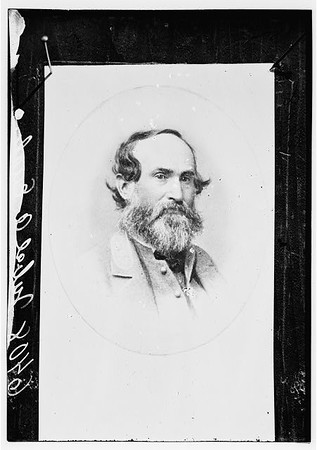
Confederate Lnt.-Gen. Jubal Early, pre-war moderate/post-war zealot. (Courtesy: Library of Congress)
On the military side of my novel Lucifer's Drum, Lnt.-Gen. Jubal Anderson Early (1816-1894) stands center stage. His thrust against Washington, D.C. in the summer of 1864 gave the North a bad scare, and so gives the novel much of its tension. Before and during the war, Early typified an outlook that the war ended up burying—one that prized loyalty to state over national loyalty. It was a feeling and a concept steeped in the past—several steps beyond tribes, a step or two beyond city-states, but well short of full-blown nationalism. Early's chauvinistic love for his home state of Virginia led him to join the Confederate forces. He never missed a chance to extoll Virginia, sometimes at the expense of other states under the Confederate banner—and to the exasperation of fellow officers from those states. Still, for professional military men, birthplace did not necessarily determine which side they chose.
Following the War of 1812, continued reliance on state militias seemed a lousy idea, given that war's many battlefield humiliations for the U.S. Resources were committed to upgrading the Military Academy at West Point and to building a truly national army. This enabled a devastating U.S. victory in the 1846-47 war with Mexico. On the eve of the Civil War, however, the standing army numbered only 16,000—but within its ranks, an identification with country over state or region was inevitably fostered. It may not have prevented Early, Robert E. Lee and 60% of their fellow Virginians from going South, but there was still that 40% who went the other way. Prominent among them was Union General George "Pap" Thomas, one of the ablest leaders of the conflict, who saved the Union position at Chickamauga and shattered John Bell Hood's Confederate force at Nashville. In November, 1863, following the Northern victory at Chattanooga, Thomas ordered a new cemetery laid out for his dead. Asked whether he wanted them buried according to state, the general famously replied, "No—mix 'em up. I'm sick of states' rights." Thomas stood for this dawning nationalist perspective, just as Early stood for his obsolete state-centered one. The two men were fellow Virginians and contemporaries but really signified different eras, an outgoing and an incoming. Ken Burns, in his monumental The Civil War series, observed how the war transformed the country in people's minds from a plural to a singular—from "the United States are" to "the United States is." In that linguistic shift, you hear a new worldview swallowing an old one—something that happens all the time in history, though seldom so suddenly or violently.
In the pre-war years, Jubal Early was no fanatic. As Franklin County prosecutor, he was named delegate to the state convention that had been called to decide on secession, which he opposed until very late in the crisis. He showed little patience for the rabid pro-slavery element. As an attorney ten years earlier, in 1851, he had successfully represented an ex-slave woman named Indiana Choice. (Choice had been freed by her widowed mistress, whose second husband later tried to negate the manumission.) But the war left Early bitter and recalcitrant. Following exile in Canada, he returned to Virginia and resumed his law practice. The mid-1870’s found him virulently white-supremacist, refusing to participate in any commemorative ceremony that included black veterans. In word and in writing, he also did much to promote the cult of Robert E. Lee, which raised that great, now-deceased general to godlike status (much as the cult of Lincoln did for that greatest, most mysterious of Presidents.) Early never married, though he sired four children by Julia McNealey of Rocky Mount, VA. Disdaining the loyalty oath, he died “unreconstructed” in 1894, aged 77.
{A postscript on "Pap" Thomas: During Reconstruction, he commanded occupying troops in the South, often deploying them to defend black communities against the Klan. He also set up military commissions to enforce labor contracts with black citizens, circumventing the bigoted local courts. When he died of a stroke in 1870, aged 53, his Virginia relatives all boycotted the funeral. For his allegiance to the Union and his effectiveness against Southern arms, he had long been dead to them.}
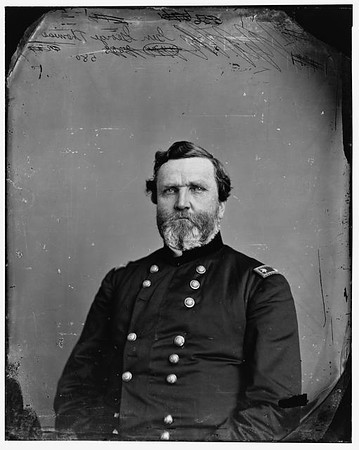
Union Maj.-Gen. George "Pap" Thomas, an American
first and a Virginian second. (Courtesy: Library of Congress)
**************************************************************************
And friends—at this time, like none other, taking on the subject of Jubal Early is like drinking from a firehose. Because wartime Early leads to post-war Early, which leads to white supremacy and Jim Crow. Which leads to desegregation and the Confederate Battle Flag. Which leads to now. How many times has it been said that the Civil War is still being fought, 150 years on? And how much more pertinent could that thought be, with the AME Church in Charleston, SC now hallowed by the blood of the Nine, killed by one who sported the Confederate flag as a purely white-supremacist symbol? And with growing calls for South Carolina—the first state of the Confederacy, the war's Ground Zero—to take down said flag at its State House? And for other Southern states to do likewise? And with debate intensifying over any number of Confederate memorials? For obvious historical reasons, Lucifer's Drum bears on its cover the flag in question. It fits there. But should it be endorsed and flown by any state government? The answer cuts right to the heart of this war that—in spirit, and therefore in fact—we are still fighting.
It is hard to think of another instance where a war's losing side has been given such latitude in the writing (and re-writing) of that war's history. In the years after Appomattox and the aborted Reconstruction, the North had a considerable interest in mollifying its former enemy, recognizing that to further fuel the South's hatred would cause no end of trouble—spasmodic violence, bitter obstruction, further exhaustion. Sentimentality was invoked to cover the nation's raw scars, as in memorial pictures that showed Union and Confederate veterans shaking hands. Slavery's collapse and the emancipation of four million people—the war's biggest consequence, the sorest point for the South—was systematically de-emphasized in favor of Reconciliation, a simple Union vs. Disunion theme. But the violence, the obstruction and the exhaustion came anyway.
Attacks on black voting rights went largely unanswered. Jim Crow laws took root and would get no serious challenge for eighty years. Lynchings spiked and spiked again. Confederate monuments were erected throughout the South, not just to honor brave men but, even more, to frame the Southern cause as a straight-up defense of home and freedom. (In the lovely Oxford, MS town square stands one with the inscription, "To Those Who Died In A Just And Holy Cause.") In 1915, D.W. Griffith's masterful pro-Klan/pro-Confederate fantasy The Birth Of A Nation was honored with a screening at the White House. The film, with the apparent endorsement of Southern-born-and-raised President Woodrow Wilson, stirred anti-black violence across the country and caused a surge in Klan recruitment. (Around this same time, Wilson was busy re-segregating federal buildings and the federal civil service, which had been integrated since the 1880's. He remains to me the template for the Cerebral Racist, a variety that has arguably done more harm than any number of burning crosses—the kind that smiles down benevolently at an oppressed ethnic group and says, in effect, "Let me tell you all about yourself.")
Since the Civil Rights Movement of the 1960's, a mountain of scholarship has placed slavery—and the contributions of black Union soldiers—back at the center of Civil War history, while at the same time cultivating a nuanced, non-glorifying view of the North. The heirs to states'-rights doctrine have not taken this lying down. On the contrary, they have made a concerted effort to obfuscate slavery as the central cause and to sanitize the past. School textbooks have long been a vital part of this battlefield. In Virginia in 2010, a newly published fourth-grade history textbook described massive black enlistment in the Confederate forces, including two battalions that supposedly fought under Stonewall Jackson. But all this happened only in the fevered imaginations of neo-Confederates. Trained historians—of whom the author of this book was not one—fortunately decried the fabrication and had the passage struck. That same year, the conservative-dominated and nationally influential Texas Board of Education endorsed the idea that states' rights, not slavery, should be taught as the war's primary issue. In April of that year, at the request of the Sons Of Confederate Veterans, Virginia Governor Bob McDonnell resurrected Confederate History Month by proclamation, omitting any mention of slavery as a root cause for the war. A national protest caused the governor to back down on this point and make a statement condemning the Peculiar Institution. At that same time, however, Mississippi Governor Haley Barbour declared Confederate Heritage Month ("Heritage"—such a comfy term compared to "History," which so often proves dark, slippery and nervous-making.) Barbour defended McDonnell and stood by his own silence on slavery as a root cause: We all know it was bad, so why bring it up?
Sgt. Samuel Smith of the 119th USCT (United States Colored Troops) and family.
(Courtesy: Library of Congress)
Of those white Southerners who deny or downplay the connection between slavery and the Civil War, I think a majority do so mainly out of an understandable defensiveness. Defensiveness not just against hard-to-swallow historical fact, but against Northern snobbery on the subject. And as a Northern transplant, I can confirm that this snobbery persists—flattering those who indulge in it, while projecting responsibility for American racial ills ever southward. Vanity and easy judgment always seem to go together. Up North, Southern transplants routinely squeeze the Dixie accent out of themselves, just to deflect the pompous, soul-killing assumptions of Northern strangers. And I recall one particular Yankee megabrain bragging to me about snubbing an airplane seat-mate because she was from North Carolina. There were many terms to describe this action of hers, none of them nice, and maybe I should have offered her a few of them. But I swear, I was just too gob-smacked to speak.
Going farther: the most vicious, unabashed racial invective I have ever heard from whites I heard up North. It's instructive to recall that the most intense hatred that Martin Luther King said he ever encountered was not in Alabama or Mississippi but in Chicago, when he marched for housing rights; also, that slaves had a major role in building that great Northern economic engine, New York City; also, that at the Ku Klux Klan's peak in the 1920's, it boasted claverns from Maine to Washington State (where a highway was named for Jefferson Davis) and was most powerful of all in Indiana, where maybe 30% of white male residents wore the hood. Nearly 40,000 Klansmen lived in Detroit alone.
That said, the portrayal of "states' rights" as the war's main point has always left a gaping question: What state right are we talking about? Which one was perceived as being under threat? The right of who to do what—and to whom? Another question pretty much flushes it out: What was it about Abraham Lincoln that triggered secession? The well-documented answer: not that he proposed to abolish slavery, but that he opposed its expansion. That and not any plausible threat of Emancipation was enough to make eleven states secede and launch four years of slaughter. True it might be that most Confederate soldiers owned no slaves (about one in ten—they were young, after all, and didn't own much of anything; for white Southern households, though, the figure was nearly one in three) and fought primarily "because ya'll are down here." But little guys only fight wars, they don't start them. For starting them, credit nearly always goes to wealthy non-combatants—those who effectively dress up their material interests as "custom" or "tradition," as chivalric honor or regional pride.
Some demonstrably noble men fought for the Confederacy. On the subject of race, a few of them were even several clicks ahead of the average Caucasian, North or South. One of them was surely Major-General William Mahone, whose counter-attacks at the Battle of the Crater inflicted a heavy federal defeat and killed a lot of Union boys, many of them black. In the early 1880's, however, he formed the Readjuster Party in Virginia, a bi-racial coalition of liberal Republicans and Democrats, meant to reduce the state's crushing debt but also to oppose the white planter elite. It advocated public funding for both black and white schools and an end to the poll tax. Though he was elected Senator, Mahone's party enjoyed only a few years' success before the forces of white supremacy crushed it. And there was Major-General Pat Cleburne, "The Stonewall Of The West," about whom I have written previously: (https://www.goodreads.com/author_blog...). Observing the South's dire manpower shortage and admiring the performance of black Union troops, Cleburne proposed that male slaves be freed in exchange for their enlistment in the Confederate cause. Irish-born and a relative outsider, Cleburne had never realized how intertwined that cause was with slavery and with white-supremacist doctrine—which is why his proposal met with awkward silence and complete inaction. No argument and no arithmetic concerning manpower could overcome the narcotic of racial hegemony.
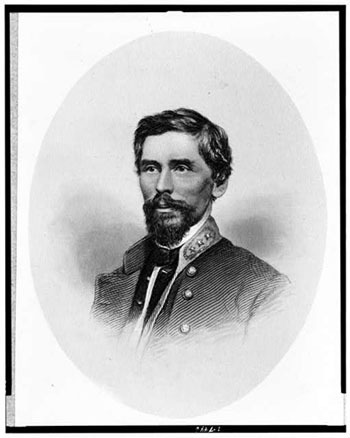
Maj.-Gen. Pat Cleburne, out of step with
his fellow Confederates on the subject of
slavery. (Courtesy: Library of Congress)
Recently I was perusing a friend's book of family history and came upon this entry: "Captain Thomas Ebenezer Cummings was killed on Sept. 11, 1864 in the battle of Jonesboro near Atlanta, Georgia, after fighting three years for states' rights, not for slavery." It made me recall a bumper-sticker I saw a decade ago, bearing the image of the battle flag: "Sons of Confederate Veterans Against Racism." There is real poignance to this belief, no doubt utterly sincere—that a man's motivating fire can be kept separate from the general conflagration, and that his descendants can point to it as if this were all that mattered. Still, if the South's cause was based just on lofty notions of self-rule, it must be asked . . .
Why did South Carolina's statement of secession—the very first—complain that the North had "denounced as sinful the institution of slavery" and "encouraged and assisted thousands of our slaves to leave their homes?" Why did it blast Lincoln as someone "whose opinions and purposes are hostile to slavery?" And why did Mississippi's statement of secession declare, "Our position is thoroughly identified with the institution of slavery—the greatest material interest in the world?" And why did Texas's statement of secession target the very notion of racial equality, blowing hard about the North's "unnatural feeling of hostility to these Southern States and their beneficent and patriarchal system of African slavery, proclaiming the debasing doctrine of equality of all men, irrespective of race or color—a doctrine at war with nature, in opposition to the experience of mankind, and in violation of the plainest revelations of Divine Law?"
Why in his infamous "Cornerstone Speech" did Confederate Vice-President Alexander Stephens feel it necessary to affirm "the great truth that the negro is not the equal of the white man; that slavery—subordination to the superior race—is his natural and normal condition"—and to declare his government "the first, in the history of the world, based on this great physical, philosophical, and moral truth?" And why, in the post-war years, were prominent ex-Confederates like Jubal Early so bent on imposing Jim Crow laws, meant to approximate black slavery as closely as possible? Thus there should be no wonder at all why the Confederate Battle Flag enjoyed a resurgence in the late 1950's-early 60's, when resistance to the Civil Rights Movement had it flying all across the South, including the grounds and domes of state houses—or that before hometown crowds, segregationist politicians liked nothing more than to invoke their Rebel forebears.
Nothing is more subjective than a cultural symbol, flags in particular. That is why we'd never expect a Nicaraguan to feel the same swell of emotion that an American does before the Stars 'n' Stripes, or a Pakistani to feel as an Englishman does before the Union Jack. Emotions are fully real to whoever is feeling them; they are not subject to rational justification. But when you choose to fly a flag—or build a monument, or name a park, or name a school, or design a license plate—you are publicly honoring whatever it represents. You are implying that the whole community should do likewise, if only by acquiescence. And that is when something more than sentiment is required. That is when you need a factual basis that justifies the honor.
Children in the ruins of Charleston, SC, 1865. (Courtesy: Library of Congress)
For many white Southerners, the Confederate flag conjures proud defiance and the image of a magnificent gray army. Well, that's factual enough—the South was proudly defiant, its army one of the greatest in world history. Over the decades, along with dyed-in-the-wool racists, plenty of people have displayed the emblem without nasty intent—for nothing more specific than that prideful jolt, or a poke in the North's judging eye (think Lynyrd Skynyrd). It's when we go deeper and wider that the trouble starts. There are tons more quotes like the ones I gave above, each of them reinforcing a bedrock truth: slavery and white supremacy were central to the Confederacy's aims, the main reasons for its birth. Its banners were soaked in a poison wellspring. The battle flag did not "come to stand for racism" in recent times, as some in the media have suggested, but stood for it from the get-go—whatever benign meanings were projected onto it later. Long-term unawareness of this requires a truly impressive degree of denial and avoidance.
The Klan and the neo-Nazis require no such denial and avoidance. They embrace the flag's historically based meaning and wave it all the time—it represents their whole program, after all. They are tapped into its dark essence, as is the Charleston shooter, as are the toxic websites that inspired him. In the wake of the massacre, defenders of the flag complained that the murderer had "misused" or "hijacked" it. Far more accurate it would be to say he blew the cover on it, tore wide open a sentimental falsehood. Whenever the flag is hoisted over some state house—that is when it's being misused.
"Political correctness" has long been the right's go-to explanation for anything it doesn't like, a rubber stamp for easy dismissal. In lefty enclaves, PC culture does exist with its simplistic assumptions, its censoring reflex and attendant smugness. (I think every college freshman orientation should include discourse on the First Amendment and its historical relevance.) But the right has its own, better-funded and more conspicuous brand of PC—whole sets of received wisdom, zealously guarded—of which spotless Southern triumphalism is just one aspect. When a government endorses a flag with this kind of documented historical baggage, it promotes that baggage, whether or not it denies the existence of same. How welcome and respected is a black resident supposed to feel, with his/her home state's government so visibly celebrating an epic pro-slavery enterprise? "It's complicated," you often hear—and if they're talking about the whole tragic saga with its social mosaic, political cross-currents and personalities, it sure is. The South itself is complicated—downright byzantine, in ways that are both endearing and exasperating. But there's nothing complicated about what should be done here. That part is pretty straightforward.
As for private citizens who keep flying the battle flag—yes, that's free speech, no way around it. But it's telling that it has become less and less common, no longer mainstream. To be born white in the modern South is, for a great many, to be born up to your eyeballs in black culture, with black friends and acquaintances never far. Some awareness of their feelings and perspectives is bound to seep through eventually, and often has. And sometimes that awareness reaches a tipping point, as I believe it did in 2001, when Georgia voters erased the Confederate emblem from their state flag. Or just two weeks ago, when the State of Alabama quietly ran it down the pole and stashed it away.
Whatever the case, 2015 finds us way past the point where the flag can be plausibly defended. Anyone who chooses to display it should not be (or act) surprised—and above all, should not act somehow persecuted—when fellow Americans of all races react against it, white Southerners included. They will do so from solid historical fact, something that no amount of fabrication and propaganda can ever bury. Apart from the memory of the Charleston Nine and apart from the Declaration of Independence, if there is just one thing we can focus on to guide us, I would suggest that Alexander Stephens quote about the Confederacy's founding truths, so self-evident to him: "the negro is not the equal of the white man; slavery—subordination to the superior race—is his natural and normal condition." Let that one echo, and the whole flag issue will be an easy call.
June 6, 2015
Dark Road, June Night: It Begins
Lucifer's Drum starts its journey in the wee hours of June 6, 1864, on a lonely road in northern Virginia. So I am marking this particular June 6 by posting the novel's first chapter. Here the Copperhead (pro-Confederate) newspaper publisher Gideon Van Gilder is fleeing through the night, pursued by something terrible.
CHAPTER ONE
NORTHERN SHENANDOAH VALLEY
JUNE 6, 1864
Gideon Van Gilder had left his dignity far behind, like an expensive topcoat forgotten in haste. He did not mourn its loss—had not mourned it even at the last roadside inn, when he started awake and spied his stricken face in a shaving mirror. Now, huddled again inside the rocking coach, he could think only of escape. Escape—southward, southward by moon and carriage light, along this road so rough that it threatened to break the axles. Up the hill-haunted Shenandoah lay sanctuary, some haven behind the booming, gargantuan battle lines. Only there could he know rest once more. Rest, and perhaps the luxury of pride.
The lump of the derringer beneath his vest was small comfort–he had never fired a pistol in his life. At times in the jouncing blur of his journey, he had found himself gripping his cane between his knees like a talisman of dubious power. More frequently than ever he yelled at his hunchbacked coachman, calling him a sausage-eating monkey or a deformed German half-wit. The coachman said little.
Awaking from a fitful doze, Van Gilder realized that the coach’s rocking had ceased. He shuddered as he blinked out of the window into a mass of tall black shapes that hid the moon. He heard a ragged breathing sound. After a disoriented moment, he identified the sound as that of the horses and the obstruction as a stand of pine. He shifted to the other side and elbowed the door open. In the carriage lamp’s glow he discerned the misshapen form of the coachman. He was carrying two pails down an embankment, headed for the ripple of an unseen creek.
Van Gilder drew a breath to holler, but in the dark his voice came as a hushed rasp. “Kirschenbaum!”
Maintaining his balance on the slope, the coachman made an awkward turn. “Horses are tired, you makes them run all night. Tired like me, sir. I get vater.”
“Do it, then, imbecile! But no more stops!”
The hunched form started to turn away, then hesitated. “Herr Van Gilder?”
“Get the damned water!”
“We gets closer to the secesh.”
“Yes!” Van Gilder hissed “Yes—and I’ve paid you! Get the water!”
“I did not know I must take you five days and now all night. And we gets closer to the secesh.”
Though still hushed, Van Gilder’s voice began its climb toward full fury. “Fool! I know where we’re going! I’ve paid you!”
“You pay me more, I think.”
In the rippling stillness, one of the animals snorted. Van Gilder sputtered a curse. “Three dollars more, when we reach the place!”
“Ten.”
From the creek, a bullfrog let out a deep “bong” sound. Van Gilder thought of the derringer—wishing, thwarted. This time he spoke in just a murmur. “Ten, when we get there.”
“I thank you,” said the hunchback, who resumed his descent.
Dense with cricket noise, the warm, still air pressed in on Van Gilder, worsening his agitation. He took up his map, rattled it open and lit a match. In the match’s flutter he followed the black line of his route to the town of Strasburg, marked by a tight circle. Twenty-five miles to go, more or less. He blew out the match, folded the map and again peered outside.
“Kirschenbaum!” he called in a hoarse whisper.
From the embankment, the hunchback’s laboring form reappeared with the pails, slopping water. Kirschenbaum began watering the first pair of horses. When they got to Strasburg, Van Gilder thought, he would stick his derringer in the face of this insolent moron. Then he would drop a single coin at his feet and tell him to get out of his sight forever.
“Van Gilder!” came a deep-throated call.
Van Gilder jerked upright. For a crazed moment, he could neither move nor think nor breathe. Then, blindly, he began fumbling for his derringer.
“Don’t fret,” came the voice. “I am here to see that you pass safely through our lines.”
Van Gilder stopped pawing at his vest. Shaking, he leaned slowly out the side. He saw Kirschenbaum standing motionless, staring past the back of the coach. From that direction he heard a crunch of pebbles, very close. How—how could anyone have come upon them with such stealth? Leaning out farther, he forced his head to turn. Out of the gloom, the shape of a horse and rider emerged. The man wore a military cap, cape and double-breasted tunic, its brass buttons winking like sparks. With the oil running low, the lamps cast a meager halo about the coach—and as the stranger entered it, his uniform proved to be Union blue. He held a revolver and the reins in one hand, an extinguished lantern in the other.
Van Gilder gazed, open-mouthed as the intruder guided his mount forward and then halted–a bearded, powerful-looking officer, the right side of his face hidden by bandages. In an attitude of dutiful ease, he slouched in the saddle, his revolver held loosely away. His one visible eye peered down at Kirschenbaum, though it was Van Gilder whom he addressed:
“Major Henry Spruce, Army of the Potomac, currently on detached service. I am your official escort—to ensure that you make your rendezvous in Strasburg. That you do so without being fired upon by federal pickets, who perhaps know a traitor when they see one.”
There was something odd about the major’s low-in-the-throat intonation. Still gaping, Van Gilder fidgeted with the buttons of his coat. “How did you know . . . ?”
“For reasons that are plain enough, our government has observed you closely for some time. We welcome your decision and wish to aid you in carrying it out. The Union is well rid of you, don’t you think?”
Van Gilder’s ire stirred, eating through his fear. “And I, sir . . . I am well rid of the Union!”
The major passed the lantern down to Kirschenbaum, who distractedly placed it in the coach’s boot, along with the empty pails. Holstering his weapon, Spruce dismounted with a grace unusual for a man his size, let alone an injured one. His whiskers were cinnamon brown and the bandages new, with no trace of dirt or blood. The horse complemented him entirely–a sleek black stallion whose forehead bore a patch of white, like a chipped diamond.
Spruce held his palm out to Van Gilder. “I’ll take your piece, for now.”
Van Gilder hesitated, teetering between caution and resentment. Then, with a quivering hand, he reached under his vest, withdrew the pistol and gave it up.
The major stuck the weapon in his saddlebag, from which he then took a bundled hitching strap. Unfurling it, he fastened one end to his horse’s bridle ring and the other to the coach’s roof railing.
“What are you doing?” Van Gilder demanded.
Spruce took out a little sack, then placed his booted foot on the coach’s step plate. “My mount can trot along behind. It’ll be daylight soon, and I don’t mean to be picked off when your secesh friends see us coming.” He signaled for Van Gilder to move his legs. “You’re stuck with me for the last few miles, good sir.”
Van Gilder budged over.
The major glanced over at Kirschenbaum. “Drive on.”
“Ja, sir.”
The hunchback hoisted himself up to the driver’s box as Spruce climbed in.
At the sound of the lash, the vehicle lurched, rocked and continued along the rutted road. Van Gilder’s heart still thudded. Longing for daylight, he averted his gaze from the major who sat opposite, one hand playing with the cord of the window blind.
“A Concord Coach,” said Spruce. “You do travel in style, don’t you?”
Van Gilder granted himself a look, taking in the holstered revolver, the bayonet in its leather scabbard, the broad shoulders with epaulettes. Spruce had not seen fit to remove his hat, under which tufts of cinnamon hair protruded. However noxious, his military aspect made him a known quantity, nudging Van Gilder toward sullen acquiescence. Still it unsettled him to sit facing a man with half a face. Then Van Gilder noticed the one pale eye looking straight at him.
“You will pardon my appearance,” said Spruce. “This little addition to my features was made a few weeks ago at Spotsylvania, courtesy of one of your fine compatriots.”
Van Gilder cleared his throat. “A misfortune I would have wished to prevent. As with this war.”
Arms crossed, the major gave a shrug, barely detectable amid the jarring of the dim coach.
Van Gilder felt satisfied with his own response. Beneath the lingering shock, he was settling down. He reached for his cane. Holding it firmly, he raised his double chin and tried to meet Spruce’s eye. Instantly his stomach tightened again. Even in this gloom, the look on the rugged, half-concealed face seemed too knowing.
Van Gilder struggled for an airy tone. “Through your lines, eh? I didn’t think there were lines to speak of in this region.”
“Your information is faulty, sir. Like your politics.”
Van Gilder managed an authentic glare.
“The Valley’s in federal hands,” said the major. “General Hunter’s on the march.” With a hint of smile, he reached under his cape and withdrew a flask, which he uncorked. “It helps the pain as well as anything,” he said, and took a quick swallow.
Van Gilder’s tension eased a bit. The coach bumped along beneath him, headed toward safety. He would make Strasburg, albeit with an unwelcome companion. “So you’re all they sent,” he observed.
Spruce chortled. “Ho-ho! First you’re indignant that we knew your movements—and now you complain of insufficient escort? Thanks in no small part to you and your kind, our forces are fully engaged throughout Virginia. We can scarcely spare men for duties so . . . minor.” He took another swallow, then wiped his lips on his cuff. “My regrets, sir, but one loyal convalescent is all we can afford you.”
Looking out at the bumpy darkness, Van Gilder sneered. “In truth, Major, you’re more than enough.”
Spruce let out a comfortable sigh. “I reckon I’ll suffice.”
Van Gilder sat back. He didn’t need to look at Spruce again. For him, in these cramped shadows, the scales had balanced. Patience had never been his strong card, but he could stand the presence of a tippling bluebelly for a while. So long as it meant asylum in the great gray bosom of Dixie.
“But come, Van Gilder—credit me with restraint. I’ve been told of your career and yet refrained from calling you any number of names. Treasonous dog, reptilian Judas, Copperhead scum . . . "
Van Gilder straightened in his seat. His face grew warm as he forced a glare into Spruce’s lone eye, and for a moment he became the self that he fancied best: champion of states’ rights, arch-foe of miscegenation, battler of the tyrannical federal serpent. “Then credit me, sir! Credit me with the ardor of my convictions! The prospect of despotism and half-nigger infants may not worry you. The plague of freed black bucks robbing honest white men of their livelihoods may not concern you. But for my part I’ve endured intrigue, vilification and all manner of devilry for merely wishing peace. Peace, Major! An end to the wounds and killing! Your face, sir, would be whole now if my words and those of my fellow believers had been heeded!”
Holding a hand up, the big officer looked into his lap and slowly shook his head. “And you have many words, I’m sure. I cannot hope to match their eloquence, certainly not at this late hour.” The hand fell. “In fact and at heart, I’m a humble soldier. Besides, I’ve heard the Copperhead gospel so many times it makes my senses fog. So let’s simply enjoy the ride, eh?”
Van Gilder looked down at the major’s boots and smirked. Spruce’s voice was as odd as the man himself, sounding as if he had a pebble in his throat or needed to burp. Now it throbbed with false conciliation, its owner taking refuge from Van Gilder’s impassioned tongue. Whiskey was rapidly dulling this warrior’s spirit. The man had just pleaded for mercy, after a fashion, and Van Gilder supposed he might soon be hearing maudlin tales of a wife and children left behind. This was by no means the sort of exit he had planned, but at least he would depart Northern soil on a note of moral victory. Miraculously he was no longer afraid.
“You do well enough, Major,” he said, “—for a humble soldier. Though you rely on snideness overmuch.”
“War hardens us overmuch, Van Gilder.” Spruce took another nip and then reached into his little sack, from which he produced a silver folding cup. “I propose that this trip be made not in the spirit of rancor, but in recognition of opposing ends achieved at a single stroke.” He raised the cup, its rim glistening. “For you the South opens its grateful arms, while the North may now turn its intrigue and vilification upon other worthy targets. This journey, sir, is celebratory.”
Van Gilder leaned forward on his cane. He sniggered. “You propose that I drink with you, Major Spruce?”
Looking thoughtful, Spruce lowered the cup, then used it to push back the brim of his hat. “I . . . I propose that we honor the one objective, the one prayer we find mutually agreeable. To this sorrowful conflict’s end.”
Van Gilder arched an eyebrow.
Spruce raised the flask and the cup, poured two fingers’ worth and offered it to Van Gilder. Sneering at the cup, Van Gilder let Spruce’s hand hold it there for a moment, vibrating with the road. Then he took it. He could humor a jabbering Unionist fool. Perhaps he could even squeeze the man for an answer or two—answers that he could impart to Richmond officials, when he told them how outrageously sloppy their agents were.
“Not that it matters now,” Van Gilder said, “—but how were my movements made known to you?”
Now it was Spruce who smirked. He drew his hat down till it hid his eye. “Let it just be said that the government has its ways. More than either of us can know.”
Van Gilder shifted position, frowning at his drink. After all the tense planning for this contingency, his Southern friends—maybe even Cathcart, his most trusted—stood guilty of some idiotic lapse, the exact nature of which he would probably never know. The thought made him sullen once more.
Spruce held the flask up. “To war’s end!”
Van Gilder squinted at the hat’s brim, hoping the major could feel the heat of his contempt. “To peace!” he declared, and downed the liquor.
Smacking his lips, he gazed out at the night again. In the deep black of the east he sensed the Blue Ridge Mountains, soon to be fringed red with dawn. Sooner than that, this road would join the Valley Pike, taking him through Winchester and on to Strasburg. Surely he was in Virginia by now.
The coach slowed as it started on an uphill grade. Through the door seam came a breeze, clammy on Van Gilder’s face. He was perspiring. He realized that he had dropped both the cup and the cane and that his fingers had gone limp. As he turned his head, the fear began—a quiet explosion of cold, all over.
On the seat beside his companion he saw the corked flask. Next to that lay the major’s hat, upside down, the cinnamon wig like some dead creature in its hollow. And he saw the man watching him—fingertips together, elbows out, cape spread. A man of shadows—half-faced, dark-maned, somehow larger than before. Van Gilder knew the patient mannerism of the fingertips. He knew the lone steady eye, the barely visible scar along the scalp. And when the voice came, the true voice, he knew that too—smooth and distant yet horribly intimate, as in his nightmares.
“How do you feel, Gideon?”
Van Gilder understood at last that fear had been a presence throughout his life. Fear of many things, played out in bluster and vitriol. But the terror that struck him now dwarfed the sum of every fear he had known, quaking him in a tide of nausea. His eyelids fluttered, but if he blacked out it was only for a few seconds. In his swimming vision he beheld the half-faced specter, waiting there. Van Gilder could not move. His lips emitted a low whine.
“Nothing fatal,” said the voice. “The cup was coated with a substance derived from the glands of a large Caribbean toad. Hard to obtain, but within our means. It will simply . . . hold you in place.”
Wide-eyed, his insides bucking, Van Gilder strained against the near-complete paralysis.
“It was easy, mind you. I just had to wait, watch, trail you for a bit.”
Van Gilder stared, choked.
The fingertips parted, then came to rest on his knees. “And if you could speak, Gideon, what would the words be? A plea, I suppose. But you recall our last session and what passed between us then. A whole year ago—could that be?” Reaching out with his index, he flicked Van Gilder’s hair beside his right ear. “A covenant broken is a kind of death.” His caped bulk leaned forward, looming. “It is death. Death, precisely. With death as its only atonement.”
The coach started down a grade, speeding up with a clacking of wheels. Blood thumping in his ears, Van Gilder fought to breathe. For an instant, horror transported him back to the night that he had entered into the contract and doomed himself—a howl within his memory, unfathomable. Then he returned, though the howl could not break free. His eyes bulged at the one pale eye and he knew that he was in hell—a cramped, dim, rocking hell prepared for him alone, with the darkest of angels presiding. The specter looked down, contemplative. Next to his upended hat sat a jar full of clear fluid labeled “Formaldehyde.” Then, with that casual elegance, he drew his bayonet. If Van Gilder’s soul had harbored any small hope of reprieve, it died now. There would be no reprieve, no mercy.
The dark angel sighed. “Gideon—your atonement begins.”
CHAPTER ONE
NORTHERN SHENANDOAH VALLEY
JUNE 6, 1864
Gideon Van Gilder had left his dignity far behind, like an expensive topcoat forgotten in haste. He did not mourn its loss—had not mourned it even at the last roadside inn, when he started awake and spied his stricken face in a shaving mirror. Now, huddled again inside the rocking coach, he could think only of escape. Escape—southward, southward by moon and carriage light, along this road so rough that it threatened to break the axles. Up the hill-haunted Shenandoah lay sanctuary, some haven behind the booming, gargantuan battle lines. Only there could he know rest once more. Rest, and perhaps the luxury of pride.
The lump of the derringer beneath his vest was small comfort–he had never fired a pistol in his life. At times in the jouncing blur of his journey, he had found himself gripping his cane between his knees like a talisman of dubious power. More frequently than ever he yelled at his hunchbacked coachman, calling him a sausage-eating monkey or a deformed German half-wit. The coachman said little.
Awaking from a fitful doze, Van Gilder realized that the coach’s rocking had ceased. He shuddered as he blinked out of the window into a mass of tall black shapes that hid the moon. He heard a ragged breathing sound. After a disoriented moment, he identified the sound as that of the horses and the obstruction as a stand of pine. He shifted to the other side and elbowed the door open. In the carriage lamp’s glow he discerned the misshapen form of the coachman. He was carrying two pails down an embankment, headed for the ripple of an unseen creek.
Van Gilder drew a breath to holler, but in the dark his voice came as a hushed rasp. “Kirschenbaum!”
Maintaining his balance on the slope, the coachman made an awkward turn. “Horses are tired, you makes them run all night. Tired like me, sir. I get vater.”
“Do it, then, imbecile! But no more stops!”
The hunched form started to turn away, then hesitated. “Herr Van Gilder?”
“Get the damned water!”
“We gets closer to the secesh.”
“Yes!” Van Gilder hissed “Yes—and I’ve paid you! Get the water!”
“I did not know I must take you five days and now all night. And we gets closer to the secesh.”
Though still hushed, Van Gilder’s voice began its climb toward full fury. “Fool! I know where we’re going! I’ve paid you!”
“You pay me more, I think.”
In the rippling stillness, one of the animals snorted. Van Gilder sputtered a curse. “Three dollars more, when we reach the place!”
“Ten.”
From the creek, a bullfrog let out a deep “bong” sound. Van Gilder thought of the derringer—wishing, thwarted. This time he spoke in just a murmur. “Ten, when we get there.”
“I thank you,” said the hunchback, who resumed his descent.
Dense with cricket noise, the warm, still air pressed in on Van Gilder, worsening his agitation. He took up his map, rattled it open and lit a match. In the match’s flutter he followed the black line of his route to the town of Strasburg, marked by a tight circle. Twenty-five miles to go, more or less. He blew out the match, folded the map and again peered outside.
“Kirschenbaum!” he called in a hoarse whisper.
From the embankment, the hunchback’s laboring form reappeared with the pails, slopping water. Kirschenbaum began watering the first pair of horses. When they got to Strasburg, Van Gilder thought, he would stick his derringer in the face of this insolent moron. Then he would drop a single coin at his feet and tell him to get out of his sight forever.
“Van Gilder!” came a deep-throated call.
Van Gilder jerked upright. For a crazed moment, he could neither move nor think nor breathe. Then, blindly, he began fumbling for his derringer.
“Don’t fret,” came the voice. “I am here to see that you pass safely through our lines.”
Van Gilder stopped pawing at his vest. Shaking, he leaned slowly out the side. He saw Kirschenbaum standing motionless, staring past the back of the coach. From that direction he heard a crunch of pebbles, very close. How—how could anyone have come upon them with such stealth? Leaning out farther, he forced his head to turn. Out of the gloom, the shape of a horse and rider emerged. The man wore a military cap, cape and double-breasted tunic, its brass buttons winking like sparks. With the oil running low, the lamps cast a meager halo about the coach—and as the stranger entered it, his uniform proved to be Union blue. He held a revolver and the reins in one hand, an extinguished lantern in the other.
Van Gilder gazed, open-mouthed as the intruder guided his mount forward and then halted–a bearded, powerful-looking officer, the right side of his face hidden by bandages. In an attitude of dutiful ease, he slouched in the saddle, his revolver held loosely away. His one visible eye peered down at Kirschenbaum, though it was Van Gilder whom he addressed:
“Major Henry Spruce, Army of the Potomac, currently on detached service. I am your official escort—to ensure that you make your rendezvous in Strasburg. That you do so without being fired upon by federal pickets, who perhaps know a traitor when they see one.”
There was something odd about the major’s low-in-the-throat intonation. Still gaping, Van Gilder fidgeted with the buttons of his coat. “How did you know . . . ?”
“For reasons that are plain enough, our government has observed you closely for some time. We welcome your decision and wish to aid you in carrying it out. The Union is well rid of you, don’t you think?”
Van Gilder’s ire stirred, eating through his fear. “And I, sir . . . I am well rid of the Union!”
The major passed the lantern down to Kirschenbaum, who distractedly placed it in the coach’s boot, along with the empty pails. Holstering his weapon, Spruce dismounted with a grace unusual for a man his size, let alone an injured one. His whiskers were cinnamon brown and the bandages new, with no trace of dirt or blood. The horse complemented him entirely–a sleek black stallion whose forehead bore a patch of white, like a chipped diamond.
Spruce held his palm out to Van Gilder. “I’ll take your piece, for now.”
Van Gilder hesitated, teetering between caution and resentment. Then, with a quivering hand, he reached under his vest, withdrew the pistol and gave it up.
The major stuck the weapon in his saddlebag, from which he then took a bundled hitching strap. Unfurling it, he fastened one end to his horse’s bridle ring and the other to the coach’s roof railing.
“What are you doing?” Van Gilder demanded.
Spruce took out a little sack, then placed his booted foot on the coach’s step plate. “My mount can trot along behind. It’ll be daylight soon, and I don’t mean to be picked off when your secesh friends see us coming.” He signaled for Van Gilder to move his legs. “You’re stuck with me for the last few miles, good sir.”
Van Gilder budged over.
The major glanced over at Kirschenbaum. “Drive on.”
“Ja, sir.”
The hunchback hoisted himself up to the driver’s box as Spruce climbed in.
At the sound of the lash, the vehicle lurched, rocked and continued along the rutted road. Van Gilder’s heart still thudded. Longing for daylight, he averted his gaze from the major who sat opposite, one hand playing with the cord of the window blind.
“A Concord Coach,” said Spruce. “You do travel in style, don’t you?”
Van Gilder granted himself a look, taking in the holstered revolver, the bayonet in its leather scabbard, the broad shoulders with epaulettes. Spruce had not seen fit to remove his hat, under which tufts of cinnamon hair protruded. However noxious, his military aspect made him a known quantity, nudging Van Gilder toward sullen acquiescence. Still it unsettled him to sit facing a man with half a face. Then Van Gilder noticed the one pale eye looking straight at him.
“You will pardon my appearance,” said Spruce. “This little addition to my features was made a few weeks ago at Spotsylvania, courtesy of one of your fine compatriots.”
Van Gilder cleared his throat. “A misfortune I would have wished to prevent. As with this war.”
Arms crossed, the major gave a shrug, barely detectable amid the jarring of the dim coach.
Van Gilder felt satisfied with his own response. Beneath the lingering shock, he was settling down. He reached for his cane. Holding it firmly, he raised his double chin and tried to meet Spruce’s eye. Instantly his stomach tightened again. Even in this gloom, the look on the rugged, half-concealed face seemed too knowing.
Van Gilder struggled for an airy tone. “Through your lines, eh? I didn’t think there were lines to speak of in this region.”
“Your information is faulty, sir. Like your politics.”
Van Gilder managed an authentic glare.
“The Valley’s in federal hands,” said the major. “General Hunter’s on the march.” With a hint of smile, he reached under his cape and withdrew a flask, which he uncorked. “It helps the pain as well as anything,” he said, and took a quick swallow.
Van Gilder’s tension eased a bit. The coach bumped along beneath him, headed toward safety. He would make Strasburg, albeit with an unwelcome companion. “So you’re all they sent,” he observed.
Spruce chortled. “Ho-ho! First you’re indignant that we knew your movements—and now you complain of insufficient escort? Thanks in no small part to you and your kind, our forces are fully engaged throughout Virginia. We can scarcely spare men for duties so . . . minor.” He took another swallow, then wiped his lips on his cuff. “My regrets, sir, but one loyal convalescent is all we can afford you.”
Looking out at the bumpy darkness, Van Gilder sneered. “In truth, Major, you’re more than enough.”
Spruce let out a comfortable sigh. “I reckon I’ll suffice.”
Van Gilder sat back. He didn’t need to look at Spruce again. For him, in these cramped shadows, the scales had balanced. Patience had never been his strong card, but he could stand the presence of a tippling bluebelly for a while. So long as it meant asylum in the great gray bosom of Dixie.
“But come, Van Gilder—credit me with restraint. I’ve been told of your career and yet refrained from calling you any number of names. Treasonous dog, reptilian Judas, Copperhead scum . . . "
Van Gilder straightened in his seat. His face grew warm as he forced a glare into Spruce’s lone eye, and for a moment he became the self that he fancied best: champion of states’ rights, arch-foe of miscegenation, battler of the tyrannical federal serpent. “Then credit me, sir! Credit me with the ardor of my convictions! The prospect of despotism and half-nigger infants may not worry you. The plague of freed black bucks robbing honest white men of their livelihoods may not concern you. But for my part I’ve endured intrigue, vilification and all manner of devilry for merely wishing peace. Peace, Major! An end to the wounds and killing! Your face, sir, would be whole now if my words and those of my fellow believers had been heeded!”
Holding a hand up, the big officer looked into his lap and slowly shook his head. “And you have many words, I’m sure. I cannot hope to match their eloquence, certainly not at this late hour.” The hand fell. “In fact and at heart, I’m a humble soldier. Besides, I’ve heard the Copperhead gospel so many times it makes my senses fog. So let’s simply enjoy the ride, eh?”
Van Gilder looked down at the major’s boots and smirked. Spruce’s voice was as odd as the man himself, sounding as if he had a pebble in his throat or needed to burp. Now it throbbed with false conciliation, its owner taking refuge from Van Gilder’s impassioned tongue. Whiskey was rapidly dulling this warrior’s spirit. The man had just pleaded for mercy, after a fashion, and Van Gilder supposed he might soon be hearing maudlin tales of a wife and children left behind. This was by no means the sort of exit he had planned, but at least he would depart Northern soil on a note of moral victory. Miraculously he was no longer afraid.
“You do well enough, Major,” he said, “—for a humble soldier. Though you rely on snideness overmuch.”
“War hardens us overmuch, Van Gilder.” Spruce took another nip and then reached into his little sack, from which he produced a silver folding cup. “I propose that this trip be made not in the spirit of rancor, but in recognition of opposing ends achieved at a single stroke.” He raised the cup, its rim glistening. “For you the South opens its grateful arms, while the North may now turn its intrigue and vilification upon other worthy targets. This journey, sir, is celebratory.”
Van Gilder leaned forward on his cane. He sniggered. “You propose that I drink with you, Major Spruce?”
Looking thoughtful, Spruce lowered the cup, then used it to push back the brim of his hat. “I . . . I propose that we honor the one objective, the one prayer we find mutually agreeable. To this sorrowful conflict’s end.”
Van Gilder arched an eyebrow.
Spruce raised the flask and the cup, poured two fingers’ worth and offered it to Van Gilder. Sneering at the cup, Van Gilder let Spruce’s hand hold it there for a moment, vibrating with the road. Then he took it. He could humor a jabbering Unionist fool. Perhaps he could even squeeze the man for an answer or two—answers that he could impart to Richmond officials, when he told them how outrageously sloppy their agents were.
“Not that it matters now,” Van Gilder said, “—but how were my movements made known to you?”
Now it was Spruce who smirked. He drew his hat down till it hid his eye. “Let it just be said that the government has its ways. More than either of us can know.”
Van Gilder shifted position, frowning at his drink. After all the tense planning for this contingency, his Southern friends—maybe even Cathcart, his most trusted—stood guilty of some idiotic lapse, the exact nature of which he would probably never know. The thought made him sullen once more.
Spruce held the flask up. “To war’s end!”
Van Gilder squinted at the hat’s brim, hoping the major could feel the heat of his contempt. “To peace!” he declared, and downed the liquor.
Smacking his lips, he gazed out at the night again. In the deep black of the east he sensed the Blue Ridge Mountains, soon to be fringed red with dawn. Sooner than that, this road would join the Valley Pike, taking him through Winchester and on to Strasburg. Surely he was in Virginia by now.
The coach slowed as it started on an uphill grade. Through the door seam came a breeze, clammy on Van Gilder’s face. He was perspiring. He realized that he had dropped both the cup and the cane and that his fingers had gone limp. As he turned his head, the fear began—a quiet explosion of cold, all over.
On the seat beside his companion he saw the corked flask. Next to that lay the major’s hat, upside down, the cinnamon wig like some dead creature in its hollow. And he saw the man watching him—fingertips together, elbows out, cape spread. A man of shadows—half-faced, dark-maned, somehow larger than before. Van Gilder knew the patient mannerism of the fingertips. He knew the lone steady eye, the barely visible scar along the scalp. And when the voice came, the true voice, he knew that too—smooth and distant yet horribly intimate, as in his nightmares.
“How do you feel, Gideon?”
Van Gilder understood at last that fear had been a presence throughout his life. Fear of many things, played out in bluster and vitriol. But the terror that struck him now dwarfed the sum of every fear he had known, quaking him in a tide of nausea. His eyelids fluttered, but if he blacked out it was only for a few seconds. In his swimming vision he beheld the half-faced specter, waiting there. Van Gilder could not move. His lips emitted a low whine.
“Nothing fatal,” said the voice. “The cup was coated with a substance derived from the glands of a large Caribbean toad. Hard to obtain, but within our means. It will simply . . . hold you in place.”
Wide-eyed, his insides bucking, Van Gilder strained against the near-complete paralysis.
“It was easy, mind you. I just had to wait, watch, trail you for a bit.”
Van Gilder stared, choked.
The fingertips parted, then came to rest on his knees. “And if you could speak, Gideon, what would the words be? A plea, I suppose. But you recall our last session and what passed between us then. A whole year ago—could that be?” Reaching out with his index, he flicked Van Gilder’s hair beside his right ear. “A covenant broken is a kind of death.” His caped bulk leaned forward, looming. “It is death. Death, precisely. With death as its only atonement.”
The coach started down a grade, speeding up with a clacking of wheels. Blood thumping in his ears, Van Gilder fought to breathe. For an instant, horror transported him back to the night that he had entered into the contract and doomed himself—a howl within his memory, unfathomable. Then he returned, though the howl could not break free. His eyes bulged at the one pale eye and he knew that he was in hell—a cramped, dim, rocking hell prepared for him alone, with the darkest of angels presiding. The specter looked down, contemplative. Next to his upended hat sat a jar full of clear fluid labeled “Formaldehyde.” Then, with that casual elegance, he drew his bayonet. If Van Gilder’s soul had harbored any small hope of reprieve, it died now. There would be no reprieve, no mercy.
The dark angel sighed. “Gideon—your atonement begins.”
April 9, 2015
"Blue As Hell's Brimstone!"
I can't spend the 150th anniversary of Appomattox without posting something. This time it concerns a historical figure who plays a minor but colorful role in my novel Lucifer's Drum, Henry Kyd Douglas. Douglas served as a trusted aide to Stonewall Jackson and later to Jubal Early. At Appomattox, where he was a brigade commander, his troops fired the last shots and were last to surrender.
Douglas hailed from Shepherdstown, Virginia (later West Virginia), though his family's home Ferry Hill stood across the Potomac, on the Maryland side. Enlisting as a Confederate private at the war's outbreak, the 22-year-old fledgling lawyer rose rapidly through the ranks and by mid-1862 was on Jackson's staff, participating in the Valley Campaign, Cedar Mountain, Second Manassas and Antietam. He filled the extra role of guide at Antietam, given his first-hand knowledge of the area. At Gettysburg he was captured and sent to the officers' prison camp at Johnson's Island, Ohio, but was freed by exchange in March, 1864. Lucifer's Drum depicts him as smart, daring and high-spirited, almost a surrogate son to his superior Jubal Early, whose mid-summer thrust down the Shenandoah brought them to the doorstep of Washington, D.C.
Many of the incidents and conversations in the novel are of course imaginary, informed by history but no more than that. One particular moment, however, is taken directly from the historical record. As Early gives orders for the Confederate host to withdraw from Washington's outskirts, following the Union counterattack, he stops to boast that they have "scared Abe Lincoln like hell." To which Douglas, then a major, responds, "Yes, General, but this afternoon when that Yankee line moved out against us, I think some other people were scared blue as hell's brimstone!" Reacting to his young aide's brash modesty, Early reportedly declared, "That's true, but it won't appear in history!" Early was no prophet.
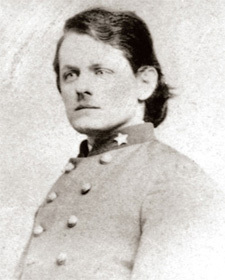
Henry Kyd Douglas, last to surrender
at Appomattox. (Courtesy: Library
of Congress)
Novels are by definition works of invention—but for historical ones, true events and true moments provide a mother lode of drama. Lucifer's Drum uses plenty of them: the solemn parade of Rebel troops past Stonewall Jackson's grave; the 4th of July picnic for the free black community of Washington, on the grounds of the President's House; Lincoln under fire on the parapet at Fort Stevens. Often, when you have researched these incidents, you are left feeling that only real life could have scripted them. Fiction pales.
Douglas saw action in nearly every Eastern campaign and survived six woundings. Varina Davis, wife of Confederate President Jefferson Davis, called Douglas, "with one exception, the handsomest man I ever met." After the war, he published his memoir I Rode With Stonewall, often cited as one of the most engaging and best-written of its kind, though not necessarily the most reliable. (You wouldn't think Douglas would have had to embellish, but it's a good bet that he did. Well, he definitely wasn't alone in that.)
Never marrying, he ended up a respected attorney in Hagerstown, Maryland, the very Unionist town that his Confederate brethren had shaken down for a "levy" during Early's Raid. Maybe its citizenry were more forgiving because of the mistake the Rebel cavalry had made on that occasion, misunderstanding Early's demand for $200,000 and snagging only $20,000 instead. History is plenty tragic, but once in a while it's funny.
Douglas hailed from Shepherdstown, Virginia (later West Virginia), though his family's home Ferry Hill stood across the Potomac, on the Maryland side. Enlisting as a Confederate private at the war's outbreak, the 22-year-old fledgling lawyer rose rapidly through the ranks and by mid-1862 was on Jackson's staff, participating in the Valley Campaign, Cedar Mountain, Second Manassas and Antietam. He filled the extra role of guide at Antietam, given his first-hand knowledge of the area. At Gettysburg he was captured and sent to the officers' prison camp at Johnson's Island, Ohio, but was freed by exchange in March, 1864. Lucifer's Drum depicts him as smart, daring and high-spirited, almost a surrogate son to his superior Jubal Early, whose mid-summer thrust down the Shenandoah brought them to the doorstep of Washington, D.C.
Many of the incidents and conversations in the novel are of course imaginary, informed by history but no more than that. One particular moment, however, is taken directly from the historical record. As Early gives orders for the Confederate host to withdraw from Washington's outskirts, following the Union counterattack, he stops to boast that they have "scared Abe Lincoln like hell." To which Douglas, then a major, responds, "Yes, General, but this afternoon when that Yankee line moved out against us, I think some other people were scared blue as hell's brimstone!" Reacting to his young aide's brash modesty, Early reportedly declared, "That's true, but it won't appear in history!" Early was no prophet.
Henry Kyd Douglas, last to surrender
at Appomattox. (Courtesy: Library
of Congress)
Novels are by definition works of invention—but for historical ones, true events and true moments provide a mother lode of drama. Lucifer's Drum uses plenty of them: the solemn parade of Rebel troops past Stonewall Jackson's grave; the 4th of July picnic for the free black community of Washington, on the grounds of the President's House; Lincoln under fire on the parapet at Fort Stevens. Often, when you have researched these incidents, you are left feeling that only real life could have scripted them. Fiction pales.
Douglas saw action in nearly every Eastern campaign and survived six woundings. Varina Davis, wife of Confederate President Jefferson Davis, called Douglas, "with one exception, the handsomest man I ever met." After the war, he published his memoir I Rode With Stonewall, often cited as one of the most engaging and best-written of its kind, though not necessarily the most reliable. (You wouldn't think Douglas would have had to embellish, but it's a good bet that he did. Well, he definitely wasn't alone in that.)
Never marrying, he ended up a respected attorney in Hagerstown, Maryland, the very Unionist town that his Confederate brethren had shaken down for a "levy" during Early's Raid. Maybe its citizenry were more forgiving because of the mistake the Rebel cavalry had made on that occasion, misunderstanding Early's demand for $200,000 and snagging only $20,000 instead. History is plenty tragic, but once in a while it's funny.
April 3, 2015
My Lost Prologue
When a novel is already fat, its author would do well *not* to include a prologue, those leisurely opening pages that give readers a bird's-eye view of time and place. Some works of fiction benefit from a prologue—a short one, preferably—but most do fine without one. I confess that when I open a book and see one, my heart sinks a little, since it means a delay of action. Still, my novel Lucifer's Drum once had a prologue. The story did seem to call for it at the time—a panoramic update, a hold-onto-your-hat overture as the Civil War lurched into its last and most horrific year.
But as I wrestled with a big story that threatened to become too big, those pages proved highly expendable. I put a lot into them, though, and am therefore posting them today, the 150th anniversary of Richmond's capture. The Confederate capital's fall was the culmination of events that started eleven months earlier, when Grant and Lee began their death struggle and the blood tide crested. All of which I tried to evoke here:
PROLOGUE: SPRING, 1864
Deep into the war, survivors found themselves looking back to the beginning. Each had a sudden, private urge to reclaim that moment, now so distant, before it too was lost. Few spoke of it, so memories groped in silence. And the more they remembered, the stranger they felt, realizing that madness and innocence are sometimes impossible to tell apart.
It had begun in fever and delirium, in shrill song and deafening cheer. With an eruption of bands and banners, with ornate cavalry and shiny black cannon rattling down the avenues. With brave, endless volunteer columns trying to look smart and march straight for the weeping girls. And with speeches: On to Richmond, God points the Way, Victory before Christmas, let him whose heart is faint turn back. A Union forever. Now, with the roar of Gettysburg not a year past, a generation of ghosts thronged the woods, hills and fields from Pennsylvania to the Trans-Mississippi.
People had at first been the manifest agents of conflict, actively willing events toward a vast and inescapable collision. Responding to the scope of the hour, they appeared somehow magnified to themselves and one another, their deeds and assertions grand as never before. Noble resolve covered everything in hues of gold, even the first homeward coffins and the humble tents dotting the hillsides. Minds, bodies, convictions—these, overnight, were galvanized for a single severe purpose, pushing and not driven, sweeping and not swept to the forward lines.
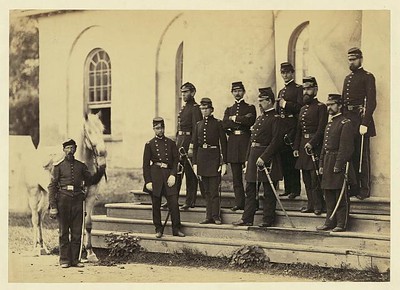
Yet at some otherworldly juncture, as the cemeteries grew and then spilled over, that purpose left the realm of human design—gone into the earth, into the smoky sky, somewhere else. A war launched in righteous certitude, by humans, had become a colossal organism that thundered of its own power. It was a creature undreamed of. Deaf to protest and opinion, it dwarfed the legions and drowned out the bands, banishing the golden light forever. Amid its heaving, unstoppable shocks, men cowered and scrambled. Armies were its beasts of burden, battalions food for its maw, each soldier a windblown seed. People had in fact never looked so small.
Deep inside the din, speeches could still be heard—Abolitionists, Constitutionalists, War Democrats, centrist Republicans and Copperheads were no less strident. But invocations of the Deity were more frequent, as if the speakers knew instinctively that mortal arguments alone would rally no one, would sound shriveled and obscene to ears grown hard. Street conversations were more clipped, more distracted, and one might note a cast of shadow in another's eye. Yesterday's expressions and sentiments remained like stumps in a hurricane and people clung to them, grasping at the same time for new certitudes. They tried to predict. They tried to envision the end. But in the fury of this storm, no eye could penetrate. And at solitary moments, all but the most flinty and partisan of souls wondered what it was they had done, what had been done, what they would do now. In the Executive Mansion, a gaunt President wondered this continually.
The opposing forces had hibernated through the winter. Greatcoated sentries leaned on their rifles and gazed across the river. For its part, the population marked time and kept busy. Women rolled bandages when they weren't cooking or mending. Children played, did chores or school work and said their prayers. But at night, clocks struck louder upon the ear. Lying awake in barracks, or in feather beds, people listened to the wind moan prophecies they could not decipher.
By daylight, many spoken prophecies centered on Ulysses S. Grant. The general's air of scruffy competence heartened Northerners, who had seen their boast trampled on too many fields. Betrayed by their own optimism, gorged sick on debate and mistrustful of appearances, they welcomed a man who was plain in speech, manner and appearance but a virtuoso in warfare. Grant came east with his record of western victories and did not boast. He went to work planning his spring campaign and assembling one of the largest forces in world history. In early May, chewing his cigar, he watched his great army cross the Rapidan into the Wilderness, into the scrub oak and blooming dogwood. Into Confederate hellfire. On the second night, with flames racing through dry undergrowth, the woods torn by the screams of wounded unable to crawl fast enough, Grant excused himself from his staff, entered his tent and wept.
What followed was armed combat as the world had never seen it. Grant did not withdraw but sent his blue leviathan hulking southeastward. Robert E. Lee's gray one followed, and the antagonists remained in daily, bludgeoning contact as the month wore on. Along with the dead and wounded, men returned wide-eyed and gibbering from the front, struck with a madness yet unnamed. Crows and wild pigs fed upon the dead before they could be carted off, and as accounts of the Wilderness, Spotsylvania and Cold Harbor bled into newsprint, the casualty rosters unfurled. Memorial portraits decorated parlors draped in black. Embalmers put up their signs. Diarists sat with nibs poised above blank pages. In school and church, children's attention strayed as they tried to picture that paradise to which their martyred fathers had gone.
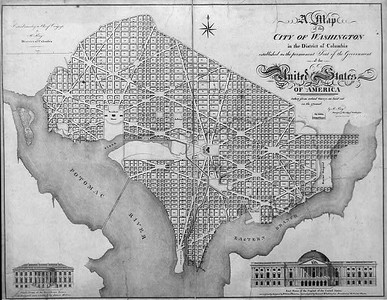
June's arrival found towns and cities in a growing state of shock. Draftees fled or scraped up the $300 substitute fee. "Bounty-jumpers" prospered by enlisting for cash bonuses, deserting, then repeating the process. Urging calm, local pro-Union leaders gave pallid homilies about honoring the dead through renewed commitment.
Washington, D.C., had more experience than most in the practice of calm. While the rest of the North sank from frenzied hope to bitter dismay, Washington sought to emulate its own statues and not flinch. It took reassurance from its grand, unfinished government buildings and its unrivaled ring of forts. It kept about its business despite daily boatloads of wounded at the Sixth Street wharf. Wounded languished in hospitals, converted churches and private homes; in hotels, warehouses and fraternal lodges. But the summer heat swelled, dulling alarm and bringing out something of the city's languid Southern character. Much less of that character survived these days. For Washington, the firing on Fort Sumter had signaled not just war, not just the swarming encampments, but also an influx of merchants and poor folk. War meant business for shops, markets, taverns, theaters, hotels, brothels and livery stables, and these had multiplied while troops paraded and battles quaked upriver or to the south. Confederate spies moved within the burgeoning population, drawing support from the city's strong pro-Southern element, passing information despite the War Department's draconian measures. Ridiculously young for its size, ridiculously divided and unready for its role as the Union's martial crux, Washington strained to meet the challenge of its transfiguration. But while it aped the smugness of older, greater cities, foreign diplomats eyed its imperial pillars and snickered. Away from the fashionable districts, shanties huddled along brawling, mud-holed streets where police chased thieves and battled ruffian gangs.
Still, as the murderous tumult continued elsewhere, the capital's summer heat slowed everything. It conjured flies from the fetid marsh and aqueduct and from the government slaughter pens. To many, a worse stench emanated from the Capitol Building, where Copperhead congressmen declared Grant a mass murderer and cried for peace while Republicans cried for censure. All looked forward to the summer recess, though it would not be much of one. A presidential election loomed with the promise of more dirt, more acrimony than the campaigns of 1860, and the parties had to marshal their forces. It was widely expected that the Lincoln administration would fall. Of the last eight Presidents, none had seen a second term, claimed either by death or factional strife.
Increasingly, dark-skinned refugees turned up—bedgraggled men, women and children liberated in Grant's wake and drawn by the capital's safety. "Contrabands," the authorities called them, ranking them with captured livestock and cotton bales. Up from the Virginia fields they came, stunned and hopeful, to scrounge some kind of living, to gaze at the monuments and at the white citizenry who glanced and kept walking. Some were taken in by the Freedman's Aid Society or the quietly industrious community of free blacks. Others slept on the street or in woodlots, or settled in shack towns along the city's northern fringe. Many of the men soon left to join their lettered, Northern-raised brethren in Negro regiments. To any white who cared to ask or listen, the ex-slaves would evince no doubt of the war's mystical dimension. They might show a ragged scar or two, indicating time spent under the devil's will and a sure preference for God's, however terrible.
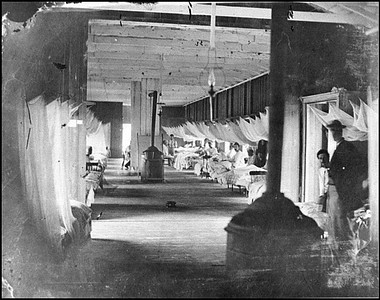
But everyone knew that the story was being blasted and re-written even as they breathed. The imponderable creature roared louder than ever, taking all in its reach. On clear days near the capital's outskirts, one could catch the far-off rumble of shelling. And certain people sensed that motives had sunk beneath the level of language, beneath the phrases about God, Honor, Freedom and Country, to the darkest region of the heart.
(Photos Courtesy: Library of Congress)
But as I wrestled with a big story that threatened to become too big, those pages proved highly expendable. I put a lot into them, though, and am therefore posting them today, the 150th anniversary of Richmond's capture. The Confederate capital's fall was the culmination of events that started eleven months earlier, when Grant and Lee began their death struggle and the blood tide crested. All of which I tried to evoke here:
PROLOGUE: SPRING, 1864
Deep into the war, survivors found themselves looking back to the beginning. Each had a sudden, private urge to reclaim that moment, now so distant, before it too was lost. Few spoke of it, so memories groped in silence. And the more they remembered, the stranger they felt, realizing that madness and innocence are sometimes impossible to tell apart.
It had begun in fever and delirium, in shrill song and deafening cheer. With an eruption of bands and banners, with ornate cavalry and shiny black cannon rattling down the avenues. With brave, endless volunteer columns trying to look smart and march straight for the weeping girls. And with speeches: On to Richmond, God points the Way, Victory before Christmas, let him whose heart is faint turn back. A Union forever. Now, with the roar of Gettysburg not a year past, a generation of ghosts thronged the woods, hills and fields from Pennsylvania to the Trans-Mississippi.
People had at first been the manifest agents of conflict, actively willing events toward a vast and inescapable collision. Responding to the scope of the hour, they appeared somehow magnified to themselves and one another, their deeds and assertions grand as never before. Noble resolve covered everything in hues of gold, even the first homeward coffins and the humble tents dotting the hillsides. Minds, bodies, convictions—these, overnight, were galvanized for a single severe purpose, pushing and not driven, sweeping and not swept to the forward lines.
Yet at some otherworldly juncture, as the cemeteries grew and then spilled over, that purpose left the realm of human design—gone into the earth, into the smoky sky, somewhere else. A war launched in righteous certitude, by humans, had become a colossal organism that thundered of its own power. It was a creature undreamed of. Deaf to protest and opinion, it dwarfed the legions and drowned out the bands, banishing the golden light forever. Amid its heaving, unstoppable shocks, men cowered and scrambled. Armies were its beasts of burden, battalions food for its maw, each soldier a windblown seed. People had in fact never looked so small.
Deep inside the din, speeches could still be heard—Abolitionists, Constitutionalists, War Democrats, centrist Republicans and Copperheads were no less strident. But invocations of the Deity were more frequent, as if the speakers knew instinctively that mortal arguments alone would rally no one, would sound shriveled and obscene to ears grown hard. Street conversations were more clipped, more distracted, and one might note a cast of shadow in another's eye. Yesterday's expressions and sentiments remained like stumps in a hurricane and people clung to them, grasping at the same time for new certitudes. They tried to predict. They tried to envision the end. But in the fury of this storm, no eye could penetrate. And at solitary moments, all but the most flinty and partisan of souls wondered what it was they had done, what had been done, what they would do now. In the Executive Mansion, a gaunt President wondered this continually.
The opposing forces had hibernated through the winter. Greatcoated sentries leaned on their rifles and gazed across the river. For its part, the population marked time and kept busy. Women rolled bandages when they weren't cooking or mending. Children played, did chores or school work and said their prayers. But at night, clocks struck louder upon the ear. Lying awake in barracks, or in feather beds, people listened to the wind moan prophecies they could not decipher.
By daylight, many spoken prophecies centered on Ulysses S. Grant. The general's air of scruffy competence heartened Northerners, who had seen their boast trampled on too many fields. Betrayed by their own optimism, gorged sick on debate and mistrustful of appearances, they welcomed a man who was plain in speech, manner and appearance but a virtuoso in warfare. Grant came east with his record of western victories and did not boast. He went to work planning his spring campaign and assembling one of the largest forces in world history. In early May, chewing his cigar, he watched his great army cross the Rapidan into the Wilderness, into the scrub oak and blooming dogwood. Into Confederate hellfire. On the second night, with flames racing through dry undergrowth, the woods torn by the screams of wounded unable to crawl fast enough, Grant excused himself from his staff, entered his tent and wept.
What followed was armed combat as the world had never seen it. Grant did not withdraw but sent his blue leviathan hulking southeastward. Robert E. Lee's gray one followed, and the antagonists remained in daily, bludgeoning contact as the month wore on. Along with the dead and wounded, men returned wide-eyed and gibbering from the front, struck with a madness yet unnamed. Crows and wild pigs fed upon the dead before they could be carted off, and as accounts of the Wilderness, Spotsylvania and Cold Harbor bled into newsprint, the casualty rosters unfurled. Memorial portraits decorated parlors draped in black. Embalmers put up their signs. Diarists sat with nibs poised above blank pages. In school and church, children's attention strayed as they tried to picture that paradise to which their martyred fathers had gone.
June's arrival found towns and cities in a growing state of shock. Draftees fled or scraped up the $300 substitute fee. "Bounty-jumpers" prospered by enlisting for cash bonuses, deserting, then repeating the process. Urging calm, local pro-Union leaders gave pallid homilies about honoring the dead through renewed commitment.
Washington, D.C., had more experience than most in the practice of calm. While the rest of the North sank from frenzied hope to bitter dismay, Washington sought to emulate its own statues and not flinch. It took reassurance from its grand, unfinished government buildings and its unrivaled ring of forts. It kept about its business despite daily boatloads of wounded at the Sixth Street wharf. Wounded languished in hospitals, converted churches and private homes; in hotels, warehouses and fraternal lodges. But the summer heat swelled, dulling alarm and bringing out something of the city's languid Southern character. Much less of that character survived these days. For Washington, the firing on Fort Sumter had signaled not just war, not just the swarming encampments, but also an influx of merchants and poor folk. War meant business for shops, markets, taverns, theaters, hotels, brothels and livery stables, and these had multiplied while troops paraded and battles quaked upriver or to the south. Confederate spies moved within the burgeoning population, drawing support from the city's strong pro-Southern element, passing information despite the War Department's draconian measures. Ridiculously young for its size, ridiculously divided and unready for its role as the Union's martial crux, Washington strained to meet the challenge of its transfiguration. But while it aped the smugness of older, greater cities, foreign diplomats eyed its imperial pillars and snickered. Away from the fashionable districts, shanties huddled along brawling, mud-holed streets where police chased thieves and battled ruffian gangs.
Still, as the murderous tumult continued elsewhere, the capital's summer heat slowed everything. It conjured flies from the fetid marsh and aqueduct and from the government slaughter pens. To many, a worse stench emanated from the Capitol Building, where Copperhead congressmen declared Grant a mass murderer and cried for peace while Republicans cried for censure. All looked forward to the summer recess, though it would not be much of one. A presidential election loomed with the promise of more dirt, more acrimony than the campaigns of 1860, and the parties had to marshal their forces. It was widely expected that the Lincoln administration would fall. Of the last eight Presidents, none had seen a second term, claimed either by death or factional strife.
Increasingly, dark-skinned refugees turned up—bedgraggled men, women and children liberated in Grant's wake and drawn by the capital's safety. "Contrabands," the authorities called them, ranking them with captured livestock and cotton bales. Up from the Virginia fields they came, stunned and hopeful, to scrounge some kind of living, to gaze at the monuments and at the white citizenry who glanced and kept walking. Some were taken in by the Freedman's Aid Society or the quietly industrious community of free blacks. Others slept on the street or in woodlots, or settled in shack towns along the city's northern fringe. Many of the men soon left to join their lettered, Northern-raised brethren in Negro regiments. To any white who cared to ask or listen, the ex-slaves would evince no doubt of the war's mystical dimension. They might show a ragged scar or two, indicating time spent under the devil's will and a sure preference for God's, however terrible.
But everyone knew that the story was being blasted and re-written even as they breathed. The imponderable creature roared louder than ever, taking all in its reach. On clear days near the capital's outskirts, one could catch the far-off rumble of shelling. And certain people sensed that motives had sunk beneath the level of language, beneath the phrases about God, Honor, Freedom and Country, to the darkest region of the heart.
(Photos Courtesy: Library of Congress)